Today, the word prejudice has come to seem synonymous with bigotry; therefore the only way a person can establish freedom from bigotry is by claiming to have wiped his mind free from prejudice. English psychiatrist and writer Theodore Dalrymple shows that freeing the mind from prejudice is not only impossible, but entails intellectual, moral and emotional dishonesty. The attempt to eradicate prejudice has several dire consequences for the individual and society as a whole.
eBook - ePub
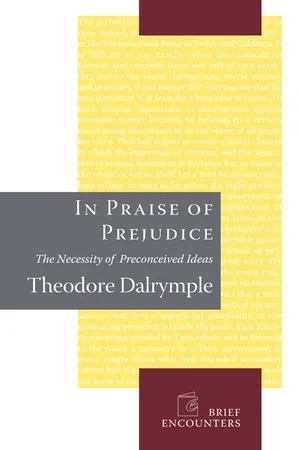
In Praise of Prejudice
How Literary Critics and Social Theorists Are Murdering Our Past
- 144 pages
- English
- ePUB (mobile friendly)
- Available on iOS & Android
eBook - ePub
In Praise of Prejudice
How Literary Critics and Social Theorists Are Murdering Our Past
About this book
Information
1
Prejudice Is Wrong, So Lack of Prejudice Is Right
THESE DAYS, there is a strong prejudice against prejudice: and this is exactly as it should be, is it not? For what is prejudice, if not wholly reprehensible? According to the Oxford Shorter Dictionary, prejudice is:
a previous judgement, especially a premature or hasty judgement. Preconceived opinion; bias favourable or unfavourable; prepossession . . . usually with unfavourable connotation. An unreasoning predilection or objection.
It follows, does it not, that we should strive to be entirely without prejudice?
The archetypical prejudice is that which relates to race. Indeed, the word race and prejudice go together like Mercedes and Benz, or Dolce and Gabbana. It is difficult to say exactly when this association formed, and certainly there was talk of race prejudice before the Nazis changed our moral outlook and priorities, if not forever (for who can see that far into the future?), at least for a long time to come. To hate, despise, depreciate, or discriminate against someone merely because he belongs to a certain racial group now seems to us the worst of all possible vices. This has helped to create a moral climate in which the expression of virtuous, and the abjuration of vicious, sentiment is mistaken for, or taken as the whole of, virtue itself. Let a man be an unscrupulous villain, so long as he utters the right phrases: that is to say, is not prejudiced.
No unprejudiced person, however, could deny the significance of racial prejudice in the production of some of the worst evils of the last century. If such prejudice is an antipathy based upon “a faulty and inflexible generalization,” as Gordon W. Alport, professor of psychology at Harvard, put it in his great work The Nature of Prejudice, then some of the worst massacres of that century of massacre were motivated, or at least made possible, by it. The fact that a massacre might take place in specific historical circumstances that lent a superficial plausibility to the motivating prejudice is beside the point. That Rwanda was being invaded by Tutsi rebels, and in Burundi to the south a massacre by a Tutsi government of every single Hutu who had attended secondary school had taken place within living memory, does not serve to excuse a genocide that could have taken place only upon a foundation of long-standing prejudice. One might put it like this: no prejudice, no genocide.
Even the entirely laudable desire to avoid future genocide, however, does not permit us to commit errors of logic. If the existence of widespread prejudice is necessary for the commission of genocide, it is certainly not a sufficient one. Nor does it follow from the fact that all who commit genocide are prejudiced that all who are prejudiced commit genocide. It is certainly true that if prejudice were a necessary condition of genocide, then to cure mankind of prejudice would cure it also of genocide; but what is desirable, at least in this one respect, is not necessarily possible. And an unachievable goal cannot be a desirable one.
I very much doubt whether anyone, at least in polite company, would admit to a prejudice about anything. To admit to a prejudice is to proclaim oneself a bigot, the kind of person who can’t, or worse still won’t, examine his preconceptions and opinions, and is, as a consequence, narrow in his sympathies, pharisaic in his judgments, xenophobic in his attitudes, rigid in his principles, punitive towards his inferiors, obsequious to his superiors, and convinced of his own rectitude. Such a one is not very attractive, to say the least. Better, then, to swallow one’s prejudices than admit them in public.
To judge by self-report, we have never lived in such unprejudiced times, with so many people in complete control of their own opinions, which are, as a result, wholly sane, rational, and benevolent. Nobody judges anything, any person or any question, except by the light of the evidence and his own reason. Of course, not quite everyone in the world has yet reached this state of enlightenment: The Protocols of the Learned Elders of Zion are still to be found in the book-stores of the Middle East, bizarre cults flourish in the midst of the most technologically advanced societies, and ancient hatreds flourish in remote, and not so remote, corners of the world. Blacks cannot safely walk the streets of Moscow, it is better not to be a Hindu in Pakistan or Bangladesh, and so on and so forth; but in the intellectual heartlands of the world, where we all happen to live, prejudice has relaxed its iron grip upon our minds and reason now rules.
An unprejudiced person is the opposite of the prejudiced one. He subjects all his presuppositions (and other thoughts) to constant re-examination; he is broad in his sympathies; hesitant and generous in his judgments; is a citizen of the world rather than of any particular part of it; subtle and flexible in his conceptions; more inclined to understand than to condemn; and, despite a certain self-satisfaction, which is the natural consequence of an awareness of his own passionless virtue, is conscious of his own limitations. He knows, as Dr. Chasuble in The Importance of Being Earnest knew, that he is susceptible to draughts.
The man without prejudices, or rather, the man who declares himself such, is a man who is terrified to be thought first bigoted, and second, so weak of mind, so lacking in individuality and mental power, that he cannot think for himself. For his opinions, he has to fall back on the shards of wisdom, or more likely unwisdom, which constitute prejudice. Every proper man, then, is a Descartes on every subject and every question that comes before him. In other words, he seeks that indubitable Cartesian point from which, and from which only, it is possible to erect a reasonable opinion—that is to say, an opinion that is truly his own and owes nothing to unexamined pre-suppositions. The answer to every question, therefore, has to be founded on first principles that are beyond doubt, or else it is shot through with prejudice. Whether the person who declares himself free of prejudice knows it or not, whether or not he has ever read the Discourse on Method, he is a belated Cartesian:
I decided to feign that everything that had entered my mind hitherto was no more than the illusions of dreams. But immediately upon this I noticed that while I was trying to think everything false, it must needs be that I, who was thinking this, was something. And observing that this truth “I think, therefore I exist” was so solid and sure that the most extravagant suppositions of skeptics could not overthrow it, I judged that I need not scruple to accept it as the first principle of philosophy that I was seeking.
2
The Uses of Metaphysical Skepticism
WE MAY INQUIRE why it is that there are now so many Descartes in the world, when in the seventeenth century there was only one. Descartes, be it remembered, who so urgently desired an indubitable first philosophical principle, was a genius: a mathematician, physicist, and philosopher who wrote in prose of such clarity, that it is still the standard by which the writing of French intellectuals is, or ought to be, judged. Have we, then, bred up a race of philosophical giants, whose passion is to examine the metaphysics of human existence? I hope I will not be accused of being an Enemy of the People when I beg leave to doubt it.
The popularity of the Cartesian method is not the consequence of a desire to remove metaphysical doubt, and find certainty, but precisely the opposite: to cast doubt on everything, and thereby increase the scope of personal license, by destroying in advance any philosophical basis for the limitation of our own appetites. The radical skeptic, nowadays at least, is in search not so much of truth, as of liberty—that is to say, of liberty conceived of the largest field imaginable for the satisfaction of his whims. He is in the realm of moral conceptions what the man who refuses to marry is in the realm of relationships: he is reluctant to foreclose on any possibilities by imposing limits on himself, even ones that are taken to be purely symbolic. I once had a patient who attempted suicide because her long-time lover refused to propose to her. I asked him the reason for his refusal, and he replied that it (marriage) was only a piece of paper and meant nothing. “If it is only a piece of paper and means nothing,” I asked him, “why do you not sign it? According to you, it would change nothing, but it would give her a lot of pleasure.” Suddenly, becoming a man of the deepest principle, he said that he did not want to live a charade. I could almost hear the argument that persuaded the man that he was right: that true love and real commitment are affairs of the heart, and need no sanction of the church or state to seal them.
The skepticism of radical skeptics who demand a Cartesian point from which to examine any question, at least any question that has some bearing on the way they ought to conduct themselves, varies according to subject matter. Very few are so skeptical that they doubt that the sun will rise tomorrow, even though they might have difficulty offering evidence for the heliocentric (or any other) theory of the solar system. These skeptics believe that when they turn the light switch, the light will come on, even though their grasp of the theory of electricity might not be strong. A ferocious and insatiable spirit of inquiry overtakes them, however, the moment they perceive that their interests are at stake—their interests here being their freedom, or license, to act upon their whims. Then all the resources of philosophy are available to them in a flash, and are used to undermine the moral authority of custom, law, and the wisdom of ages.
dp n="20" folio="8" ?
3
History Teaches Us Anything We Like
THE SLIGHTEST ACQUAINTANCE with history should be more than sufficient to persuade anyone that custom, law, and the wisdom of ages have often been oppressive and worse than oppressive. There is nothing quite so easy to abuse as authority, and the inclination to do so is present, if not in all, then in most human hearts. That is precisely why we do not trust dictators even when—or especially if—they achieved power by rebellion against another established dictatorial order. If it hadn’t been for the photograph taken by the Cuban photographer Alberto Korda, Ernesto Guevara would have been recognized by now as the arrogant, adolescent, power-hungry egotist that he undoubtedly was.
A certain historiography persuades us that the wisdom of the past is always an illusion, and that the history of authority is nothing but the history of its abuse. It is not difficult to construct such a history, of course, for there is a lamentable surfeit of evidence in its favor. In a recent book entitled Menace in Europe, for example, the talented American journalist Claire Berlinski tells us that war and genocide are not part of the history of Europe, but constitute the whole of its history. She arrives at this conclusion by looking at European history through the lens of the Holocaust and a list of wars that fills an entire page of print. (Was it not the great Gibbon himself who said, without his accustomed irony, that history was but the record of the follies and crimes of mankind?) Miss Berlinski’s is an example of what might be called the nothing-but school of historiography, by means of which a narrative is constricted from highly selected facts in order to verify a key to the understanding of everything. (Here is a baleful example of the operation of a preconceived idea.) A present discontent is read backwards, or traced by a golden thread, through the whole of history, and made to supply that history with an immanent meaning and teleology.
The golden thread could just as easily be that of something positive as negative, of course. In his great history of England, Macaulay wrote:
the history of our country during the last hundred and sixty years is eminently the history of physical, moral and intellectual improvement. And this is the way the history of medicine, for example, used to be written, principally by doctors in their retirement, as a form of ancestor-worship (no doubt in the hope that they, too, would become ancestors worthy of worship). In this version, the history of medicine was that of the smooth and triumphant ascent of knowledge and technique, to our current state of unprecedented enlightenment. But then the social historians gained control of the field, and the history of medicine became that of a self-perpetuating male elite whose main interest was in increasing its social status and income, since it is clear that for centuries it possessed no knowledge or skill that could have helped its patients, rather the reverse, and that distinguished it, in point of effectiveness, from the quacks against whom it relentlessly and ruthlessly struggled, but whom it occasionally co-opted.
If the Whig interpretation of history is plausible or applicable anywhere, it is in the history of medicine. The fact of progress, as Macaulay called it, is scarcely deniable: no one, I think, would choose pre-anesthetic, pre-aseptic methods of surgery—to take but one obvious example—for himself. Moreover, the alternative historiography of medicine would have to account for that progress: how was it that an unscrupulous group of men, concerned mainly for their status and income, did, as a matter of fact, bring about such dramatic progress? Since the fact adduced by the social historians in advance of their historiography genuinely are facts, and not artifacts, and likewise the facts adduced by the Whig historians of medicine, the best way to resolve the discrepancy between the two schools is by reference to Ranke’s famous remark—often taken as absurdly naïve from the philosophical point of view—that history is what happened, which is to say all of what happened. But a map of the world that reproduced all the details of the world, in the same size and proportion as the world itself, would not be a map of the world, but a parallel model or reproduction of the world. Some selection is therefore always necessary which, unless it be entirely at random, thus rendering it theoretically incomprehensible and practically useless, itself requires an underlying principle, or at least broad outlook.
The Whig historians of medicine choose their facts for one purpose—if not self-glorification, then at least self-congratulation—the social historians for another, namely denigration, or at least deflation. At the very time Macaulay was writing his history, Engels was writing his Condition of the Working Class in England. How were such very different views of the same object possible by men of intelligence, learning, and talent?
Perhaps the answer can best be appreciated in our response to the tremendous current economic growth in India and China. Some see this only as progress: the emergence of hundreds of millions of people from poverty into the sunny uplands of consumption. Others see in it only a polluted environment and the destruction of ancient ways of life, in favor of a homogenized, inauthentic, superficial, universal lifestyle, with increasing disparities of wealth and poverty into the bargain.
Facts alone (à la Gradgrind) cannot compel the framework into which they are fitted, though they may encourage the more intellectually honest of us to reconsider our framework. Inconvenient facts usually spur us to heroic efforts of rationalization to preserve our outlook, rather than to honest re-examination; in medical practice I have been struck by the capacity of even intellectually ungifted people to manufacture an infinitude of rationalizations almost instantaneously in defense of a course of action upon which they have already decided, in spite of the abundant evidence that it will be disastrous. When a doctor proposes an eminently sensible course of action to a patient, based upon the most compelling evidence, and the patient replies, “Yes, but. . . ,” the doctor might as well give up there and then, for however many rejoinders he may make to the patient’s irrational objections, he will never prevail by reaching the end of the infinite regress. Of course, such stubbornness is not at the root only of much human folly; it is at the root of much, perhaps most, human wisdom, too.
dp n="25" folio="13" ?
4
Why We Prefer the History of Disaster to that of Achievement
IT IS HARDLY a matter of dispute that the Whig interpretation of history is not much in favor nowadays, even in the sphere in which it is most plausible, and at least as plausible as any other interpretation. The crime-and-folly view is much preferred. Miss Berlinski confines her historiography to European history, in order to contrast it with American history, but it would not be so very difficult to construct an American history along similar lines. From the historiographic point of view, the expansion of European settlement was nothing but the despoliation of the original inhabitants and owners of the land; the War of Independence was sparked by an awareness of the long-term significance of Lord Mansfield’s ruling that a slave was free as soon as he reached British soil, which meant that slavery had no long-term future under British rule; and the continuing and unabated travails of blacks in America establish beyond all reasonable doubt the hypocritical nature of the founding philosophy, which is just a cloak for economic and racial privilege. As for Asia and Africa, the task of writing a history that is the mirror-image of the Whig interpretation would be not difficult at all.
But perhaps the most startling example of the crime-and-folly school of historiography is that of Australia. This vast country is so endowed with everything that the population of a country could reasonably want that it is often called by its own inhabitants the Lucky Country. Actually, luck has little to do with it; no one refers to Argentina, similarly endowed, as a lucky country. But a country whose problems, by comparison with those of all other countries, are minor, and disproportionately caused by the inherent and inescapable difficulties of human existence (or Original Sin, if you prefer), rather than by defective political arrangements, does not necessarily please the intellectuals, who are left with nothing, or nothing very much, to think about and rectify.
It was therefore a godsend—to Australian intellectuals, that is—when it was discovered, or rather asserted, that the country was founded upon the worst of all possible acts, namely genocide. Here, at last, was something for Australian intellectuals really to ge...
Table of contents
- Title Page
- Dedication
- Epigraph
- 1 - Prejudice Is Wrong, So Lack of Prejudice Is Right
- 2 - The Uses of Metaphysical Skepticism
- 3 - History Teaches Us Anything We Like
- 4 - Why We Prefer the History of Disaster to that of Achievement
- 5 - The Effect of Pedagogy Without Prejudice
- 6 - Prejudice Necessary to Family Life
- 7 - One Prejudice Always Replaced by Another
- 8 - The Cruel Effect of Not Instilling the Right Prejudices
- 9 - The Inevitability of Prejudice
- 10 - The Conventionality of Unconventionality
- 11 - The Overestimation of Rationality in Choice
- 12 - Authority Necessary to the Accumulation of Knowledge
- 13 - The Supposed Equality of All Opinions, Provided They are One’s Own
- 14 - Custom Supposedly Wrong Because It Is Custom
- 15 - A Partial Reading of Mill Leads to Unbridled Egotism
- 16 - The Difficulty of Founding Common Decency on First Principles
- 17 - The Law of Conservation of Righteous Indignation, and its Connection to ...
- 18 - The Paradox of Radical Individualism Leading to Authoritarianism
- 19 - Racial Discrimination Being Bad, All Discrimination Is Bad
- 20 - Rejection of Prejudice Not a Good in Itself
- 21 - The Impossibility of the Mind as a Blank Slate
- 22 - The Ideal of Equality of Opportunity Necessary to a World Without Prejudice
- 23 - Equality of Opportunity Inherently Totalitarian
- 24 - The Rejection of Authority as Egotism
- 25 - Prejudice a Requirement of Benevolence
- 26 - The Dire Social Effects of Abandoning Certain Prejudices
- 27 - The Inescapability of Commandments of Which Justification Is Unprovable
- 28 - The Exercise of Judgment Unavoidable, Even in the Absence of ...
- 29 - No Virtue Without Prejudice
- INDEX
- Copyright Page
Trusted by 375,005 students
Access to over 1.5 million titles for a fair monthly price.
Study more efficiently using our study tools.
Frequently asked questions
Yes, you can cancel anytime from the Subscription tab in your account settings on the Perlego website. Your subscription will stay active until the end of your current billing period. Learn how to cancel your subscription
No, books cannot be downloaded as external files, such as PDFs, for use outside of Perlego. However, you can download books within the Perlego app for offline reading on mobile or tablet. Learn how to download books offline
Perlego offers two plans: Essential and Complete
- Essential is ideal for learners and professionals who enjoy exploring a wide range of subjects. Access the Essential Library with 800,000+ trusted titles and best-sellers across business, personal growth, and the humanities. Includes unlimited reading time and Standard Read Aloud voice.
- Complete: Perfect for advanced learners and researchers needing full, unrestricted access. Unlock 1.5M+ books across hundreds of subjects, including academic and specialized titles. The Complete Plan also includes advanced features like Premium Read Aloud and Research Assistant.
We are an online textbook subscription service, where you can get access to an entire online library for less than the price of a single book per month. With over 1.5 million books across 990+ topics, we’ve got you covered! Learn about our mission
Look out for the read-aloud symbol on your next book to see if you can listen to it. The read-aloud tool reads text aloud for you, highlighting the text as it is being read. You can pause it, speed it up and slow it down. Learn more about Read Aloud
Yes! You can use the Perlego app on both iOS and Android devices to read anytime, anywhere — even offline. Perfect for commutes or when you’re on the go.
Please note we cannot support devices running on iOS 13 and Android 7 or earlier. Learn more about using the app
Please note we cannot support devices running on iOS 13 and Android 7 or earlier. Learn more about using the app
Yes, you can access In Praise of Prejudice by Theodore Dalrymple in PDF and/or ePUB format, as well as other popular books in Social Sciences & Sociology. We have over 1.5 million books available in our catalogue for you to explore.