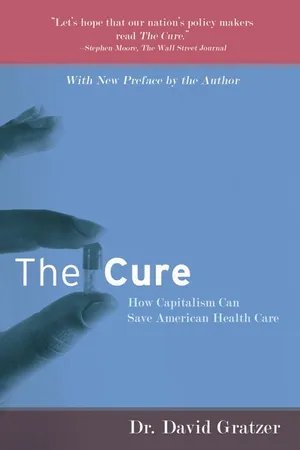
We are surrounded by medical miracles: polio has been eradicated; childhood leukemia is now treatable; death by cardiovascular disease has declined by two-thirds in the last fifty years. Yet while American medicine has never been better, angst over American health care has never been greater. Why is American health care such a mess? In this path-breaking book--Nobel laureate Milton Friedman calls it "fascinating and thorough"--Dr. David Gratzer goes to the heart of the problem, showing that the crisis in American health care stems largely from its addiction to outmoded and discredited economic ideas. What needs to be done? Dr. Gratzer mounts a bold and provocative argument, rejecting the conventional wisdom that socialized health care is compassionate and that top-down government agencies like the FDA actually save lives. Instead, he prescribes a strong dose of capitalism. The Cure offers a detailed overview of American health care, from economics and politics to medical science. Weighing in on the most controversial topics in health care, Dr. Gratzer makes the case that it's possible to reduce health expenses, insure millions more, and improve quality of care while not growing government or raising taxes. An award-winning author and essayist, he is a master storyteller, enlivening his book with anecdotes, interviews, and stories drawn from his own extensive clinical experience. He details the cardiac woes of Robert E. Lee and Dick Cheney, describes a chat over coffee with Canada's foremost private medical entrepreneur (an acquaintance of Fidel Castro, as it happens), and explains the evolution of his own thinking, from advocating HillaryCare as a medical student to promoting individual choice and competition today. The patient is in critical condition; Dr. Gratzer diagnoses the disease and prescribes the cure.
- 250 pages
- English
- ePUB (mobile friendly)
- Available on iOS & Android
eBook - ePub
About this book
Information
Topic
MedicineSubtopic
Health Care DeliveryNotes
Introduction
1 The full decision can be read at: http://www.lexum.umontreal.ca/cscscc/en/rec/html/2005scc035.wpd.html
2 The top ten innovations, in order, are: MRI/CT, ACE inhibitors, balloon angiography, statins, mammography, CABG surgery, H2-receptor antagonists, SSRIs, cataract extraction and lens implants, hip replacements and knee replacements. Only balloon angiography and mammography have no American ties. As an aside, Japan was the second most significant country, with partial credit for two innovations.
Chapter One: Dick Cheney’s Heart
1 As quoted in Michael Bliss, William Osler: A Life in Medicine (Toronto: University of Toronto Press, 1999), p. 105.
2 James Le Fanu, The Rise and Fall of Modern Medicine (New York: Car-roll & Graf Publishers, 1999), p. xv.
3 Calvin Coolidge, The Autobiography of Calvin Coolidge (New York: J. J. Little & Ives Co., 1929), p. 190.
4 Darryl Enos and Paul Sultan, The Sociology of Health Care: Social, Economic and Political Perspectives (New York: Praeger, 1977).
5 Caroline Poplin, “Managed Care,” Wilson Quarterly, Summer 1996, p. 15.
6 Cardiac care had not advanced greatly when President Dwight Eisenhower suffered a heart attack in 1955: his doctors treated him with six weeks of bed rest, oxygen, and morphine for pain.
7 Nortin M. Hadler, The Last Well Person: How to Stay Well Despite the Health-Care System (Montreal: McGill-Queen’s University Press, 2004), p. 17.
dp n="224" folio="202" ?8 Brad Evenson, “Cardiac Care Better in U.S., Study Shows,” National Post, February 8, 2001, p. A4.
9 “U.S. Heart Attack Trend Less Severe,” Washington Post, March 25, 1999, p. A18.
10 Advanced Cardiac Life Support, American Heart Association, 1997, pp. 1–49.
11 In today’s dollars, health spending per capita was about $500 a year.
12 David Cutler, personal communication, November 29, 2004.
13 In a 2002 paper, for example, the Yale economist William Nordhaus argues that the value of the increased longevity over the past century could be as large as the value of growth in all goods and services over the same period. “It would suggest that the image of a stupendously wasteful health care system is far off the mark.”
Chapter Two: Two Days That Changed Health Care
1 433CCCH, Federal Tax Service, paragraph 6587. Federal government policy first influenced the formation of employment-based health insurance in a 1942 ruling by the War Labor Board that allowed employers to bypass wage controls during World War II by providing fringe benefits to attract workers.
2 David Henderson, “Myths about U.S. Health Care,” in Better Medicine: Reforming Canadian Health Care, ed. David Gratzer (Montreal: ECW Press, 2002), p. 179.
3 If the family itemizes its deductions on its federal tax form, it can deduct its state income taxes. Therefore, the family’s 5% tax rate, after taking account of deductibility, is really 3.6% = (1–.28) * 5%.
4 Henderson, “Myths about U.S. Health Care,” pp. 179–80.
5 Ibid., p. 180.
6 Tom Miller, “How the Tax Exclusion Shaped Today’s Private Health Insurance Market,” Joint Economic Committee, U.S. Congress, December 17, 2003, p. 5.
7 John Sheils and Randall Haught, “The Cost of Tax-Exempt Health Benefits in 2004,” Health Affairs, Web exclusive, February 25, 2004, pp. 104–12; http://content.healthaffairs.org/cgi/content/full/hlthaff. w4.106v1/DC1
8 Ibid., p. 110.
9 Bill Thomas, “Vision for Healthcare,” Speech to the National Center for Policy Analysis, Washington, D.C., February 12, 2004.
10 Quoted by Alizon Draper and Judith Green, “Food Safety and Consumers: Constructions of Choice and Risk,” Social Policy and Administration, vol. 36, no. 6 (December 2002), p. 610.
dp n="225" folio="203" ?11 Stephen Pollard, “The Genie of Choice: Has It Been Let Loose in Britain?” National Review, June 20, 2003.
12 Prime Minister Tony Blair, “Progress and Justice in the 21st Century,” Speech to the Fabian Society, June 17, 2003.
13 Paul Starr, The Social Transformation of Medicine (New York: Basic Books, 1982), p. 269.
14 President Lyndon Johnson said at the event: “We wanted you to know, and we wanted the entire world to know, that we haven’t forgotten who is the real daddy of Medicare.”
15 Lawrence Mirel, “We Call It Insurance, but That’s Not Healthy,” Washington Post, August 26, 2001, p. B2.
16 Kate Sullivan, personal communication, September 2004.
17 As quoted in Greg Scandlen, “The Pulse,” Health Care News, January 1, 2003, http://heartland.org/Article.cfm?artId=11343
18 Damien McCrystal, “He May Have Just Hit 90, but Milton Friedman Should Not Be Allowed to Rest on His Far from Nobel Laurels,” Observer, September 22, 2002.
19 Milton Friedman, personal communication, November 2003. Education is another area, incidentally, where total costs have increased, although technological advances there have been less striking.
20 W. Michael Cox and Richard Alm, Myths of Rich and Poor: Why We’re Better Off Than We Think (New York: Basic Books, 1999), p. 40.
21 Kaiser Family Foundation and Health Research and Educational Trust, “Employer Health Benefits: 2005 Summary of Findings,” Menlo Park, California, 2005, p. 1; http://www.kff.org/insurance/7315/sections/upload/7316.pdf
22 Milton Friedman, “How to Cure Health Care,” Public Interest, Winter 2001; http://www.hooverdigest.org/013/friedman
23 Devon Herrick, “Why Are Health Costs Rising?” National Center for Policy Analysis, Dallas, Texas, Brief Analysis no. 437, May 7, 2003, p. 1.
24 “Kaiser Health Poll Report,” May/June 2003 Edition, Menlo Park, California, p. 16.
25 Nelson Sabatini, personal communication, February 2003.
26 As quoted to me by Prof. Friedman.
27 The following figures and quotation are drawn from Friedman, “How to Cure Health Care.”
28 Ibid.
29 Jonathan S. Skinner, Douglas O. Staiger, and Elliott S. Fisher, “Is Technological Change in Medicine Always Worth It? The Case of Acute Myocardial Infarction,” Health Affairs, Web exclusive, February 7, 2006; http://content.healthaffairs.org/cgi/content/abstract/hlthaff.25.w34
30 Vanessa Fuhrmans, “A Radical Prescription,” Wall Street Journal, May 10, 2004, p. R3.
31 Brent Pawlecki, personal communication, November 3, 2004.
32 Jack Mahoney, personal communication, November 3, 2004.
33 Fuhrmans, “A Radical Prescription.”
34 Michael E. Porter and Elizabeth Olmsted Teisberg, “Redefining Competition in Health Care,” Harvard Business Review, June 2004, p. 64.
35 Adapted from a similar analysis of the American health-care sector. See: John C. Goodman and Gerald L. Musgrave, Patient Power: Solving America’s Health Care Crisis (Washington, D.C.: Cato Institute, 1992), p. 20.
36 Elliott S. Fisher et al., “The Implications of Regional Variations in Medicare Spending, Part 1: The Content, Quality, and Accessibility of Care,” Annals of Internal Medicine, vol. 138, no. 4 (February 18, 2003), p. 273.
Chapter Three: Nixon’s Revenge
1 Paul Starr, The Social Transformation of American Medicine (New York: Basic Books, 1982), p. 381.
2 Ibid.
3 David Dranove, The Economic Evolution of American Health Care: From Marcus Welby to Managed Care (Princeton, New Jersey: Princeton University Press, 2000), p. 65.
4 Ibid.
5 John Kerry, Address on January 21, 2004.
6 James C. Robinson, “From Managed Care to Consumer Health Insurance: The Rise and Fall of Aetna,” Health Affairs, vol. 23, no. 2 (Ma...
Table of contents
- Praise
- Title Page
- Dedication
- Foreword
- Preface to the Paperback Edition
- Introduction
- ONE - Dick Cheney’s Heart
- TWO - Two Days That Changed Health Care
- THREE - Nixon’s Revenge
- FOUR - The Third Way
- FIVE - Insuring America
- SIX - Mills’ Revenge: Medicaid
- SEVEN - Mills’ Revenge II: Medicare
- EIGHT - Our Drug Problem
- NINE - The Hip That Changed History
- TEN - The Three Keys
- Acknowledgements
- Notes
- Index
- Copyright Page
Trusted by 375,005 students
Access to over 1.5 million titles for a fair monthly price.
Study more efficiently using our study tools.
Frequently asked questions
Yes, you can cancel anytime from the Subscription tab in your account settings on the Perlego website. Your subscription will stay active until the end of your current billing period. Learn how to cancel your subscription
No, books cannot be downloaded as external files, such as PDFs, for use outside of Perlego. However, you can download books within the Perlego app for offline reading on mobile or tablet. Learn how to download books offline
Perlego offers two plans: Essential and Complete
- Essential is ideal for learners and professionals who enjoy exploring a wide range of subjects. Access the Essential Library with 800,000+ trusted titles and best-sellers across business, personal growth, and the humanities. Includes unlimited reading time and Standard Read Aloud voice.
- Complete: Perfect for advanced learners and researchers needing full, unrestricted access. Unlock 1.5M+ books across hundreds of subjects, including academic and specialized titles. The Complete Plan also includes advanced features like Premium Read Aloud and Research Assistant.
We are an online textbook subscription service, where you can get access to an entire online library for less than the price of a single book per month. With over 1.5 million books across 990+ topics, we’ve got you covered! Learn about our mission
Look out for the read-aloud symbol on your next book to see if you can listen to it. The read-aloud tool reads text aloud for you, highlighting the text as it is being read. You can pause it, speed it up and slow it down. Learn more about Read Aloud
Yes! You can use the Perlego app on both iOS and Android devices to read anytime, anywhere — even offline. Perfect for commutes or when you’re on the go.
Please note we cannot support devices running on iOS 13 and Android 7 or earlier. Learn more about using the app
Please note we cannot support devices running on iOS 13 and Android 7 or earlier. Learn more about using the app
Yes, you can access The Cure by David Gratzer in PDF and/or ePUB format, as well as other popular books in Medicine & Health Care Delivery. We have over 1.5 million books available in our catalogue for you to explore.