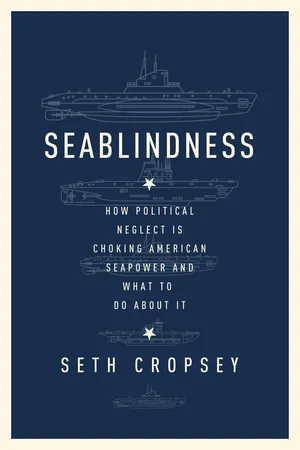
The challenges to American security in the Western Pacific, the seas that surround Europe, and the Persian Gulf are growing. At the same time, U.S. military commanders seek more naval forces to protect America's interest in the safe transit of American goods, deterrence in a proliferating world, and the defense of our key allies. At the same time U.S. defense budgets are shrinking. American seapower has not been as small as it is today since before World War I. Unless reversed, U.S. seapower will continue its decline into the indefinite future as politicians ignore the widening gulf between the cost of modernizing and expanding American seapower, and the resources devoted to this most strategic arm of the nation's defense. Seablindness explains the dilemma. It looks at the consequences of neglect including the effect of increased deployments on families, global scenarios set in the immediate future, the views of America's most knowledgeable military officers, the anxious reactions of U.S. allies, and hard facts to show how a lack of political will is dismantling the nation's global reach and with it, our position as the world's great power.
eBook - ePub
Seablindness
How Political Neglect Is Choking American Seapower and What to Do About It
- 304 pages
- English
- ePUB (mobile friendly)
- Available on iOS & Android
eBook - ePub
About this book
Information
Subtopic
Military Policy
CHAPTER I
WHAT IS A HOLLOW MILITARY?
Mao Zedong dismissed the United States as zhilaohu, a paper tiger. All imperialist states, he said, were weak because of their appetite to enlarge. Their militaries looked strong, he admitted, but overextension had gutted them. Mao’s description missed the mark. Overextension did not tax the United States or its allies. America’s economic and military strength allowed its resolute policy to win the Cold War. The system of purges that strove for ideological purity and of an absolute embrace of a centrally controlled economy died with Mao. It was replaced by one that, while still authoritarian, repressive, and ruled by a single party, encouraged the Chinese people’s enterprising character.
A couple of decades after Mao’s “paper tiger” expression became common usage, Army Chief of Staff General Edward “Shy” Meyer coined another phrase along parallel lines, “hollow army.” A troubled economy helped created the vacant space at the core of U.S. forces. After President Nixon ordered and then gradually lifted wage and price controls in the early 1970s, and following the Federal Reserve’s historically low interest rates, companies sought to make up for lost earnings. Inflation began to rise.
At this point, the administration replaced conscription with the all-volunteer force (AVF). Military salaries couldn’t keep pace with inflation rates, which ballooned from nearly 9 percent in 1973, the year that the AVF began, to 14 percent in 1980, the year that President Carter lost his campaign for reelection. Sailors who helped launch and recover planes aboard aircraft carriers earned less than hamburger flippers at McDonald’s. Among some of the youngest enlisted personnel, salaries fell below the federal government’s poverty level,1 which made the military less attractive to new recruits and more likely to lose qualified people, along with their experience and skills.
In 1979, the Navy reported that it had 20,000 fewer petty officers than it needed.2 The Army missed its recruitment goal by 15,000 soldiers.3 In that year, six out of the ten Army divisions on U.S. soil were deemed “not combat ready.” This was troubling because the burden of stopping and reversing a possible Soviet invasion of Western Europe rested on the ability of U.S. forces to return to the continent and fight. If the U.S. Army’s predicament at home wasn’t sufficiently alarming, in Europe itself, one out of four U.S. combat divisions were rated as “not combat ready.”
The military responded by filling the ranks with large numbers of the unqualified. As the 1970s drew to a close, fresh recruits caused enough disciplinary problems or proved so unqualified that 40 percent of them had to be fired. Combat unreadiness was central to the military’s hollowness. General Frederick Kroesen, who had commanded U.S. troops in World War II and risen to become commander of the U.S. Army in Europe, described the U.S. Army in Europe as “obsolescent.”4
What the military calls “modernization,” the replacement of old equipment with new and more technologically advanced hardware, added to the hollowing effect of the 1970s. A chart of money spent on procurement since 1948 looks like jagged wide-angle pictures of Wyoming’s Grand Teton Mountains: sharp peaks divided by deep precipices. The summits occur during the Korean conflict, the Vietnam War, the Reagan buildup, and the Iraq and Afghanistan wars. As the defense budget started to climb out of the trough that followed the end of the Vietnam War, Defense Department leaders wanted to replace antiquated weapons with new technologically superior ones.
The bottom of the post–Vietnam War dip in weapons procurement occurred in 1977 and 1978. New systems such as the Navy’s Aegis radar—which integrates a ship’s tracking and fire control systems—had been developed to replace twenty-five-year-old technology. The Defense Department started purchasing these and other systems, such as the Air Force’s F-15 fighter and the Army’s Apache attack helicopters, to modernize the entire military.
But there was a cost. Defense budgets couldn’t pay for both modernization and readiness. Fuel, flight hours, spare parts—all part of the large amount of logistics needed for training—are some examples of what’s required to keep a military force ready to fight.
The same logic applies in other competitive human activities. If an aspiring Olympic downhill skier can’t find financial support for training, lodging, food, and transportation—in addition to equipment—the athlete will lack the necessaries to hone his competitive skill.
Insufficient resources for readiness compounded the problem of attracting the high-quality personnel who are needed to operate more technologically advanced equipment and magnified the weakness that Army Chief of Staff General Meyer described as a hollow military.
Fundamental differences between the Navy’s idea of its role in protecting the nation and basic security assumptions of the Nixon and Carter administrations cannot be separated from the especially acute readiness problems that U.S. seapower faced. The Navy saw its mission as responding to crises around the world, while the White House, throughout the 1970s, concentrated on shoring up the central front in Europe against the Soviet-led Warsaw Pact. Naval leadership would align its strategy later, but at the time the Navy had yet to articulate a strategic idea that fit administration policy.5 An official from the Carter administration’s Office of Management and Budget told the Navy “to get its act together.”
Then events intervened. The Soviet invasion of Afghanistan, the failure of the Carter administration’s attempt to rescue American hostages held in Tehran, the hollow force’s emergence as an issue in the 1980 presidential campaign, and Republican president nominee Ronald Reagan’s arguments that peace depended on strength occurred in less than a year. These events prepared a solid base for popular support of large increases in defense spending. The defense budget measured 5.5 percent of gross domestic product (GDP) in 1979. Seven years later it had climbed by over a fifth to 6.8 percent of GDP.6 In constant (2015) dollars, defense spending during the same period rose from slightly over $400 billion to slightly over $600 billion annually.7 The hollow force disappeared.
But not before the new administration learned the scope of naval unpreparedness. When John Lehman became secretary of the Navy at the beginning of the first Reagan term, he found that the Navy had “less than a week’s supply of most major defensive missiles and torpedoes.”8 The magazines of the fleet’s 479 ships were incomplete, and the shelves of logistics dumps were not full enough to replenish them. The media reported that $9 billion was needed to buy enough ammunition to reach authorized levels.9
Spare parts for ships and aircraft were one-third of the amount required. Such critical aircraft as the anti-submarine carrier-based S-3 Viking were so poorly supplied with spare parts that only three out of ten were capable of performing their missions.10 The Navy was so short on reserve aircraft that if they were used to fill gaps in the service’s twelve existing air wings—one wing per carrier—there were enough planes for only nine carriers.11 Insufficient funding was responsible for a backlog of twenty-six ships awaiting overhaul. The new Navy secretary reported that maintenance had been put off at the Great Lakes Naval Training Center’s gym for so long that the building “collapsed flat on the ground in 1981.”12
A similar hollowing affected the Navy’s fleet size. Measured in displacement, the U.S. Navy possessed more tonnage—3.5 times as much—in every category of combatant than the Soviets in the mid-1960s. Then, the U.S. Navy decommissioned aging World War II ships, and the Soviet fleet increased modestly. By the mid-1970s, absent resources to preserve the U.S. lead, the Soviets had caught up sufficiently so that its surface and submarine fleets, excluding the immense U.S. lead in aircraft carriers, out-displaced that of the United States.13
Displacement comparisons don’t tell the whole story. At the height of the hollow force of the 1970s, about 1978, the Soviet fleet consisted of 446 surface combatants to the United States’s 217. The advantage that the United States enjoyed in aircraft carriers, twenty-one to three, could never compensate for a numerically superior surface fleet’s ability to cover key global choke points, maintain presence, conduct convoy operations, deny access, or challenge denied access.
Other comparisons give a better picture. Ship-days measure the amount of time a single naval ship spends on patrol out of its home waters. Fewer ships mean fewer possible ship-days. In 1965, Soviet ship-days in the Caribbean and Mediterranean Seas as well as in the Atlantic, Indian, and Pacific Oceans numbered 7,500. For the same places and in the same year, the United States recorded almost 110,000 ship-days. Nine years later, U.S. ship-days had dropped to 61,300. Soviet ship-days had increased to 53,100.14
In other words, just as the Navy needed to modernize a fleet that was being decimated because of age, the Johnson administration was shifting defense budgets away from military hardware needed in the future and spending money on current operations in Vietnam. Its pre–Vietnam War level of shipbuilding funds was halved throughout the war.
The prospect of a hollow military has returned. Beginning with Leon Panetta, President Obama’s first secretary of Defense, all three secretaries of Defense of the Obama administration pointed out this possibility. A few months after taking office, Panetta, responding to the administration’s plan to decrease defense spending by $350 billion over ten years, said that additional cuts “would have devastating effects” on the Defense and State departments. As the Obama administration ended, those cuts totaled at least three times as much. Panetta added that going beyond the proposed $350 billion reduction would “result in hollowing out the force,” and “weaken our ability to respond to the threats in the world.”15
Robert Gates followed Leon Panetta as secretary of Defense. As he was preparing to leave office, Gates told the graduating class at Notre Dame in May 2011 that an adequately funded U.S. military “cannot be taken for granted.” Specifically, he said, “our military credibility, commitment and presence are required to sustain alliances, to protect trade routes and energy supplies, and to deter would-be adversaries.” Gates warned that across-the-board spending cuts—like sequestration—such as those that followed the Vietnam War and the Cold War, would hollow out the military.16
After Gates left office, he spoke more candidly. About sequestration, he told CBS that “there may be a stupider way to do things, but I can’t figure out what it is. . . . The result is a hollow military and we will pay for it in the same way we paid for it every time we have done this in the past. And that is, in the next conflict, and there will be a next conflict, with the blood of our soldiers.”17
Until now, the current form of U.S. military hollowness has been a matter of will rather than of financial embarrassment. The U.S. military as a whole replicates the deficiencies of American seapower that were sketched earlier. Hobbled by budget-induced problems of readiness, maintenance, operational capacity, and an inability to modernize, the military is hard-pressed to carry out the national military strategy of the Joint Chiefs of Staff.
Where two Army corps were once stationed in Europe, the United States today maintains two permanent brigades, with a rotating armored brigade to be added in 2017.18 One corps is made of two divisions and includes between 40,000 and 100,000 troops. One brigade is made up of between 3,000 and 5,000 troops. The Army reports that only twenty of its sixty brigades—with members from active duty, reserves, and the National Guard—are combat ready, eleven of which are committed to ongoing missions.19 Russian forces in the regions that abut Eastern Europe are at least twenty times the size of U.S. ground forces. They are equipped with modern and effective weapons, both offensive and defensive.
The Air Force chief of staff, General David L. Goldfein, told Congress in 2016 that, contrary to the nation’s military strategy, the U.S. Air Force (USAF) is not fully prepared to handle more than one of the required two major regional contingencies.20 The United States has been shrinking the size and, by failing sufficiently to modernize, the capability of its entire armed forces as our potential adversaries grow in numbers and combat ability.
These facts inclined the Obama administration’s third secretary of Defense, former Nebraska Senator Chuck Hagel, to share his immediate predecessors’ views. His experience in the Vietnam War as an Army infantry soldier also contri...
Table of contents
- Cover
- Title Page
- Copyright
- Dedication
- Contents
- Preface
- Chapter I: What Is a Hollow Military?
- Chapter II: Why Seapower?
- Chapter III: Sinews Challenged: Russia
- Chapter IV: Failure of Imagination
- Chapter V: The Invasion of Estonia
- Chapter VI: Sinews Challenged: China
- Chapter VII: Old Strategy Meets New Facts
- Chapter VIII: Budget Apocalypse
- Chapter IX: They Also Serve Who Only Stand and Wait
- Chapter X: Rebuilding American Seapower
- Chapter XI: Naval Rearmament
- Chapter XII: The Mediterranean Tide Shifts
- Chapter XIII: The Morality of Defense
- Notes
- Index
Trusted by 375,005 students
Access to over 1.5 million titles for a fair monthly price.
Study more efficiently using our study tools.
Frequently asked questions
Yes, you can cancel anytime from the Subscription tab in your account settings on the Perlego website. Your subscription will stay active until the end of your current billing period. Learn how to cancel your subscription
No, books cannot be downloaded as external files, such as PDFs, for use outside of Perlego. However, you can download books within the Perlego app for offline reading on mobile or tablet. Learn how to download books offline
Perlego offers two plans: Essential and Complete
- Essential is ideal for learners and professionals who enjoy exploring a wide range of subjects. Access the Essential Library with 800,000+ trusted titles and best-sellers across business, personal growth, and the humanities. Includes unlimited reading time and Standard Read Aloud voice.
- Complete: Perfect for advanced learners and researchers needing full, unrestricted access. Unlock 1.5M+ books across hundreds of subjects, including academic and specialized titles. The Complete Plan also includes advanced features like Premium Read Aloud and Research Assistant.
We are an online textbook subscription service, where you can get access to an entire online library for less than the price of a single book per month. With over 1.5 million books across 990+ topics, we’ve got you covered! Learn about our mission
Look out for the read-aloud symbol on your next book to see if you can listen to it. The read-aloud tool reads text aloud for you, highlighting the text as it is being read. You can pause it, speed it up and slow it down. Learn more about Read Aloud
Yes! You can use the Perlego app on both iOS and Android devices to read anytime, anywhere — even offline. Perfect for commutes or when you’re on the go.
Please note we cannot support devices running on iOS 13 and Android 7 or earlier. Learn more about using the app
Please note we cannot support devices running on iOS 13 and Android 7 or earlier. Learn more about using the app
Yes, you can access Seablindness by Seth Cropsey in PDF and/or ePUB format, as well as other popular books in Politics & International Relations & Military Policy. We have over 1.5 million books available in our catalogue for you to explore.