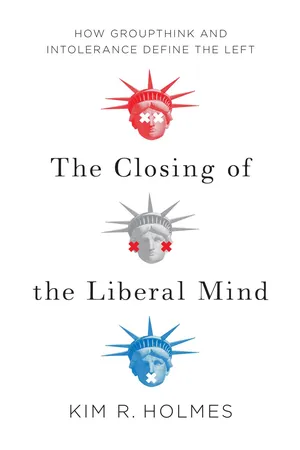
A former U.S. Assistant Secretary of State and currently Acting Senior Vice President for Research at The Heritage Foundation, Kim R. Holmes surveys the state of liberalism in America today and finds that it is becoming its opposite—illiberalism—abandoning the precepts of open-mindedness and respect for individual rights, liberties, and the rule of law upon which the country was founded, and becoming instead an intolerant, rigidly dogmatic ideology that abhors dissent and stifles free speech. Tracing the new illiberalism historically to the radical Enlightenment, a movement that rejected the classic liberal ideas of the moderate Enlightenment that were prominent in the American Founding, Holmes argues that today's liberalism has forsaken its American roots, incorporating instead the authoritarian, anti-clerical, and anti-capitalist prejudices of the radical and largely European Left. The result is a closing of the American liberal mind. Where once freedom of speech and expression were sacrosanct, today liberalism employs speech codes, trigger warnings, boycotts, and shaming rituals to stifle freedom of thought, expression, and action. It is no longer appropriate to call it liberalism at all, but illiberalism—a set of ideas in politics, government, and popular culture that increasingly reflects authoritarian and even anti-democratic values, and which is devising new strategies of exclusiveness to eliminate certain ideas and people from the political process. Although illiberalism has always been a temptation for American liberals, lurking in the radical fringes of the Left, it is today the dominant ideology of progressive liberal circles. This makes it a new danger not only to the once venerable tradition of liberalism, but to the American nation itself, which needs a viable liberal tradition that pursues social and economic equality while respecting individual liberties.
eBook - ePub
The Closing of the Liberal Mind
How Groupthink and Intolerance Define the Left
- English
- ePUB (mobile friendly)
- Available on iOS & Android
eBook - ePub
About this book
Information
NOTES
INTRODUCTION
1Joe Burris, “Student Suspended for Pop-Tart Gun, Josh Welch, Files Appeal with Maryland County School System,” Baltimore Sun, March 3, 2013; see also Alexandra Petri, “Pop-Tart ‘Gun’ Suspension: Seriously, Folks?,” Washington Post, March 5, 2013.
2Petula Dvorak, “Free-Range Kids and Our Parenting Police State,” Washington Post, April 13, 2015.
3The differences between the moderate Enlightenment and the radical Enlightenment are discussed later in this volume.
CHAPTER ONE
1S. V. Dáte, “O’Malley, Sanders Shouted Down at Netroots by ‘Black Lives Matter’ Protest,” National Journal, July 18, 2015.
2Edmund Fawcett, Liberalism: The Life of an Idea (Princeton, NJ: Princeton University Press, 2014), pp. 10–11. Kindle edition.
3Stephen Holmes, The Anatomy of Antiliberalism (Cambridge, MA: Harvard University Press, 1996), p. 4.
4See Fawcett, Liberalism, pp. 34–35; and Biancamaria Fontana, ed., Constant: Political Writings (Cambridge: Cambridge University Press, 1988), p. 177.
5See, e.g., Steven Lukes, Individualism (Colchester: European Consortium for Political Research Press, 1973).
6Holmes, The Anatomy of Antiliberalism, p. 4. Emphasis added.
7François Guizot, History of the Origins of Representative Government in Europe, trans. Andrew R. Scoble (London: Henry G. Bohn, 1861), p. 264.
8Fawcett, Liberalism, pp. 118–19.
9Thomas Jefferson, “Thomas Jefferson to James Madison, 6 Sept. 1789,” in The Papers of Thomas Jefferson, vol. 32, ed. Barbara B. Oberg (Princeton, NJ: Princeton University Press, 2005); see also Philip B. Kurland and Ralph Lerner, “Popular Basis of Political Authority,” in The Founders’ Constitution, ed. Philip B. Kurland and Ralph Lerner, vol. 1, chap. 2, document 23 (Chicago: University of Chicago Press, 1985).
10For an analysis of these ideas, see Fawcett, Liberalism, pp. 120–21.
11Ibid., p. 120.
12Ibid., p. 127.
13Louis Hartz, The Liberal Tradition in America: An Interpretation of American Political Thought Since the Revolution (Orlando, FL: Harcourt, Inc., 1991). First published by Harcourt, Brace & World (New York), 1955.
14Richard Allen Epstein, The Classical Liberal Constitution: The Uncertain Quest for Limited Government (Cambridge, MA: Harvard University Press, 2014).
15Clinton Rossiter, ed., The Federalist Papers (New York: New American Library, 1961).
16Madison, for example, wrote in Federalist No. 49 that “[t]he passions ought to be controlled and regulated by the government.” Ibid., p. 317.
17Ibid., p. 322.
18Ibid., p. 324.
19Ibid., pp. 324–25.
20John C. Calhoun, “A Positive Good,” Speech in the U.S. Senate (1837), http://www.stolaf.edu/people/fitz/COURSES/calhoun.html.
21In order to secure Southern votes for the Constitution, the framers agreed to a provision that gave the states twenty years to eliminate the slave trade. Madison argued at the Constitutional Convention that even those twenty years were “dishonorable.” In Federalist No. 42, he wrote that it would be a “great gain” that a “period of twenty years may terminate for ever within these States,” a practice he called “unnatural” and “the barbarism of modern policy.” Matthew Spalding, ed., The Heritage Guide to the Constitution, 2nd ed. (Washington, DC: Regnery Publishing, 2014), p. 196; see also Rossiter, The Federalist Papers, p. 266.
22See, e.g., M. Stanton Evans, The Theme Is Freedom: Religion, Politics, and the American Tradition (Washington, DC: Regnery Publishing, 1996).
23Wilson, who argued for his administration’s policy of segregation in federal departments, once said: “Segregation is not humiliating, but a benefit, and ought to be so regarded by you gentlemen.” William Loren Katz, Eyewitness: The Negro in American History (New York: Pitman Publishing Corp., 1967), pp. 389–90. Croly wrote, “The Southern slave owners . . . were right, moreover, in believing the negroes were a race possessed of moral and intellectual qualities inferior to those of the white men.” Herbert David Croly, The Promise of American Life (Los Angeles: Library of Alexandria, 2012), ch. 4, section II, paragraph 2. Kindle edition.
24“Birth control itself, often denounced as a violation of natural law, is nothing more or less than the facilitation of the process of weeding out the unfit, of preventing the birth of defectives or of those who will become defectives.” Margaret Sanger, Woman and the New Race (New York: Brentano, 1920), chap. 18, republished by Bartleby at http://www.bartleby.com/1013/18.html.
25Melvin I. Urofsky and Paul Finkelman, “Abrams v. United States (1919),” in Documents of American Constitutional and Legal History, 3rd ed. (New York: Oxford University Press, 2008), pp. 666–67.
26George Novack, “American Intellectuals and the Crisis,” New International, February 1936, pp. 23–27, and June 1936, pp. 83–86.
27Marisa Schultz, “Obama Says N-Word in Racism Discussion,” New York Post, June 22, 2015.
28Allen J. Matusow, The Unraveling of America: A History of Liberalism in the 1960s (Athens, GA: University of Georgia Press, 2009), p. 310.
29Ibid., p. 312...
Table of contents
- Cover
- Title Page
- Copyright
- Contents
- Introduction
- One: The Decline of American Liberalism
- Two: The Rise of the Postmodern Left
- Three: Why the Postmodern Left Is Not Liberalism
- Four: The Illiberal Style of Liberal Politics Today
- Five: Promethean Government Unbound
- Six: Bullies, Shaming Rituals, and the Culture of Intolerance
- Seven: The Death of the Liberal Intellectual
- Eight: The Troubled Legacy of the Radical Enlightenment
- Nine: The Closing of the Liberal Mind
- Conclusion: The Way Forward
- Acknowledgments
- Notes
- Select Bibliography
- Index
Trusted by 375,005 students
Access to over 1.5 million titles for a fair monthly price.
Study more efficiently using our study tools.
Frequently asked questions
Yes, you can cancel anytime from the Subscription tab in your account settings on the Perlego website. Your subscription will stay active until the end of your current billing period. Learn how to cancel your subscription
No, books cannot be downloaded as external files, such as PDFs, for use outside of Perlego. However, you can download books within the Perlego app for offline reading on mobile or tablet. Learn how to download books offline
Perlego offers two plans: Essential and Complete
- Essential is ideal for learners and professionals who enjoy exploring a wide range of subjects. Access the Essential Library with 800,000+ trusted titles and best-sellers across business, personal growth, and the humanities. Includes unlimited reading time and Standard Read Aloud voice.
- Complete: Perfect for advanced learners and researchers needing full, unrestricted access. Unlock 1.5M+ books across hundreds of subjects, including academic and specialized titles. The Complete Plan also includes advanced features like Premium Read Aloud and Research Assistant.
We are an online textbook subscription service, where you can get access to an entire online library for less than the price of a single book per month. With over 1.5 million books across 990+ topics, we’ve got you covered! Learn about our mission
Look out for the read-aloud symbol on your next book to see if you can listen to it. The read-aloud tool reads text aloud for you, highlighting the text as it is being read. You can pause it, speed it up and slow it down. Learn more about Read Aloud
Yes! You can use the Perlego app on both iOS and Android devices to read anytime, anywhere — even offline. Perfect for commutes or when you’re on the go.
Please note we cannot support devices running on iOS 13 and Android 7 or earlier. Learn more about using the app
Please note we cannot support devices running on iOS 13 and Android 7 or earlier. Learn more about using the app
Yes, you can access The Closing of the Liberal Mind by Kim R. Holmes in PDF and/or ePUB format, as well as other popular books in Politics & International Relations & Conservatism & Liberalism. We have over 1.5 million books available in our catalogue for you to explore.