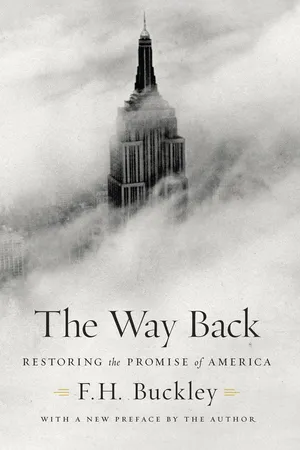
The promise of America is that, with ambition and hard work, anyone can rise to the top. But now the promise has been broken, and we've become an aristocracy where rich parents raise rich kids and poor parents raise poor kids. We've been told that the changes are structural, that there's nothing we can do about this. But that doesn't explain why other First World countries are beating us hands down on the issue of mobility. What's different about America is our politics. An ostensibly progressive New Class of comfortably rich professionals, media leaders, and academics has shaped the contours of American politics and given us a country of fixed economic classes. It is supported by the poorest of Americans, who have little chance to rise, an alliance of both ends against the middle that recalls the Red Tories of parliamentary countries. Because they support an aristocracy, the members of the New Class are Tories, and because of their feigned concern for the poor, they are Red Tories. The Way Back explains the revolution in American politics, where political insurgents have challenged the complacent establishment of both parties, and shows how we can restore the promise of economic mobility and equality by pursuing socialist ends through capitalist means.
- English
- ePUB (mobile friendly)
- Available on iOS & Android
eBook - ePub
About this book
Information
Index
Social SciencesCHAPTER
1
Socialist Ends, Capitalist Means
IN 1977 THE UNITED STATES LAUNCHED THE VOYAGER SPACE probe with the goal of explaining planet Earth to the residents of other galaxies. Aboard was a gold-plated phonograph record, bearing greetings from UN Secretary-General (and former Nazi officer) Kurt Waldheim, as well as a sample of our music: Chuck Berry’s Johnny B. Goode and three pieces by Bach. We don’t know what the space aliens might have made of this. Saturday Night Live reported that we received a message back: Send more Chuck Berry. For his part, William F. Buckley thought that three selections from Bach was rather like boasting, but if so this was remedied by Jimmy Carter’s lugubrious message: “This is a present from a small, distant world… We are attempting to survive our time so we may live into yours.”
Notwithstanding its provenance, there wasn’t anything particularly American about what was on the record. Suppose, then, that you were charged with selecting a single text (this time on a flash drive) to explain America to Kurt Vonnegut’s Tralfamadorians. Would it be the Constitution? The Declaration of Independence? The Gettysburg Address? Very reasonable suggestions, all of them, but I’d choose a much-derided children’s novel by Horatio Alger, Ragged Dick. The book is never read today, which is a shame, since it is as witty as anything by Mark Twain and Alger’s street-sharp urchin provides a fascinating look at the streets and slang of nineteenth century New York. Dick has the wiles to escape the con man’s snares, but he isn’t a thief and has a personal code of honor. He’s also ambitious and smart enough to profit from the book’s simple messages: that all labor is respectable, that poverty is no bar to advancement, that getting ahead requires education and saving one’s money.
Those unfashionable messages, and not a lack of literary merit, explain why the book is scorned today. It celebrates, unabashedly, the traditional American virtues of open-handedness, pluck, and optimism. Mostly, it’s a book about mobility, about making it in a country that welcomed those who wished to get ahead; and that message, not the Constitution or the Declaration, is at the heart of the idea of America. A boy with Dick’s drive, intelligence and honesty would make his way where others lagged behind, for mobility wasn’t the same thing as equality of outcome.
Ragged Dick is very much an American hero. Other cultures don’t celebrate the rags-to-riches arriviste as Americans do. In France, Molière’s Le bourgeois gentilhomme mocked middle class pretentions, and Honoré de Balzac told us that great fortunes which came out of nowhere were built on crime. The English gave us “ill-bred” and “bounder,” words never heard in America. For the lowly born Pip, the dream of advancement was a cruel snare in Charles Dickens’ Great Expectations. Not surprisingly, things were worse still in Russia, and in Dostoyevsky’s Raskolnikov the desire to rise bred a murderous resentment.
Even in America, twentieth century writers lost faith in economic mobility. F. Scott Fitzgerald seemed to agree with Balzac about the criminal origins of new money, since the Great Gatsby’s wealth came from illegal bootlegging. As for the promise of economic success, Arthur Miller lectured audiences on its hollowness. But America was a mobile society for most of the twentieth century, and during Horatio Alger’s time—the late nineteenth century—a good many people followed Ragged Dick’s path up the ladder. More recently, however, the ladder has been rolled up, and Alger’s America is another country. The level of income inequality today is higher than at any time in the last 90 years. There’s even less mobility in America than in most First World countries. That’s new, and it will transform American politics.
We’ve already seen this, in the 2012 presidential election, and even more so in the 2016 presidential campaign. The anger expressed by the voters, their support for candidates from far outside the traditional political class, has little parallel in American history. From the Left there have been protest movements in the past, but what we’ve seen on the Right is new and amounts to an entire repudiation of complacent establishment Republicans. Presidential candidates who in years past might have seemed shoo-ins have faltered, their places taken by a more rambunctious set of outsiders who communicate through their brashness, their rudeness, their belief that we are in crisis. To their more polite critics they say: We are not so nice as you!
The Republican establishment seeks to persuade voters of its essential niceness, but niceness has not closed the deal. On measures of freedom provided by respected conservative and libertarian think tanks, the United States has fallen like a rock (down to twelfth for the Heritage Foundation, sixteenth for the Cato Institute). Once the country of promise, America now lags behind many of its First World rivals on measures of economic mobility and has spawned an aristocracy. A broken education system, a dysfunctional immigration law, a decline in the rule of law, and a supercharged regulatory state have rolled up the ladder on which the Ragged Dicks of years gone by climbed. Voters across the spectrum demand radical change, and yet the Republican establishment seems content with minimal goals at a time of maximal crisis. Rejecting the Party establishment, the Republican insurgent might hope for less conservative heart, more conservative spleen.
The Republican insurgent has a vision of the good society that is not so different from that of the old-fashioned liberal of fifty years ago. For both, the goal is a society of opportunity, where all may rise, where we’re judged by the content of our character, where class distinctions were something we left behind in the countries we came from. Unlike the modern liberal or progressive, however, the Republican insurgent believes that the best way to get there is through free markets, open competition, the removal of wasteful government barriers. The Republican insurgent pursues socialist ends through capitalist means.
The Left has complained of inequality. What rankles the Republican insurgent, however, is immobility, and in particular the idea that it might result from a set of unjust rules that advantage a new class of aristocrats. We might be prepared to accept the fact of deep income inequality if we thought that everyone stood the same chance of getting ahead, and that people were sorted out by their abilities. Ragged Dick is a desperately poor, orphaned bootblack, but he’s accepted as an equal by his wealthy friend, Frank Whitney, and we’re led to believe that they’ll end up in the same place. Henry Fosdick, honest and intelligent but lacking Dick’s ambition, will find himself a rung down on the scale. The Hibernian Johnny Nolan, honest but lacking in both intelligence and ambition, will end up yet another rung down. Those at the very bottom are not even honest, and an unpleasant end is prophesized for them. But what if we’re not like that anymore? What if today’s Ragged Dick lags behind, his place at the top taken by those who have gamed the system, whose wealth is founded upon illicit advantages? If that’s the case, if America offers no better opportunities for advancement than other countries, then the core understanding of American Exceptionalism will have been lost.
This would be a tragedy, for income inequality and immobility are serious problems, and we’d all want to return to the levels of income equality and mobility of 50 years ago, if we could leave everything else the same, if we could do so without cost. That might seem impossible, for most of the things which have been proffered—free trade barriers, massive tax hikes and the like—would be enormously costly. But then there are other solutions which would give us an economy both wealthier and more just, an entrepreneurial society in which people would have a better chance of getting ahead. We’d all want to go there—unless we were one of America’s aristocrats.
Things We Can’t Change
As an ideal, income mobility wasn’t there at the country’s formation, but emerged later when Lincoln and the Civil War gave America a new birth of freedom, in which the opportunity to rise above one’s station came to define the country’s promise. If one had to pick the crucial moment it would be a little-known speech by Abraham Lincoln at an agricultural fair in 1859, when he worked out the implications of the Declaration of Independence in a country that was still half slave. From this everything else followed, the Civil War, the land grant colleges, the open door policy for immigrants, Ragged Dick’s America.
Today, however, the United States is a highly unequal society and, what is far worse, a highly immobile society as well. Jobs have expanded at the very top and bottom of the economy, while middle class jobs have cratered. That’s regrettable, for countries with greater economic equality have higher levels of civic participation and personal trust. People feel better about each other when the game doesn’t seem to be rigged against them. They’re also happier and less likely to support demagogues who promise greater equality but would restrict political freedom and threaten the rule of law to attain it. Finally, inequality and immobility are unjust when they result from special favors the government grants to its political friends and cronies.
So we’d want more income equality and mobility. Easier said than done, however. People on the Left have argued that inequality might go away if we could only raise taxes on the rich. However, the top U.S. marginal rates for individuals and corporations are amongst the steepest in the world, and capital gains taxes here are much higher than the First World average. Attacks on greed aren’t going to do very much either. The acquisitive instinct (to give it a less emotionally charged name) is coded in the DNA of the species, and I haven’t heard of plans to rewire our brains to eliminate it. In any event, as greed is ubiquitous, it can’t explain why there’s more immobility in America than elsewhere.
Nor are there any magic fixes in our welfare system, which is one of the most generous in the world. Not only is this a pretty good country to be poor in, but people at the bottom rung in America are amongst the richest people in the world. Moreover, the kinds of welfare improvements that get proposed are often self-defeating. For example, increasing the minimum wage would benefit some workers at the margin, but would also hasten the trend to automation, with store clerks replaced by check-out kiosks. Between 2007 and 2009 a Democratic Congress raised the minimum wage from $5.15 to $7.25 an hour, this as the economy plummeted and unemployment skyrocketed. There’s no persuasive evidence that the higher minimum wage did workers any good.
Then there’s the move to an information economy, free trade, and globalization. In the recent past, good jobs awaited high school grads on the assembly lines and in the factories of America, jobs that gave people a solid and secure footing in the middle class. Those jobs, however, are increasingly a casualty of an economy that requires higher levels of skill. High-tech jobs have increased in number, while low-skilled jobs are disappearing. In addition, free trade has moved low-tech jobs to countries with lower labor costs, while at the same time increasing the number of high-skilled jobs in America. Globalization brings Third World people into the middle class, but shrinks the First World’s middle class.
We might not like what this has done to income equality and mobility, but there’s not a lot we’d want to do about it. Or could do. We can’t smash our computers, the way that 19th century Luddites smashed cotton looms, and expect we’d be doing anything other than shipping more jobs offshore. The same goes for free trade. Lower trade barriers have greatly strengthened the economy and increased the number of jobs overall, as American companies became better able to meet the challenge of foreign competition. A retreat from free trade would also encourage firms to incur the deadweight losses of lobbying for sweetheart trade barriers from politicians, in order to protect the firms from foreign competition.
There are also several reasons why we’d never expect to see perfect income mobility between generations. First, it always helps to have the head start that wealthy parents give one: better schools, better networks, better first jobs. That’s why countries with high levels of income inequality are also countries with low levels of income mobility. From rich parents, rich kids. Second, and relatedly, the environment in which children are raised matters. Children raised by wealthy parents are less likely to come from broken homes, and will learn by example to value education. Compared to poor children, they’re exposed to a much higher social and cultural environment. In addition, there’s a developing empirical literature suggesting that the personal qualities (“phenotypes,” for the geneticist) that are correlated with economic success are heritable. That is, we’d expect to see some correlation between the personal (phenotypic) attributes of parents and children.1 A lot of things we thought to be random or a product of our environment seem now to be inherited, and this might also be true of the things which make people wealthy. If Lady Gaga was born that way, why not the rich?
Legacy Nation
A degree of aristocracy is thus to be expected in any society, and not merely expected but also natural. We are apt to think that economic inequalities are self-correcting, self-arighting, but it’s not so; and the natural rights lawyer who said that all men are equal lied to us. Instead, equality cuts against the grain, and what is natural are differences, the differences between rich and poor, high and low. What is natural is aristocracy, the natural default position of any society, and not just aristocracy but a hereditary aristocracy. What is unnatural, unexpected, anomalous, the briefest of interludes in the world’s long history of class distinctions, is Ragged Dick’s America.
For a hereditary aristocracy to arise, only two things are needed, common to all of us: a bequest motive and relative preferences. The bequest motive is simply the desire to see our children do well, a sentiment that does not require an evolutionary explanation, but one which I nevertheless provide in Chapter 13. We are hard-wired to seek to pass on our genes, and this means that, like Deuteronomy, we distinguish between strangers and brothers.2 We’ll be willing to incur enormous sacrifices for children and near relatives, but for strangers to whom we are not related we have only a constrained sympathy. What that will leave us with is a world of family ties and the thick nepotism where sons succeed fathers in politics, business, Hollywood, art, and music.
The bequest motive is one of the strongest human impulses, stronger even than the instinct for self-preservation. We read of parents who give up their lives to save their children, and marvel at this. But would we have done anything else? We were told we were members of a “me” generation, but it’s not so. Instead, we sacrifice for our children, only dimly aware of the costs we incur in doing so, unless perhaps we recall how our parents sacrificed for us. If we should then want to see our children end up on top, in an aristocratic society, is that so very surprising?
The second needed thing, for an aristocracy, is relative preferences. We have absolute preferences when we want something, and relative preferences when we also want more of it than the other fellow. And as we wish well for our children, given the bequest motive, we would want them to fare better than other people’s children, given relative preferences. We would be willing to accept a poorer world, so long as our children end up on top. We might even prefer a world that leaves our children worse off, so long as everyone else fares worse still.
That’s enough to kick-start an aristocracy. But for an aristocracy to persist over time, its members must be able to identify each other and form an alliance against the new men who wish to rise. Through their schools, their neighborhoods, their politics, they must be able to recognize each other. And of course the members of America’s elite can do so. They’ll have gone to Harvard, not Podunk U. They’ll live in Wesley Heights D.C., and not Manassas VA. They’ll subscribe to liberal politics and abhor the Tea Party. In all of this they’ll recognize each other as members of a New Class that constitutes the country’s elite and frames its policies, and in this way a society of peers and peasants has replaced Horatio Alger’s country of equal opportunity.
Rising inequality in American has been blamed on the “one percent,” the people in the top income centile making more than $400,000 a year. For those making less than that, bumper stickers on cars proclaim their drivers to be members of the 99 percent. The distinction between the two groups is useful, since income tax data permits us to identify the one percent. We know what they earn, what their jobs are and how they came by their money. They can serve as proxies for inequality generally. In truth, however, the one percent includes a very disparate group of people, the entrepreneurial gazillionaire and the car dealer making just a bit more than $400,000 a year. But it also includes members of the New Class whose unearned privileges...
Table of contents
- Cover
- Title Page
- Copyright
- Dedication
- Contents
- Preface to the Paperback Edition
- Acknowledgments
- 1. Socialist Ends, Capitalist Means
- Part I: The Idea of America
- Part II: The Way We Are Now
- Part III: Things We (Mostly) Can’t Change: Technology, Taxes, Welfare, Culture, Genes
- Part IV: Things We (Mostly) Can’t Change: The Aristocrat Abides
- Part V: Things We Can Change
- Appendices
- Endnotes
- Index
Trusted by 375,005 students
Access to over 1.5 million titles for a fair monthly price.
Study more efficiently using our study tools.
Frequently asked questions
Yes, you can cancel anytime from the Subscription tab in your account settings on the Perlego website. Your subscription will stay active until the end of your current billing period. Learn how to cancel your subscription
No, books cannot be downloaded as external files, such as PDFs, for use outside of Perlego. However, you can download books within the Perlego app for offline reading on mobile or tablet. Learn how to download books offline
Perlego offers two plans: Essential and Complete
- Essential is ideal for learners and professionals who enjoy exploring a wide range of subjects. Access the Essential Library with 800,000+ trusted titles and best-sellers across business, personal growth, and the humanities. Includes unlimited reading time and Standard Read Aloud voice.
- Complete: Perfect for advanced learners and researchers needing full, unrestricted access. Unlock 1.5M+ books across hundreds of subjects, including academic and specialized titles. The Complete Plan also includes advanced features like Premium Read Aloud and Research Assistant.
We are an online textbook subscription service, where you can get access to an entire online library for less than the price of a single book per month. With over 1.5 million books across 990+ topics, we’ve got you covered! Learn about our mission
Look out for the read-aloud symbol on your next book to see if you can listen to it. The read-aloud tool reads text aloud for you, highlighting the text as it is being read. You can pause it, speed it up and slow it down. Learn more about Read Aloud
Yes! You can use the Perlego app on both iOS and Android devices to read anytime, anywhere — even offline. Perfect for commutes or when you’re on the go.
Please note we cannot support devices running on iOS 13 and Android 7 or earlier. Learn more about using the app
Please note we cannot support devices running on iOS 13 and Android 7 or earlier. Learn more about using the app
Yes, you can access The Way Back by F. H. Buckley in PDF and/or ePUB format, as well as other popular books in Social Sciences & Social Classes & Economic Disparity. We have over 1.5 million books available in our catalogue for you to explore.