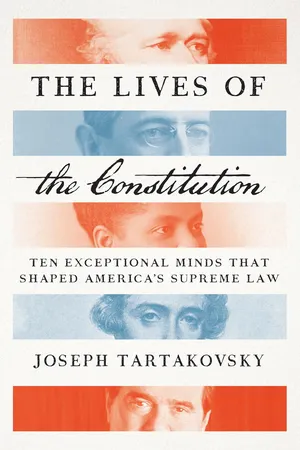
The Lives of the Constitution
eBook - ePub

The Lives of the Constitution

Ten Exceptional Minds that Shaped America's Supreme Law

  1. 320 pages
  2. English
  3. ePUB (mobile friendly)
  4. Available on iOS & Android
eBook - ePub

The Lives of the Constitution

Ten Exceptional Minds that Shaped America's Supreme Law

About this book

In a fascinating blend of biography and history, Joseph Tartakovsky tells the epic and unexpected story of our Constitution through the eyes of ten extraordinary individuals—some renowned, like Alexander Hamilton and Woodrow Wilson, and some forgotten, like James Wilson and Ida B. Wells-Barnett.Tartakovsky brings to life their struggles over our supreme law from its origins in revolutionary America to the era of Obama and Trump. Sweeping from settings as diverse as Gold Rush California to the halls of Congress, and crowded with a vivid Dickensian cast, Tartakovsky shows how America's unique constitutional culture grapples with questions like democracy, racial and sexual equality, free speech, economic liberty, and the role of government.Joining the ranks of other great American storytellers, Tartakovsky chronicles how Daniel Webster sought to avert the Civil War; how Alexis de Tocqueville misunderstood America; how Robert Jackson balanced liberty and order in the battle against Nazism and Communism; and how Antonin Scalia died warning Americans about the ever-growing reach of the Supreme Court.From the 1787 Philadelphia Convention to the clash over gay marriage, this is a grand tour through two centuries of constitutional history as never told before, and an education in the principles that sustain America in the most astonishing experiment in government ever undertaken.

Frequently asked questions

Yes, you can cancel anytime from the Subscription tab in your account settings on the Perlego website. Your subscription will stay active until the end of your current billing period. Learn how to cancel your subscription.
No, books cannot be downloaded as external files, such as PDFs, for use outside of Perlego. However, you can download books within the Perlego app for offline reading on mobile or tablet. Learn more here.
Perlego offers two plans: Essential and Complete
  • Essential is ideal for learners and professionals who enjoy exploring a wide range of subjects. Access the Essential Library with 800,000+ trusted titles and best-sellers across business, personal growth, and the humanities. Includes unlimited reading time and Standard Read Aloud voice.
  • Complete: Perfect for advanced learners and researchers needing full, unrestricted access. Unlock 1.4M+ books across hundreds of subjects, including academic and specialized titles. The Complete Plan also includes advanced features like Premium Read Aloud and Research Assistant.
Both plans are available with monthly, semester, or annual billing cycles.
We are an online textbook subscription service, where you can get access to an entire online library for less than the price of a single book per month. With over 1 million books across 1000+ topics, we’ve got you covered! Learn more here.
Look out for the read-aloud symbol on your next book to see if you can listen to it. The read-aloud tool reads text aloud for you, highlighting the text as it is being read. You can pause it, speed it up and slow it down. Learn more here.
Yes! You can use the Perlego app on both iOS or Android devices to read anytime, anywhere — even offline. Perfect for commutes or when you’re on the go.
Please note we cannot support devices running on iOS 13 and Android 7 or earlier. Learn more about using the app.
Yes, you can access The Lives of the Constitution by Joseph Tartakovsky in PDF and/or ePUB format, as well as other popular books in History & Historical Biographies. We have over one million books available in our catalogue for you to explore.

Information

NOTES
OVERTURE
ixdays of Noah”: Thomas Paine, Writings of Thomas Paine (1894), ed. Moncure Daniel Conway, Vol. 1, 118–19.
xione clear intent”: Clinton Rossiter, 1787: The Grand Convention (1966), 334.
xiiiIt is not to be wondered”: James Madison to Reynolds Chapman, Jan. 6, 1831, Founders Online, National Archives. See also James Madison to Thomas Ritchie, Sept. 15, 1821, Founders Online, National Archives (publication of his convention notes should be “delayed till the Constitution should be well settled by practice”); James Madison to Charles J. Ingersoll, Jun. 25, 1831, Founders Online, National Archives (explaining that he signed bill creating Second Bank of the United States in 1817 despite earlier certainty as to its unconstitutionality because it is destabilizing and willful to push prior opinions in the face of a national “common understanding,” a “construction reduced to practice, during a reasonable period of time,” a “uniform sanction of successive Legislative bodies, through a period of years and under the varied ascendancy of parties,” “deliberate & reiterated precedents,” “execution throughout a period of 20 years with annual legislative recognitions,” and the “entire acquiescence of all the local authorities,” which together create a rule of constitutional interpretation like those that bind judges); James Madison to William C. Rives, Oct. 21, 1833, Founders Online, National Archives (explaining that he reversed his position on the constitutionality of the Bank of the United States “on the ground of the authoritative and multiplied sanctions given to it, amounting he conceived, to an evidence of the judgment and will of the nation . . . [and] that such a sanction ought to overrule the abstract and private opinions of individuals”).
xivmany defining elements”: See, e.g., Alexander Hamilton, John Jay, and James Madison, The Federalist (1788) 45 (“no apprehensions are entertained” of commerce power), 78 (courts have “neither force nor will” and suffer from a “natural feebleness”).
xiveasier to alarm”: William R. Davie to James Iredell, Jan. 22, 1788, Life and Correspondence of James Iredell (1863), ed. Griffith J. McRee, Vol. II, 217.
CHAPTER ONE — ALEXANDER HAMILTON
A War Ends and a Constitution Begins
3half-million souls”: Robert Middlekauff, The Glorious Cause: The American Revolution, 1763–1789 (1982), 563–64.
3nearly half the state’s population”: Alexander Hamilton to Robert Morris, Aug. 13, 1782, The Papers of Alexander Hamilton, Vol. 3, 1782–1786, ed. Harold C. Syrett. Columbia University Press (1962), 132–43 [hereinafter AH Papers, various years]; Alexander Clarence Flick, Loyalism in New York During the American Revolution (1901), 182 & n.2.
3robbing, exiling”: Flick 162–68; Maya Jasanoff, Liberty’s Exiles: American Loyalists in the Revolutionary World (2011), 64–65.
3saw their homes burned”: Ron Chernow, Alexander Hamilton (2004), 76; E. Wilder Spaulding, New York in the Critical Period, 1783–1789 (1932), 116–17; Edwin G. Burrows and Mike Wallace, Gotham: A History of New York City to 1898 (1999), 252–55.
4duly enacted laws”: Spaulding 119–28.
4A statute from 1784”: “An Act for the immediate Sale of certain forfeited Estates,” Apr. 6, 1784, in Laws of the Legislature of the State of New York in Force Against the Loyalists, and Affecting the Trade of Great Britain and British Merchants, and Others Having Property in that State (1786), 41–42; see also “An Act for the Speedy Sale of the confiscated and forfeited Estates within this State, and for other Purposes therein mentioned,” May 12, 1784, id. at 43–86; Flick 152–58.
4Philipsburg Manor”: Middlekauff 568.
4disenfranchised most Tories”: “An Act to preserve the Freedom and Independence of this State,” May 12, 1784, in Laws of the Legislature of the State of New...

Table of contents

  1. Cover
  2. Title Page
  3. Copyright
  4. Dedication
  5. Contents
  6. Overture: The Constitution’s Third Century
  7. Builders 1765–1804
  8. Interlude from Abroad 1835–1888
  9. Dreamers 1885–1931
  10. Restorers 1934–2016
  11. Finale: The Experiment Endures
  12. Acknowledgments
  13. Notes
  14. Index