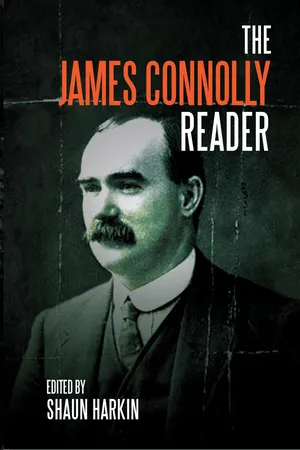
Considered by many Ireland's most important revolutionary, James Connolly devoted his life to struggles against exploitation, oppression, and imperialism. Active in workers' movements in the United States, Scotland , and Ireland, Connolly was a peerless organizer, sharp polemicist, and highly original thinker. His positions on the relationship between national liberation and socialism, revolution in colonized in colonized and under developed economies, and women's liberation in particular were often decades ahead of their time. This collection seeks to return Connolly to his proper place in Irish and global history, and to inspire activists, students, and those interested in history today with his vision of an Ireland and world free from militarism, injustice, and deprivation.
- 250 pages
- English
- ePUB (mobile friendly)
- Available on iOS & Android
eBook - ePub
A James Connolly Reader
About this book
Information
Topic
StoriaSubtopic
Storia irlandese1.
Manifesto of the Irish Socialist Republican Party
“The great appear great to us only because we are on our knees; LET US RISE.”
Object
Establishment of AN IRISH SOCIALIST REPUBLIC based upon the public ownership by the Irish people of the land, and instruments of production, distribution, and exchange. Agriculture to be administered as a public function, under boards of management elected by the agricultural population and responsible to them and to the nation at large. All other forms of labor necessary to the well-being of the community to be conducted on the same principles.
Program
As a means of organizing the forces of the democracy in preparation for any struggle which may precede the realization of our ideal, of paving the way for its realization, of restricting the tide of emigration by providing employment at home, and finally of palliating the evils of our present social system, we work by political means to secure the following measures:
1.Nationalization of railways and canals.
2.Abolition of private banks and money-lending institutions and establishments of state banks, under popularly elected boards of directors, issuing loans at cost.
3.Establishment at public expense of rural depots for the most improved agricultural machinery, to be lent out to the agricultural population at a rent covering cost and management alone.
4.Graduated income tax on all incomes over £400 per annum in order to provide funds for pensions to the aged, infirm, and widows and orphans.
5.Legislative restriction of hours of labor to 48 per week and establishment of a minimum wage.
6.Free maintenance for all children.
7.Gradual extension of the principle of public ownership and supply to all the necessaries of life.
8.Public control and management of national schools by boards elected by popular ballot for that purpose alone.
9.Free education up to the highest university grades.
10. Universal suffrage.
The Irish Socialist Republican Party
That the agricultural and industrial system of a free people, like their political system, ought to be an accurate reflex of the democratic principle by the people for the people, solely in the interests of the people.
That the private ownership, by a class, of the land and instruments of production, distribution, and exchange, is opposed to this vital principle of justice, and is the fundamental basis of all oppression, national, political, and social.
That the subjection of one nation to another, as of Ireland to the authority of the British Crown, is a barrier to the free political and economic development of the subjected nation, and can only serve the interests of the exploiting classes of both nations.
That, therefore, the national and economic freedom of the Irish people must be sought in the same direction, viz., the establishment of an Irish socialist republic, and the consequent conversion of the means of production, distribution, and exchange into the common property of society, to be held and controlled by a democratic state in the interests of the entire community.
That the conquest by the social democracy of political power in Parliament, and on all public bodies in Ireland, is the readiest and most effective means whereby the revolutionary forces may be organized and disciplined to attain that end.
BRANCHES WANTED EVERYWHERE. ENQUIRIES INVITED. ENTRANCE FEE, 6d.
MINIMUM WEEKLY SUBSCRIPTION 1d.
Offices: 67 MIDDLE ABBEY STREET, DUBLIN.
September 1896
2.
Socialism and Nationalism
In Ireland at the present time there are at work a variety of agencies seeking to preserve the national sentiment in the hearts of the people.
These agencies, whether Irish language movements, literary societies, or commemoration committees, are undoubtedly doing a work of lasting benefit to this country in helping to save from extinction the precious racial and national history, language, and characteristics of our people.
Nevertheless, there is a danger that by too strict an adherence to their present methods of propaganda, and consequent neglect of vital living issues, they may only succeed in stereotyping our historical studies into a worship of the past, or crystallizing nationalism into a tradition—glorious and heroic indeed, but still only a tradition.
Now traditions may, and frequently do, provide materials for a glorious martyrdom, but can never be strong enough to ride the storm of a successful revolution.
If the national movement of our day is not merely to reenact the old sad tragedies of our past history, it must show itself capable of rising to the exigencies of the moment.
It must demonstrate to the people of Ireland that our nationalism is not merely a morbid idealizing of the past, but is also capable of formulating a distinct and definite answer to the problems of the present and a political and economic creed capable of adjustment to the wants of the future.
This concrete political and social ideal will best be supplied, I believe, by the frank acceptance on the part of all earnest nationalists of the republic as their goal.
Not a republic as in France, where a capitalist monarchy with an elective head parodies the constitutional abortions of England, and in open alliance with the Muscovite despotism brazenly flaunts its apostasy to the traditions of the revolution.
Not a republic as in the United States, where the power of the purse has established a new tyranny under the forms of freedom; where, one hundred years after the feet of the last British redcoat polluted the streets of Boston, British landlords and financiers impose upon American citizens a servitude compared with which the tax of pre-revolution days was a mere trifle.
No! The republic I would wish our fellow countrymen to set before them as their ideal should be of such a character that the mere mention of its name would at all times serve as a beacon light to the oppressed of every land, at all times holding forth promise of freedom and plenteousness as the reward of their efforts on its behalf.
To the tenant farmer, ground between landlordism on the one hand and American competition on the other, as between the upper and the nether millstone; to the wage workers in the towns, suffering from the exactions of the slave-driving capitalist to the agricultural laborer, toiling away his life for a wage barely sufficient to keep body and soul together; in fact to every one of the toiling millions upon whose misery the outwardly splendid fabric of our modern civilization is reared, the Irish Republic might be made a word to conjure with—a rallying point for the disaffected, a haven for the oppressed, a point of departure for the socialist, enthusiastic in the cause of human freedom.
This linking together of our national aspirations with the hopes of the men and women who have raised the standard of revolt against that system of capitalism and landlordism, of which the British Empire is the most aggressive type and resolute defender, should not, in any sense, import an element of discord into the ranks of earnest nationalists, and would serve to place us in touch with fresh reservoirs of moral and physical strength sufficient to lift the cause of Ireland to a more commanding position than it has occupied since the day of Benburb.
It may be pleaded that the ideal of a socialist republic, implying, as it does, a complete political and economic revolution would be sure to alienate all our middle-class and aristocratic supporters, who would dread the loss of their property and privileges.
What does this objection mean? That we must conciliate the privileged classes in Ireland!
But you can only disarm their hostility by assuring them that in a free Ireland their “privileges” will not be interfered with. That is to say, you must guarantee that when Ireland is free of foreign domination, the green-coated Irish soldiers will guard the fraudulent gains of capitalist and landlord from “the thin hands of the poor” just as remorselessly and just as effectually as the scarlet-coated emissaries of England do today.
On no other basis will the classes unite with you. Do you expect the masses to fight for this ideal?
When you talk of freeing Ireland, do you only mean the chemical elements which compose the soil of Ireland? Or is it the Irish people you mean? If the latter, from what do you propose to free them? From the rule of England?
But all systems of political administration or governmental machinery are but the reflex of the economic forms which underlie them.
English rule in England is but the symbol of the fact that English conquerors in the past forced upon this country a property system founded upon spoliation, fraud, and murder: that, as the present-day exercise of the “rights of property” so originated involves the continual practice of legalized spoliation and fraud, English rule is found to be the most suitable form of government by which the spoliation can be protected, and an English army the most pliant tool with which to execute judicial murder when the fears of the propertied classes demand it.
The socialist who would destroy, root and branch, the whole brutally materialistic system of civilization, which like the English language we have adopted as our own, is, I hold, a far more deadly foe to English rule and tutelage than the superficial thinker who imagines it possible to reconcile Irish freedom with those insidious but disastrous forms of economic subjection—landlord tyranny, capitalist fraud, and unclean usury; baneful fruits of the Norman Conquest, the unholy trinity, of which Strongbow and Diarmuid MacMurchadha—Norman thief and Irish traitor—were the fitting precursors and apostles.
If you remove the English army tomorrow and hoist the green flag over Dublin Castle, unless you set about the organization of the Socialist Republic your efforts would be in vain.
England would still rule you. She would rule you through her capitalists, through her landlords, through her financiers, through the whole array of commercial and individualist institutions she has planted in this country and watered with the tears of our mothers and the blood of our martyrs.
England would still rule you to your ruin, even while your lips offered hypocritical homage at the shrine of that freedom whose cause you had betrayed.
Nationalism without Socialism—without a reorganization of society on the basis of a broader and more developed form of that common property which underlay the social structure of ancient Erin—is only national recreancy.
It would be tantamount to a public declaration that our oppressors had so far succeeded in inoculating us with their perverted conceptions of justice and morality that we had finally decided to accept those conceptions as our own, and no longer needed an alien army to force them upon us.
As a socialist I am prepared to do all one man can do to achieve for our motherland her rightful heritage—independence; but if you ask me to abate one jot or tittle of the claims of social justice, in order to conciliate the privileged classes, then I must decline.
Such action would be neither honorable nor feasible. Let us never forget that he never reaches heaven who marches thither in the company of the devil. Let us openly proclaim our faith: the logic of events is with us.
The Shan Van Vocht, January 1897
3.
Queen Victoria’s Diamond Jubilee
“The great appear great to us, only because we are on our knees: LET US RISE.”
Fellow workers,
The loyal subjects of Victoria, Queen of Great Britain and Ireland, Empress of India, etc., celebrate this year the longest reign on record. Already the air is laden with rumors of preparations for a wholesale manufacture of sham “popular rejoicings” at this glorious (?) commemoration.
Home rule orators and nationalist Lor...
Table of contents
- Cover
- Copyright
- Contents
- Chronology of Connolly’s Life
- James Connolly’s Writings
- 1. Manifesto of the Irish Socialist Republican Party
- 2. Socialism and Nationalism
- 3. Queen Victoria’s Diamond Jubilee
- 4. The Men We Honour
- 5. The Gaelic Revival
- 6. The Roots of Modern War
- 7. British Butchers in Egypt
- 8. Socialism and Religion
- 9. The Working Class and Revolutionary Action
- 10. Let Us Free Ireland!
- 11. Taken Root!
- 12. Emigration
- 13. Sinn Féin and the Language Movement
- 14. To Irish Wage Workers in America
- 15. Facets of American Liberty
- 16. Socialism Made Easy
- 17. Sinn Féin, Socialism, and the Nation
- 18. Erin’s Hope: The End and the Means
- 19. Industrial Unionism and the Trade Unions
- 20. Labour in Irish History
- 21. Sweatshops behind the Orange Flag
- 22. Ireland, Karl Marx, and William Walker
- 23. Direct Action in Belfast
- 24. Visit of King George V
- 25. Some Rambling Remarks: “The Struggle Emancipates”
- 26. July the Twelfth
- 27. To the Linen Slaves of Belfast: Manifesto of the Irish Women Workers Union
- 28. North-East Ulster
- 29. The Dublin Lockout: On the Eve
- 30. Glorious Dublin!
- 31. How to Release Jim Larkin
- 32. A Titanic Struggle
- 33. A Fiery Cross or Christmas Bells
- 34. The Isolation of Dublin
- 35. Labor and the Proposed Partition of Ireland
- 36. The Exclusion of Ulster
- 37. Old Wine in New Bottles
- 38. Our Duty in This Crisis
- 39. A Continental Revolution
- 40. The National Danger
- 41. A Martyr for Conscience Sake: Karl Liebknecht
- 42. The Hope of Ireland
- 43. Courtsmartial and Revolution
- 44. Socialists and the War
- 45. Revolutionary Unionism and War
- 46. Moscow Insurrection of 1905
- 47. For the Citizen Army
- 48. Ireland: Disaffected or Revolutionary
- 49. Economic Conscription
- 50. The Ties That Bind
- 51. The Re-Conquest of Ireland: Woman
- 52. We Will Rise Again
- 53. The Irish Flag
- Some Suggestions for Further Reading
- Acknowledgments
- Notes
- Index
- About the Editor
- Back Cover
Trusted by 375,005 students
Access to over 1.5 million titles for a fair monthly price.
Study more efficiently using our study tools.
Frequently asked questions
Yes, you can cancel anytime from the Subscription tab in your account settings on the Perlego website. Your subscription will stay active until the end of your current billing period. Learn how to cancel your subscription
No, books cannot be downloaded as external files, such as PDFs, for use outside of Perlego. However, you can download books within the Perlego app for offline reading on mobile or tablet. Learn how to download books offline
Perlego offers two plans: Essential and Complete
- Essential is ideal for learners and professionals who enjoy exploring a wide range of subjects. Access the Essential Library with 800,000+ trusted titles and best-sellers across business, personal growth, and the humanities. Includes unlimited reading time and Standard Read Aloud voice.
- Complete: Perfect for advanced learners and researchers needing full, unrestricted access. Unlock 1.5M+ books across hundreds of subjects, including academic and specialized titles. The Complete Plan also includes advanced features like Premium Read Aloud and Research Assistant.
We are an online textbook subscription service, where you can get access to an entire online library for less than the price of a single book per month. With over 1.5 million books across 990+ topics, we’ve got you covered! Learn about our mission
Look out for the read-aloud symbol on your next book to see if you can listen to it. The read-aloud tool reads text aloud for you, highlighting the text as it is being read. You can pause it, speed it up and slow it down. Learn more about Read Aloud
Yes! You can use the Perlego app on both iOS and Android devices to read anytime, anywhere — even offline. Perfect for commutes or when you’re on the go.
Please note we cannot support devices running on iOS 13 and Android 7 or earlier. Learn more about using the app
Please note we cannot support devices running on iOS 13 and Android 7 or earlier. Learn more about using the app
Yes, you can access A James Connolly Reader by James Connolly, Shaun Harkin in PDF and/or ePUB format, as well as other popular books in Storia & Storia irlandese. We have over 1.5 million books available in our catalogue for you to explore.