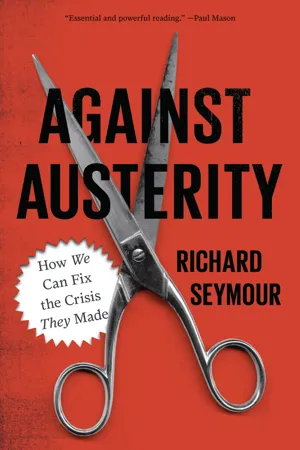
Five years into capitalism's deepest crisis, which has led to cuts and economic pain across the world, Against Austerity addresses a puzzling aspect of the current conjuncture: why are the rich still getting away with it? Why is protest so ephemeral? Why does the left appear to be marginal to political life? In an analysis which challenges our understanding of capitalism, class and ideology, Richard Seymour shows how 'austerity' is just one part of a wider elite plan to radically re-engineer society and everyday life in the interests of profit, consumerism and speculative finance. But Against Austerity is not a gospel of despair. Seymour argues that once we turn to face the headwinds of this new reality, dispensing with reassuring dogmas, we can forge new collective resistance and alternatives to the current system. Following Brecht, Against Austerity argues that the good old things are over, it's time to confront the bad new ones.
- 208 pages
- English
- ePUB (mobile friendly)
- Available on iOS & Android
eBook - ePub
About this book
Information
1
Class
Class is a communist concept. – Margaret Thatcher
Austerity is a class strategy.
But surely not? Aren’t we simply obliged to make cutbacks now that times are tough? Who can honestly say that the country isn’t broke? It would be nice to keep spending on all the gold-plated public sector pensions and bedroom scroungers and wasters, but there simply isn’t enough money in the kitty, darlings. People will just have to pull their socks up. And tighten their belts. And figuratively rearrange other parts of parts of their apparel until the mess is sorted out.
But surely not? Aren’t we simply obliged to make cutbacks now that times are tough? Who can honestly say that the country isn’t broke? It would be nice to keep spending on all the gold-plated public sector pensions and bedroom scroungers and wasters, but there simply isn’t enough money in the kitty, darlings. People will just have to pull their socks up. And tighten their belts. And figuratively rearrange other parts of parts of their apparel until the mess is sorted out.
And isn’t ‘class’ itself something of a relic anyway, like the Madonna sex book, or a paid-for copy of London’s Evening Standard? Or, at best, an abstraction remote from the messier realities of everyday life, like logging on to Twitface, sharing electrifying hoof fetish porn, and then ordering copious quantities of something via eBay to get richly and joyously shit-faced with? What sort of political fundamentalist bangs on about ‘class’ while the inhabitants of online heterotopias are obliviously fapping away together? What room is there for ‘class’ in these many proliferating life-worlds?
Despite these well-thought-out objections, and many more like them, I will insist on advocating the bland thesis that austerity is a class strategy. What else could it be? There is no socially neutral way of interpreting and resolving the multiple crises of production, politics and ideology triggered by the ‘credit crunch’. There is no way that any strategy for confronting these problems could not respond to definite social interests, whether by proactively seeking to cater to them, reactively adapting to pressure, or anticipating and out-manoeuvring attempted obstructions. And these interests, whether concentrated in the form of the investment banks or the TUC, look a great deal like class interests.
The programme of austerity itself seems straightforward, as political scientist Mark Blyth explains: ‘Austerity is a form of voluntary deflation in which the economy adjusts through the reduction of wages, prices, and public spending to restore competitiveness, which is (supposedly) best achieved by cutting the state’s budget, debts, and deficits.’1 Yet the case for this is not, on the face of it, a compelling one. The austerians maintain that a programme of cuts, properly implemented, can boost growth. The simple version of the argument is that government spending crowds out private sector spending. Freeing up wealth by cutting the tax burden should spur investment and dynamism. The more elaborate version is that cuts, or ‘fiscal consolidation’, will increase the confidence of investors, lenders and households. Knowing that the government’s finances are being put in order, and that this is part of a sustained policy, they can look forward to a period of renewed growth, and thus expect more income in the future. As a result, households will borrow to spend, capital will invest, and banks will lend, thus precipitating a new phase of economic expansion. This is the austerity road to prosperity: expansionary austerity, as it is known.
The origins of this particular idea can be traced to an attempt by economists to theorise the practice of Western European governments undergoing fiscal consolidation in the 1980s. The argument essentially expressed the view of the West German government, or more specifically the Council of Economic Experts which advised it. It was the West German leadership in particular that advocated austerity as a basis for a future, leaner growth model for Europe.2
Of course, this contradicts the macroeconomic commonplace that cutting public spending at a time of economic weakness merely reduces consumer spending power and thus leads to lower growth. With lower growth, the state will take in less revenues with which to pay its debts. Any deficit will be increased, bond holders will become less confident of the state’s ability to pay its debts and will thus drive up the cost of government borrowing, and the government will be forced into a new round of cuts merely to keep up its repayments. This sort of vicious cycle has already blighted Eurozone economies such as Greece and Ireland.
The empirical evidence from the UK, according to the Office for Budget Responsibility, seems to support the claim that austerity policies reduced growth in the UK in 2011–12 by around 1.4 per cent.3 A 2011 IMF working paper points out that much of the empirical support for the claim that austerity is expansionary is based on studies which are biased by the inclusion of effects which don’t arise from the cuts themselves but from external factors. The paper estimates that far from producing expansion, ‘a 1 percent of GDP fiscal consolidation reduces real private consumption over the next two years by 0.75 percent, while real GDP declines by 0.62 percent’.4
Of course, the IMF has experience of implementing austerity, generally in the form of ‘structural adjustment programmes’. These programmes have usually been applied to countries which urgently need to borrow. The result, almost invariably, has been to suppress growth. It is not even clear if the short-term goals of these programmes – improving the balance of payments and reducing inflation – are actually achieved. The research is ambivalent on this point. But the evidence is that, for as long as austerity is implemented, growth is reduced.5
However, it isn’t good enough simply to point this out. The pro-austerity argument acknowledges the conventional ‘Keynesian’ macroeconomic wisdom, but nevertheless insists that in certain limited conditions fiscal austerity can be paradoxically growth-inducing: provided fiscal austerity is part of a sustained reform, provided private sector business really believes that the tax burden will decline over the long term, then it can be expansionary. It would be a mistake, both analytical and political, to dismiss this too lightly.
Further, it would be just as mistaken not to acknowledge that there is something eminently rational, from a certain point of view, about the desire to reduce the amount of public debt. Capitalist democracies have experienced a rising level of debt since the 1970s, linked to weak growth, higher structural unemployment, and a growing tax resistance on the part of the rich.6 And since the banking crisis became a generalised economic crisis, this has turned into a sharp rise in public debt. US, UK and Eurozone states saw an increase in public indebtedness by between 20 and 40 per cent of GDP in the years from 2007 to 2009.7
There is a tendency on the Left to relativise about this, invoking by comparison the extraordinarily high levels of public debt during the Second World War. But there are rational reasons why those same capitalist democracies sought to constrain public debt during the 1990s, and why they seek to do so now. The problem with austerity as a debt-reduction strategy is not necessarily that it identifies debt as an issue. It is, firstly, that it falsely and tendentiously blames debt on the tendency of democratic politicians and state bureaucrats to inflate budgets, rather than looking at the growing gap between the structural commitments of national states and the declining growth of national economies.8 Secondly, to the extent that debt-reduction is a rational priority, it is not universally so. It is only rational if one accepts that capitalism, and specifically neoliberal capitalism, is the only game in town. And, if one accepts that the interests of elites – businesses and banks – are the most important interests in any national economy.
With this said, what kind of class strategy could austerity be?
No Such Thing as Society: Classes and Neoliberalism
A few words about the ontology of social classes are necessary before we proceed any further. This is because everything you know about class is just so much teak-hued horseshit. It isn’t your fault. The attempt to obscure, or ‘disappear’, the concept of class is a deliberate, politicised mission.
Class, argued Mrs Thatcher, is a ‘communist concept’. In a way, this is obviously preposterous. The valences of class are as varied as those of ‘individual’, ‘nation’, ‘people’ and so on. But as a disciple of Friedrich Hayek, Thatcher had a specific point in mind. This is linked to her more famous insistence that ‘there is no such thing as society’, only individuals and families.
What Thatcher meant is that at base, ‘society’ is composed of nothing but entrepreneurial, self-maximising units. Collectivities are at best ‘thin’ associations, or convenient fictions that enable people who are otherwise in permanent rivalry to work together for a shared goal. But these are potentially dangerous in that they can distort ‘the market’ and suppress individual freedom – which is nothing other than the freedom to be an entrepreneur. It is typical of neoliberal ideology that this rather bleak, brutal, Social Darwinist perspective of eternal struggle and competition is conveyed in the cuddly language of self-help books. Mrs Thatcher explained: ‘I remember practically exploding when I heard some Americans talking about “the underclass,” as if they weren’t individuals with feelings. Each one is entitled to his own dignity, to develop his talents and abilities. Underclass? Socialist claptrap!’9
Intriguingly, US Congressman Rick Santorum attempted to emulate Mrs Thatcher in August 2013 when rallying the Republican faithful. He said:
What does Barack [Obama] talk about all the time? The middle class. Since when in America do we have classes? Since when in America are people stuck in areas, or defined places called a class? That’s Marxism talk. When Republicans get up and talk about middle class we’re buying into their rhetoric of dividing America. Stop it.10
This was, again, tone deaf and absurd. The ‘middle class’ in US culture is the-class-of-no-class. It is a broad, indeterminate mass of people ranging from cleaners to stockbrokers, a pea soup in which classes are dissolved. Not only does this have nothing to do with the Marxist conception of class; it is not particularly relevant to any rigorous conception of class.
Why do the more doctrinaire neoliberals become so defensive about the concept of class that the mere use of the term is sufficient to get their sinewy lips beating together? The concept of class is dangerous for neoliberals because it cuts against the grain of their social theory, permitting that there are forms of collective organisation that have nothing to do with enterprise. It authorises the perpetuation and expansion of collective forms of organisation that lead to the gradual, ineluctable suppression of capitalist freedom. Which, to neoliberals, does look a great deal like communism. However, Mrs T...
Table of contents
- Cover
- Half-title Page
- Title Page
- Copyright
- Contents
- Preface
- Acknowledgements
- Introduction: The Bad News Gospel
- 1. Class
- 2. State
- 3. Ideology
- Conclusion: Strategy
- Index
Trusted by 375,005 students
Access to over 1.5 million titles for a fair monthly price.
Study more efficiently using our study tools.
Frequently asked questions
Yes, you can cancel anytime from the Subscription tab in your account settings on the Perlego website. Your subscription will stay active until the end of your current billing period. Learn how to cancel your subscription
No, books cannot be downloaded as external files, such as PDFs, for use outside of Perlego. However, you can download books within the Perlego app for offline reading on mobile or tablet. Learn how to download books offline
Perlego offers two plans: Essential and Complete
- Essential is ideal for learners and professionals who enjoy exploring a wide range of subjects. Access the Essential Library with 800,000+ trusted titles and best-sellers across business, personal growth, and the humanities. Includes unlimited reading time and Standard Read Aloud voice.
- Complete: Perfect for advanced learners and researchers needing full, unrestricted access. Unlock 1.5M+ books across hundreds of subjects, including academic and specialized titles. The Complete Plan also includes advanced features like Premium Read Aloud and Research Assistant.
We are an online textbook subscription service, where you can get access to an entire online library for less than the price of a single book per month. With over 1.5 million books across 990+ topics, we’ve got you covered! Learn about our mission
Look out for the read-aloud symbol on your next book to see if you can listen to it. The read-aloud tool reads text aloud for you, highlighting the text as it is being read. You can pause it, speed it up and slow it down. Learn more about Read Aloud
Yes! You can use the Perlego app on both iOS and Android devices to read anytime, anywhere — even offline. Perfect for commutes or when you’re on the go.
Please note we cannot support devices running on iOS 13 and Android 7 or earlier. Learn more about using the app
Please note we cannot support devices running on iOS 13 and Android 7 or earlier. Learn more about using the app
Yes, you can access Against Austerity by Richard Seymour in PDF and/or ePUB format, as well as other popular books in Social Sciences & Sociology. We have over 1.5 million books available in our catalogue for you to explore.