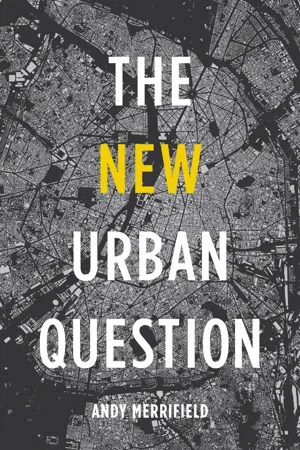
The New Urban Question is an exuberant and illuminating adventure through our current global urban condition, tracing the connections between radical urban theory and political activism. From Haussmann's attempts to use urban planning to rid 19th-century Paris of workers revolution to the contemporary metropolis, including urban disaster-zones such as downtown Detroit, Merrifield reveals how the urban experience has been profoundly shaped by class antagonism and been the battle-ground for conspiracies, revolts and social eruptions. Going beyond the work of earlier urban theorists such as Manuel Castells, Merrifield identifies the new urban question that has emerged and demands urgent attention, as the city becomes a site of active plunder by capital and the setting for new forms of urban struggle, from Occupy to the Indignados.
- 160 pages
- English
- ePUB (mobile friendly)
- Available on iOS & Android
eBook - ePub
The New Urban Question
About this book
Information
1
Whither Urban Studies?
In talking about urban studies, and about what’s to follow in this book, I speak from and for the perspective I know best: the critical urban tradition that developed out of Marxism in the 1970s, as pioneered by the likes of Henri Lefebvre, David Harvey, and Manuel Castells. I tried to document and contribute toward this tradition in my book Metromarxism, where I claimed some of the best urban studies has been done by certain Marxists, and some of the best Marxism has been done by certain urban theorists.1
If we look back at the debates that raged in the 1970s, one of the biggest was about the nature of the urban. Just what is the urban anyway? What is a city? Why should it command such interest for critical scholars? The obvious rejoinder is that the city plays a special role under capitalism—indeed it was important in the birth of capitalism itself. The city assumes a twin role: an engine for capital accumulation, on the one hand, and a site for social/class struggle, on the other. It is crucial for the expansion of capitalism and for overthrowing capitalism. It is a theoretical object of curiosity because it is a political subject of necessity.
All of which bodes the question what is this “it”? In The Urban Question, Castells wondered what could we possibly mean by “city,” and what is this concept “urban”? Why urban sociology and not simply sociology? Why urban geography and not simply geography? Castells, of course, was trying to figure out the specificity of the city, for both theory and politics, and it’s a question we might still want to ponder. If anything, the question takes on renewed significance today because our world assumes a very different urban form than it did in the 1970s. Since 2006, the majority of the world’s population is, we’re told, urbanized, with some 3.3 billion dwellers living in urban agglomerations of some guise or another; and, if trends continue, this is set to increase exponentially. By 2030, 60 percent of planet earth will be urban; by 2050, 75 percent.
Yet beyond mere curiosity, what do these figures imply? Are they significant? Is urban studies a numbers game anyway? In 1938, the American sociologist Louis Wirth expressed a skepticism about “measuring” the degree to which the contemporary world is “urban” from the proportion of the total population living in cities. The influence cities exert upon social life, he said, is greater than any statistical population ratio might infer. The urban isn’t a physical entity delimited in space but its very own cosmos, its very own “way of life.”2
Never anyone terribly interested in numbers, Henri Lefebvre said a fuller understanding of our urban age could only be reached through conceptualization of the whole, through conceptualization of what he termed “planetary urbanization.” In 1970, Lefebvre posited “the complete urbanization society.”3 In his day, he said, the complete urbanization of society was virtual, though one day might become real. Lefebvre is the last of a pretty extinct species: a philosopher of the city—or, better, “metaphilosopher” of the city.4 This notion of “philosopher” harks back to the ancient Greeks; not somebody who is detached, solitary and contemplative, dealing with rarified abstractions, but somebody who’s completely engaged in politics and big questions about democracy. Indeed, the very bedrock for ancient Greek philosophy was questions that linked the polis to democracy. The city, philosophy, and politics were synonymous. The philosopher Hippodamus, remember, was the first city planner, initially proposing a grid pattern and zoning scheme, as well as a central agora open square, that beloved place of gathering and assembly so precious to democracy; and we know how Plato, in The Republic, said much about how cities relate to democracy—or, as in Plato’s case, to too much democracy.
The point here is that philosophy, the city, and political engagement all went together. Within the field of urban geography, particularly in U.K. urban geography, there are certain things that today militate against this noble philosophical tradition. One is the dominance of the positivist-empiricist tradition. The reason may be obvious in our age of “experts” and “technocrats,” in this era some describe as “post-political”: positivism has always hid behind the shield of quantification and “objectivity,” always tried to rid itself of politics. In that sense, positivism/empiricism is a convenient methodology for technocrats trying to find consensus without conflict. Their opinions are neutral and expert, right? Their knowledge isn’t value-laden. Yours, if it’s critical and theoretically partisan, is warped, ideological.
The second reason for the prioritization of empirical data—which ties in neatly with the first reason—is that it can raise money for the corporate university, can more easily capture grant money, more easily produce a “knowledge commodity,” a knowledge that may be calculated and evaluated in an institution’s competitive yearnings and chart-topping desires. Very little money, if any, is doled out to work on theory, therefore theory/philosophy is unimportant because it is financially unimportant. To be sure, it is extremely difficult to evaluate and judge its “impact” on any spreadsheet.
You no longer think about a problem: you spend your time thinking about filling in a grant proposal about a problem. This creates a certain superficiality to the idea of doing “research”: research constitutes amassing data; it rarely means thinking deeply about a problem, certainly not formulating concepts about this problem, and then engaging in a politics around that problem. This isn’t helpful in the development of deeper, critical understandings of the urban problematic. Arguably, it creates a discipline that is at heart anti-intellectual. And anti-intellectualism doesn’t “impact” well in the long run.
On the other flank, neither does sloppy theorizing, or theorizing divorced from political and social engagement. Consequently, there are dangers of “pure” theorizing, too, especially the sociologicalization of certain forms of continental philosophy, and here we might indict those who try to “adopt” or “instrumentalize” in some kind of disembodied way the usual suspects, thinkers like Badiou, Rancière, Žižek, Deleuze and Guattari, even Lefebvre. “Thoughts without content are empty,” said Kant in The Critique of Pure Reason; although he also said “thoughts without concepts are blind.” And so we hobble along, between analytical emptiness and conceptual blindness ...

Still, a reloaded urban studies doesn’t mean middle-ground: it suggests a thorough reframing of the urban question, of dealing adequately with the ontological question, that of being in the world, of being in an urban world. Within this conceptualization we need to dispense with all the old chestnuts between global North and global South, between developed and underdeveloped worlds, between urban and rural, between urban and regional, between city and suburb, just as we need to dispense with old distinctions between public and private, state and economy, and politics and technocracy. From this standpoint, frontier lines don’t pass between any North–South or urban–rural divide, but reside “within the phenomenon of the urban itself”—as Lefebvre says in The Urban Revolution. Hence the need to conceptualize and politicize how the globe is no longer demarcated through definitive splits between strict opposites: all demarcations and frontier lines are immanent within urban society, between dominated peripheries and dominating centers that exist all over the planet.
The notion of immanence is writ large in Marx’s as well as Spinoza’s thought, and is instructive for our own urban problematic. Immanence is everywhere in Marx’s vocabulary. Marx said that value is immanent to capitalism, so is the world market, which is the very basis of capitalism, of what it is and what is emergent in its very Being; we could easily transpose “urban” for “world market” without losing any clarity of Marx’s meaning. As for Spinoza, in Ethics he called the immanent force of nature and reality substance. Substance is the bedrock content to human reality, perceivable and conceivable only through its manifold attributes. Substance is, of course, Spinoza’s pantheist theory of God, his notion that God is immanent in all reality, including ourselves; but maybe the form of this notion holds, too, for the immanent nature of the urban, for its complex ontological tissuing, for the fabric that now clothes our daily lives.
What is being affirmed here is the urban as a single substance whose attributes—the built environment, transport infrastructure, population densities, topographical features, social mixes, political governance—are all the formal expressions of what pervades it ontologically. We might even say that the “city” is an attribute of the urban. These attributes are how the urban looks and how it can be seen and known. The urban isn’t out there, necessarily observable and measurable, but is immanent in our lives, an ontology not an epistemology, not a transitive attribute of our society but the immanent substance of our society.
Within this conceptualization, it’s possible to conceive planetary urbanization not as simply bricks and mortar, as high-rise buildings and autoroutes, but as a process that produces skyscrapers as well as unpaved streets, highways as well as back roads, by-waters and marginal zones that feel the wrath of the world market—both its absence and its presence. This process involves dispossession of land, of sequestering the commons and eminent domain. The urban now signifies a new kind of “dependency,” justifying cultural, technological and economic obsolescence in rural economies. In the 1970s, the peasant sociologist Andrew Pearse spoke of the expansion of an “Urban-Industrial-Complex” into the world’s rural areas, which sanctioned agricultural production through an urban reward system. Today, we’d have to rename that complex an “Urban-Financial-Complex,” with a reward system that penalizes and disciplines agricultural production, doing so planetarily, doing so from multiple centers of urban corporate power.5
We should stop using the term city, Lefebvre says, and adopt instead the terminology “urban society.” Urban society, he was fond of saying, “is built upon the ruins of the city.”6 The city is a pseudo-concept, a historical concept, not an analytical reality. In pushing for the notion of urban society Lefebvre is asking us to open the floodgates, to quit bounding something, to give up on solidity and the security of an absolute and embrace something relative and open, something becoming. We should leave behind the form of the city and embrace the apparent formlessness of urban society.
I say “apparent” because we might remember there’s nothing formless as such about Lefebvre’s conception of space; he was keen to emphasize that space is global, fragmented and hierarchal in one fell swoop. It is a mosaic of stunning complexity, punctuated and textured by centers and peripheries, yet a mosaic in which the “commodity-form” gives this patterning its underlying definition. If we wanted to delve into the cell-like molecular structure of this urban substance, of this urban space, we could perhaps see it as an immense accumulation of commodities, bounded by the “commodity-form,” even while its “value-form” is boundless. The “commodity-form” vis-à-vis the “value-form” is a key distinction Marx makes at the beginning of Capital. It was one way, after all, in which he could talk about how things have particularity and generality at the same time, have intrinsic form yet are also extrinsically formless. I’d like to see the urban pictured in the same analytical light, as something with structure and form, as something as functionally chaotic—Lefebvre’s “rational delirium”—yet as fractally ordered as a series of subatomic particles.
We have to be imaginative about how we might conceive this reality. We could see it the way an atomic physicist might see it but really we are talking about something very vast—a terrestrial planetary u...
Table of contents
- Cover
- Half-title Page
- Title Page
- Copyright
- Contents
- Preface: Neo-Haussmannization and its Discontents
- 1. Whither Urban Studies?
- 2. Old Urban Questions Revisited (and Reconstituted)
- 3. Cities Under Tension
- 4. Strategic Embellishment and Urban Civil War
- 5. Sentimental Urban Education
- 6. Urban Jacobinism
- 7. Old Discourse on New Inequality
- 8. Every Revolution has Its Agora
- 9. Taking Back Urban Politics
- 10. Whose City? The Parasites’, of course...
- Afterword: The Parasitic Mode of Urbanization
- Index
Trusted by 375,005 students
Access to over 1.5 million titles for a fair monthly price.
Study more efficiently using our study tools.
Frequently asked questions
Yes, you can cancel anytime from the Subscription tab in your account settings on the Perlego website. Your subscription will stay active until the end of your current billing period. Learn how to cancel your subscription
No, books cannot be downloaded as external files, such as PDFs, for use outside of Perlego. However, you can download books within the Perlego app for offline reading on mobile or tablet. Learn how to download books offline
Perlego offers two plans: Essential and Complete
- Essential is ideal for learners and professionals who enjoy exploring a wide range of subjects. Access the Essential Library with 800,000+ trusted titles and best-sellers across business, personal growth, and the humanities. Includes unlimited reading time and Standard Read Aloud voice.
- Complete: Perfect for advanced learners and researchers needing full, unrestricted access. Unlock 1.5M+ books across hundreds of subjects, including academic and specialized titles. The Complete Plan also includes advanced features like Premium Read Aloud and Research Assistant.
We are an online textbook subscription service, where you can get access to an entire online library for less than the price of a single book per month. With over 1.5 million books across 990+ topics, we’ve got you covered! Learn about our mission
Look out for the read-aloud symbol on your next book to see if you can listen to it. The read-aloud tool reads text aloud for you, highlighting the text as it is being read. You can pause it, speed it up and slow it down. Learn more about Read Aloud
Yes! You can use the Perlego app on both iOS and Android devices to read anytime, anywhere — even offline. Perfect for commutes or when you’re on the go.
Please note we cannot support devices running on iOS 13 and Android 7 or earlier. Learn more about using the app
Please note we cannot support devices running on iOS 13 and Android 7 or earlier. Learn more about using the app
Yes, you can access The New Urban Question by Andy Merrifield in PDF and/or ePUB format, as well as other popular books in Social Sciences & Human Geography. We have over 1.5 million books available in our catalogue for you to explore.