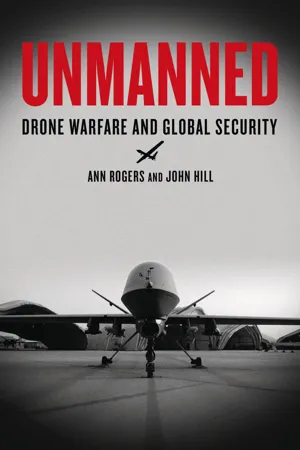
Drones have become the controversial new weapon of choice for the US military abroad. Unmanned details the causes and deadly consequences of this terrifying new development in warfare, and explores the implications for international law and global peace. Ann Rogers and John Hill argue that drones represent the first truly globalised technology of war. The book shows how unmanned systems are changing not simply how wars are fought, but the meaning of conflict itself. Providing an unparalleled account of new forms of 21st century imperial warfare, Unmanned shows how drone systems dissolve the conventional obstacles of time and space that have traditionally shaped conflict in the international system. It considers the possibility that these weapons will become normalised in global conflict, raising the spectre of new, unpredictable and unaccountable forms of warfare.
- 192 pages
- English
- ePUB (mobile friendly)
- Available on iOS & Android
eBook - ePub
About this book
Information
1
From Balloons to Big Safari: UAV Development
The US intelligence community is the single greatest contributor to US operational UAV development.
Thomas Erhard, Special Assistant to the Chief of Staff, USAF
Air power, as USAF Major Carl Baner puts it, enables ‘observation … the collection of data and information. The elevation and extent of air and space provides the airman with a perspective of the theater that is not afforded to the soldier or sailor’.1 As he notes, it also provides the means to act on that information. Particularly since 2001, UAVs have evolved to the point at which they provide commanders with effective tools to address both aspects of air power. The road has not always been smooth, however, with manned aircraft and satellites competing over key missions, and expensive failed programmes littering the way. UAVs seem to have finally found their niche as the technological capacity and the appropriate operational environment have come together in the asymmetric conflicts of the twenty-first century. However, this niche is highly controversial, associated with the extension of an imperialist surveillance and militarised violence into situations previously unavailable for such action.
Balloon Warfare
Although UAVs have only come to prominence in the public eye in the last couple of decades, they have been a part of the military inventory for much longer than that. The history of unmanned flight is of course longer than the history of manned flight, and the usage of unmanned flight in war also predates the use of manned aircraft; in fact, its development was tied up with military applications from the very beginning. The Montgolfier brothers, credited with the development of the hot-air balloon, were inspired by the potential they saw for the usage of such a craft in war.2 This potential was borne out in as much as unmanned balloons undertook the first verified aerial bombing raid in history, when in 1849, during the Austrian siege of Venice, an attempt was made by the Austrians to drift balloons carrying 30 lb bombs over the Venetian defences. The bombs were released either by timer or, according to a contemporary account in The Scientific American, by an electric switch connected via a long trailing copper wire. Unguided as well as unmanned, the attempt was a failure, as a change in the wind drove most of the balloons off target, even bringing some of them back over Austrian lines.
The balloon had a long manned history as a military observation tool, but even as late as World War II both the Allied and Axis powers used unmanned balloons to attack each other. Curtis Peebles describes how the British Operation Outward sent almost 100,000 small balloons towards Germany, carrying either a small (6 lb) incendiary device or trailing wires with the intent of causing short circuits in power-lines – a task at which they had some success, resulting, for example, in the destruction of a power plant in 1942. A by-product of the programme was seen in the attempts by German fighters to intercept the balloons – much more costly to the Luftwaffe than the very basic balloons were to the British: an early example of how cheap UAVs might swamp air defences. The Japanese attempted a similar thing, but with a more sophisticated device operating over an intercontinental distance, when late in the war they released over 9,000 balloons carrying small bombs – either incendiary or anti-personnel weapons – which then crossed the Pacific riding on the jet stream. Three hundred are known to have reached North America although they caused little damage, the most serious event being the killing of six curious picnickers in Oregon. The only control these devices had was an estimation of the jet stream speed and direction, and a timing device.
Radio-Control Versus Autopilot
However, the real path towards the effective delivery of air power by UAVs lay with heavier-than-air craft, lightweight engines and wireless technology. A radio-control system was first patented by Nikola Tesla in 1898, a system he demonstrated on a radio-controlled boat to amazed onlookers at Madison Square Gardens. Experiments applying radio-control to aircraft came hard on the heels of the Wright Brothers’ first manned flight, with war once again driving the technology. Archibald Low, an eccentric British engineer and inventor known as ‘the father of unmanned guidance systems’,3 worked on developing radio-control for aircraft during World War I, conducting the first demonstration of wirelessly controlled unmanned flight in 1917 for the British military, under the code name Aerial Target – in reality the aircraft was intended to be used as a flying bomb, a kind of early cruise missile. The project was not taken up.
This development was paralleled with a different technology in the US, where the Hewitt-Sperry automatic plane underwent a number of trial flights in 1917 and 1918, again with the intention of functioning as a flying bomb, particularly with the aim of attacking enemy shipping. The US Army commissioned a similar aircraft, the Kettering Bug, to function as an aerial torpedo over a range of around 40 miles. Ultimately, 45 of the 12-foot-long biplanes were built but were not used in action. Neither of these aircraft were remotely guided, but rather they flew a programmed course using an autopilot system consisting of the new Sperry-developed gyroscope, a barometer and a timer, to manage height, direction/attitude and distance. As Thomas Mueller notes, this made the Kettering Bug ‘the first airplane capable of stabilizing and navigating itself without a pilot on board’.4
This approach labels the Hewitt-Sperry and the Kettering bug true ‘drones’, for although the term is common in describing contemporary unmanned aircraft, the more accurate term for most of this type of aircraft currently is ‘remotely piloted’, reflecting the fact that decisions are being made about course, height and so on by a human being reacting in real time. A drone is bound to do what it has been programmed to do (we will, however, be following accepted practice and using the terms interchangeably). The advantage of this kind of autopilot guidance at this stage of development is range: the aircraft can fly out of sight of any human controller, whereas radio-control was dependent on the remote controller being able to see the aircraft that he or she was controlling. This means range is limited (or that the controller has to accompany the aircraft in another manned aeroplane). The third category would be ‘autonomous’, that is, there is no human pilot remote or otherwise, but nor is the aircraft simply following a course by rote: rather, the machine makes choices based on changing conditions, reacting perhaps to terrain changes, or enemy radar signals, or maybe even target recognition. This doesn’t come until much later, and indeed is only a partial reality today.
Experiments in radio-control continued between the wars, on land, sea and in the air. The Soviet Union developed tele-tanks, a system in which a manned tank operated a partner unmanned tank via radio-control. These saw use in the Winter War with Finland.5 The US Navy used radio-control to direct target ships for gunnery practice, such as the obsolete USS Iowa, sunk in 1923. The system of radio-control in this instance was developed by John Hays Hammond Jr, a protégé of Thomas Edison and Alexander Graham Bell.6 Military experiments with unmanned aircraft also continued between the wars. The British Navy acquired a radiocontrolled aerial target aircraft based on parts from a couple of manned aircraft, the de Havilland Tiger Moth and the Moth Major. This task is one eminently suited to basic radio-control as it does not require the plane to travel long distances, but perhaps circle a ship at a distance of no more than a few miles. The aircraft, known as the Queen Bee (some accounts suggest that this name was the original source of the term ‘drone’), first flew in 1935 and was quite effective in its role. Over 400 were built, both in land and seaplane versions – the latter launched by steam catapult. Robin Braithwaite reports that the aircraft had an automatic landing system to allow the aircraft to land safely should radio-control be lost, and that ‘In its heyday, it was not uncommon to discover an orphaned Queen Bee, devoid of fuel but otherwise serviceable, quietly bobbing about at sea’.7 The novelist and aircraft engineer Nevil Shute Norway’s Airspeed company was commissioned to build a dedicated UAV as a successor to the Queen Bee, the Queen Wasp. This aircraft, also designed both in floatplane and land-based versions, was much less successful, and no more than a few prototypes were built.
Towards Guidance Beyond Visual Range
Many of these early developments have as much to do with the development of guided missiles as with unmanned aircraft, since both Low’s radio-controlled Aerial Target and the US Sperry gyroscope-guided aircraft were designed as weapons rather than as aircraft designed to return for reuse. This technology would be advanced in the course of World War II, both in the form of guided weapons and reusable unmanned aircraft. To some extent it was still the province of the talented amateur. Reginald Denny was one such, a Briton who, having served in the Royal Flying Corps in World War I, emigrated to the US to become a film actor (in which he was successful, acting in many well-known movies). He developed a hobbyist’s interest in radio-controlled aircraft, started a modeller’s shop on Hollywood Boulevard, and promoted his belief that drones had a useful role in gunnery practice to the US military. He made his first sale in 1940, and over the course of the war around 15,000 ‘Denny Radioplanes’ were produced. These aircraft were conventional-looking single-engine monoplanes with a 12-foot wingspan. Few survive, a testament, as one commentator put it, to the trainee gunners’ accuracy.8 The company was later taken over by Northrop, which today, as Northrop Grumman, remains in the UAV business. A number of other radio-controlled target drones based on manned aircraft were used in World War II, from the US Navy’s Curtis N2C-2 biplane, which first flew in 1937, to the US Army Air Force’s (USAAF) Culver PQ-8/14 based on a light civil monoplane. These were controlled from an accompanying aircraft and were successful in their role, with over 2,000 of the later PQ-14 variant being built. In a footnote to UAV history, Marilyn Monroe was discovered by an army photographer who took pictures of her assembling the Denny Radioplane when she was working at the Denny plant in 1944.
The US military also continued to experiment with radio-controlled ‘aerial torpedoes’. But the Navy team that developed the N2C-2 based target drone were to take the concept a fundamental step further. The officer in charge, who retired as Rear Admiral Delmar S. Fahrney, US Navy, writes, ‘Back at the Naval Aircraft Factory in April 1939, as officer in charge of “Project Fox,” I began planning, design, and development work on a guided missile that could be successfully controlled beyond visual range’.9 The key to this step was television, and Fahrney records how a contract with RCA led to the provision of a small TV transmitter. By 1941 successful flight tests had been carried out and development went ahead with what they called an ‘assault drone’. He describes how in 1942 a TG-2 biplane torpedo bomber, converted into a drone and controlled by an operator looking at a six-inch television screen on an accompanying aircraft, carried out a successful torpedo attack demonstration on a US destroyer. Since the drone was not acting as the missile itself, this can be seen as the first use of an unmanned combat air vehicle (UCAV). In later tests they were also flown directly into the target, acting in a secondary role, in effect, as cruise missiles.10
Laurence Newcome, who was heavily involved in the Pentagon’s UAV development programme, recounts how almost immediately after its initial success with the TG-2 the Naval Aircraft Factory sought to overcome the limitations of the new TV–equipped drone, namely its inability to deal with night-flying or bad weather. They did this by adding a radar guidance system, and developed two drones able to use both systems, the TDN-1 and the TDR-1. These were fairly basic plywood monoplanes capable of carrying around 2,000 lbs of bombs, but they proved the worth of the UAV concept in the war in the Pacific. Three Special Task Air Groups (STAGs) with 99 control aircraft, 891 drones and over 3,000 personnel were stood up in 1943, and in 1944 STAG-1 was deployed near Guadalcanal and rapidly demonstrated their aircraft’s value by flying four drones into a grounded Japanese vessel. This led to further successful attacks on a range of fixed targets, often attacking through heavy anti-aircraft fire, while, as Newcombe writes, ‘their [Grumman] Avenger mother ships orbited 6–8 miles away’.11
In this kind of attack the drone weapon is deployed as a missile: it is destroyed in the process, as it is directed on to the target as a kind of flying bomb – along the lines of the better-known German V-1, which, however, used a gyroscope and compass along with a range-counter, to fly automatically. But most interestingly, especially given the long post-war emphasis on the drone as a surveillance tool, STAG-1 also experimented in action with the use of the drone as a bomber rather than simply a bomb. Newcombe describes how ‘armed with a combination of ten 500- and 100-lb bombs, a single TDR-1 dropped the bombs on gun emplacements and then headed for home’. Although it crashed on the way back due to battle damage, this key event ‘had proven the operational validity of the unmanned combat air vehicle (UCAV)’. Later attacks used a combination of approaches, with the drones dropping their bombs on targets then being guided into Japanese shipping in what Newcome calls ‘a pilotless prelude to the Japanese Kamikaze attacks that began a week later’. He assesses the effects of the drone attacks as follows:
Of the 50 drones STAG-1 had sent into combat, 15 were lost to mechanical/technical causes, three to enemy fire, and 31 hit or damaged their targets. More importantly, not one STAG-aviator was lost or injured on these missions during some of the bloodiest contests of the war in the Pacific.12
The significance of this seems to be twofold: these aircraft proved the worth of the UAV and indeed the UCAV concept in as much as they worked, delivering a weapon accurately on to the target without a human pilot on board. Secondly, the fact that Newcombe draws attention to the lack of US casualties involved in the process indicates one of the fundamental advantages of the UAV: they can carry out dangerous military operations at no risk to the military personnel operating them.
That said, not all UAV operations at this time were risk-free. The US approach to remotely piloted vehicles included the adaptation of large military aircraft at the end of their operational lives, such as the four-engined Liberator and Flying Fortress bombers. USAAF chief General H.H. Arnold, in supporting the effort to bring ‘the greatest pressure possible against the enemy’, wrote in a 1944 staff memo, ‘If you can get mechanical machines to do this, you are saving lives at the outset’.13 Unfortunately, in this case that was not quite true. These aircraft required a crew of two on board to achieve take-off, who then bailed out. This left the accompanying mothership to control them by radio, the controller having the benefit of a new control technology: a television picture of the view out of the cockpit of the controlled aircraft as well as a view of the control panel to help them in the task of directing the explosive-filled plane on to the target. Despite these aids, this programme was of limited success, creating as much danger for the American crews, accompanying aircraft and towns surrounding the English airfields from which they were launched, as they did for the enemy. Possibly the biggest historical impact of these ‘Weary Willies’, as they were nick-named, lay in the premature detonation of one such converted B-24 Liberator, which resulted in the death of Joseph Patrick Kennedy, intended by his family for the position of US President. This task then fell to his younger brother, John.
Newcome finds additional, and provocative, significance in the way the drone programme was managed during the war, which he suggests would not be unfamiliar today. Firstly he identifies, in the apparently positive way in which new capacities were rapidly added to the drone (TV, radar, etc.), the phenomenon of ‘requirements creep’ that delayed availability, complicated production and increased costs. He also saw an institutional resistance to supporting this new and untried technology, as well as a failure to bring operational commanders on board early in the process. This all happened in the context of war, which he characterises as a ‘come as you are’ affair in which few major technological developments occur, with most major wartime weapons systems in production before the war began.14
Cold War Surveillance
As Rebecca Grant points out in the introduction to Thomas Ehrhard’s study, 50 years passed between the end of the war and the Predator’s appearance in the Bosnian war, a period in which the UAV seemed to have fallen from grace. ‘Vanished from sight’ might be a more accurate term, as key programmes, if not yet the drones themselves, became stealthy, operating to some extent under the cover of black or secret programmes of shadowy organisations such as the National Reconnaissance Office (NRO) or, later, the Defense Airborne Reconnaissance Office (DARO), and operated by, in some cases, the CIA, rather than the USAF. In fact, as Ehrhard points out, ‘the US intelligence community is the single greatest contributor to US operational UAV development’.15
Newcome describes how the particular exigencies of the Cold War had some influence on how UAVs developed after World War II. One factor was the perception that the next war would be a nuclear one. Experience with flying manned aircraft over the Bikini Atoll nuclear tests illustrated the dangers of putting aircrew into such a radioactive environment to see what was going on, and so out of this scenario came the pressure to create unmanned reconnaissance aircraft to deal with such ‘dirty’ missions. The ‘cold’ nature of the Cold War also meant that such operations as were flown by US forces over hostile territory were reconnaissance flights rather than strike missions. As such, Newcome notes that these surveillance flights were among the hottest missions of the Cold War, posing real risks to the pilots manning the aircraf...
Table of contents
- Cover
- Half-title Page
- Title Page
- Copyright
- Dedication
- Contents
- Abbreviations
- Introduction
- 1 From Balloons to Big Safari: UAV Development
- 2 The Drone Takes Off
- 3 The UAV and Military Doctrine
- 4 The Consequences of Killing Without Consequences
- 5 Targets: The View From Below
- 6 Unlegal: Justifying a Drone War
- 7 Killer Robots
- 8 From Man O’ War to Nano-War: Revolutions in Military Affairs
- Notes
- Bibliography
- Index
Trusted by 375,005 students
Access to over 1.5 million titles for a fair monthly price.
Study more efficiently using our study tools.
Frequently asked questions
Yes, you can cancel anytime from the Subscription tab in your account settings on the Perlego website. Your subscription will stay active until the end of your current billing period. Learn how to cancel your subscription
No, books cannot be downloaded as external files, such as PDFs, for use outside of Perlego. However, you can download books within the Perlego app for offline reading on mobile or tablet. Learn how to download books offline
Perlego offers two plans: Essential and Complete
- Essential is ideal for learners and professionals who enjoy exploring a wide range of subjects. Access the Essential Library with 800,000+ trusted titles and best-sellers across business, personal growth, and the humanities. Includes unlimited reading time and Standard Read Aloud voice.
- Complete: Perfect for advanced learners and researchers needing full, unrestricted access. Unlock 1.5M+ books across hundreds of subjects, including academic and specialized titles. The Complete Plan also includes advanced features like Premium Read Aloud and Research Assistant.
We are an online textbook subscription service, where you can get access to an entire online library for less than the price of a single book per month. With over 1.5 million books across 990+ topics, we’ve got you covered! Learn about our mission
Look out for the read-aloud symbol on your next book to see if you can listen to it. The read-aloud tool reads text aloud for you, highlighting the text as it is being read. You can pause it, speed it up and slow it down. Learn more about Read Aloud
Yes! You can use the Perlego app on both iOS and Android devices to read anytime, anywhere — even offline. Perfect for commutes or when you’re on the go.
Please note we cannot support devices running on iOS 13 and Android 7 or earlier. Learn more about using the app
Please note we cannot support devices running on iOS 13 and Android 7 or earlier. Learn more about using the app
Yes, you can access Unmanned by Ann Rogers, John Hill in PDF and/or ePUB format, as well as other popular books in History & Military & Maritime History. We have over 1.5 million books available in our catalogue for you to explore.