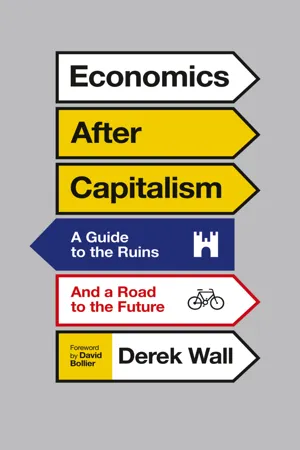
'There is no alternative' has been the unofficial mantra of the neoliberal order since its utterance by Margaret Thatcher in the 1980s. However, there is an alternative to our crisis-ridden, austerity-inflicted world - and not just one alternative, but many. Challenging the arguments for markets, mainstream economics and capitalism from Adam Smith onwards, Economics After Capitalism provides a step-by-step guide to various writers, movements and schools of thought, critical of neoliberal globalisation. These range from Keynesian-inspired reformists such as Geroge Soros and Joseph Stiglitz, critics of inequality like Thomas Piketty and Amaitya Sen, to more radical voices including Naomi Klein, Marxists such as David Harvey, anarchists, and autonomists including Toni Negri and Michael Hardt. By providing a clear and accessible guide to the economics of anti-capitalism, Derek Wall successfully demonstrates that an open source eco-socialist alternative to rampant climate change, elite rule and financial chaos is not just necessary, but possible.
- 192 pages
- English
- ePUB (mobile friendly)
- Available on iOS & Android
eBook - ePub
About this book
Information
1
WARM CONSPIRACIES AND COLD CONCEPTS
The capitalist epoch will come to be seen as one in which we relied on incredibly crude economic mechanisms called ‘markets’. Markets are like machines for coordinating and relaying information, but they are only effective in relaying limited kinds of information in very circuitous ways. Markets are often thought to be highly efficient, but in the future they will be seen as highly inefficient and costly. Markets not only fail to take account of social and environmental costs, but they also generate instability, insecurity, inequality, antisocial egotism, frenetic lifestyles, cultural impoverishment, beggar-thy-neighbour greed and oppression of difference. (Albritton 1999: 180)
Frank Knight is often described as the founder of the Chicago School. The economics department at the University of Chicago, famous for Milton Friedman and other neo-liberal economists, inspired Mrs Thatcher, Ronald Reagan and other right-wing politicians. It could be said that their neo-liberalism, which promotes capitalism above all else, has transformed the world and now dominates our planet. Democrats from Obama to Clinton, and Labour leaders from Bob Hawke to Tony Blair, accepted many of the Chicago School’s key assumptions and the ‘Washington consensus’ of deregulation, privatisation, tax cuts (at least for corporations), slashed welfare, and reduced trade union rights, based on Chicago School economic sentiments, remain almost universal today.
However, in 1932, on the evening before the US presidential election of that year, Frank Knight did something very odd indeed. He gave a lecture entitled ‘The Case for Communism: From the Standpoint of an Ex-liberal’, and opened it by suggesting ‘those who want a change and wish to vote intelligently should vote Communist’ (Burgin 2009: 517). For most of his career, Knight was a committed free marketer, who was known for converting socialists like James Buchanan into fervent advocates of capitalism. Milton Friedman referred to him as ‘our great and revered teacher’ (Nelson 2001: 119). Knight was a richly paradoxical character; no simple free marketeer, he believed in capitalism but was aware of its innate contradictions. He argued that luck and inheritance, as well as hard work, determine how well we do. He saw capitalism as leading to increasing inequality and tending towards crisis, and was also sceptical of ideas of economic rationality (Burgin 2009). In the 1930s, capitalism was in crisis, a severe economic depression occurred and even the likes of Frank Knight, in his case both dramatically and briefly, were looking for alternatives.
In 2015, the world economy is growing but capitalism has been tarnished. In 2008, a financial crisis, caused by deregulation of banking in line with neo-liberal principles, led to a world recession. Neo-liberalism has led to increased inequality in the US and UK. To keep us spending, despite slower wage growth, there was a massive expansion of personal credit. Capitalism, after all, has many contradictions, but one of the most significant is the wage relationship. If wages rise, firms face greater costs and less profit, neo-liberalism has made it easier for companies to reduce wages by cutting trade union power and relocating to low wage economies. If wages fall, firms face more difficulty in finding consumers (who after all generally have to work to afford to buy products), and see profits decrease. There is, of course, no single unique contradiction; the geographer David Harvey (2014) has identified 17, and his list may not be exhaustive. The contradiction between wages, costs and consumption, means increased credit becomes vital as a way of allowing consumers to borrow to spend despite stagnant wages. Virtually fraudulent ‘subprime’ mortgages were sold to poor householders, most notoriously in Florida. Subprime is jargon, meaning mortgages for people who can’t afford them. The mortgages started with ultra-low teaser interest rates which then rapidly increased. You don’t have to be a genius to see that this would end in tears. Mortgage debt, as Michael Lewis in his beautifully written book, The Big Short (2010), was re-packaged and sold on, so that banks in Britain, such as Northern Rock, ended up with toxic debt from the US. Banks and other financial institutions descended into crisis, governments stepped in to bail them out, markets took fright, economic growth became negative and millions of us lost homes, jobs and incomes. The inequalities of capitalism contributed to the crisis, the mantra of deregulation meant that risks were allowed to build up and calls for an end to neo-liberalism grew loud. This book is about alternatives to neo-liberalism, and argues that capitalism is merely one way of running the economy, that capitalism doesn’t work and that alternatives are possible.
In writing this book I am, in a sense, taking the Frank Knight wager. Knight argued that capitalism was flawed but ultimately, despite his socialist origins and his 1932 episode of communist advocacy, he felt that there was no alternative. I enjoy reading Knight immensely; along with the free market feminist economists Deirdre McCloskey, he is an example of an intelligent advocate of capitalism, aware of its problems and committed to a society that works not simply for the rich and powerful, but for all of us. How can we create practical alternatives to capitalism that work to put food on the table, providing long-term material well-being not only for a minority but a whole planet?
Commentators predicted a new economics, and in 2009 Elinor Ostrom, the first woman to win the Nobel Prize for economics, delivered a lecture boldly entitled ‘Beyond Markets and States’; however, the orthodoxy retained its power (Wall 2014). The journalist Richard Seymour, in Against Austerity (2014), argued that the neo-liberals retained a virtual monopoly on economics, there were few clearly articulated alternatives and the rich and powerful worked to turn a crisis into an opportunity. He noted that the growth of government debt was used to justify more cuts in public spending, and in countries like Britain ever more deeply market-based policies are justified as a source of growth.
The future looks both clear and bleak. The economic system we have at present cannot cope with climate change, cannot reduce inequality, and it attempts to overcome its contradictions by insisting upon more of the same. The left, strong in Frank Knight’s day, seems weaker than ever. Greater inequality and reduced standards of workers’ protection, along with the sale of institutions and assets such as the British National Health Service and even Greek beaches, will lead to greater misery. Increasing police powers and surveillance will be used to stifle dissent. Discontent is, at least in Europe, leading to the growth of far right parties. It’s easier to explain falling living standards as being a result of immigration than the workings of economic theories and bond markets, so politicians are prepared to use race, nationalism, or sectarian religious sentiments to gather votes. From India, where the right-wing People’s Party, or BJP, won the 2014 general election in the world’s biggest democracy, to the emergence of the Tea Party in the US, to the rise of Islamic fundamentalists such as ISIS in Syria, economic and ecological crisis is fuelling hate-filled, regressive movements rather than positive change.
In the wake of the 2008 crisis, there were calls for an inclusive, compassionate capitalism. Some of these calls seem genuine and progressive, others a little absurd. In July 2014, it was reported by the Evening Standard that
A London summit on ‘caring capitalism’ that attracted Prince Charles and Bill Clinton as speakers became embroiled in a bitter legal dispute.
Philanthropist Lady Lynn Forester de Rothschild, who says the one-day conference was her idea, has launched a £187,000 High Court claim against the think-tank that helped stage the event …Lady de Rothschild claims HJS, a registered charity, and its executive director Alan Mendoza are holding £137,000 of ‘surplus funds’ from the conference that should be returned to the couple’s investment company EL Rothschild … It also says HJS must give her control of websites connected with the conference and other assets such as a contacts database which she says ‘does not belong to’ HJS.
(www.standard.co.uk/news/london/lady-de-rothschild-sues-thinktank-over-funds-from-caring-capitalism-summit-9625722.html)
Pleas for such inclusive capitalism have come from those who argue that rising inequality is impossible to sustain. US billionaire Nick Hanauer dramatically warned fellow ‘plutocrats’ in June 2014 that the pitchforks were coming:
Some inequality is intrinsic to any high-functioning capitalist economy. The problem is that inequality is at historically high levels and getting worse every day. Our country is rapidly becoming less a capitalist society and more a feudal society. Unless our policies change dramatically, the middle class will disappear, and we will be back to late 18th-century France. Before the revolution.
And so I have a message for my fellow filthy rich, for all of us who live in our gated bubble worlds: Wake up, people. It won’t last.
If we don’t do something to fix the glaring inequities in this economy, the pitchforks are going to come for us. No society can sustain this kind of rising inequality. In fact, there is no example in human history where wealth accumulated like this and the pitchforks didn’t eventually come out. You show me a highly unequal society, and I will show you a police state. Or an uprising. There are no counterexamples. None. It’s not if, it’s when.
(www.politico.com/magazine/story/2014/06/the-pitchforks-are-coming-for-us-plutocrats-108014.html)
However, more intensive rather than more inclusive capitalism is apparently on its way. What seems now to be taking hold, at least on the part of right-wing governments, such as the Conservatives in Canada, UK and Australia, is a kind of ‘catastrophe capitalism’. With these right-wing governments committed to capitalism, the crisis can only be solved by introducing more capitalism, which creates more chaos, leading to more capitalism! As I write, the UK government is busily privatising the state-owned National Health Service, an icon of socialism in Britain. Workers can no longer gain funds for unfair dismissal cases, so firms can, if they wish, increasingly bully employees with impunity if they so desire. A Deregulation Bill, passed with the support of the opposition Labour Party, allows public green space to be sold off to private companies. Increasingly, profit is the goal of life in Britain, a sacred principle for politicians of most parties. Fracking, which poisons water and accelerates climate change by releasing methane gas, is being heavily supported with tax cuts, subsidies and planning changes that allow fracking companies to operate below people’s homes and land. In Australia, while forest fires have been linked to climate change, the carbon tax has been abolished by a prime minister in denial. In Canada, the highly polluting tar sands sites are being expanded. Workers’ rights are being weakened all over the world. Meanwhile, bankers’ bonuses are defended to the death in another element of this system which appears almost designed to fail.
The creation of crises, as various writers on the left have pointed out, leads to new opportunities for corporations. The future unfolding is likely to be characterised by more conflict, but also more contracts for capitalists. Providing an alternative based on the common good, rather than the needs of the 1 percent, is challenging. However, anti-capitalism has deep roots, has never been removed and has the potential to flower.
The Anti-capitalist Movement
Anti-capitalist sentiments pre-date capitalism as it is understood as an advanced industrial or post-industrial system based on profit and investment. Given that centuries before capitalism existed, Jesus threw the moneylenders out of the temple, one wonders how he would have reacted to contemporary church towers being used as mobile phone masts or the corporate enthusiasms of some American Protestants. Five centuries before Christ entered the temple, the Buddha, Gautama Siddhartha, set up a philosophical system in opposition to the notion of economic (wo)man and the desire for ever more consumer goods. The fact that the Buddha’s holiness was indicated, amongst other signs, by his long ear lobes, a symbol of nobility enjoyed by the then Nepalese ruling class whose lavish jewellery distended their ears, suggests that Zen is only half of the process. Challenging organised religion, the philosopher Spinoza argued that, shorn of superstition, the true faith advocated obedience to the principle of mutual love or the common good. Rebellion against empire has a long history too. The Spartacus uprising, where the slaves attempted to overthrow Roman power, deserves a mention, immortalised as it was by Rosa Luxemburg’s brave but failed Spartacist revolution of 1919 and put into celluloid by the Marxist scriptwriter Howard Fast (Bronner 1987; Fast 1990). From the peasant revolutionaries such as John Ball to the Anabaptists who took on and nearly defeated the Saxon Lutheran princes, there is a tradition of struggle against established economic and political power that stretches back centuries (Strayer 1991).
In Britain during the eighteenth century, small producers, farmers and workers who insisted instead on the maintenance of a moral economy that placed need before greed used direct action to oppose the power of the rich and powerful (Tilly 1978). Land enclosure was fought with a series of peasant revolts and oppressive landlords were shamed in the seventeenth century by ritual processions known as ‘charivari or skimmingtons’ (Wall 2004). In Ireland, oppressive landowners were humiliated by hunger strikers who starved themselves to death at their gates in the nineteenth century. The so-called ‘utopian socialists’ continued the habit of resistance to the market, particularly in Britain and France. It is worth mentioning Robert Owen, the factory-owning radical, who attempted to build a socialist commonwealth in the early nineteenth century (Taylor 1982). Karl Marx, who spent his entire adult life attempting to understand capitalism at the very time it was maturing, sought to create a system to help fight it (Harvey 1990; Wheen 2000). Marx’s attitude to capitalism was complex; while he attacked it as exploitative, he also saw it as a progressive force, which by developing the means of production would pave the way to a new society. For good and sometimes for ill, the twentieth century saw Marxist-inspired revolutions over much of the globe. In turn, Marx’s anarchist detractors created militant movements opposed to capitalism during the nineteenth and twentieth centuries (Woodcock 1963).
The Frankfurt School of western Marxists, based around figures such as Adorno, Horkheimer and Marcuse, saw capitalism as a totalitarian system that controlled the working class via parliamentary democracy and consumerism (Jay 1973). According to Marcuse, representative democracy seduces the public into thinking that they can participate politically, when in fact they are being manipulated by a capitalist elite who choose the real rulers of society. Marcuse partly helped inspire the student uprisings of the late 1960s and early 1970s, particularly in Paris in 1968 (Brown 1974).
Drawing upon both the Frankfurt School and feminism, green movements have crystallised during the last quarter of the twentieth century to argue that a society focused on market economics diminishes human beings and manipulates spiritual and social needs into forms of consumerism (Snyder 1974). Greens have attacked capitalism, above all, because of its emphasis on economic growth, which they have seen as ecologically unsustainable (Douthwaite 1993; Porritt 1984). Activists have increasingly targeted corporations as a source of ecological and human injustice. From the boycott of Nestlé over its high-pressure selling of powdered milk to mothers whose lack of access to clean water resulted in raised infant mortality, to animal rights campaigns against vivisecting companies, anti-corporate protest has grown more diverse.
The Zapatista uprising of January 1994 is pivotal to the revival of anti-capitalism in recent decades. This previously obscure guerrilla army occupied five southern Mexican provinces to protest at the introduction of the North American Free Trade Agreement (NAFTA), which they believed would lead to the loss of their land to multinationals. Their spokesperson Marcos argued, ‘NAFTA is a death sentence because it leads to competition based on your level of skill, and what skill level can illiterate people have? And look at this land. How can we compete with farms in California and Canada?’ (Russell 1995: 6). The Zapatistas were reported as stating: ‘There are those with white skins and a dark sorrow. Our struggle walks with these skins. There are those who have dark skins and a white arrogance; against them is our fire. Our armed path is not against skin colour but against the colour of money’ (Earth First! Update 53, November 1994: 3).
The Zapatistas fought to prevent these ‘ejidos’, or communal landholdings, from being sold to private landowners. The Zapatista Army of National Liberation began as a local militia to defend the poorest people of Mexico’s poorest provinces, but mutated into a wider campaign against capitalism, motivated by fear that free trade would create even greater suffering in the Chiapas. The Zapatistas exploited the power of the Internet, a product of capitalism and driving force of globalisation, to help kickstart the anti-capitalist mobilisation during the 1990s and the early years of this century (Anon. 1998; Holloway and Pelaez 1998).
Following 9/11 and the second Iraq War, anti-capitalist protests waned; however, the emergence of left governments in Latin America, including Venezuela, Bolivia and Ecuador, has promoted an alternative to neo-liberal globalisation. The financial crisis of 2008–09 and the resulting recession had contradictory effects. The Occupy protests and new anti-capitalists political parties like Podemos in Spain and Syriza in Greece are products, at least in part, of this crisis. Yet while the intellectual arguments for unrestrained capitalism were undermined, at the same time, programmes of austerity were used to deregulate economies and promote neo-liberalism. There are a number of cogent arguments for a market economy and capitalism, to which we shall now turn.
Globalisation, Capitalism and the Arguments for Neo-liberalism
It is important to define the key terms and to explore, albeit briefly, the arguments used to defend economic orthodoxy. Globalisation is a much-debated term but can be defined straightforwardly as the decline in the power of nation states and the growing flow of resources on a planetary scale. While technology, culture and other factors come into play, globalisation is first and foremost an economic process driven by market forces. The market is a system in which we buy and sell items. In theory, the market is made up of thousands of competing firms, whose desire for profit means they provide goods and services. Even some supposed ‘anti-capitalists’ such as David Korten, author of When Corporations Rule the World (2001), view the market as a positive and practical way of organising economic activity. However, the market tends to evolve into capitalism. Capitalism is, essentially, a system where profits are made within a market-based context and reinvested in new capital equipment, that is, machines and inform...
Table of contents
- Cover
- Title Page
- Copyright
- Contents
- Foreword to the New Edition by David Bollier
- Foreword to the First Edition by Nandor Tanczos
- Acknowledgements
- 1 Warm Conspiracies and Cold Concepts
- 2 Vaccinating against Anti-capitalism: Stiglitz, Soros and Friends
- 3 White Collar Global Crime Syndicate: Korten, Klein and Other Anti-corporatists
- 4 Small is Beautiful: Green Economics
- 5 Planet Earth Money Martyred: Social Credit, Positive Money and Monetary Reform
- 6 Imperialism Unlimited: Marxisms
- 7 The Tribe of Moles: Autonomism, Anarchism and Empire
- 8 Ecosocialist Alternatives: Marx’s Ecology
- 9 Women of the World Unite: Feminist Economics
- 10 Life After Capitalism: Alternatives, Structures, Strategies
- Bibliography
- Index
Trusted by 375,005 students
Access to over 1.5 million titles for a fair monthly price.
Study more efficiently using our study tools.
Frequently asked questions
Yes, you can cancel anytime from the Subscription tab in your account settings on the Perlego website. Your subscription will stay active until the end of your current billing period. Learn how to cancel your subscription
No, books cannot be downloaded as external files, such as PDFs, for use outside of Perlego. However, you can download books within the Perlego app for offline reading on mobile or tablet. Learn how to download books offline
Perlego offers two plans: Essential and Complete
- Essential is ideal for learners and professionals who enjoy exploring a wide range of subjects. Access the Essential Library with 800,000+ trusted titles and best-sellers across business, personal growth, and the humanities. Includes unlimited reading time and Standard Read Aloud voice.
- Complete: Perfect for advanced learners and researchers needing full, unrestricted access. Unlock 1.5M+ books across hundreds of subjects, including academic and specialized titles. The Complete Plan also includes advanced features like Premium Read Aloud and Research Assistant.
We are an online textbook subscription service, where you can get access to an entire online library for less than the price of a single book per month. With over 1.5 million books across 990+ topics, we’ve got you covered! Learn about our mission
Look out for the read-aloud symbol on your next book to see if you can listen to it. The read-aloud tool reads text aloud for you, highlighting the text as it is being read. You can pause it, speed it up and slow it down. Learn more about Read Aloud
Yes! You can use the Perlego app on both iOS and Android devices to read anytime, anywhere — even offline. Perfect for commutes or when you’re on the go.
Please note we cannot support devices running on iOS 13 and Android 7 or earlier. Learn more about using the app
Please note we cannot support devices running on iOS 13 and Android 7 or earlier. Learn more about using the app
Yes, you can access Economics After Capitalism by Derek Wall in PDF and/or ePUB format, as well as other popular books in Economics & Environmental Economics. We have over 1.5 million books available in our catalogue for you to explore.