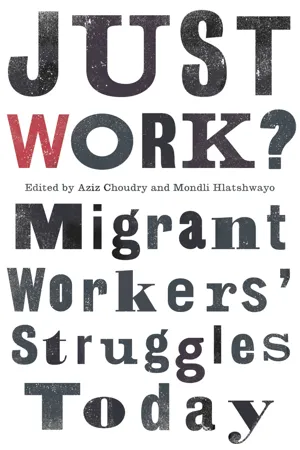
This book offers a vast range of grassroots perspectives on global migrant labour organisation in the twenty-first century. From workers' organisations in South African migrant worker resistance in the Gulf, from forest workers in the Czech Republic to domestic workers' structures in Hong Kong, this book brings together a wealth of lived experiences and hidden struggles for the first time. Highlighting the changing nature of frontline struggles against exploitation, Just Work? shows that migrant workers are finding new and innovative ways of resisting neoliberal immigration measures as they are forced to fight against the precarious nature of jobs from both within and outside of traditional forms of labour organisations. With contributions from scholars and activists from around the world engaged in this resistance, this will be an accessible collection based on grassroots experiences, placed in a political economy framework. The full list of regions explored are: South Africa, Latin America, Philippines, the Gulf Arab States, North America, Czech Republic, Hong Kong, Japan, London, Nigeria, New Zealand, Canada and Switzerland.
- 288 pages
- English
- ePUB (mobile friendly)
- Available on iOS & Android
eBook - ePub
About this book
Information
1
Just Work? Migrant Workers, Capitalist Globalisation and Resistance
The living and working conditions of migrant workers and the political economy of migration have been examined in many studies. While this body of work helps us to understand the challenges and conditions that migrant workers face, including the dynamics of class, gender, race and immigration status, and the roles that various sections of the global migrant workforce play in labour processes, this international collection of essays illuminates a less-discussed topic: migrant workers’ struggles and labour organising experiences. This book centres migrant workers’ agency, forms of worker organisation, the politics of solidarity with migrant workers, campaigns to improve their working conditions and the role of trade unions, without neglecting and downplaying constraints and challenges facing migrant workers today. Together, the chapters of this book reflect critically on the possibilities and limitations of organising migrant workers across a number of sectors in five continents in an era of capitalist crisis, the neo-liberalisation of immigration regimes (Akers Chacón and Davis, 2006; Arat-Koc, 1999) and ‘austerity’. In Just Work?, academics and labour organisers collaborate to deepen our understanding of these phenomena, and critically examine recent labour organising efforts and the prospects for improving the economic and social conditions of migrant and immigrant workers in a number of contexts. This global volume contributes to the critical literatures on migration, precarious employment, transformation of paid work and the political actions of migrant workers. It is grounded in critical interdisciplinary scholarship, and activist and organising experiences, exploring contexts which are less well traversed by previous work on migrant and immigrant workers. It also purposefully combines the genres of academic scholarship with chapters written by labour organisers and migrant justice activists – although sometimes these approaches overlap. We believe that it is important and necessary to bring reflexive scholar-activist perspectives on labour migration more squarely into view. Migrant and immigrant workers around the world continue to organise in the face of exploitation and oppression, and often find themselves on the frontlines of struggles against precarity, austerity and other forms of capitalist exploitation which impact all working people. Indeed, their struggles continue to highlight ways in which capital exploits workers through immigration status and the social relations of race, gender and class across the world. Moreover, the struggles, organising and resistance of migrant workers are an indication of an era where migrant and immigrant workers are a vital part of a social and political force in a global power struggle.
Yet in many of the dominant popular representations of migration today, the histories, systems and structures which underpin the terms and conditions of who moves between nation states and how and why they move are often as nameless as most of the migrants themselves. The global free market economy has not led to the building of a ‘global village’ or a borderless world, despite what many of its advocates have promised. While many barriers to the mobility of capital have been dismantled through policies of liberalisation and deregulation, the majority of the world’s people do not experience such freedom to move across borders. Simplistic, populist explanations which dehumanise migrants, criminalise their movements and obscure the reasons why people migrate continue to abound. Indeed, this chapter was written at a time of renewed xenophobic violence in South Africa which left several dead, while forcing thousands from their homes. Meanwhile an estimated 800 people from Africa and the Middle East had just drowned in the sinking of a single overloaded boat – one of many vessels carrying people trying to cross the Mediterranean to Europe, desperate for a future. It is also one of many deadly migration routes which is claiming lives every day. In an April 2015 public address, former Canadian Prime Minister Kim Campbell told a University of Alberta audience that gender equality, which she claimed to be a ‘Canadian value’ was under threat in a ‘society of immigration’ (National Post, 2015). The start of the 2016 US presidential campaign gave a prominent platform for sometimes virulently racist anti-immigrant posturing by several nominees. On the other side of the Atlantic, the 2015 British election campaign saw most major political parties, once again, trying to talk ‘tougher’ than each other about curbing and controlling immigration.
From the murders and displacements in South Africa to the drownings in the Mediterranean, migrant deaths are not random ‘incidents’, but rather they are manifestations of the intentional violence of border policies and anti-migrant racism. Far from bringing people together, flattening the world, or ironing out inequities, capitalist globalisation is deepening gaps between rich and poor within and across nation states through preying on ethnic, racial and religious divisions within the working class. Growing xenophobia is also leading to immigrant-blaming, culture talk, and the securitisation and militarisation of borders fuelled by heightened state-sanctioned politics of fear and loathing against ‘migrants’ and ‘foreigners’. Yet it is important to reiterate that the policing of borders and tighter restrictions on immigration have never been meant to completely stop migration. Rather, various forms of migration and labour management policies seek to control and discipline pools of labour for capitalist exploitation. Many Marxist scholars contend that the so-called developed economies tend to be largely supported by the labour of migrant workers. For example, Cornelius and Rosenblum (2005: 101) suggest that ‘[f]rom a Marxist perspective, owners of capital also benefit from maintaining a category of job characterized by a flexible labor supply, allowing lay-offs to minimize losses to capital during economic downturns’. In other words, capital benefits from the use of relatively cheap migrant labour because it is able to further lower the value of its labour power which increases capital’s surplus value.
The imperialist exploitation and undermining of many societies in the Global South under earlier eras of colonialism, and historical institutional arrangements concerning labour, are key to understanding labour and migration in today’s era of global capitalism (Kundnani, 2007; Rodriguez, 2010a). Colonialism and capitalist economic development have created the structural conditions of dispossession, poverty and inequality which drive many people to migrate in search of work. While internal migration within countries is a major phenomenon across most of the world, and the challenges faced by internal migrants must not be ignored, this book focuses on international migration. Capitalist restructuring is the major driving force behind patterns of migration, as well as a key influence on immigration and labour policy. When businesses need a specific form of labour, they demand access to it through laws and arrangements organised by the capitalist state.
Worldwide, migrant workers and racialised immigrant workers have long provided pools of ‘cheap’ labour to be exploited. Migration sociologist, Anthony Richmond (1994: 204), describes the rise of ‘a system of global apartheid based on discrimination against migrants and refugees from poorer developing countries’. A global, often Western-educated elite exists that is relatively mobile, but the overwhelming majority is temporary, non-status, exploitable and often underground.
Today, in many countries, border controls increasingly manage flows of largely temporary migrant workers – a rotating-door labour market geared to just-in-time production and service provision. Through a range of systems of closed work permits and sponsorship by employers, migrant workers are frequently tied to one job with a single boss, which makes complaints about abuse or substandard or dangerous working conditions risky and difficult, if not impossible, with their legal status dependent on remaining at the same workplace. Arun Kundnani (2007: 145), reflecting on British immigration history, writes that instead of the idea of the post-Second World War reserve army of manual workers:
The new post-industrial migrant workforce was characterized by several distinct streams – reserve regiments of labour – each adapted to the specific needs of different sectors of the economy. The intricacies of the system would be kept subject to constant review and adjustment, so that the numbers, character and entitlements of workers entering the economy under different schemes could be changed as necessary. Each of these various routes provided employers with a different package of exploitation.
As this book illustrates, the creation and maintenance of categories of workers with different sets of rights tied to their immigration status is a standard policy feature and capitalist strategy which is fundamental to the functioning of many economies, facilitating the provision of reduced labour costs to employers. Pools of undocumented labour are particularly subject to exploitation by capital in order to reduce labour costs and generate greater surplus value. The book also challenges the construction of undocumented migrants and others without immigration status as ‘illegal’. These categories of migrants are the most exploited and victimised – by employers and by state authorities in the form of arrests, violence and deportations. In many cases, these workers do precarious and hazardous work and their rights are violated by employers who take advantage of their status. Based on the principles of human solidarity, is it ethical and just to regard other human beings as ‘illegal’ or ‘alien’? Van Driel (2008) argues that the illegal trafficking in people is a feature of globalisation. Corruption, bribery and longer waiting periods for those who have applied for documentation show that ‘illegality’ is also promoted by states (Van Driel, 2008). For example, in the South African context, Lehulere (2008: 38) argues that the criminalisation of migrant workers runs deep and is also part of the Congress of South African Trade Unions’ (COSATU) discourse. COSATU criticised employers for ‘employing foreign immigrants, especially the illegal ones’, and called on ‘employers to stop taking advantage of the desperate situation of foreign nationals’.
In a context of xenophobic attacks and state crackdowns on migrants in South Africa, Europe, North America and other parts of the world, some social movements, activist groups and progressive NGOs have responded to the language of ‘illegal migrants’ by asserting that ‘no one is illegal’. ‘By holding on to a perspective that “no one is illegal”, the social movements provide a way out of the crisis that is truly internationalist, and that is morally defensible in the eyes of the world’ (Lehulere, 2008: 36).
A GLOBAL PHENOMENON
Labour migration is not only a South–North phenomenon. Much labour migration – and a substantial amount of remittance flow – occurs across and among Southern countries. For example, the global literature has tended to ignore migration and the phenomenon of international migrant work in Africa – Southern Africa in particular is emerging as an epicentre of African migration (Segatti, 2011). According to Segatti, the percentage of international migrants in Southern Africa is almost double that in any of the other subregions of Africa. Johannesburg for instance, because of its economic activities, attracts international and domestic migrant workers in particular (Hlatshwayo, 2012; see Chapter 2). In this context of migration in Southern Africa, women migrant workers from Zimbabwe tend to work in precarious conditions in places like Johannesburg. For example, these women are involved in sex work, domestic work and hospitality work (Hlatshwayo, 2010; see Chapter 2).
Turning to Asia and the Pacific, according to the International Organization for Migration (IOM) (2013), 8.6 million Bangladeshis were working as migrants in other countries by 2013. An estimated 10 per cent of the population of the Philippines works abroad. Moreover, according to the IOM, temporary work schemes in both Australia and Aotearoa/New Zealand increase the number of temporary migrant workers, particularly in the latter, which remains the leading destination for migrants from the Pacific Islands, and where in recent years there have been new initiatives from within and outside of the union movement to organise migrant workers and protect their rights.
Within Europe, since the latest global economic crisis, migration from countries such as Greece and Spain to other European countries is accelerating (Dumont, 2013). According to Dumont, migration within the European Union rose by 15 per cent, following a decline of almost 40 per cent during the crisis: ‘The trend of people leaving countries hardest hit by the crisis is accelerating, up by 45% from 2009 to 2011’ (2013: 1). Across the Atlantic, Stoney et al. (2013) note that the South American immigrant population in the US has grown 30 times since 1960. Migration from Mexico into the US has increased since the North American Free Trade Agreement (NAFTA) negatively impacted Mexican peasant subsistence farmers (Delgado Wise, 2004; Uchitelle, 2007). As Delgado Wise (2004: 592) states in relation to NAFTA:
behind the integration process and current migratory dynamic that exists between Mexico and the United States there lies a greater subordination of Mexico to the strategic, economic and geopolitical interests of its northern neighbour, wherein Mexican workers – including those who work inside the country as well as those who emigrate and are employed beyond its borders – are compelled to play a tactical role in the United States’ process of industrial restructuring.
By 2008, the number of workers entering Canada under temporary foreign worker programmes outnumbered those arriving through the traditional immigration system to become permanent residents for the first time. These programmes are predicated on maintaining qualitatively different sets of rights and status for citizens, permanent residents and temporary workers respectively. Built around labour flexibilisation and labour flexibility, critics, including trade union and immigration justice groups (for example, Choudry et al., 2009; Choudry and Thomas, 2012) have charged that these programmes have few real safeguards, and lead to much actual and potential abuse of workers. During 2013 and 2014, there was sustained media attention and criticism of the Temporary Foreign Workers Programme (TFWP), followed by official announcements of reforms and promises of further changes to the scheme. Yet while some of this debate reflected concerns about the actual and potential exploitation of foreign workers, most demands hinged on the preservation of Canadian jobs. Very few acknowledged the broader historical and contemporary feature of Canada’s capitalist economy – its systemic reliance upon exploitation through race, immigration status and shifting forms of ‘unfree labour’ (for exceptions, see Ramsaroop and Smith, 2014). Public pressure led the federal government (with its eye on the 2015 federal election), to ban the restaurant industry from using the TFWP (for example, Harper, 2014). Opposition parties and labour unions called for the moratorium to be extended to the entire programme. But the moratorium placed on the use of migrant workers in this sector constitutes a knee-jerk reaction, which fails to address the deeply racialised foundations of Canada’s temporary labour migration regime, and the role of capitalist restructuring and broader transformations of work in contributing to the pronounced use of temporary foreign workers across many sectors. Indeed, in mid-2015, thousands of low-skilled temporary foreign workers would be forced to leave Canada, and stay outside for four years before being able to apply for another work permit due to the reforms of the TFWP.
In large part, migrant labour is produced through factors that include structural adjustment imposed in the Global South by the World Bank/International Monetary Fund and other financial institutions, and often supported through bilateral official aid, ‘development’ projects and restructuring of economies along neoliberal lines through trade and investment liberalisation and aid arrangements. Akers Chacón and Davis (2006: 90) defines ‘neoliberal immigration’ as ‘displacement accompanied by disenfranchisement and often internal segregation in host countries’. Free market capitalist policies force people from their farms, jobs, families and communities and into exploitation and precarity...
Table of contents
- Cover
- Title Page
- Copyright
- Contents
- Acknowledgements
- List of Abbreviations
- 1 Just Work? Migrant Workers, Capitalist Globalisation and Resistance
- Part I: Africa and the Middle East
- Part II: Europe
- Part III: Asia and the Pacific
- Part IV: North America
- Contributor Biographies
- Index
Trusted by 375,005 students
Access to over 1.5 million titles for a fair monthly price.
Study more efficiently using our study tools.
Frequently asked questions
Yes, you can cancel anytime from the Subscription tab in your account settings on the Perlego website. Your subscription will stay active until the end of your current billing period. Learn how to cancel your subscription
No, books cannot be downloaded as external files, such as PDFs, for use outside of Perlego. However, you can download books within the Perlego app for offline reading on mobile or tablet. Learn how to download books offline
Perlego offers two plans: Essential and Complete
- Essential is ideal for learners and professionals who enjoy exploring a wide range of subjects. Access the Essential Library with 800,000+ trusted titles and best-sellers across business, personal growth, and the humanities. Includes unlimited reading time and Standard Read Aloud voice.
- Complete: Perfect for advanced learners and researchers needing full, unrestricted access. Unlock 1.5M+ books across hundreds of subjects, including academic and specialized titles. The Complete Plan also includes advanced features like Premium Read Aloud and Research Assistant.
We are an online textbook subscription service, where you can get access to an entire online library for less than the price of a single book per month. With over 1.5 million books across 990+ topics, we’ve got you covered! Learn about our mission
Look out for the read-aloud symbol on your next book to see if you can listen to it. The read-aloud tool reads text aloud for you, highlighting the text as it is being read. You can pause it, speed it up and slow it down. Learn more about Read Aloud
Yes! You can use the Perlego app on both iOS and Android devices to read anytime, anywhere — even offline. Perfect for commutes or when you’re on the go.
Please note we cannot support devices running on iOS 13 and Android 7 or earlier. Learn more about using the app
Please note we cannot support devices running on iOS 13 and Android 7 or earlier. Learn more about using the app
Yes, you can access Just Work? by Aziz Choudry, Mondli Hlatshwayo in PDF and/or ePUB format, as well as other popular books in Economics & Labour Economics. We have over 1.5 million books available in our catalogue for you to explore.