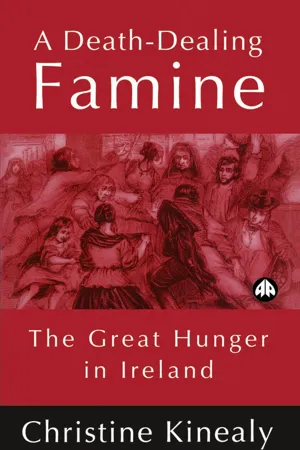
Famine expert Christine Kinealy examines the influences that shaped the responses to the Famine of 1845-52. The key factors she analyses include political ideologies; providentialist ideas that read the potato blight as a judgement from God; opportunistic interpretations; the role of civil servants, Irish landlords and merchants.
- 200 pages
- English
- ePUB (mobile friendly)
- Available on iOS & Android
eBook - ePub
About this book
Information
CHAPTER 1
The Great Hunger in Ireland. Ideologies and Interpretations
The Irish Famine of 1845–52 was a defining event in the history of modern Ireland. Yet until recently it has been the subject of relatively little scholarly research, despite a rich resource of contemporary evidence. Documentary evidence relating to the Famine years is abundant and this has led some historians to identify a historiographical silence from the 1930s to the 1970s.1 It is only in recent years that researchers have started to access these sources and, as a consequence, more has been written to commemorate the 150th anniversary of the Great Famine than was written in the whole period since 1850. Despite this, the folk memory of the Famine and popular interest have remained strong.
The relative absence of academic research arose partly from ideological struggles concerning the nature and purpose of Irish historical research during the period from 1845 to the present. Even the designation of the Famine has been an area of debate. In popular understanding ‘The Great Famine’ has become the most common sobriquet for the years of devastation and destruction in Ireland. Yet, ‘The Great Hunger’, ‘The Great Starvation’, ‘The Bad Times’, ‘God’s Visitation’, ‘The Great Calamity’, ‘The Irish Holocaust’ and the Irish phrases ‘An Gorta Mór’, ‘An Droch-Shaoghal’ and ‘Bliain an Ghorta’ are all ways of describing the same event, and indicate differences of interpretation and emphasis. Canon O’Rourke, in his early account of the Famine published in 1874, noted that during the course of the Famine, relief committees and government officials avoided using the term ‘famine’, substituting instead ‘distress’, ‘destitution’, ‘dearth of provisions, ‘severe destitution’, ‘calamity’, ‘extreme misery’, and so on.2 The Irish phrase ‘An Gorta Mór’, meaning ‘The Great Hunger’, is regarded by some as being an accurate description of years of hunger, which were not simply caused by food shortages. For the same reason, the use of the term ‘famine’ is disliked by a number of nationalist commentators on the grounds that between 1845 and 1852, large volumes of food were exported from Ireland as thousands died of starvation. For others, the word ‘holocaust ‘ is too emotive and ascribes too much culpability to the British government. The word is also closely associated with the extermination of the Jews by the Nazis in the twentieth century, although it was used by a number of nineteenth-century commentators when describing the Famine – Michael Davitt, for example, refers to it as ‘the holocaust of humanity’.3
The historiographical silence and the language of denial employed both during and after the Famine are remarkable in view of the scale of losses suffered by the Irish people during the Famine years. Between 1846 and 1851, at least one million people died out of a base population of over eight million people. To this can be added the high mortality amongst emigrants, which may have accounted for a further 100,000 deaths. Furthermore, many of the survivors of the Famine years experienced shortened lifespans as a consequence of successive years of privation. Overall, the high population losses make the Irish Famine one of the most lethal in modern world history.4 Even 150 years later, Ireland has not recovered demographically from the consequences of the Famine, and within Europe, Ireland is the only country to have a smaller population than it had in 1840. Psychologically, it is only beginning to be recognised that the scars left by this tragedy have been deep. It is only now, as Ireland emerges with a distinctive and positive identity within Europe, that Irish people throughout the world have been able to come to terms with the impact of these years and define what it means for their culture and history.5
In view of the enormity of the Famine and the significance of its legacy, the dearth of research until recently is even more surprising. Moreover, since the 1930s, and more overtly since the 1960s, scholarly research has been dominated by what is collectively referred to as a ‘revisionist’ interpretation of Irish history. At its heart this reinterpretation of Irish history aimed at being totally research-driven, objective and value-free. In regard to the Famine though, revisionism explicitly set itself in contrast to a ‘nationalist’ interpretation, which it viewed as politically inspired or judgemental, the antithesis of what the revisionists were trying to achieve.6 In its more extreme form revisionism has gone down an overtly antinationalist path in its own values. These claims in regard to revisionist interpretations of the Famine have in turn been challenged.7 Fundamentally, the concept of a value-free history, whilst noble in its intentions, is flawed in its execution. In striving for objectivity, that very purpose itself violates the concept, as the quest reflects the writer’s own value-system and is set in the context within which the historian is writing. Hence, ‘revisionism’ in its attempts to demythologise Irish history in the middle years of the nineteenth century, and its conscious debunking of ‘nationalist myths’, imbued Irish Famine revisionists with a particular set of alternative values, which coloured their judgement on the sources and material. As Dr Maley observed in relation to the revisionist debate, ‘The “objective” historian sees identity as something that everyone else has too much of.’8
From the 1930s to the 1980s, when the revisionist approach was in the ascendant, only two major books were produced on the Famine. Yet whilst little original research was carried out during this period, a number of influential orthodoxies emerged. These shaped scholarly research on the nineteenth century, in which the Famine was given no special significance. At the core of the revisionist view of the Famine lay three main assertions: first, that the Famine was not a watershed in modern Irish history but merely an accelerator of existing trends; second, that in view of Ireland’s large population and underdeveloped agricultural sector, a subsistence crisis was inevitable; and third, that, judged by the standards of the 1840s, the British government did all that reasonably could have been expected of it. Within this interpretation, suffering, mortality and blame were minimised, and the legacy of colonialism and the role of cultural stereotyping and racist attitudes were marginalised.9
The Irish Famine did not occur in a vacuum and it is better understood within the continuum of Anglo–Irish relations. Yet within revisionist interpretations, the political relationship between England and Ireland has been downplayed. In its more extreme form, this has resulted in an ‘exculpation of imperialism’ which has attempted to prove that there was ‘no real design or evil intent’ behind England’s ‘conquest, dispossession and cultural extirpation’ of the native Irish.10 The Act of Union of 1800 altered the political relationship between England and Ireland. At its core, however, the Union was essentially a device for controlling and regulating Ireland. Whilst the Union may have created a unified political machine based in London, the underlying colonial relationship between the two countries was still evident. The Famine provides compelling evidence of this inequality, for after 1847, the British government decided to throw the financial burden for Famine relief exclusively on Irish, not British, taxpayers.
Dr Brendan Bradshaw, in a controversial and debate-provoking article published in 1989, identified a gulf that had emerged between the revisionist interpretation of the Famine and the traditional nationalist understanding of this event.11 Bradshaw may have overstated the polarities of this divide, and, since this article was published, much of the writing by historians has been clearly within the post-revisionist camp. Recent research is challenging not only the dominant revisionist viewpoint, but also a number of accepted canons of the nationalist interpretation. However, a number of key issues are still apparent within the revisionist/post-revisionist divide, although the most bitter disputes appear to be between non-historians.12
More recently, Bradshaw has refined his position. He continues to believe that as a consequence of their commitment to so-called value-free history, revisionists ‘have not succeeded in recovering the actuality of the Irish historical experience’ and thus ‘have not been able to convince the Irish public at large about the authenticity of their depiction of the Irish past’. Bradshaw argues for a new way forward, based on rigorous research and a determination to revise myths or ‘bad’ history, but in which the historian is at the same time ‘both committed and objective … sympathetic and critical’.13
The origins of the revisionist/nationalist interpretations date from the Famine period itself, although the nationalist construction was given a sharper political focus in the latter decades of the nineteenth century. An early interpretation of the Famine, which many revisionists were later to restate, was provided by a key player in the British government’s relief operations, Sir Charles Trevelyan, Permanent Secretary at the Treasury and commander-in-chief of Famine relief. At the end of 1847, Trevelyan declared the Famine to be over, despite the fact that 1.5 million people were still dependent on a minimal and punitive form of state assistance. As thousands of people continued to die in Ireland and evictions and emigration increased, a myth was simultaneously being created concerning the causes, impact and duration of the Famine.
In 1848, Trevelyan published his own account of Famine relief. This was the only written account of the Famine produced by a senior relief official. He employed a moral and providential framework in which to place the Famine, which he described as ‘the judgement of God on an indolent and unself-reliant people’, a people, moreover, who liked to ‘make a poor mouth’. He further asserted that no government had ever done more to alleviate the suffering of its people.
In an effort to suggest empathy with the suffering Irish, Trevelyan, whose family came from Cornwall, described himself as a ‘reformed Celt’, which he contrasted with the ‘unreformed’ Celts in Ireland.14 But Trevelyan’s interpretation was scorned by many relief officials, including Clarendon, the Lord Lieutenant in Ireland.15 A pointed criticism was made by George Poulett Scrope MP, who had opposed many of the government’s policies in Ireland. He said of Trevelyan’s book:
A stranger to the real events of the last two hundred years might read through the whole hundred pages without ever finding out that during the ‘Irish Crisis’ several hundred thousand souls perished in Ireland of want, through the inefficiency of those ‘colossal’ relief measures.16
Trevelyan’s interpretation, nevertheless, has been influential. A number of English and Irish historians have echoed some of his assertions regarding the causes of the Famine. For example, the English social historian G. M. Trevelyan stated that:
In Eighteenth Century Ireland the population rose even faster, from about one and a half millions to four millions. But social and racial characteristics were not favourable to economic change, and instead of industrial or agricultural revolution, there was chronic starvation and frequent famine among the potato-fed population, culminating in the disaster of 1847.17
A number of contemporary historians have viewed the Irish Famine as the realisation of a Malthusian prophecy or, in the words of the economic historian Peter Mathias, ‘the fate predicted for it by Malthus’.18 The eminent Irish historian Roy Foster described the Famine as a ‘Malthusian apocalypse’.19 Malthus himself showed little interest in the affairs of Ireland (until commissioned by the Edinburgh Review to do so) and was far more interested in the demography of Sweden and Norway.20 As the Famine raged in Ireland, leading political economists and their disciples carried out ideological battles in the lecture theatres, journals and even pulpits and schoolrooms (political economy was part of the national school curriculum in nineteenth-century Ireland) of the United Kingdom.21 Archbishop Whately, W.E. Hearn and William Neilson Hancock, amongst others, argued that the economic development of Ireland required a reduction in population and an increase in capital investment. Despite mass mortality, they also doggedly argued for less government intervention and more free trade. Overall, ‘the Famine crisis made it all the more important that the principles of political economy should be applied to Ireland. Any relaxation, however nobly motivated was a “killing kindness” … for protectionism.’22 The relationship between population, poverty and potatoes superficially was an attractive one, but was greatly overstated. However, one consequence of the high dependence on the potato of a large section of the Irish people was that on the eve of the Famine, Ireland had one of the tallest, healthiest and most fertile populations in Europe. At the same time, and in contrast to popular perception, alongside the potato economy a large commercial corn sector existed, which on the eve of the Famine was exporting sufficient corn to England to feed 2 million people, thereby earning Ireland the title of ‘the granary of Britain’, whilst it was being simultaneously depicted as a peasant economy.
The scale of the tragedy of the Famine makes it difficult to depict or understand on either a national or an individual level. Writers who have attempted to convey this horror have been criticised for not being sufficiently clinical and detached in their approach. Hence, Cecil Woodham-Smith’s popular interpretation The Great Hunger. Ireland 1845–49 (first published in 1962) was dismissed by one of the doyens of Irish history, F.S.L. Lyons, as being too ‘emotive’.23 Woodham-Smith’s work was further marginalised and ridiculed by the academic community in Ireland: in 1963 a university undergraduate examination paper asked students to discuss the proposition: ‘The Great Hunger is a great novel’.24 A number of years later, in a provocative, if ironic, essay entitled We are all Revisionists Now, Roy Foster categorised Woodham-Smith as a ‘zealous convert’.25 These comments set the tone for the teaching of the Famine to a generation of undergraduates. However, they did not deter the general public from reading Woodham-Smith’s publication, which ensured that The Great Hunger became one of the best-selling history books of all time. And today scholars are more willing to acknowledge the contribution of Woodham-Smith to the historiography of the Famine.
In contrast, the various revisionist interpretations have, in general, avoided the central issues of responsibility, culpability and blame. Within this context, the involvement of the British government is pivotal, although the roles played by landlords, merchants, local shopkeepers, public opinion, the press, the Catholic Church, the Irish nationalists and Irish taxpayers are also important. As more research is carried out on these groups, a more textured and nuanced view of the Famine will emerge, although a number of core questions (and possibly answers) will remain.
The issue of responsibility is perhaps the most clear-cut. One consequence of the Act of Union of 1800, was that Ireland lost its own parliament in Dublin and thereafter sent 100 MPs to the Parliament in Westminster. The Irish MPs, even following Catholic Emancipation in 1829, were predominantly Protestant and landlords who did not pursue an obvious ‘Irish’ interest, but followed the traditional Whig/Tory division of British politics. Daniel O’Connell and his supporters were an exception, although traditionally they allied themselves with the Whig Party. However, when the potato blight first appeared in Ireland, O’Connell was already old and weak. He died in 1847 en route to Rome, having left Ireland at the height of the distress. An uprising by a group of radical nationalist known as Young Ireland early in 1848 (which can be viewed as a part of the European-wide ‘year of revolutions’), found little support within Ireland. However, their rebellion served to harden attitudes within the British Parliament and press towards the protracted Famine in Ireland. Although insignificant at the time, Young Ireland’s uprising left a legacy of nationalist writings, including John Mitchel’s oft-quoted accusation that ‘the Almighty, indeed, sent the potato blight but the English created the Famine’.26
Throughout the course of the Famine, all legislation and policy formulations emanated from Westminister. Advice from the relief commissioners in Dublin, and the increasingly sympathetic interventions of Lord Clarendon, the Lord Lieutenant of Ireland after 1847, were ignored. The British government in the 1840s was by modern standards an undemocratic and unaccountable institution. Although the Reform Act of 1832 had extended the franchise, it was only to the propertied upper middle classes, whose main concerns in the 1840s were ending trade protection, cutting taxes (especially the hated income tax, from which Ireland was exempt) and achieving a return to cheap government. Their opinions found both an outlet and a coherence in the columns of the influential The Times, which argued that money spent on Irish relief was money wasted. The rest of the population – the majority – remained outside these debates. For the most part, they were disenfranchised and, given the high rate of illiteracy, probably uninformed about the situation in Ireland. The draconian ‘new’ Poor Law of 1834 had demonstrated the anti-poor attitude of the ruling classes. The pitilessness of life in England was apparent from the contemporary writings of Charles Dickens, Frederich Eng...
Table of contents
- Cover
- Title Page
- Copyright
- Contents
- Dedication
- Acknowledgements
- 1 The Great Hunger in Ireland. Ideologies and Interpretations
- 2 ‘A State of Degradation’. Pre-Famine Ireland
- 3 Rotten Potatoes and the Politics of Relief
- 4 Putrefying Vegetation and ‘Queen’s Pay’
- 5 ‘Black ’47’
- 6 ‘The Expatriation of a People’
- 7 ‘A Policy of Extermination’
- Epilogue ‘The Famine Killed Everything’
- Note on Further Reading
- Notes
- Index
Trusted by 375,005 students
Access to over 1.5 million titles for a fair monthly price.
Study more efficiently using our study tools.
Frequently asked questions
Yes, you can cancel anytime from the Subscription tab in your account settings on the Perlego website. Your subscription will stay active until the end of your current billing period. Learn how to cancel your subscription
No, books cannot be downloaded as external files, such as PDFs, for use outside of Perlego. However, you can download books within the Perlego app for offline reading on mobile or tablet. Learn how to download books offline
Perlego offers two plans: Essential and Complete
- Essential is ideal for learners and professionals who enjoy exploring a wide range of subjects. Access the Essential Library with 800,000+ trusted titles and best-sellers across business, personal growth, and the humanities. Includes unlimited reading time and Standard Read Aloud voice.
- Complete: Perfect for advanced learners and researchers needing full, unrestricted access. Unlock 1.5M+ books across hundreds of subjects, including academic and specialized titles. The Complete Plan also includes advanced features like Premium Read Aloud and Research Assistant.
We are an online textbook subscription service, where you can get access to an entire online library for less than the price of a single book per month. With over 1.5 million books across 990+ topics, we’ve got you covered! Learn about our mission
Look out for the read-aloud symbol on your next book to see if you can listen to it. The read-aloud tool reads text aloud for you, highlighting the text as it is being read. You can pause it, speed it up and slow it down. Learn more about Read Aloud
Yes! You can use the Perlego app on both iOS and Android devices to read anytime, anywhere — even offline. Perfect for commutes or when you’re on the go.
Please note we cannot support devices running on iOS 13 and Android 7 or earlier. Learn more about using the app
Please note we cannot support devices running on iOS 13 and Android 7 or earlier. Learn more about using the app
Yes, you can access A Death-Dealing Famine by Christine Kinealy in PDF and/or ePUB format, as well as other popular books in Politics & International Relations & International Relations. We have over 1.5 million books available in our catalogue for you to explore.