Over the past four decades the world has seen a 'green awakening'. Green parties have been elected to parliaments and councils all over the world. A common set of environmental priorities have been promoted by green internationalisation and these parties are playing an increasing role at all levels of political decision-making. Will this awakening continue or will the greens be corrupted by power? What impact has their politics had? Will green thinking be able to compete with other ideologies in coping with the problems of the 21st century? Green Parties, Green Future analyses over a hundred of these parties' experience from all over the world. It reveals the story of the expansion and development of the movement, from local environmental groups to national and global decision-makers.
- 256 pages
- English
- ePUB (mobile friendly)
- Available on iOS & Android
eBook - ePub
About this book
Information
1
THE GREEN AWAKENING
The 1960s was a turbulent decade. After a period of relative calm following the end of the Second World War everything began to change. Colonies fought for and achieved independence. The USA’s aggressive attempts to contain communism with the mass bombing of Vietnam, isolation of Cuba, military interventions against progressive regimes and support for the fascist junta in Chile, mobilised enormous protests all over the world; the apartheid regimes of Southern Africa also triggered worldwide dismay and protest. At the same time socialism didn’t have a much better reputation following the Soviet interventions in Hungary in 1956, Czechoslovakia in 1968, and Afghanistan in 1979. A ‘new’ left arose, still anti-imperialist, but without blinkers in relation to communist one-party dictatorships. Women’s liberation advanced. Oppressed people everywhere rose to demand equal rights. Even in the assumed-to-be well-organised Western European welfare societies, discontent emerged and developed into political movements. The new generation demanded personal liberation from old traditions and superstitions. In Europe a ‘sexual liberation’ changed lifestyles and partly transformed into the student revolts of 1968. In some places, especially in France, links were made between student demands for more individual freedom and workers’ and trade unionists’ demands for improved working conditions, including ‘industrial democracy’. A few years into the 1970s, however, some basic flaws of the 1968 movement could be observed: it was deeply split and had failed to organise into a powerful political organisation with leverage in the decision-making political system; despite its feminist rhetoric, it also remained predominantly male in its structures. Above all, it was driven by a materialist (often Marxist) outlook and was unable to understand and fight against the causes of the destruction of the environment and the quality of life.
Already in the 1970s many of the activists of the 1968 and similar protest movements became disillusioned with political slogans and other types of primarily verbal action. One alternative option was to define the enemy – be it the state, big business, the military-industrial complex, or just all those who held power – as deadly foes whom it would not be possible to affect or defeat by normal non-violent methods. Those who chose this option took up arms in what they considered a legitimate war of liberation. ‘If it’s right in Vietnam and Palestine, why not in Frankfurt, Paris and Stockholm?’ One of the most well-known examples was the German Red Army Faction (or Baader-Meinhof Gang), but there were similar groups in other democracies: Action Direct in France, the Communist Combatant Cells in Belgium, the Red Brigades in Italy. Spain, Portugal and Greece, with their history of recent fascist dictatorship, also saw the emergence of violent groups. Even Northern Europe, with a reputation for stability, saw an eruption of terrorist violence. The Danish ‘Blekinge Street Gang’ (Blekingegadebanden) robbed banks in the 1970s and ’80s, sometimes with deadly results, giving as a motive their wish to support the Palestinian resistance against the Israeli occupation.1
It is symbolic that the most well-known figure of the 1968 revolt, Daniel Cohn-Bendit – who later turned Green and was a member of the European Parliament from 1994 to 2014 – in a book commemorating the fortieth anniversary of the ’68 revolt, already in the title urges readers to Forget 68 (the book is in French, despite the English title).2 When telling the story of the Greens, however, to forget ’68 completely would be going too far. Undoubtedly some inspiration was taken from this upheaval by the Green pioneers in the 1970s, not least from the fact that quite a few of the activists who had been involved in the revolt switched to Green groups and parties. But perhaps it could be said that the main impact of ’68 on the Green awakening came from its failure. The fledgling Greens in the 1970s had to realise that even if tough opposition to the existing political system was necessary, it was not enough; the Greens also had to propose alternatives and set the rules of the game, that is, participate in making political decisions on all levels.
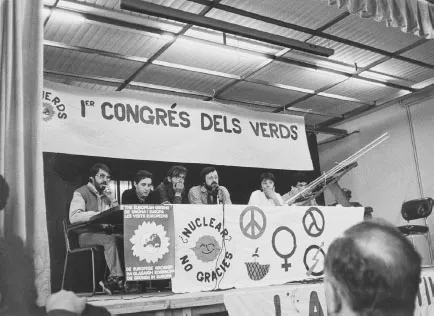
Figure 1 A Green congress in Catalonia in 1985. One poster (far right) is a reminder of Green roots among peaceniks, feminists and other alternative movements. Another (far left), with text in six European languages, illustrates the limited expansion of Green parties in 1985 compared to 30 years later. At the microphone, Paul Staes, MEP of the Flemish Greens, Agalev. Photo: the author.
EARLY WHISTLE-BLOWERS
One early whistle-blower was the Chinese thinker Meng Zi (Mencius), who lived 372–289 BC. He observed environmental destruction on a mountain, wrote about the causes of deforestation, and gave advice on the planting of new trees. Most of the early alarm-bells, however, come from the eighteenth and nineteenth centuries. Some lists of forerunners of Green thinking mention the Swedish biologist Carl von Linné (1707–1778) because he stated that animals have a soul. The French philosopher Jean-Jacques Rousseau (1712–1778) has also been interpreted as a Green pioneer for his belief that human beings are basically good: the evil of the world isn’t the result of wickedness inherent in humans, but rather of their distance from a natural condition. Others mention Johann Wolfgang Goethe (1749–1832), because of the basic conflict in his major dramatic work, Faust, around civilisation and the meaning of life. The American Henry Thoreau (1817–1862), in his book Walden, A Reflection Upon Simple Living in Natural Surroundings, appears as a model for the ‘green wave’ people, who choose to withdraw into a more or less ‘primitive’ rural lifestyle.3 Another example is the speech given in 1854 by the Native Indian Chief Seattle to a gathering of white settlers, demanding respect for the rights of indigenous people and their ecological way of living. Aldo Leopold (1887–1948) took a similar line in his posthumous bestseller A Sand Country Almanac, which has its place in Green history for its pioneering elaboration of an ecocentric and holistic ethic regarding Nature.4 The Ukrainian biochemist Vladimir Vernadsky (1863–1945) is often mentioned as a founding father by ecologists in the former Soviet Union, because of his book The Biosphere and his theory of the noosphere (human cognition) as the third stage of the Earth’s development, after the geosphere (inanimate matter) and the biosphere (life).5 Just as the emergence of life has transformed the geosphere, the noosphere will, according to Vernadsky, transform the biosphere – which, it could be argued, is exactly what is going on at the beginning of the twenty-first century, with the shift from Holocene to Anthropocene.
FUTURE SHOCK AND GLOBAL CHALLENGE
In the period of the Green awakening a number of futurologists made dramatic predictions about a future that would be fundamentally different from the contemporary industrialised world. Even if not explicitly ecological, some of these forecasts influenced the Green awakening, two of which deserve mentioning.
The first is Future Shock, by the American futurologist Alvin Toffler, who claimed that humanity was in for ‘too much change in too short a period of time’, mainly because of the technological development. Industrialisation would become ‘super-industrialisation’ leading to an ‘information overload’.6 There is no doubt that technology has transformed the structure of production and the labour market profoundly, with far-reaching effects. In January 2015 it was reported that 400,000 jobs have disappeared from the Swedish industrial sector since 1980. Relocalisation away from the old high-cost industrial countries to new low-cost countries is not the only reason for this trend. Another is the dramatic increase in robotisation which makes human labour redundant. From a Green point of view this provides a strong argument for the shortening of working hours.
The second influential study is Le defi mondiale (The Global Challenge) by the French liberal journalist Jean-Jacques Servan-Schreiber (1924–2006), founder of L’Express.7 One of his predictions was that computerisation would be more revolutionary for the poor parts of the world than for the rich, while new technology would create direct information links between poor peasants in Africa, Asia, Latin America and the rest of the world. This vision seemed far-fetched in 1980; in 2015 it is a reality. The fact that vast numbers of people now have an internet-linked, multi-information device in their pocket is not enough to ensure a fair globalisation from below, but it has changed the situation in a way that Greens must react to.
GREEN THINKING: ENVIRONMENTALISM OR ECOLOGISM?
In the foreword to the second edition of his seminal work, Green Political Thought Andrew Dobson wrote: ‘In 1989 I knew of no textbook of this sort that included a chapter on ecological political thought, but now there are several.’8 Still, he dates the birth of ‘ecologism’ to more than a decade earlier: ‘The Limits to Growth report of 1972 is hard to beat as a symbol for the birth of ecologism in its fully contemporary guise.’ That might be true, in hindsight. But Dobson is right in claiming that the real beginning of the use of ecologism as a label for the thinking of Green parties occurred around 1990. Acceptance of ‘ecologism’ as the acknowledged term for the ideology of Green parties is, however, not all-encompassing. The term is not to be found on the Encyclopaedia Britannica website, for example, where environmentalism is exhaustively defined as:
a political and ethical movement that seeks to improve and protect the quality of the natural environment through changes to environmentally harmful human activities; through the adoption of forms of political, economic, and social organisation that are thought to be necessary for, or at least conducive to, the benign treatment of the environment by humans; and through a reassessment of humanity’s relationship with nature.
Likewise, when searching for ecologism on the English Wikipedia site, one is redirected to environmentalism, which is here defined as:
a broad philosophy, ideology and social movement regarding concerns for environmental protection and improvement of the health of the environment, particularly as the measure for this health seeks to incorporate the concerns of non-human elements.
Another Green encyclopaedia in which ecologism does not appear is John Button’s A Dictionary of Green Ideas – neither among the 1,500 entries, nor in a three-page list of words starting with ‘eco-’. Instead Button seems to use environmentalism to refer to what others call ecologism.9 The broad and detailed definitions of environmentalism given by the Encyclopaedia Britannica, Button’s Green dictionary, and the English Wikipedia give the impression that these sources have chosen to use environmentalism in place of ecologism – but only in English. The equivalent of ecologism is treated under that label on Wikipedia in several other languages: German: Ökologismus; Swedish: Ekologism; Danish: Økologisme; French: Écologisme; Dutch: Ecologisme. The reason why neither the Britannica, nor Button’s dictionary, nor the English Wikipedia carry special articles on ecologism is difficult to understand, especially as most of the theoretical writing on ecologism as a political ideology has been done by authors writing in English. An example is Andrew Dobson, who underlines that it is very important to distinguish between environmentalism and ecologism, each of which he defines as follows:
Ecologism holds that a sustainable and fulfilling existence presupposes radical changes in our relationship with the non-human natural world, and in our mode of social and political life.
Environmentalism argues for a managerial approach to environmental problems, secure in the belief that they can be solved without fundamental changes in the present values or patterns of production and consumption.
It is obvious that ecologism and environmentalism are rather close to two other important concepts used to describe different trends in Green thinking: deep ecology (= ecologism) and shallow ecology (= environmentalism). To some extent a third pair of concepts could also be seen as representing a similar divide: fundi (fundamentalist = ecologist) and realo (realist = environmentalist), although theoretically this dichotomy is of another dimension, as it was originally coined among the German Greens to distinguish between different strategies rather than ideological/philosophical trends, the fundis giving priority to maintaining the Greens as a radical counter-force against the centres of power, the realos advocating a strategy for securing executive power, including participating in only partly Green coalition governments.
In Dobson’s view environmentalism is no ideology at all, while ecologism is an ideology based upon the ‘twin condition of a belief in the limits to growth and a questioning of strong anthropocentrism’. He claims that ‘many of the people and organisations whom we would want to include in the green movement are environmentalist rather than political-ecologist’. He emphasises that while ecologism emerged only in the 1960 and ’70s, environmentalism is much older. This distinction between environmentalism and ecologism seems well-founded and makes an important contribution to an understanding of the differences between Green parties (which have an ecologist agenda) and a lot of other groups, including in the business world, which advocate all kinds of ‘ecological’ production and ‘green’ consumption, wildlife conservation, and so forth, which are merely environmentalist.
While environmentalism, as implied by the word, deals with the environment, Green political programmes are comprehensive, proposing alternative positions on every type of issue that might be the subject of political decision-making. To pretend that such a political platform is ‘environmentalist’ would give the wrong impression of a narrow, ‘single-issue’ political programme. But are the Green party programmes ‘ecologist’? Some Greens would still prefer just to talk about ‘green thinking’.
GREEN THINKING AND OTHER IDEOLOGIES
From a green perspective the great classical political ideologies – conservatism, liberalism and socialism – seem to have forgotten all other parts of existence than currently living human beings. Somewhat simplified, the essence of these ideologies could be summarised as follows: conservatism strives to maintain the supremacy of the upper class; liberalism wants to open up society for free competition between individuals irrespective of social class; socialism has the ambition of eradicating class differences and creating equality for everybody. The only relations taken into account are those between living people. There is no concern for other forms of life (animals, plants).
Some writers have claimed that conservatism is close to ecologism, because of its conservationist trend. But there is an important difference, as expressed by Dobson:...
Table of contents
- Cover
- Title Page
- Copyright
- Contents
- List of Figures
- Preface
- Foreword by Caroline Lucas
- Introduction: The Greens – Towards Hegemony in the Anthropocene
- 1 The Green Awakening
- 2 Green Philosophy, Science and Social Theory
- 3 Green Parties All Over the World
- 4 Green Policies: Building Stones of a Green Ideology
- 5 Greens in Governments
- 6 Green Global Governance for the Twenty-first Century
- Appendix: Green Parties in 100 countries
- Notes
- Index
Trusted by 375,005 students
Access to over 1.5 million titles for a fair monthly price.
Study more efficiently using our study tools.
Frequently asked questions
Yes, you can cancel anytime from the Subscription tab in your account settings on the Perlego website. Your subscription will stay active until the end of your current billing period. Learn how to cancel your subscription
No, books cannot be downloaded as external files, such as PDFs, for use outside of Perlego. However, you can download books within the Perlego app for offline reading on mobile or tablet. Learn how to download books offline
Perlego offers two plans: Essential and Complete
- Essential is ideal for learners and professionals who enjoy exploring a wide range of subjects. Access the Essential Library with 800,000+ trusted titles and best-sellers across business, personal growth, and the humanities. Includes unlimited reading time and Standard Read Aloud voice.
- Complete: Perfect for advanced learners and researchers needing full, unrestricted access. Unlock 1.5M+ books across hundreds of subjects, including academic and specialized titles. The Complete Plan also includes advanced features like Premium Read Aloud and Research Assistant.
We are an online textbook subscription service, where you can get access to an entire online library for less than the price of a single book per month. With over 1.5 million books across 990+ topics, we’ve got you covered! Learn about our mission
Look out for the read-aloud symbol on your next book to see if you can listen to it. The read-aloud tool reads text aloud for you, highlighting the text as it is being read. You can pause it, speed it up and slow it down. Learn more about Read Aloud
Yes! You can use the Perlego app on both iOS and Android devices to read anytime, anywhere — even offline. Perfect for commutes or when you’re on the go.
Please note we cannot support devices running on iOS 13 and Android 7 or earlier. Learn more about using the app
Please note we cannot support devices running on iOS 13 and Android 7 or earlier. Learn more about using the app
Yes, you can access Green Parties, Green Future by Per Gahrton in PDF and/or ePUB format, as well as other popular books in Biological Sciences & Environmental Conservation & Protection. We have over 1.5 million books available in our catalogue for you to explore.