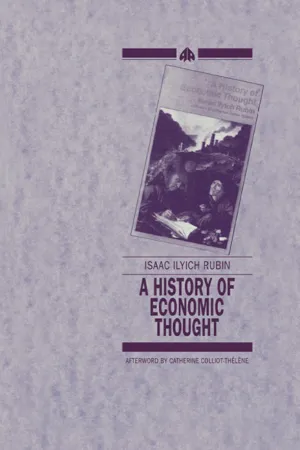
This is an important and unparalleled work which situated Marx's economic theory in relation to the economic theories that predate him - from mercantilism to John Stuart Mill. First published in 1929, the book dates from the fertile period of Marxist economic theory that produced the works of Preobrazhensky, Kondratiev and Bukharin. However as a review of pre-Marxist economics it stands out from the many books which dwell only on the contemporary industrialisation debates. This is a selective reading of economic thought, offering analysis of those elements in past economics that accord with the areas of interest to Marxism. Each section gives a brief analysis of a specific school of thought, with particular attention to the social and ideological climate within which it evolved. The book differs from orthodox accounts in not merely mentioning historical background but using it as a central explanation of the evolution of economic theories. As a counterpoint to Rubin, Catherine Colliot-Thelene has written a daring essay which locates a crucial flaw in the logical structure of Marx's Capital.
- 400 pages
- English
- ePUB (mobile friendly)
- Available on iOS & Android
eBook - ePub
History of Economic Thought
About this book
Information
Part One
Mercantilism and its Decline
CHAPTER ONE
The Age of Merchant Capital
The age of merchant capital (or early capitalism) covers the 16th and 17th centuries. This was an era of major transformations in the economic life of Western Europe, with the extensive development of seafaring trade and the emerging predominance of commercial capital.
The economy of the later middle ages (the 12th to 15th centuries) can be characterized as a town or regional economy. Each town, together with its surrounding agricultural district, comprised a single economic region, within whose confines all exchange between town and countryside took place. A substantial portion of what the peasants produced went for their own consumption. A further part was given over as quickrent to the feudal lord, and what meagre surpluses were left were taken to the neighboring town for sale on market days. Any money received went to purchase goods fashioned by urban craftsmen (textiles, metalwares, etc.). The lord received a quickrent—established by custom—from the peasant serfs who lived on his estates. Over and above this, he also received the produce from his manor’s own tillage, which was worked by these same peasants doing compulsory labour service (the barshchina, or corvée). A large part of these products were for the lord’s own consumption, or for that of his innumerable household servants and retainers. Anything left over was sold in the town, so that the receipts could be used to buy either articles made by local craftsmen or luxuries brought in by traders from far away countries, primarily from the East. What therefore distinguished rural feudal economy was its overwhelmingly natural character and the feeble development of money exchange.
If the rural economy was organized around the feudal demesne, the industry of the towns was organized into guild handicrafts where production was carried out by small master craftsmen. Each master owned the simple tools and instruments necessary for his trade, and worked personally in his own shop with the help of a small number of assistants and apprentices. His products were made either on special order from individual consumers or were held in stock for sale to local inhabitants, or peasants who had journeyed in to market. Because the local market was limited, the craftsman knew in advance the potential volume of demand for his product, while the backward, static technique of craft production allowed him to tailor the volume of production to exactly what the market would bear. The craftsmen of each profession all belonged to a single union, or guild, whose strict rules permitted them to regulate production and to take whatever measures were necessary to eliminate competition—whether between individual masters of a given guild or from persons who were not guild members. This right to a monopoly over producing and selling within a given region was accorded only to members of the guild, who were bound by the guild’s strict code of rules: no master could arbitrarily expand his output or take on more than the statutory number of assistants and apprentices; he was obliged to turn out products of an agreed quality and to sell them only at an established price. The removal of competition meant that craftsmen could market their wares at high prices and be assured of a relatively prosperous existence, in spite of the limited size of their sales.
By the late middle ages there were already signs that the regional, or town economy which we have just described was in a state of decline. However, it was not until the epoch of merchant capital (the 16th and 17th centuries) that the break up of the old regional economy and the transition to a more extensive national economy became in any way widespread. As we have seen, regional economy was based on a combination of the rural feudal demesne with the guild handicrafts in the towns; it was, therefore, only with the decomposition of both of these that the disintegration of the regional economy could occur. In both cases their decomposition was brought about by one and the same set of basic causes: the rapid development of a money economy, the expansion of the market, and the growing strength of merchant capital.
With the end of the crusades in the late middle ages trade expanded between the countries of Western Europe and the East (the Levantine trade). The European countries acquired, firstly, raw materials from the tropical countries (spices, dyestuffs, perfumes) and, secondly, finished goods from the highly-developed Eastern craft industries (silk and cotton textiles, velvet, carpets, and the like). Such luxury articles, imported into Europe from so far away, were very dear, and were purchased overwhelmingly by the feudal aristocracy. In the main it was the Italian trading cities, Venice and Genoa, which carried on this commerce with the East, dispatching their fleets across the Mediterranean Sea to Constantinople, Asia Minor, and Egypt, where they bought up Eastern commodities that had in large part been delivered from India. From Italy these commodities were transported to other European countries, some in the commercial convoys of these same Italians, others overland to the North, through the South German towns (Nuremberg, Augsburg, and others) and on to the towns of Northern Germany which had formed themselves into the Hanseatic League and controlled the Baltic and North Sea trade.
The military conquests of the Turks in the 15th century cut the Italians off from direct contact with the countries of the East. But the fledgeling interests of commercial capital demanded the continuation of so profitable a source of trade, and consequently Europe undertook an intense search for direct, oceanic routes to India—efforts which were crowned with brilliant success. In 1498, the Portuguese Vasco da Gama rounded the Southern tip of Africa and found a direct route to India. In 1492, Columbus, whose mainly Spanish expedition was also seeking a direct path to India, accidentally discovered America. From this point onwards, the old Levantine trade with the East across the Mediterranean gave way to an ocean going commerce in two directions: eastwards to India, and westwards to America. International commercial hegemony passed out of the hands of the Italians and the Hanseatic cities to those countries situated along the Atlantic Ocean: first to Spain and Portugal, afterwards to Holland, and finally to England.
The colonial trade brought enormous profits to European merchants, and enabled them to accumulate sizable money capitals. They would purchase colonial commodities for next to nothing and sell them in Europe at an enormous markup. Colonial trade was monopoly trade: each government would attempt to establish a monopoly over the trade with its own colonies, and block foreign ships and traders access to them. Thus the riches of the American colonies, for example, could only be exported to Spain, while only Spanish merchants had the right to supply these colonies with European commodities. The Portuguese did exactly the same with India, as did the Dutch, once they had ousted the Portuguese from that part of the world. The Dutch entrusted their India trade to the Dutch East India Company, a special joint stock company set up by them in 1602, which received a trading monopoly for this purpose. Similar ‘companies’ (i.e., joint stock companies) were founded by the French and English, and each received a commercial monopoly with their respective colonies. It was out of the far flung activities of these societies that the English East India Company, founded in 1600, later developed.
As a consequence of the colonial trade, huge quantities of precious metals (mainly silver at first) were shipped into Europe, thus increasing the quantity of money in circulation. In America (Mexico, Peru) the Europeans came upon rich silver mines, which could be worked with far less labour than the poor and exhausted mines of Europe. On top of this the mid-16th century saw the introduction of a significant improvement in the technology of silver extraction—the amalgamation of silver with mercury—and copious streams of cheap American silver and gold flowed into Europe. Its first point of arrival was Spain, which owned the American colonies. But it did not stay there: backward, feudal Spain was compelled to purchase industrial goods, both for its own consumption and for export. And so Spain’s negative balance of trade resulted in an outflow of its precious metals to all the countries of Europe, the largest masses being accumulated in Holland and England, the nations where the development of merchant and industrial capital was most advanced.
If trade with the colonies prompted a flow of precious metals into Europe, this flow in its turn brought with it a growth in commercial exchange and a money economy. The stocks of precious metals in Europe grew by three to three and a half times during the 16th century alone. Such an enormous rise in the mass of precious metals, whose value had fallen as a consequence of the greater ease with which they could now be extracted, produced as an inevitable consequence a universal rise in prices. Indeed, 16th century Europe experienced a ‘price revolution.’ Prices of everything rose sharply, two to three times on average, but sometimes even more. Thus in England, for example, prices of wheat, which for several centuries had held constant at five to six shillings per quarter had reached twenty-two shillings by 1574 and forty shillings by the end of the same century. While wages also went up, they lagged appreciably behind the rise in prices: whereas provisions were now twice as expensive (i.e., their prices had risen by 100%), the growth in wages was only between 30 and 40%. By the close of the 17th century real wages had fallen to approximately half of what they had stood at at the start of the 16th century. The rapid enrichment of the commercial bourgeoisie in the 16th and 17th centuries was accompanied by a drastic decline in the standard of living of the lower classes of the population, the peasantry, craftsmen, and workers. The impoverishment of the peasantry and craftsmen appeared as the inevitable result of the break up of the feudal order in the countryside and the guild crafts in the towns.
The rise of the money economy heightened the feudal lords’ demand for money and at the same time opened up the potential for an extensive market in agricultural produce. The feudal lords of the most advanced commercial nations (England and Italy) began to replace the in natura obligations of their peasants with a money quickrent.* The peasant serfs whose previous obligations had been precisely fixed by long-standing custom were gradually turned into free tenants who rented the land by agreement of the lord. Though they had acquired their freedom, its embodiment, the rent, proved more of a burden as time went on. Often the lord preferred to lease his land not to small-scale peasants, but to larger, better-off farmers who had it within their means to make improvements to their holdings. The English landowners of the end of the 15th and beginning of the 16th centuries often cleared the small-scale peasant-tenants off their land, or ‘enclosed’ the communal lands which the peasants had previously used for grazing their cattle, since the areas thus made free could be put to better use raising sheep. As English and Flemish cloth manufacturers increased their demand for wool, so prices shot up and sheep breeding became a more profitable undertaking than cultivating the soil. ‘Sheep swallow down the very men themselves,’ said Thomas More at the beginning of the 16th century. Another of his contemporaries wrote: ‘Gentlemen do not consider it a crime to drive poor people off their property. On the contrary, they insist that the land belongs to them and throw the poor out from their shelter, like curs. In England at the moment thousands of people, previously decent householders, now go begging, staggering from door to door.’[1]
If in the countryside the feudal order was in a process of decomposition, in the towns the growth of merchant capital was causing a simultaneous decline of guild handicrafts. The petty craftsman could preserve his independence only so long as he was producing for the local market with exchange taking place between the town and its immediate environs. But side by side with the growth of international trade there was also the development of trade between the different regions and towns within a given country. Certain towns specialized in the manufacture of particular items (e.g., textiles or armaments), which they produced in too large a quantity for their sale to be limited to the local surroundings; hence markets further afield had to be sought. This was particularly true of t...
Table of contents
- Cover
- Title Page
- Copyright
- Contents
- Editor’s Preface
- Author’s Preface to the Second Edition
- Part One: Mercantilism and its Decline
- Part Two: The Physiocrats
- Part Three: Adam Smith
- Part Four: David Ricardo
- Part Five: The Decline of the Classical School
- Part Six: Conclusion: A Brief Review of the Course
- Afterword By Catherine Colliot-Thélène
- Name Index
- Subject Index
Trusted by 375,005 students
Access to over 1.5 million titles for a fair monthly price.
Study more efficiently using our study tools.
Frequently asked questions
Yes, you can cancel anytime from the Subscription tab in your account settings on the Perlego website. Your subscription will stay active until the end of your current billing period. Learn how to cancel your subscription
No, books cannot be downloaded as external files, such as PDFs, for use outside of Perlego. However, you can download books within the Perlego app for offline reading on mobile or tablet. Learn how to download books offline
We are an online textbook subscription service, where you can get access to an entire online library for less than the price of a single book per month. With over 1.5 million books across 990+ topics, we’ve got you covered! Learn about our mission
Look out for the read-aloud symbol on your next book to see if you can listen to it. The read-aloud tool reads text aloud for you, highlighting the text as it is being read. You can pause it, speed it up and slow it down. Learn more about Read Aloud
Yes! You can use the Perlego app on both iOS and Android devices to read anytime, anywhere — even offline. Perfect for commutes or when you’re on the go.
Please note we cannot support devices running on iOS 13 and Android 7 or earlier. Learn more about using the app
Please note we cannot support devices running on iOS 13 and Android 7 or earlier. Learn more about using the app
Yes, you can access History of Economic Thought by Isaac Ilyich Rubin in PDF and/or ePUB format, as well as other popular books in Biological Sciences & Science General. We have over 1.5 million books available in our catalogue for you to explore.