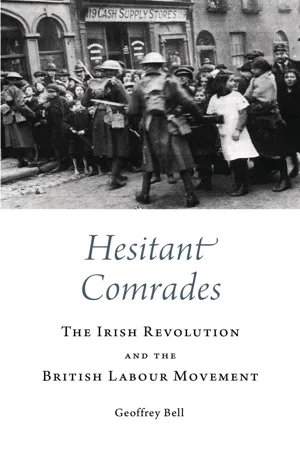
Geoffrey Bell's Hesitant Comrades is the first published history of the policies, actions and attitudes of the British working class towards the Irish national revolution of 1916-21. Drawing principally on primary sources, Bell brings to light for the first time important incidents in British/Irish history, including how the leaders of British trade unions were complicit in Belfast loyalist sectarianism; the troubled nature of the Labour Party's relations with its Irish community; and how the Bolsheviks criticised British Marxists over their inaction on Ireland. The author also considers socialist debates on the compatibility of Irish nationalism with socialism, as well as the contentious 'Ulster question'. He examines prominent figures of the era, ranging from Ramsay MacDonald to Sylvia Pankhurst. With sources ranging from newly discovered writings to reports of police spies - Hesitant Comrades is a scholarly, provocative and groundbreaking perspective on the fragile relationship between the British left and the Irish revolution.
- 288 pages
- English
- ePUB (mobile friendly)
- Available on iOS & Android
eBook - ePub
About this book
Information
1
Easter 1916
The British labour movement and James Connolly were well acquainted. Connolly, born in Edinburgh in 1868 of Irish parents, had from his youth immersed himself in socialism and trade unionism. In Scotland, Ireland and the United States he became a workers’ leader, agitator and Marxist writer. He met, worked with or argued against many of the famous British socialists of his generation, including H. M. Hyndman, Eleanor Marx and Keir Hardie. Then, in Dublin, Easter 1916, he led his Irish Citizen Army to fight side by side with combatants from another, but particularly Irish, tradition: that of Irish Republicanism or Fenianism. At first glance this seemed a peculiar alliance; a socialist whose theory insisted it was class allegiance that mattered joining with those who stressed national identity. Connolly realised there were those who would ask questions. Within days of the defeat of the alliance he had been executed, but just before his death he asked his daughter, Nora, if she had read the socialist papers. He said, ‘They will never understand why I am here’. He added, ‘They will all forget that I am an Irishman’. That was never going to be a sufficient explanation.
Guns in Dublin and Beyond
The Irish Republican Brotherhood and, as a junior partner, the Irish Citizen Army seized Dublin’s main post office on Easter Monday 1916 and declared the establishment of the Irish Republic. So began Ireland’s Easter Rising, an insurrection against British rule. The ‘rebellion’, as British politicians preferred to call it, lasted less than a week and ended in surrender. The dead included 450 Irish and 100 British soldiers. In the immediate aftermath 14 leaders of the Rising were shot by the British military authorities. One hundred and sixty others were charged and imprisoned for offences connected to the Rising, and 1,862 men and five women were deported to England and interned without trial. Many of these had no involvement in the Rising.
Before the Rising, the political leadership in Ireland was held by the Irish Parliamentary Party – or Nationalists – led by John Redmond, which advocated devolution or Home Rule but supported the maintenance of the constitutional link with Britain. After Easter 1916 the leadership passed to Sinn Féin who, following the example of the Rising, sought the establishment of an independent Irish Republic. The contest for that Republic, against the British government and minority opinion in Ireland, mainly in the northeast, dominated the politics of Ireland for the next five and a half years. It also became an issue of contention within Britain itself and attracted significant international attention. These were revolutionary times when, at their end, one existing political system and state formation was replaced by another. That was signposted with the signing of the Articles of Agreement for a Treaty Between Great Britain and Ireland (or Anglo–Irish Treaty) in December 1921.
The verdict of the vast majority of historians of these years, Irish and British, is that the British overreacted to the Rising, creating martyrs and giving the impression that they were no longer interested in ‘Justice for Ireland’, to recall the mission of William Gladstone who a generation before had tried to enact Irish Home Rule. In the aftermath of the Rising different emotions held sway. When the British government’s Chief Secretary for Ireland and Liberal Member of Parliament, Augustine Birrell, did the decent thing and stood down because the Rising was on his watch, he referred to it in his resignation speech to the House of Commons as, ‘this great evil’.1 The passing of a few years did not always calm emotions. Also in the Commons, more than four and a half years after the event, another Chief Secretary and Liberal MP, Sir Hamar Greenwood, told the Commons, ‘I always think that the rebellion of 1916 was the greatest crime in modern history.’2
What fuelled such overreaction was not just the traditional emotionalism to which British politicians have often been prone when Irish disaffection is concerned but also, in this instance, the fact that in 1916 the United Kingdom and the British Empire were at war. Thus not only would the British define the Rising as a rebellion in normal circumstances, it was especially traitorous because the rest of the ‘nation’ was involved in a life and death struggle for what was, many assumed, its very existence.
The Great War had commenced in August 1914 and, although it had not done so with unanimous support in Britain and Ireland, certainly there was majority backing, especially after war had been declared. Two examples, relevant to what follows, can be given. The first is Redmond. The war’s outbreak had been accompanied by what was, for him, a dream realised, the promise of Home Rule. While the application of the relevant legislation was postponed until the end of the war or for two years, whichever came later, and while the legislation itself had included a proposed partition of Ireland, temporary or longer it was not clear, nevertheless the pledge was there. With this in his pocket Redmond declared his Irish Volunteers, a private militia originally raised to ensure previous promises of Home Rule were kept, would now become an army of defence against any German invasion. He took this to its logical conclusion telling his soldiers to ‘account yourselves as men, not only in Ireland but wherever the firing line extends’. He thus became a recruiter for the British war effort and its army. As many as 50,000 Irishmen enlisted in the first six months, 140,000 in all. Redmond’s encouragement was only one of many reasons for this, but undoubtedly one it was.3
The second relevant example of the pro-war sentiment is the British labour movement. That is defined here and throughout as the Labour Party, its political affiliates, most notably the Independent Labour Party (ILP) and Fabian Society, the trade unions as represented by the Trades Union Congress (TUC) and those left-wing socialist parties or groups outside the Labour Party, such as the British Socialist Party (BSP). Not all of these supported participation in the war. Indeed, on the eve of the conflict, there was the following:
Hold vast demonstrations against war in every industrial centre … There is no time to lose … Workers, stand together therefore for peace! Combine and conquer the militarist enemy and the self-seeking Imperialists to-day, once and for all. … Down with class rule. Down with the rule of brute force. Down with war. Up with the peaceful rule of the people.
(Signed on behalf of the British Section of the International Socialist Bureau.)
August 1 1914
J. Keir Hardie
Arthur Henderson
Hardie and Henderson were leaders of the Labour Party, the International Socialist Bureau was the organising body of the Second International or Socialist International to which Labour, the ILP, the Fabians and the BSP were affiliated. The International had warned of capitalist war and declared resistance to it in numerous conference resolutions and speeches from the 1890s onwards. They turned out to be mere words. Only the major socialist parties in Russia, Serbia and Ireland opposed the war. One of the signatories of the above, Arthur Henderson, was soon putting his name to another document, issued by leaders of British trade unions, supporting participation in the war and declaring that the reason for the conflict was that Germany was ‘seeking to become the dominant power in Europe, with the Kaiser the dictator over all.’ The other signatory of the previous statement, Keir Hardie, the first ever Labour MP and first Labour Party leader, continued to oppose the war as did the ILP both on largely pacifist grounds. Hardie died a broken man the following year.
In the month the war began, the TUC and the Labour Party leaderships declared an industrial truce for the duration of the conflict. The same month, the Labour Party declared an electoral truce. Arthur Henderson became leader of the Parliamentary Labour Party (PLP), succeeding Ramsay MacDonald who had opposed the war. Henderson became a member of the coalition government in May 1915, an enrolment overwhelmingly endorsed at the TUC conference in September 1915 and the Labour Party conference in January 1916. The leadership of the trade unions agreed to the Treasury Agreements of March 1915 and the Munitions of War Act of July 1915 which outlawed strikes and imposed compulsory arbitration. In early 1916, when the government introduced conscription, although the Labour Party and trade union leaderships opposed the bill when it was tabled, a special party conference decided to offer no further opposition. In pursuit of victory in the war all other political matters which had preoccupied minds prior to August 1914 were put aside by most leading protagonists, be it the suffragettes campaigning for votes for women, Irish Home Rulers and those resisting them, or the leaders of the growing tide of industrial militancy. Even the left-wing BSP supported the war. As MacDonald declared, ‘when this war broke out organised Labour in this country lost the initiative. It became a mere echo of the old governing classes’ opinion.’4
The British Left and Ireland, 1916
The Labour Party was established in 1906, its precursor, the Labour Representation Committee (LRC) in 1900. By the second general election of 1910 it had secured 42 seats in the House of Commons – all but one of which were in constituencies where the Liberals did not stand, the consequence of early Liberal and Labour cooperation. By 1916 Labour had a membership of 2,220,000, but these were in trade unions and political organisations that affiliated to the party en masse; Labour did not have individual membership until 1918. The early motivation for the party sprang from the desire to increase working class representation in parliament and to reverse anti-trade union legislation. Many of the early prominent figures in the party reflected such concerns. For example, Henderson had started his political life as a Liberal, and while he became a trade union leader in the North of England he was a negotiator rather than a strike caller, someone who favoured employers and unions coming together to resolve difference rather than confronting each other. His non-conformist preaching and temperance advocacy underlined his actual and political sobriety.5
What ideology Labour had in these early years tended to be supplied by its two major political affiliates, the ILP and the Fabian Society. The ILP had been formed in 1893 and while it was more explicitly political than the pre-1918 Labour Party its largely working class membership ranged from Lib/Lab to Marxist, although subjectively, ‘most rank and file members of the ILP and certainly all of its activists saw themselves as socialist crusaders.’6 The ILP’s membership at the outbreak of war was between 20,000 and 30,000 and it was to rise considerably during the war, which suggests the pro-war consensus was not as all-embracing as might appear.7 The Fabian Society took no position on the war, although the majority of its membership supported it.8 The Fabians had been established in 1884 and while during its first 30 years its members never exceed several thousand, its influence through its essays, tracts, leaflets and policy blueprints was much greater than this suggests. Its politics were eclectic: they were in favour of reform, not revolution; they were practical rather than theoretical; they were progressive, often claimed to be socialist, but of the gradualist variety. Thus they fitted in well with the early Labour Party and were by 1918, its leading historian has concluded, more influential in the party than the ILP.9 The first significant ideological statement of the party, Labour and the New Social Order, was written in 1918 by the prominent Fabian Sidney Webb.
Larger than the Fabian and way to its left was the BSP, the successor to the Social Democratic Federation, still led in 1914, by H. M. Hyndman. Its membership then at 13,875 had fallen to 7,335 in 1916.10 Many who left disagreed with Hyndman’s support for the war, as did many who stayed. Accordingly, the BSP’s Easter 1916 also had its drama. It was then, at the party’s annual conference, that the pro-war position of the leadership was defeated and replaced by a call for an end to hostilities and peace by negotiation. The other major decision taken by the 1916 conference was to affiliate to the Labour Party.
Of those political organisations outside and to the left of the Labour Party, and anti-war, the most significant were the Socialist Labour Party (SLP) and the Workers’ Suffrage Federation (WSF). Both were, by and large, confined to specific geographical areas. For the SLP this was Scotland, particularly Glasgow, while the WSF’s base was in the East End of London and, to a lesser extent, in South Wales. Neither had a membership in four figures. It is worth emphasising that the SLP was by no means the most influential or largest working class political organisation in Glasgow. That role was filled by the Glasgow ILP, which since 1906 had been well-served by the weekly newspaper Forward, which, although independent, was dominated by the ILP and, by the outbreak of the war, was the most widely-read socialist newspaper in Glasgow.11
The WSF was under the leadership of Sylvia Pankhurst, and had emerged from the suffragette movement led by her mother Emmeline through the Women’s Social and Political Union. The two had fallen out in 1913 with Sylvia forming the East London Federation of Suffragettes the following year. Significantly, one of the reasons for the split was Sylvia’s appearance on a platform supporting the workers of the Dublin Lock-out, which was seen by Emmeline and another of her daughters Christabel as compromising the independence of the Women’s Social and Political Union. The Workers’ Suffrage Federation evolved from the East London Federation of Suffragettes and the Women’s Suffrage Federation.
Such, briefly, was the British labour world in the second decade of the twentieth century. One further part of that world, relevant here, can be noted, that of Irish ethnicity. Labour MPs Jack Jones and James Parker were from Irish Catholic families, as was another Labour MP, James O’Grady, who spent 15 years as a union organiser in Belfast. Others prominent in the Labour Party in this period with Irish connections included J. R. Clynes, the son of an evicted Irish peasant, Ramsay MacDonald, who was an election agent in a Belfast by-election in 1905, Bruce Glasier, who had visited Ireland on behalf of the Fabians in 1899, and Kei...
Table of contents
- Cover
- Title Page
- Copyright
- Contents
- Acknowledgements
- Abbreviations
- Prologue
- 1. Easter 1916
- 2. Interesting Times
- 3. The Labour Party
- 4. The Trades Union Congress
- 5. Alternatives
- 6. Voices from Below
- 7. Socialism and Nationalism
- 8. Ulster
- 9. The Treaty
- 10. Conclusions
- Notes
- Bibliography
- Index
Trusted by 375,005 students
Access to over 1.5 million titles for a fair monthly price.
Study more efficiently using our study tools.
Frequently asked questions
Yes, you can cancel anytime from the Subscription tab in your account settings on the Perlego website. Your subscription will stay active until the end of your current billing period. Learn how to cancel your subscription
No, books cannot be downloaded as external files, such as PDFs, for use outside of Perlego. However, you can download books within the Perlego app for offline reading on mobile or tablet. Learn how to download books offline
We are an online textbook subscription service, where you can get access to an entire online library for less than the price of a single book per month. With over 1.5 million books across 990+ topics, we’ve got you covered! Learn about our mission
Look out for the read-aloud symbol on your next book to see if you can listen to it. The read-aloud tool reads text aloud for you, highlighting the text as it is being read. You can pause it, speed it up and slow it down. Learn more about Read Aloud
Yes! You can use the Perlego app on both iOS and Android devices to read anytime, anywhere — even offline. Perfect for commutes or when you’re on the go.
Please note we cannot support devices running on iOS 13 and Android 7 or earlier. Learn more about using the app
Please note we cannot support devices running on iOS 13 and Android 7 or earlier. Learn more about using the app
Yes, you can access Hesitant Comrades by Geoffrey Bell in PDF and/or ePUB format, as well as other popular books in Politics & International Relations & Communism, Post-Communism & Socialism. We have over 1.5 million books available in our catalogue for you to explore.