Solidarity without Borders reads the micropolitics of migrants as political actors within a Gramscian context by observing alliances between migrants and trade unions, worker organisations and other radical constituencies. This book argues for Gramsci's theory of the formation of a transnational counter-hegemonic bloc, by studying methods of modern resistance and new forms of solidarity between these forming groups. With case studies of the Gezi Park Protests in Turkey, social movements in Ireland and the Lampedusa in Hamburg, the authors consider how diverse new migrant political actors, newfound cross-border alliances, and spaces of resistance shape the political dimensions of protest. As migrants are often deprived of agency and placed outside the mobilisations taking place across Europe, Solidarity without Borders demonstrates how new solidarity relations are shaped and how these may construct a new common ground for struggle and for developing political alternatives.
eBook - ePub
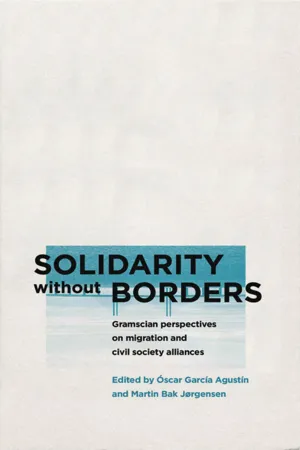
Solidarity without Borders
Gramscian Perspectives on Migration and Civil Society Alliances
- 256 pages
- English
- ePUB (mobile friendly)
- Available on iOS & Android
eBook - ePub
Solidarity without Borders
Gramscian Perspectives on Migration and Civil Society Alliances
About this book
Information
Part I
The Heterogeneity of Political Actors
2
Gramsci’s ‘Philosophy of Praxis’ and the Topic of Migration
The theme of ‘emigration’ is one of the ‘argomenti principali’ (principle topics) listed by Antonio Gramsci on 8 February 1929 in his first prison notebook. His concern is very clearly to criticise culturalist analyses of emigration from the Italian South and to counter these with an approach derived from his ‘philosophy of praxis’ and the understanding of subalternity. Can his categories and empirical analyses still be useful for the study of recent migration processes from the global South to Europe?
Some thoughts and categories developed by Gramsci from the workers’ council’s ‘Ordine Nuovo’ period to the Prison Notebooks seem particularly relevant in that:
• he views emigration processes from the South and immigration processes in the North as social phenomena of one and the same dynamics of a specific (hegemonic) type of political and social development;
• he sees migration as a global phenomenon, bearing in mind the spread of Italian labour over the whole world;
• he wants to understand the culturally particular, in its marginalised and folklorised subaltern form, as well as its role in a new form of civiltà.
In order to elaborate and evaluate those hypotheses, however, we have (1) to look more closely at the relationships between what he describes as the ‘Southern question’ and his critique of the common categories of the analysis of migration processes; (2) to understand in detail what he describes as ‘subalternity’ in the context of the Southern question and the role of intellectuals; and (3), in conclusion, to evaluate what his categories can mean to us today for the question of disparities and possible alliances in migration processes.
GRAMSCI’S CRITIQUE OF THE CULTURALIST VIEW ON MIGRATION
Gramsci makes particular reference to the fact that the society which loses emigrants is very reluctant to reflect on the phenomenon of migration. Nor does migration comply with the notion of human worth inherent in popular consciousness in the North. It provokes images of the terrible and reluctantly discussed side of the Italian Risorgimento, the unresolved issue of the economic and social ‘backwardness’ of the South. In response to an article printed in the Pegaso magazine in September 1930, which dealt with the curious phenomenon that while Italian labour is distributed over the entire planet, there is hardly any literature in Italy which deals with the subject, Gramsci writes:
That writers concern themselves little with the emigrant abroad is less surprising than the fact that they do not deal with the life he leads before actual emigration, in other words with the conditions that compel him to emigrate; … which are bound up with the inner process of emigration, long before the actual journey to a foreign country. (Gramsci 1975b: 2254, Q23)
One of the few literary works about migration from Italy known at Gramsci’s time (besides those portraying the ‘American Myth’, such as De Amici’s) was Francesco Perri’s novel The Emigrants. This story deals with the historical conflict that gave rise to emigration from Calabria, but in Gramsci’s view it obscures and mystifies more than it reveals.
It is apparent that Perri is not directly familiar with the simple life of the Calabrians through his own emotional and psychological experience, but that he makes use of the old regionalist clichés…. The absence of any historical sense is intentional, since this enables him to treat all folklore themes as a homogenous mass, whereas in reality they differ greatly in space and time. (Gramsci 1975b: 2201f., Q23)
Gramsci is referring here to a procedure within culturalism that ascribes and typifies particular characteristics, something that can frequently be observed in present-day studies on migration (Apitzsch 1995). Gramsci returns to the real historical background to migration processes by discussing FIAT’s policies for the recruitment of migrant labourers. He refers to Agnelli’s policy in 1925–26, when 25,000 Sicilians were recruited as labour migrants for the factories in Turin. The attempt failed miserably. The Sicilians, who were supposed to live in barrack-like accommodation where strict internal discipline was maintained, fled in droves from the factory to nearby farms in search of work. The criminal records of those years reinforced even more the Sicilians’ reputation as brigands.
What is interesting here is that Gramsci’s treatment of the event does not include any reference to general cultural peculiarities of the Sicilians. Instead, he sees it as a continuation of the old struggle between the Piedmontese and the Sicilians, between the industrial North and the peasant South. The migrants, who originally came on a ‘voluntary’ basis, recognised immediately on entering the barracks that there was a connection between migration and the history of their colonisation. For Gramsci, the Sardinian chronicler who can draw parallels very quickly with the state of virtual war between the Piedmontese and the Sardinians, these Sicilians and their ways of behaving are in no sense ‘alien’.
Gramsci, using a methodological approach familiar to us from ethnomethodology and psychoanalysis, reverses the angle of vision to that of ‘the alien’ himself. It is not the immigrants that are alien, since the causes for their collective behaviour are easily identified; instead, those groups and social formations that come into being in the large factories as a consequence of capitalist factory owners’ behaviour are the subjects that are alien not only for politicians and political scientists but also for ordinary people. This is an aspect that Gramsci discussed even before the Ordine Nuovo period, shortly after the end of the First World War, and to which he often returned in the Prison Notebooks. Unlike other Marxist theorists, Gramsci finds the idea of all proletarians uniting both abstract and insufficient – what interests him instead is the specifically new that comes into being in the melting pot of the large factory. For Gramsci it is important that the new can only be created when what happens to the subjects in this process is autonomously grasped as something essentially new. In one of his first articles about ‘Socialism and Culture’, written in 1916 (Gramsci 1975a: 22ff., SG), Gramsci quotes Novalis to show that the prerequisite for understanding the alien is the understanding of oneself. In 1916, Gramsci termed this a ‘transcendental’ aspect. By linking the ‘transcendental’ component of early Romanticism with Vico’s work on the ‘First Corollary concerning the speech in poetic characters of the first nations’, he then goes a step further in his analysis of the ‘alien’. The members of the dominant minority do not have to ‘understand’ the majority, but instead it is the subordinated groups who should discover themselves and thereby develop their universal claim to equal civil rights.
What makes Gramsci’s writings such a rich source of material today for solving the problems of multinational and multicultural coexistence is the fact that he does not reduce the social problems associated with differing degrees of modernity to the relationship between native people and foreigners, but defines these differences as a problem of modern consciousness generally. Modern consciousness is characterised for him by the fact that only through ‘folkloristic’ distortions is it able to retain certain moments of its rural prehistory and the counter-knowledge rooted in and dominated by the process of modernisation. The relationship of such sedimented collective experience to industrial society is by no means identical to the relationship between traditional and modern societies; this difference in degree of modernity is much rather a crucial defining aspect of modern society itself. Gramsci developed this aspect with extraordinary clarity in his 27th prison notebook. According to his analysis, so-called ‘folklore’ research cannot be conducted in isolation from ‘official’ world views in the dominant society.
Gramsci’s reflections on folklore are provoked by a question that might be posed today in the context of migration from rural to post-industrial areas, without losing any of its relevance. Gramsci states his position on the question as to whether or not folklore should be taught at teacher-training establishments. ‘To deepen the impartial culture of the teachers? To show them the object that they should not destroy?’ (Gramsci 1975b: Q23§13). Gramsci poses this question in precisely the same sense in which one could ask today whether it is necessary to include an introduction to alien cultures in teacher-training courses. The answer, for Gramsci, will depend significantly on whether the introduction of such new syllabus content is nothing more than ‘firing broadsides at folklore’ – in other words, to convince the younger generations of migrants that they are caught up in a culture that must be overcome, or which is seen ‘as an eccentricity, an oddity or a picturesque element’ – or whether such cultural activity should be seen as a serious matter which should also be taken seriously. In Gramsci’s view, the issue is not to choose between the illusory alternatives of pluralism and universalism – in other words, the point is not whether one accepts the Ptolemaic system as an element of folklore or whether it is combatted as archaic and a barrier to progress. Both reactions would be an expression of thought that is confined by categories of cultural difference, one in which the culture of the subaltern masses is disqualified out of hand as something backward and as something that has therefore to be removed from the dominant culture.
Gramsci therefore sees the debate between universalists and relativists as a ‘mock battle’. The real issue for him is to identify within historically real ‘common sense’, in all its specific variations, that reformative element which Solon and Vico had already mentioned, namely the consciousness of fundamental human rights and the dignity and worth of each individual human being. If, by contrast, popular consciousness as ‘pre-history in the present’ obstructs such reformative strivings, it can easily prove to be an element hostile to the simple individual and something he must rid himself of, since ‘folklore has always been linked to the culture of the dominant classes, and has extracted elements that have become joined with existing traditions’ (Gramsci 1975b: 1105).
The principal concern (and Gramsci refers here to the Catholic population in Italy, as befits his specific historical situation) should be to assess the extent to which a new ‘reformed’ civiltà could arise from the complex of popular culture.
Only in this way will the teaching of folklore be more efficient and really bring about the birth of a new culture among the broad popular masses, so that the separation between modern culture and popular culture of folklore will disappear. An activity of this kind, thoroughly carried out, would correspond on the intellectual plane to what the Reformation was in Protestant countries. (Gramsci 1988: 362)
Today, however, in Western societies individual developments and crises of migrants, not only of the first, but also of the second generation, are often purposively explained in terms of the closed cultural context of the society of origin in order to arrive at a ‘better understanding’. Especially in studies conducted in the fields of education, sociology and cultural anthropology, the society of origin is being interpreted unquestioningly in the name of cultural identity as something ‘immutable’. A contrast is thus constructed, creating two clinically separated worlds with an opposition between their respective central components. Once this polarity has been established, it will control subsequent perceptions, thus reinforcing the prejudice and vice versa. The migrant is locked within the ideological structure of his/her society of origin, while at the same time Western values are assumed to be the superior ones.
The debate on the multicultural society is barely able to include the question of societal sub- and superordination. As long as the population of rich industrial countries continues to be underclassed by immigrants, the stress on cultural identity can have a certain functional utility, in the sense of subordination under the dominant culture. The question of cultural relations cannot be discussed without referring it back to the question of hegemonic structures and the reflection on subalternity. As the historical example of the Reformation shows, Gramsci is thinking of a fundamental change in consciousness throughout society, of a new civiltà.1 Without such a reform of consciousness, political changes are unthinkable.
For Gramsci, the revolutions between the seventeenth and nineteenth centuries in Europe ran parallel to a mental reformation that involved overcoming corporatism as well as dogmatic universalist tendencies. The same has still to take place in Italy ‘because national consciousness was formed and indeed had to be formed through the conquest over two forms of culture: town hall particularism on the one hand, and Catholic cosmopolitanism on the other’ (Gramsci 1975b: 1801, Q15).
Also Italian liberal cosmopolitanism should be substituted by an ‘interested cosmopolitanism’ that understands the phenomenon of migration as the specific relation of the Italian peasant masses to the world.
Traditional Italian cosmopolitanism would have to become cosmopolitanism of the modern type, i.e. it would have to ensure the best conditions for the development of the Italian ‘uomo-lavoro’, wherever in the world he might happen to be – not as a citizen of the world, to the extent that he is a ‘civis romanus’ or a Catholic, but to the extent that he is a producer of ‘civiltà’. (Gramsci 1975b: 1988, Q19)
This quote is expressive of Gramsci’s very own personal aim – to apply a universalist spirit to the critique of particularist and folklorist elements in the ‘plurality of cultures’, i.e. to recognise the gesture of submission that these elements entail, but also to identify the universal or the global in the particular, in the subaltern, in the ‘foreign’. This is the struggle against any sociological analysis of everyday culture which is ‘permanently afraid that modernity is going to destroy the object of (its) study’ (Gramsci 1975b: 1506).
Gramsci’s thoughts regarding the so-called ‘subaltern social strata’ (Prison Notebooks, vol.27, as well as many other writings on cultural hegemony) appear to supply a wealth of ideas relating to precisely this problem. Gramsci’s concept permits us to base our analysis not only on one but on many cultures within a given society. At the same time, however, it is clear that the ‘many cultures’ cannot be separated from the context that binds them to the structures of domination in both the country of origin and the country to which they emigrate. The concept of ‘national culture’ takes effect for Gramsci at this point: as a hegemonic framework in which dominated and subordinate cultures encounter each other. This means that ‘popular’ or ‘folk’ culture cannot be reduced to national culture, or vice versa (cf. Gramsci 1975b: 1660f.). Because dominant and subordinate cultures are described in terms of their opposition and their mutual interdependency, it is necessary to reflect further on the process by which the entire complex develops and the direction that that development takes.
THE SOUTHERN QUESTION AND THE PROBLEM OF SUBALTERNITY
Gramsci’s famous essay ‘Some Aspects of the Southern Question’, written prior to his imprisonment in November 1926 and never corrected or completed before being published in the exile journal Lo Stato Operaio in Paris in 1930, is ...
Table of contents
- Cover
- Title Page
- Copyright
- Contents
- Series Preface
- Preface and Acknowledgements
- Introduction
- Part I: The Heterogeneity of Political Actors
- Part II: Solidarity and Alliances
- Part III: Avoiding Misplaced Alliances
- Part IV: Spaces of Resistance
- Conclusion
- Contributors
- Index
Trusted by 375,005 students
Access to over 1.5 million titles for a fair monthly price.
Study more efficiently using our study tools.
Frequently asked questions
Yes, you can cancel anytime from the Subscription tab in your account settings on the Perlego website. Your subscription will stay active until the end of your current billing period. Learn how to cancel your subscription
No, books cannot be downloaded as external files, such as PDFs, for use outside of Perlego. However, you can download books within the Perlego app for offline reading on mobile or tablet. Learn how to download books offline
Perlego offers two plans: Essential and Complete
- Essential is ideal for learners and professionals who enjoy exploring a wide range of subjects. Access the Essential Library with 800,000+ trusted titles and best-sellers across business, personal growth, and the humanities. Includes unlimited reading time and Standard Read Aloud voice.
- Complete: Perfect for advanced learners and researchers needing full, unrestricted access. Unlock 1.5M+ books across hundreds of subjects, including academic and specialized titles. The Complete Plan also includes advanced features like Premium Read Aloud and Research Assistant.
We are an online textbook subscription service, where you can get access to an entire online library for less than the price of a single book per month. With over 1.5 million books across 990+ topics, we’ve got you covered! Learn about our mission
Look out for the read-aloud symbol on your next book to see if you can listen to it. The read-aloud tool reads text aloud for you, highlighting the text as it is being read. You can pause it, speed it up and slow it down. Learn more about Read Aloud
Yes! You can use the Perlego app on both iOS and Android devices to read anytime, anywhere — even offline. Perfect for commutes or when you’re on the go.
Please note we cannot support devices running on iOS 13 and Android 7 or earlier. Learn more about using the app
Please note we cannot support devices running on iOS 13 and Android 7 or earlier. Learn more about using the app
Yes, you can access Solidarity without Borders by Óscar García Agustín, Martin Bak Jorgensen, Óscar García Agustín, Martin Bak Jørgensen in PDF and/or ePUB format, as well as other popular books in Social Sciences & Emigration & Immigration. We have over 1.5 million books available in our catalogue for you to explore.