This is the best-selling biography of the IRA resistance fighter and hunger-striker, Bobby Sands. In this updated, new edition, Denis O'Hearn draws from a wealth of interviews with friends, comrades, fellow prisoners and prison wardens, to provide a faithful and shocking insight into life in Northern Ireland's H-Block prisons, an exploration of the motivations and thoughts of the Republican strikers and the story of one of the world's most radical, inspirational figures. Following his journey from its very beginnings - an ordinary boy from a working-class background in Belfast to a highly politicised, articulate revolutionary whose death in HM Prison Maze sent reverberations around the world, Bobby Sands: Nothing But An Unfinished Song captures the atmosphere of the time and the vibrancy of the man: a militant anti-imperialist who held on to his humanity despite living through a bitter, ugly struggle.
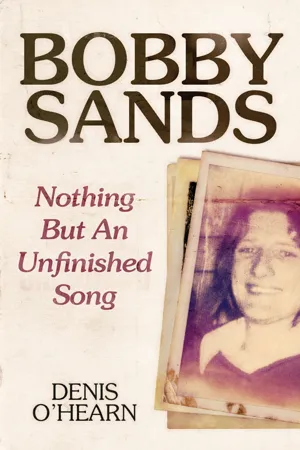
- 464 pages
- English
- ePUB (mobile friendly)
- Available on iOS & Android
eBook - ePub
About this book
Information
Chapter One
Growing Up in Utopia
Rosaleen Sands held her baby on her knee, nursing him. They were in the living room in their home at Abbots Cross and the radio was playing in the background. The song was a Perry Como hit from a couple of years before called “Because.” The words of the song obviously affected Rosaleen very deeply, because she remembered it all many years later. She was full of hope for the young child, but she also remembered the difficulties she and generations before her had endured. The Second World War was not long over. And although things were relatively quiet now, conflicts broke out periodically between the Irish Republican Army and Northern Ireland’s Protestant state.
Rosaleen looked down at the newborn child and spoke to him.
“Bobby, if there’s ever a war, you and I will go down to the South where you won’t be conscripted. And if the Troubles ever flare up here, and the IRA gets going, we’ll go to the South.”1
Rosaleen had plenty of reasons to worry. Northern Ireland—its six counties were carved in 1920 out of the northeast corner of the island of Ireland by the British—comprised the largest piece of that corner that contained an assured majority of three Protestants for every two Catholics. Protestants ran the state, ultimately giving their loyalty to the Queen of England. Most Catholics and a few Protestants refused to recognize it, instead aspiring to a united Ireland. In 1922, its first prime minister, James Craig, called the local government at Stormont, east of Belfast, “a Protestant parliament for a Protestant people.” The current Prime Minister Basil Brooke once told people not to employ Catholics, boasting, “I have not a Roman Catholic about my own place.”2
Protestants ran the police forces, both the regular Royal Ulster Constabulary (RUC) and the state-sponsored paramilitary “B-Specials.” Rosaleen remembered the B-Specials invading her neighborhood when she was a child. And now, in 1954, the industries that had assured jobs for working-class Protestants were rapidly falling apart. Places like the Harland and Wolff shipyard, whose proud Protestant workers built the Titanic in 1912, were shedding workers by the hundreds. What an explosive mix! A dominant population that was losing its economic advantages but which still had its police and plenty of guns, and a marginalized population with a history of rebellion.
Perhaps the most immediate social threat in Ireland’s harsh climate, however, was the region’s housing. After decades of neglect, three out of every ten houses were uninhabitable.3 A higher proportion of Catholics lived in Belfast’s overcrowded slums: the lower Falls, Ardoyne or Rosaleen Sands’s childhood district of the Markets. Their labyrinths of narrow streets were lined by rows of two-story brick houses with outside toilets. The children slept several to a bed, head-by-toe, like sardines packed in a tin.
So when Rosaleen Kelly married John Sands on March 28, 1951 and they moved into a nearly new private house in a countryside village at 6 Abbots Cross, five miles north of Belfast, they thought they had a better future to look forward to. Both had come from Belfast working-class backgrounds. Rosaleen’s father, Robert, worked as a groom in the Catholic Markets district. John’s father, Joseph, was a “spiritgrocer,” a fancy name for a bartender. Yet John’s mother, Elizabeth Forsythe, was a Reformed Presbyterian, a particularly conservative brand of Protestantism that harkened back to Puritanism. John lived among Protestants until after he moved out from his parents’ home and got work in McWatters’s (later Inglis’s) bakery in the Markets district where Rosaleen Kelly lived and worked as a weaver.
Abbots Cross was one of five experimental “garden villages” that were nestled in a scenic valley between Ben Madigan (now called Cave Hill) and Carnmoney Hill. Just south of Abbots Cross, the Glas-na-Bradan River flowed from between the two hills down to the Belfast Lough. The immediate surroundings were a far cry from the repetitive brick-terraced streets back in Belfast. Country roads were dotted with rural farmhouses. Within a stone’s throw of the Sands’s new house was “The Abbey,” the magnificent country house of Sir Charles Lanyon, the architect who built most of the great buildings of nineteenth-century Belfast. The Sands family would eventually have a close association with two of them: the Crumlin Road Jail and Courthouse.
The Sands house was the second in a neat terraced street of twenty-four white houses, built in an open plan, with no fences or walls to divide the front gardens. The estate was neatly planned, incorporating features of the existing Irish landscape and built around a brand-new shopping center. Its utopian plan was so precise that the number of houses numbered exactly one hundred.4
But not everything was well within this utopia. Despite its stylish modernism, Abbots Cross was deeply sectarian. Directly behind the Sands’s hedged back garden was a large, modern Presbyterian church. Directly across the street from the clean, white shopping center were a Congregational church and a brand-new Protestant elementary school. There was a Church of Ireland, Free Presbyterian, Methodist, Baptist, and Plymouth Brethren churches. There was a community for everyone . . . except Catholics.
The discomfort of Abbots Cross for a woman like Rosaleen Sands, brought up among anti-Catholic police actions in the 1920s and 1930s, was heightened by the numbers of policemen and state-sponsored paramilitaries (the B-Specials) living in the estate.
So Rosaleen Sands lived a fiction in Abbots Cross. She never let on that she was a Catholic. Sands, a good Ulster-Scots name, blended well among her neighbors: the Meekes, the Bairds, and the Craigs. Everyone took Rosaleen to be a Protestant because she was so quiet and did not bother with the neighbors.5
On March 9, 1954, two years after they moved to Abbots Cross, Rosaleen gave birth to their first child, a boy who they named Robert Gerard. She prayed that Bobby would never get caught up in the violence that she had known as a child. But it was not long before the IRA “got going” again, opening a bombing campaign along the Irish border in 1956. Sectarian tensions rose between Protestant and Catholic, or Unionist and Nationalist. The Sands family were unaffected as long as they could live quietly without discussing religion with their neighbors. They succeeded for several years, during which Marcella was born in April 1955 and then Bernadette in November 1958.
Eventually, however, the woman next door found out Rosaleen’s religion. She began taunting her when John was away at work. She hammered on the walls incessantly during the day. When Rosaleen took her washing out to hang it on the line, the neighbor put similar clothes on her line. If Rosaleen cleaned her windows the neighbor did, too. Rosaleen could feel her sneering across at her. Things got so bad that she took the children out for long walks during the day to avoid the neighbor. Eventually Rosaleen became ill. Her doctor took John aside and told him if he wanted his wife to regain her health, either take the neighbors to court or give up the house.
“So,” recalled Bernadette years later, “my parents being so quiet and not wanting to bother anybody, they gave up the house.”
• • •
For six months when Bobby was seven, the Sands family lived with relatives. In December 1961, they finally got a house in the new estate beside Abbots Cross. In the 1950s, the northern Irish government had begun building big public housing estates for some of the thousands of working-class families who urgently needed somewhere decent to live. The first estate, called Rathcoole after the Irish rath cúil, meaning “ring-fort of the secluded place,” was built in phases, working its way up the foot of Carnmoney Hill. By 1961, Rathcoole comprised three square miles of public housing for fourteen thousand people.
Rathcoole was planned as a model estate for the “respectable working class,”6 with jobs in nearby industrial projects. It was to be another utopia. But unlike Abbots Cross, a third of its new residents were Catholics. Among them was the Sands family, in a spacious house at 68 Doonbeg Drive, at the foot of Carnmoney Hill.
Bobby was surrounded by huge open green spaces. He and his sisters could go out their front door and climb up the Carnmoney mountain on trails that wound through dense gorse and nettles. They visited adventurous places on the mountain including the remains of ancient Celtic forts and monuments. It was thick with birds, which Bobby learned to identify.
Kids from the surrounding streets joined them. They would build a hut while Bobby built a fire. He took out his mother’s pots and some food and they toasted bread or potatoes, imagining they were camping out. When Rosaleen caught them, says Bernadette, she would “half kill” them.7
Bobby was always doing something. He faced regular fights with the neighborhood kids with a degree of stoicism, bordering on stubbornness. If he got hit, he hit back. If he was badly beaten, he walked around the corner before he cried. He often turned his stubbornness on his mother. If Rosaleen sent him outside to play as punishment, he refused to come back when she called.
Yet he was very protective of his sisters. If anyone hit them he jumped to their defence. He was smaller than the other kids but he stood up for his sisters, no matter what the consequences.8
Bobby’s education began at Stella Maris primary school, a mixed gender Catholic school close to his house that also served the surrounding districts of Glengormley, Bawnmore, and Greencastle. Later, he attended Stella Maris secondary school, next door to the primary school. He was never a very serious student, instead concentrating on organized sport. According to schoolmate Dessie Black, he was intelligent but lazy in school.
“All we wanted to do was just play football. More time was spent round picking football teams for matches and that than doing school-work and that.”9
Outside of school, Bobby played soccer with a religiously mixed group of local boys, always including his best mate Tommy O’Neill. Together, they joined the youth team of Stella Maris, the local amateur soccer club. Stella Maris was a remarkable institution for the north of Ireland, where religious sectarianism was rampant. Although the team trained in the gym of Bobby’s school, it attracted Protestant boys from surrounding areas. Terry Nicholl, a Mormon, joined Stella Maris because he had just one interest, soccer, and would have played for anybody.10 Willie Caldwell and Geordie Hussey, two more Protestant “football fanatics,” also joined. Nobody asked if you were Catholic or Protestant. If you were a half-decent soccer player, you were on the team.
Dennis Sweeney never liked Bobby Sands much. He thought he was an insecure person who tried to cover it up by showing off, sometimes even using violence on the soccer field. “Certainly not a leader by any means, more a person who was led,” he thought.
But others describe Bobby Sands as an amiable teammate. Their recollections also reflect a trait that others would notice in his later life: extreme enthusiasm, sometimes expressed in behavior that went “over the top.”
Geordie Hussey says Sands was “a bit of a grafter” who did his best at his position of left half. He didn’t score many goals but he could be counted on to get the ball and he was a good tackler. What he lacked in natural ability, he made up in enthusiasm.
His enthusiasm extended into other sports. Bobby loved swimming but cross-country running was his real sporting passion. He won cross-country medals11 and his love of running came through later in his prison writings. In The Loneliness of a Long-Distance Cripple, he compares his strength as a teenager winning a cross-country race to his deteriorating physical state in prison. In the story, Sands describes a long-distance race in the cold Irish winter that “bites deep into the lungs and reddens the nose and cheeks.” He is excited by the race but surprisingly aware, even sad, at how the incursion of the runners scars the countryside. He is at once part of the environment and against it.
“Bang.” The thrush fled and I sprang forward. The marshy ground churned and sucked and squelched as hundreds of foreign spiked feet mutilated and scarred its face. Across an open field we charged in a bunch. My mind was racing as I tried to weigh up the situation and opposition as the lay of the land was seen then gone in a matter of a few strides.
Sands struggled to overcome the challenges both of the environment and the other runners until, finally, “I broke the finishing line, breathing like a racehorse in deep vast gulps.” Although it was only a schoolboy race, “Victory was mine and I felt like an Olympic champion.”
• • •
As Sands grew into his teens, his circle of friends widened. He went to the Alpha picture house or to dances at the local church hall. There was roller-skating in the religiously mixed Floral Hall in Bellevue near the Belfast Zoo. Weekend dances there were mainly Protestant but mixed. On Sundays a more Catholic but still mixed group attended dances in the Star of the Sea hall in Rathcoole or St. Etna’s hall in Glengormley. Bobby’s friends at the time remember him as a “happy-go-lucky” boy who loved dancing and the socializing that went with it.
Things were beginning to change, however, in the society around him. Systematic sectarianism was emerging. By 1966,...
Table of contents
- Cover
- Title Page
- Copyright
- Contents
- Foreword to the New Edition by Mumia Abu-Jamal
- Preface to the New Edition
- Prelude
- Chapter 1. Growing Up in Utopia
- Chapter 2. Violence and Anger
- Chapter 3. Into the IRA
- Chapter 4. A Change of Scene
- Chapter 5. A Trip to the South
- Chapter 6. Prison
- Chapter 7. Things Get Hot
- Chapter 8. Learning to Rebel
- Chapter 9. Leaving Long Kesh
- Chapter 10. Putting It into Practice
- Chapter 11. A Bad Day in Dunmurry
- Chapter 12. Castlereagh
- Chapter 13. Back to Prison
- Chapter 14. Solitary Confinement
- Chapter 15. On the Blanket
- Chapter 16. Escalating the Protest
- Chapter 17. H6: Building Solidarity Within
- Chapter 18. H6: Extending the Protest
- Chapter 19. Toward the Inevitable
- Chapter 20. Hunger Strike
- Chapter 21. Step by Step
- Chapter 22. The End
- Chapter 23. The Beginning
- Notes
- Acknowledgements
- Index
Trusted by 375,005 students
Access to over 1.5 million titles for a fair monthly price.
Study more efficiently using our study tools.
Frequently asked questions
Yes, you can cancel anytime from the Subscription tab in your account settings on the Perlego website. Your subscription will stay active until the end of your current billing period. Learn how to cancel your subscription
No, books cannot be downloaded as external files, such as PDFs, for use outside of Perlego. However, you can download books within the Perlego app for offline reading on mobile or tablet. Learn how to download books offline
Perlego offers two plans: Essential and Complete
- Essential is ideal for learners and professionals who enjoy exploring a wide range of subjects. Access the Essential Library with 800,000+ trusted titles and best-sellers across business, personal growth, and the humanities. Includes unlimited reading time and Standard Read Aloud voice.
- Complete: Perfect for advanced learners and researchers needing full, unrestricted access. Unlock 1.5M+ books across hundreds of subjects, including academic and specialized titles. The Complete Plan also includes advanced features like Premium Read Aloud and Research Assistant.
We are an online textbook subscription service, where you can get access to an entire online library for less than the price of a single book per month. With over 1.5 million books across 990+ topics, we’ve got you covered! Learn about our mission
Look out for the read-aloud symbol on your next book to see if you can listen to it. The read-aloud tool reads text aloud for you, highlighting the text as it is being read. You can pause it, speed it up and slow it down. Learn more about Read Aloud
Yes! You can use the Perlego app on both iOS and Android devices to read anytime, anywhere — even offline. Perfect for commutes or when you’re on the go.
Please note we cannot support devices running on iOS 13 and Android 7 or earlier. Learn more about using the app
Please note we cannot support devices running on iOS 13 and Android 7 or earlier. Learn more about using the app
Yes, you can access Bobby Sands by Denis O'Hearn in PDF and/or ePUB format, as well as other popular books in History & Historical Biographies. We have over 1.5 million books available in our catalogue for you to explore.