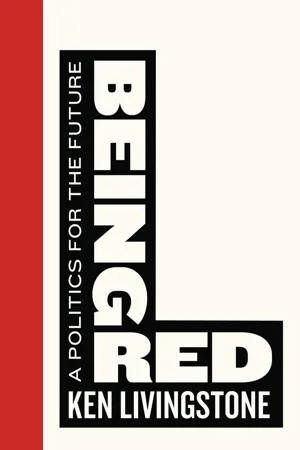
In Being Red, Ken Livingstone serves up an account of the Labour Party and its future, at a pivotal moment in its history. Having worked most of his life within the party in various leading roles; as the head of the Greater London Council, as Member of Parliament and as Mayor of London, Livingstone is able to offer insights into the internal workings of the party, and the rise and fall (and potential rise again) of its radical socialist ethos. Discussing his battle with Boris Johnson, the fight against privatisation and pollution as well as his analysis of Jeremy Corbyn's arguably radical leadership and its implications for the future, Livingstone displays his trademark honesty and humour, refusing to shy away from controversy or debate. Published in partnership with the Left Book Club.
- 208 pages
- English
- ePUB (mobile friendly)
- Available on iOS & Android
eBook - ePub
About this book
Information
CHAPTER ONE
The GLC Years
Ken Livingstone in Conversation with Anna Minton
Let me take me you back, if I may, to May 1981, when you’d recently been elected, at just 35 years old, to one of the most important jobs in London government, as leader of the Greater London Council (GLC). It was also a time of huge turbulence for the left. A few months later, in September, the left-wing candidate Tony Benn would challenge Denis Healey for the deputy leadership of the Labour Party and lose by the slimmest of margins, gaining 49.6 per cent of the vote to Healey’s 50.4 per cent. Had Tony Benn won that election the history of the left may have looked very different…
I suppose if you’d been interviewing me then, I would have said that by now I’d assume we’d be living in a social democratic paradise. Because at that point, when we won the election to the GLC, the Thatcher government was deeply unpopular and there was no certainty that she’d be re-elected.
What I felt particularly strongly at the time was the example of history – what had been done in London in the past, in terms of setting the stage for the post-war welfare state. When Herbert Morrison won the London County Council in 1934 he broadly used it as a test bed for the welfare state that the then Labour government brought in in 1945. And I specifically felt that the things we were doing there, after all the disappointments of the Wilson-Callaghan government – that these were a chance to set a new agenda and to win that ideological debate for the left. Wilson and Callaghan had just so abysmally failed to reset – nothing like as bad as Blair of course – so they [the left] were looking for somebody else to go on and do this.
People have talked about how you tried to revive democracy and democratic processes during your time at the GLC. I’ve read that there were meetings that would have 30, 40 people packed into the room and that it felt like it was just a completely different style of doing things.
Under the old Labour administration, even when we were in opposition, there was a line – you got your whip every Friday afternoon telling you how you had to vote for the next week and there’d be discipline if you broke the whip and all that. But I just said from the beginning: ‘This is how we’d like you to vote but it’s up to you how you vote. It’s a matter between you and your local party or constituents.’ And the rebellions just didn’t happen. People felt that everything was being openly and honestly discussed in the Labour group. My committee chairs were free to oppose a policy that the leaders’ committee had agreed when they got to the group meeting, so it was a very open democratic structure. With the exception of the fiasco over rate capping, I don’t think we ever really lost a vote on anything.
Given we only had a majority of four, it was an awful lot of just day-to-day management, of needing to be in the building and around and talking to people. When I was mayor it was a much more executive role, but this was about managing the group – holding it together. We’d won 50 seats, the Tories 41, and the Liberals had one, and then two defected. So we went from a majority of eight down to four. And there were eight members who really couldn’t stand me and who’d have been happy to see me replaced. So, just holding it all together and managing it was important.
Can we talk a bit about the culture of the GLC – the idea of the ‘People’s Palace’ and the very different sort of culture and style of government you had there?
Well it had become this nightmarish bureaucracy. If you look back at Herbert Morrison’s London County Council – Morrison was leader between 1934 and 1940 and became deputy prime minister under Clement Atlee – it was quite innovative and open. But then there was a succession of bureaucratic Labour leaders right the way up to 1965 when the LCC was replaced by the GLC. The whole thing was structured around the traditional civil service and bureaucracy and so opening it up was electrifying. But some of the senior officers had doubts. Six, seven weeks in, the head of personnel went to see the medical officer and demanded to be declared unfit for work so he could retire immediately. And he did this on a Friday night, so we came in on the Monday and the whole HR side had just gone. But we were really lucky because Maurice Stonefrost, who was the Treasurer, was quite enthused by all of this.
He emerges as quite a key figure and he became pivotal to the way you ran the GLC.
He was a really nice guy to work with. If he’d been the sort of hostile bureaucratic type he could have made our lives so difficult, given that he controlled the entire financial side of things. But he did everything possible to make sure we could carry our policies through.
I read somewhere that in one of your really large meetings a woman actually changed her baby’s nappy, which provoked outrage from some of the Tory elders.
Oh yes. No one would really notice that now. Same with homosexuality. This was a time when even though it was no longer illegal, anyone in public life who was exposed as gay had to resign their seat in Parliament immediately, or someone like Dusty Springfield had to go through their entire life living a lie and so on. And raising issues like lesbian and gay rights, or Ireland, this was all just off the agenda. I think that part of the failure of the Kinnock Labour Party was that he just wasn’t in touch with the changes that were starting to come up through society. He was traditional Labour from South Wales and all the people around him thought this was completely diversional – just stuff about women, lesbians, gays, blacks. They said, ‘let’s stick to traditional working class stuff’. They didn’t realise that our society was undergoing a huge change.
And why do you think you did realise that, despite also being quite enmeshed in Labour Party politics?
Basically I was young. I’d grown up in London which had waves of immigration which changed us. But also my background wasn’t in politics. My interests as a kid were astronomy and natural history and my first eight years in work were spent as a technician in cancer research. It meant I came to politics with a mind based on scientific research, in which to find the truth you examine the data. Whereas for most people in politics, it’s like a matter of faith. And if the facts don’t conform to their preconceptions they tend to ignore them. And so I was open to new ideas. I’m still very nerdy and obsessed and read the science stories in the papers first.
You were very much trying to set up a ‘real’ left alternative, after all the accusations that Labour before 1979 had been ‘in office but not in power’. So what were the key planks of your programme?
The key one was transport because at the time we were in a quite deep recession. You always got a seat on the tube, even in the rush hour, and there were an awful lot of empty seats. And we felt that by cutting the fares it was a way of getting people out of their cars and onto public transport. And also it’s a way of putting money back in people’s pockets. It’s redistribution. Then again, I’d never driven – I’d like to see us all in a public transport world.
Why did you never drive?
Because it was so expensive basically. I remember I took some driving lessons in 1967 and each lesson was about the equivalent of a fifth of my weekly pay, and then even when you did have a car there were parking charges and all that. So the commitment to public transport was actually a way of redistributing a bit of wealth to people. We had to increase the rates to cut the fares, but 60 per cent of our rates came from the business sector and half of that from the giant corporations in the City of London and Westminster, so it was a rough and ready but very good mechanism for redistributing wealth.
How about the other parts of your programme, such as industry and employment?
When we were drawing up the manifesto for the 1981 election, we aimed to work out exactly how we were going to pay for everything, so we went into the election with the aim – actually an incredibly big aim – of being able to pay for it. And the biggest single chunk of that was the industry employment side of it. But when it came to carrying it out, I left that completely to Mike Ward1 – it was his area of expertise. I was quite good at delegating. That’s why the GLC worked. Compared to the nightmare of Blair’s New Labour where everything was one-to-one meetings, we actually had a proper cabinet structure so that all the committee chairs met every week – I think it was Tuesday mornings – and everything was discussed, every idea that came up was tested and argued over and so on. There was no sort of thing of me announcing ‘we’re doing this’ or ‘we’re doing that’ and that’s the first people heard of it.
I talked to Doreen Massey,2 who worked with you at the Greater London Enterprise Board,3 and she said that it was an incredible time because it was about trying to counter the coming financialisation of the economy and the Tory plans for deregulation.
Honestly, the Greater London Enterprise Board never achieved as much as we wanted because the powers of the GLC were quite limited. You had to work by building a consensus with business organisations, but I think Mike Ward has said he doesn’t think he ever had a meeting with any of the City finance corporations. We were looking at workers co-ops and things like that and trying to rebuild our manufacturing base. Patrick Abercrombie’s post-war plan had included a commitment to reduce London’s population to 5 million by 1990.4 So in that first 25 years after the war they were moving all the people out to new towns and moving jobs out. When Labour was elected in 1973 we stopped that because it was hollowing out London and it didn’t work.
But at the same time, public transport had been neglected because of this idea that one day everyone would have a car. The plan at the time we won the 1973 election was that all the great motorways would come into central London so that the M1 would come into Hyde Park, the M23 would come straight up through West Norwood, through Brixton, then you’d have these three concentric ringways, so we’d have looked like some absolutely ghastly American city. So the 25 years we’d had of people working slowly towards better public transport would fade out and everyone would have their own car. We realised this was going to be devastating for London, so the GLC election in 1973 was about a shift away from that. We ran on a commitment to oppose the motorways and therefore you had to rebuild public transport.
Let’s talk about Ireland now and how you became interested in the Republican cause.
I remember watching the first non-unionist MP in the ’60s being interviewed on TV and explaining just how great the degree of discrimination was there. So, in the late ’60s, before the armed struggle started, I saw that what was being done to Catholics in Northern Ireland was similar to what happened to black people in the Deep South in America – it was the same pattern of discrimination. Once the bombing campaign had started and I was selected to stand for Hampstead [in 1977] – well, Hampstead starts in Kilburn and suddenly I’m in the biggest Irish community in London. So, then I started getting involved as Irish groups were coming to see me. The majority of Irish just wanted to keep their heads down because there was an awful lot of violence and hatred directed at them. But I had started reading about Ireland and I’d got a sense of what we’d done over the years. I realised this was just wrong.
I covered Northern Ireland as a journalist in the mid 1990s and when I went there I was just amazed really. I’d done history at school and university – modern history – and I knew something about Ireland. But when I got there, I felt I’d had no idea. I realised ‘this is Britain’s war’, and it felt like no one had really told us. To what extent do you think it was that very partial reporting of the politics of Northern Ireland that meant most people weren’t really aware of what was going on?
The Thatcher line was that this wasn’t political, these were just psychopaths and criminals. My first visit to Northern Ireland must have been in early 1982 and I remember being really shocked, it was like going back to Britain in the 1950s, it was just so poor and so drab. And at that stage Sinn Féin was saying that the IRA can never defeat the British Army, that there has to be a political solution. And oddly enough, years later, when I used to get invited down to the army training college at Camberley, the officers there would say, ‘we always knew we couldn’t defeat the IRA. Every time we killed one there would be ten more recruits.’ It had to be a political solution. And this was in the mid 1990s, before Blair did the deal. After I’d spoken to the army officers, there would be a unionist on the platform and they [the officers] would tear them apart saying, ‘you have got to make concessions – our people are being killed because you’re just being so stubborn’. But the idea that this was the view of leading figures in the armed forces never came across at all.
When I came back from that meeting [in 1982] we said that there’s potential here to do a deal and end the conflict. But Thatcher just continued, completely obdurate. And another 1,000 people died in the years leading up to Blair’s deal, completely unnecessarily.
In 1983, you and Jeremy Corbyn invited Gerry Adams and Danny Morrison to the House of Commons.
Because Jeremy had just been elected as an MP, we had a meeting in the House of Commons. The point was to get across that these people weren’t psychopaths and gangsters. And there was overwhe...
Table of contents
- Cover
- Title Page
- Copyright
- Contents
- List of Illustrations
- Series Preface
- Editor’s Preface
- Foreword
- 1 The GLC Years
- 2 The GLA Years and Beyond
- 3 Boris Will Be the Death of Me
- 4 Rebuilding the Party, Rebuilding Britain
- 5 Ken: A Personal Portrait
- 6 ‘I Don’t Know Much About Art But …’
- Notes
Trusted by 375,005 students
Access to over 1.5 million titles for a fair monthly price.
Study more efficiently using our study tools.
Frequently asked questions
Yes, you can cancel anytime from the Subscription tab in your account settings on the Perlego website. Your subscription will stay active until the end of your current billing period. Learn how to cancel your subscription
No, books cannot be downloaded as external files, such as PDFs, for use outside of Perlego. However, you can download books within the Perlego app for offline reading on mobile or tablet. Learn how to download books offline
Perlego offers two plans: Essential and Complete
- Essential is ideal for learners and professionals who enjoy exploring a wide range of subjects. Access the Essential Library with 800,000+ trusted titles and best-sellers across business, personal growth, and the humanities. Includes unlimited reading time and Standard Read Aloud voice.
- Complete: Perfect for advanced learners and researchers needing full, unrestricted access. Unlock 1.5M+ books across hundreds of subjects, including academic and specialized titles. The Complete Plan also includes advanced features like Premium Read Aloud and Research Assistant.
We are an online textbook subscription service, where you can get access to an entire online library for less than the price of a single book per month. With over 1.5 million books across 990+ topics, we’ve got you covered! Learn about our mission
Look out for the read-aloud symbol on your next book to see if you can listen to it. The read-aloud tool reads text aloud for you, highlighting the text as it is being read. You can pause it, speed it up and slow it down. Learn more about Read Aloud
Yes! You can use the Perlego app on both iOS and Android devices to read anytime, anywhere — even offline. Perfect for commutes or when you’re on the go.
Please note we cannot support devices running on iOS 13 and Android 7 or earlier. Learn more about using the app
Please note we cannot support devices running on iOS 13 and Android 7 or earlier. Learn more about using the app
Yes, you can access Being Red by Ken Livingstone in PDF and/or ePUB format, as well as other popular books in Política y relaciones internacionales & Política. We have over 1.5 million books available in our catalogue for you to explore.