The growing cult of the celebrity in contemporary culture is throwing up paradoxical ideas about the contradictions between 'high' art and mass appeal and blurring the already unstable boundaries between art, commodity and popular culture. This is a lively and accessible study of the phenomenon, informed by a look at what happens when the 'serious' world of art collides with celebrity. Global culture is now dominated by celebrities, some of whom, like Madonna and Stallone, are art collectors and some, like Dennis Hopper and David Bowie, are part-time artists. Walker explains how artists such as Warhol, Gavin Turk, Jeff Koons, Elizabeth Peyton and Alison Jackson contribute to, but also critique, the cult of celebrity by depicting film celebrities, rock stars and royalty in paintings and statues. Celebritisation has overtaken the art world too: Walker surveys 14 art stars of the twentieth century from Dali to Tracey Emin. He also reviews alternatives: the left wing pantheon of figures such as Mao, Che Guevara and Rosa Luxemburg, and pictorial celebrations of the people.
- 304 pages
- English
- ePUB (mobile friendly)
- Available on iOS & Android
eBook - ePub
Art and Celebrity
About this book
Information
1
Celebrities as Art Collectors and Artists
Celebrities in such realms as film, television and rock music are often highly creative individuals and so they have an affinity with fine artists. Some stars meet visual artists and, in certain cases, friendships and collaborations follow. Crossovers also occur: some film stars take up painting while some visual artists direct films. A number of leading actors have played the role of artists in films and this has encouraged them to make a close study of the life, work and methods of those artists. Examples include: Charles Laughton as Rembrandt in Rembrandt (1936); José Ferrer as Toulouse-Lautrec in Moulin Rouge (1952); Kirk Douglas as van Gogh and Anthony Quinn as Gauguin in Lust for Life (1956); Charlton Heston as Michelangelo in The Agony and the Ecstasy (1965); Ed Harris as Jackson Pollock in Pollock (2000).1
Art Collectors and Patrons
Successful entertainers earn millions and so have large surpluses to spend and invest. Some decide to become serious art collectors. Furthermore, they generally acquire large mansions or apartments (sometimes several in different countries), which then need decorating and furnishing. Many Hollywood figures have vied with one another for high status by buying expensive art works, ceramics, furniture and designer-name goods in order to display them in their so-called ‘celebrity homes’ (those that are the subject of bus tours in Hollywood and television series).2 In 1970, Paul Staiger (b. 1941), a West Coast painter, depicted the exteriors of celebrity homes belonging to such stars as Kirk Douglas and Randolph Scott in a photo-realist manner. His titles provided precise postal addresses. Today, emerging movie stars are more likely to keep their addresses secret because of the dangers posed by stalkers.
Notable Hollywood art collectors of the past and the present include: Michael Caine, Douglas Cramer, Tony Curtis, Kirk Douglas, David Geffen, Richard Gere, Alfred Hitchcock, Dennis Hopper, Sam Jaffe, Charles Laughton, Steve Martin, Jack Nicholson, Clifford Odets, Vincent Price, Sylvester Stallone, Billy Wilder and Edward G. Robinson.
Robinson (aka Emanuel Goldenberg, 1893–1973) was born into a Jewish-Romanian family that moved to the United States early in the twentieth century.3 While growing up in New York, Robinson enjoyed collecting cigar bands (later he became a heavy cigar smoker), cigarette cards depicting baseball players and pictures of stage and music hall female stars. His interest then shifted to the visual arts and he began to collect reproductions of works by Remington, Rembrandt and Goya. He developed an ambition to become an actor and after succeeding on the New York stage, he received offers from Hollywood and, in 1931, he became famous for his role as the gangster Rico in the film Little Caesar. Much to Robinson’s chagrin, he became forever identified with this character. Hal Wallis, the film’s director, was also an art collector.
Once Robinson became a movie star, he discovered that fame and money did not satisfy his cultural needs. However, the money enabled him to afford genuine works of art and on every trip to major cities, he would visit public and private art galleries. In 1926, he bought his first oil painting in an auction. Soon, his taste fixed on impressionist and post-impressionist paintings. Robinson, a committed and discriminating buyer, established a substantial and valuable collection of pictures that included works by the Europeans Cézanne, Chagall, Corot, Degas, Delacroix, Matisse, Monet, Morisot, Picasso, Pissarro, Renoir, Rouault, Seurat, van Gogh and the American Grant Wood. (Wood was to become a friend.) Robinson sought advice from art dealers but he also visited artists in their studios; for instance, he met Matisse in Paris on the latter’s 70th birthday and conversed with Chagall in Rome. In 1939, when Robinson was in Paris with his wife and son, he encountered Vuillard and since the artist was short of money, Robinson commissioned him to paint a family portrait. On a trip to Mexico, he visited Diego Rivera, the communist muralist, and bought some paintings. Rivera showed him watercolours by his wife Frida Kahlo and Robinson acquired several; thus, he appreciated Kahlo long before Madonna. (Rivera also arranged for the movie star to visit the exiled revolutionary Leon Trotsky in his closely guarded villa.) In 1947, Robinson purchased a painting by the British artist Walter R. Sickert from the Kaplan Gallery, London because it depicted him and co-star Joan Blondell in the 1936 gangster film Bullets or Ballots. The painting, entitled Jack and Jill, was probably based on a publicity still.4
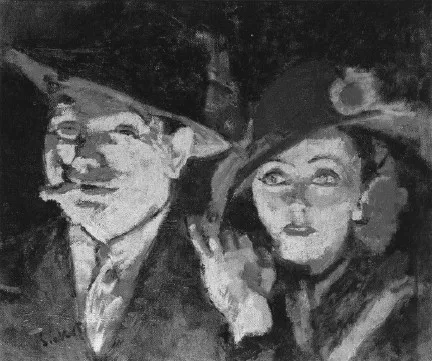
6. Walter R. Sickert, Jack and Jill, c. 1936–37.
Painting, oil on canvas, 62 × 75 cm. Private Collection.
© Estate of Walter R. Sickert, 2002, All Rights Reserved, DACS.
© Estate of Walter R. Sickert, 2002, All Rights Reserved, DACS.
Robinson lived in Beverly Hills but instead of adding the usual swimming pool to his home, he built a gallery and opened it to art lovers and students twice a week. (Some Hollywood mansions have sculpture gardens.) In May 1953, the National Gallery of Art in Washington DC was pleased to mount an exhibition of 40 paintings from Robinson’s collection. Robinson’s first wife Gladys was an amateur painter and he himself took up the medium for private pleasure in later life. In 1956, when he was compelled to sell his beloved collection to meet a divorce settlement, it raised $3,250,000. Being a self-confessed ‘art addict’, he bought some pictures back and quickly established another collection, which included African sculptures. This collection was eventually sold for $5,125,000. Regarding his acquisitive urge, Robinson once remarked: ‘I have not collected art, art collected me. I never found a painting, they found me. I have never owned a work of art, they own me. What people call my collection is this group of masterpieces that collected each other, and then very kindly allowed me to go into debt to pay the bills.’5 Robinson’s passion for collecting and appreciating visual art encouraged many of those around him to follow suit.
Vincent Price (1911–1993) was a tall, handsome American with a charming, extrovert personality and distinctive voice. He became famous for playing sinister but suave, humorous villains in horror movies but he also excelled on the stage, radio and television. Before his acting career took off, he was fascinated by fine art and its history.6 Price came from an affluent, cultured, middle-class family in St Louis and became interested in the visual arts via reproductions in art books. He soon enjoyed seeing originals in the city’s museum of art. His obsession with collecting art began at the age of twelve when he bought a Rembrandt etching for $37.50 and it persisted throughout his life. At the age of 16, his parents allowed him to tour European cities where he tirelessly explored museums, galleries and cathedrals. From then on, whenever he had any spare time, Price would haunt junk shops, private galleries and museums in order to increase his knowledge of art and its monetary value, and to hunt for bargains. In the 1960s, I encountered him at John Kasmin’s gallery in London (he was often in England for films being shot at Elstree) and I remember being surprised to see a screen idol in the flesh and in a gallery because it had not occurred to me that movie stars might be interested in contemporary art.
Price studied English and the history of art at Yale University. As a young man, his secret ambition was to be either an artist or an actor. He tried his hand at practical art but discovered he had no aptitude for it; furthermore, he was colour-blind. He then undertook an MA degree course at the Courtauld Institute in London where he researched a thesis on Albrecht Dürer and the School of the Danube. While in London, during 1935, he attended openings of exhibitions by the Anglo-American sculptor Jacob Epstein, whose work was then outraging the public. Price abandoned the Courtauld when he was offered acting roles in historical dramas.
On his return to the United States, Price was a success on the New York stage. For one of his apartments, he commissioned the American artist Bernard Perlin to paint a mural of Adam and Eve in his tiny bathroom. He also bought a large oil painting of the revolutionary leader Emilio Zapata by the Mexican painter José Orozco. Like Robinson, whom he eventually befriended, Price moved from New York to Hollywood to appear in films. With his second wife Mary – a costume designer who was also an avid collector – he occupied various houses in Los Angeles and filled them with acquisitions. Many visitors, who included established artists such as Max Beckmann and Rufino Tamayo, and the teenage Dennis Hopper, saw his homes and art collection. During the early 1950s, at one home, Hopper painted abstracts and used a kiln the Prices had to make tiles. The works by de Kooning, Pollock and Richard Diebenkorn that Hopper saw there left a lasting impression.
Price’s appreciation of art spanned many cultures and periods; he valued contemporary American art as well as the masterpieces of the past and so his ever-expanding collection was extremely broad ranging. It eventually included paintings by Afro, André Derain, Diebenkorn, Goya, Pollock (a small one), Mark Tobey and Maurice Vlaminck. Drawings, prints and watercolours especially appealed to Price partly because they were more affordable. Acquisitions included: lithographs by Honoré Daumier; a drawing of Adam by Modigliani; a drawing by Delacroix; a self-portrait drawing by Henri Matisse; a watercolour of a picador by Constantin Guys; and a lithograph of the Irish singer May Belfort by Toulouse-Lautrec. At one time, he even owned a handwritten book by Paul Gauguin attacking Catholicism. Price also collected tribal artefacts from Africa and North America (including a Benin bronze and a Native American carved totem pole), folk art and pottery, and pre-Columbian art from Mexico and Peru. Price’s eye sometimes let him down: he once bought a ‘van Gogh drawing’ that turned out to be a fake.
During 1943–44, Price tried his hand at art dealing by opening The Little Gallery in Beverly Hills. One customer was Charles Laughton; he bought works by Morris Graves. Price later participated in a crusade to establish a contemporary art museum in Los Angeles. The Modern Institute of Art existed for two years – 1948–50 – before funding dried up. Price tried hard to raise the cultural level of Los Angeles and the movie community. Exasperated by the struggle, he told one reporter: ‘You can sell ’em [the moneyed men who ran Hollywood] sin and sell ’em sex but when you try to peddle “culture” you run smack into a solid wall of stupid ignorance.’7
Once Price’s support for the arts became widely known, he was asked to serve on many arts committees, councils and juries. In 1958, for example, he served on the jury of the Pittsburgh International Exhibition alongside Marcel Duchamp and Professor Lionello Venturi. The prizewinner that year was the Spanish painter Antoni Tàpies.
Price was not content to enjoy art by himself – he wanted the public to share his pleasure and so he proselytised on its behalf by giving public lectures, radio talks and by writing about it. Even today, the enthusiasm conveyed by his 1959 ‘visual autobiography’, I Like What I Know, is highly infectious.8 Other books and catalogues he wrote or compiled included: The Drawings of Delacroix (1961), Contemporary Sioux Painting (1962), The Holy Bible Illustrated by Michelangelo … (1964) and The Vincent Price Treasury of American Art (1972).
A hugely popular television quiz show in America during the 1950s was The $64,000 Question (and The $64,000 Challenge). Price appeared on the show answering questions about art and he was joint winner twice. One of his contestants was his friend and fellow collector Edward G. Robinson. Between 35 and 50 million watched the programmes and Price was convinced they helped to increase public appreciation and knowledge of the visual arts.
During the 1960s, he wrote articles on architecture, junk sculpture, modern art, collecting, nudity in art, museums and art books for a syndicated column published in over 80 newspapers. In 1962, Price accepted a commission from the Sears Roebuck Company to select 15,000 original art pieces for sale to the public via the company’s department stores. For several years, he toured the world buying art both old and new. (He persuaded Sears to give him a chequebook so that he could pay living artists immediately.) Mary Price established a frame-making workshop to ensure all purchases were well presented. The so-called ‘Vincent Price Collection’ was a tremendous success both financially and in terms of publicity for art and for Sears Roebuck. However, Price’s promotion of ‘department store art’ did prompt some sour comments from one LA art dealer.
Earlier, in the 1950s, Price had donated 90 works to the East Los Angeles College, Monterey Park, to establish a ‘teaching art collection’. The Junior College, located in a largely Hispanic district, has trained a number of artists and actors (Edward James Olmos, for instance), and it later opened a Vincent Price Gallery on campus devoted to preserving Price’s legacy and extending his enthusiasm for the visual arts. The gallery has mounted a programme of exhibitions including, in 1983, one devoted to Price himself. It also maintains a website.9 Price’s contribution to the furtherance of the American public’s understanding of the visual arts can hardly be over-estimated.
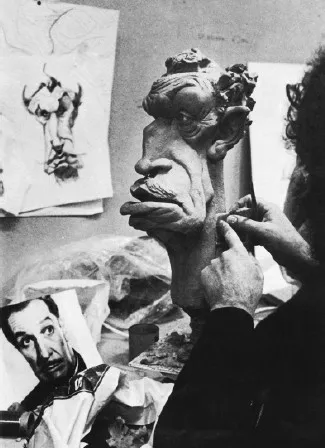
7. Andrew Macpherson, ‘A member of Spitting Image modelling film star Vincent Price’, 1984.
Photo © Andrew Macpherson, Los Angeles.
Sylvester Stallone (b. 1946, New York, aka ‘The Italian Stallion’) became a world-famous movie star during the 1970s and 1980s for his action-man roles as Rocky the boxer and Rambo the Vietnam veteran. He currently lives in Beverly Hills but during the 1990s, he occupied a large mansion and estate in Miami worth $16 million. In 1997, Stallone’s neo-classical-style villa overlooking Biscayne Bay was profiled by the glossy magazine Architectural Digest.10 Stallone has a passion for architecture and building and spent a small fortune remodelling the mansion. He was inspired by the baroque fantasies of Gianni Versace (1946–1997), the Italian fashion designer to the stars (and celebrity murder victim), a friend of his who had a home in South Beach Miami, and by interiors seen in Paris and Venice. Stallone was seeking ‘warmth, boldness, pageantry and over-the-top myth’ and told his Italian designer Massimo Papiri to ‘Rococo me to the max’.
Photographs by Dan Forer revealed lavishly decorated interiors with allegorical ceiling frescos, ornate chandeliers and furniture, and many paintings and scu...
Table of contents
- Cover
- Title Page
- Copyright
- Contents
- Acknowledgements
- Introduction
- 1 Celebrities as Art Collectors and Artists
- 2 Artists Depict Celebrities
- 3 Simulation and Celebrities
- 4 Alternative Heroes
- 5 Art Stars
- Conclusion
- Notes
- Bibliography
- Index
Trusted by 375,005 students
Access to over 1.5 million titles for a fair monthly price.
Study more efficiently using our study tools.
Frequently asked questions
Yes, you can cancel anytime from the Subscription tab in your account settings on the Perlego website. Your subscription will stay active until the end of your current billing period. Learn how to cancel your subscription
No, books cannot be downloaded as external files, such as PDFs, for use outside of Perlego. However, you can download books within the Perlego app for offline reading on mobile or tablet. Learn how to download books offline
Perlego offers two plans: Essential and Complete
- Essential is ideal for learners and professionals who enjoy exploring a wide range of subjects. Access the Essential Library with 800,000+ trusted titles and best-sellers across business, personal growth, and the humanities. Includes unlimited reading time and Standard Read Aloud voice.
- Complete: Perfect for advanced learners and researchers needing full, unrestricted access. Unlock 1.5M+ books across hundreds of subjects, including academic and specialized titles. The Complete Plan also includes advanced features like Premium Read Aloud and Research Assistant.
We are an online textbook subscription service, where you can get access to an entire online library for less than the price of a single book per month. With over 1.5 million books across 990+ topics, we’ve got you covered! Learn about our mission
Look out for the read-aloud symbol on your next book to see if you can listen to it. The read-aloud tool reads text aloud for you, highlighting the text as it is being read. You can pause it, speed it up and slow it down. Learn more about Read Aloud
Yes! You can use the Perlego app on both iOS and Android devices to read anytime, anywhere — even offline. Perfect for commutes or when you’re on the go.
Please note we cannot support devices running on iOS 13 and Android 7 or earlier. Learn more about using the app
Please note we cannot support devices running on iOS 13 and Android 7 or earlier. Learn more about using the app
Yes, you can access Art and Celebrity by John A. Walker in PDF and/or ePUB format, as well as other popular books in Politics & International Relations & Democracy. We have over 1.5 million books available in our catalogue for you to explore.