"This bold book explains why it will be so difficult to persuade the Pakistani military to renounce political power and return to the barracks. It is a must read for anyone who cares about Pakistan or its future." Lee H. Hamilton, President and Director, Woodrow Wilson International Center for Scholars "Siddiqa demonstrates [how] economic impunity and political impunity are closely related."
Nicole Ball, Senior Fellow, Center for International Policy, Washington DC "No one else has so comprehensively [explained] the army's involvement in Pakistan's economy, nor linked it so clearly with the army's growing and seemingly permanent role in Pakistan's politics." Stephen P. Cohen, Senior Fellow, Foreign Policy Studies, Brookings "Complex, riveting, absorbing, Siddiqa has written a vitally important book which enhances our understanding of the army on the front line in the war on terror."
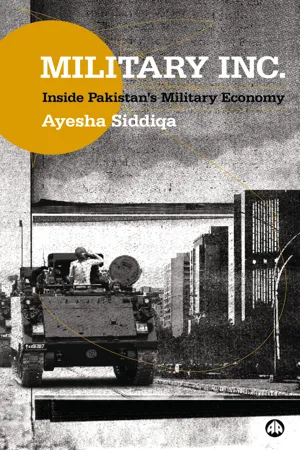
Ahmed Rashid, Far Eastern Economic Review "An incisive look at the largely hidden economic empire run by and for the benefit of Pakistan's military. This courageous book will not please Pakistan's generals. But no Pakistani, civilian or military, can afford to ignore its sobering analysis." Robert M. Hathaway, Director, Asia Program, Woodrow Wilson International Center for Scholars Pakistan is a strategic ally of the US in the "war on terror". It is the third largest receiver of US aid in the world. Yet Pakistan is a state run by its army. Siddiqa shows how the power of the military has transformed Pakistani society, where the armed forces have become an independent class. The military is entrenched in the corporate sector. So Pakistan's companies and its main assets are in the hands of a tiny minority of senior army officials. Siddiqa examines this military economy and the consequences of merging the military and corporate sectors. Does democracy have a future? Will the generals ever withdraw to the barracks? Military Inc. analyses the internal and external dynamics of this gradual power-building and the impact that it is having on Pakistan's political and economic development.
- 304 pages
- English
- ePUB (mobile friendly)
- Available on iOS & Android
eBook - ePub
About this book
Information
Subtopic
Military & Maritime HistoryIndex
HistoryTable of contents
- Cover
- Title Page
- Copyright
- Dedication
- Contents
- Acknowledgements
- List of acronyms
- Introduction
- Chapter 1 Milbus: a theoretical concept
- Chapter 2 The Pakistan military: the development of praetorianism, 1947–77
- Chapter 3 Evolution of the military class, 1977–2005 83
- Chapter 4 The structure of Milbus
- Chapter 5 Milbus: the formative years, 1954–77
- Chapter 6 Expansion of Milbus, 1977–2005
- Chapter 7 The new land barons
- Chapter 8 Providing for the men: military welfare
- Chapter 9 The cost of Milbus
- Chapter 10 Milbus and the future of Pakistan
- Notes
- References
- Index
Trusted by 375,005 students
Access to over 1.5 million titles for a fair monthly price.
Study more efficiently using our study tools.
Frequently asked questions
Yes, you can cancel anytime from the Subscription tab in your account settings on the Perlego website. Your subscription will stay active until the end of your current billing period. Learn how to cancel your subscription
No, books cannot be downloaded as external files, such as PDFs, for use outside of Perlego. However, you can download books within the Perlego app for offline reading on mobile or tablet. Learn how to download books offline
Perlego offers two plans: Essential and Complete
- Essential is ideal for learners and professionals who enjoy exploring a wide range of subjects. Access the Essential Library with 800,000+ trusted titles and best-sellers across business, personal growth, and the humanities. Includes unlimited reading time and Standard Read Aloud voice.
- Complete: Perfect for advanced learners and researchers needing full, unrestricted access. Unlock 1.5M+ books across hundreds of subjects, including academic and specialized titles. The Complete Plan also includes advanced features like Premium Read Aloud and Research Assistant.
We are an online textbook subscription service, where you can get access to an entire online library for less than the price of a single book per month. With over 1.5 million books across 990+ topics, we’ve got you covered! Learn about our mission
Look out for the read-aloud symbol on your next book to see if you can listen to it. The read-aloud tool reads text aloud for you, highlighting the text as it is being read. You can pause it, speed it up and slow it down. Learn more about Read Aloud
Yes! You can use the Perlego app on both iOS and Android devices to read anytime, anywhere — even offline. Perfect for commutes or when you’re on the go.
Please note we cannot support devices running on iOS 13 and Android 7 or earlier. Learn more about using the app
Please note we cannot support devices running on iOS 13 and Android 7 or earlier. Learn more about using the app
Yes, you can access Military Inc. by Ayesha Siddiqa in PDF and/or ePUB format, as well as other popular books in History & Military & Maritime History. We have over 1.5 million books available in our catalogue for you to explore.