'Hip Hop is Dead! Long Live Hip Hop!' From the front lines of hip hop culture and music in the USA, Britain, France, Japan, Germany, Hawaii, Tanzania, Cuba, Samoa and South Africa, academics, poets, practitioners, journalists, and political commentators explore hip hop -- both as a culture and as a commodity. From the political economy of the South African music industry to the cultural resistance forged by Afro-Asian hip hop, this potent mix of contributors provides a unique critical insight into the implications of hip hop globally and locally. Indispensable for fans of hip hop culture and music, this book will also appeal to anyone interested in cultural production, cultural politics and the implications of the huge variety of forms hip hop encompasses.
eBook - ePub
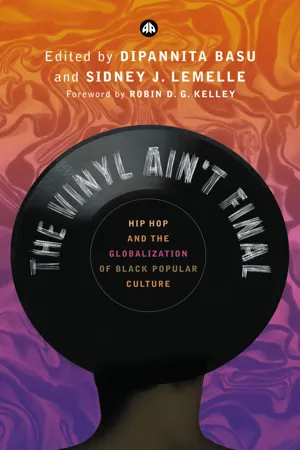
The Vinyl Ain't Final
Hip Hop and the Globalization of Black Popular Culture
- 288 pages
- English
- ePUB (mobile friendly)
- Available on iOS & Android
eBook - ePub
The Vinyl Ain't Final
Hip Hop and the Globalization of Black Popular Culture
About this book
Information
Subtopic
MusicSIDE TWO:
Rap and Hip Hop Groove Globally
8
The Nation Question: Fun^da^mental and the Deathening Silence
The politics of the group Fun^da^mental is the politics of hip hop, crossed with a punk Islam that morphs increasingly into interventions around race and representation, the war of ‘terror,’ and a radical version of human rights activism. This chapter charts an intertwined story about the journalistic reportage that surrounds the band, the record company from which they come, and the role of commentary and critique of the cultural politics, in a National register, that is their chosen milieu. In Britain, should it surprise us, the lyrical-rhythmic production of this Nation Records’ outfit has led to a terse relationship with the mainstream. Much of the music industry press and the critical comment that has been addressed to the band, and to their left-oriented takes on racism, imperialism, women and war, has betrayed itself as inadequate through distortion, condemnation, and hostility.
It is by now a commonplace that hip hop often suffers a bad press, but when it comes in the guise of Islam-oriented South Asians from the North of England, mixed up with a militant New York sensibility and an intolerance of intolerance that takes on world historical political issues, this is exacerbated. I want to argue that a new angle on Fun^da^mental might be due, though it is not for me to say that the language of the music press or academic convention is always wrong and to be rejected. It is rather that I favor the possibility of additional, even complementary, reorientations in an experimental set which hopes to open ears and minds. So, as the spotlight is moved to a different part of the stage, it might be plausible to look more carefully at the concepts and codewords involved. Thus: cue the master of anti-colonial ceremonial, Aki Nawaz, aka Propa Gandhi. The ‘fun’ and the ‘mental’ in fundamentalism is unleashed with a cascading mantra: ‘There shall be love, there shall be resistance, there shall be expression, there shall be defense, there shall be peace, or … there shall be war.’1
Conventional discussions of hip hop in Europe begin with ritual acknowledgement of the derivation of the form from the United States, soon followed by equally ritual insistence that local versionings of hip hop have their own character and autonomy. Without minimizing or forgetting variations in the regional reach of the music, I am tempted to argue that insistence on the similarity and difference of European hip hop(s) is little more than a two-step cultural cringe, masquerading as a boundary demarcation, but in all cases subject to forces of complicity, co-option, commercialization, and enclosure. If hip hop in Europe is marked by the same issues of articulation and institutionalization that afflict U.S. variants, it may be that a more interesting analysis would address something other than provenance or autonomy, and not repeat the formulaic recitations of the music press and cultural-industrial complex.
Global hip hop is of course institutionalized. It is a part of the music industry as industry. Here it is useful to remember Adorno’s insistance that we examine the mass production process of the cultural. Routinization is engraved into the grooves of records that are played over and over,2 and which are now played all over the place in an industry grafted onto a cultural form that activates a vast apparatus. Systematically integrating creativity, performance, distribution, sales; image, fashion, consumption and design; record stores, nightclubs, fashion shoots and parties; journalists, A&R (artist and repertoire), style mags and sweatshirts; spray cans and raybans, turntables and tablas; junglist-reggae feedback loops of extravagance and power; mad sonic digital fx, old school, nu skool and codes from back in the day … even the language of hip hop conforms minds to its ways. Yet as an industry, hip hop commands and demands a range of responses and potentials to rival other contemporary media forms.
This industry has reach. ‘Hip hop … has become a vehicle for global youth’ says one commentator,3 just as he narrates the routine of a move from the ‘adoption to an adaptation of US musical forms and idioms.’4 This historical and progressivist model does acknowledge that there is now a universal hip hop language, and notes that attention is also due to its forms outside the United States. But by insisting on this attention, I suggest a telling concession is made to pride of place in a way that betrays the origins and the sentiment of hip hop as it is made and lived by practitioners, rather than as documented by music press commentators and academics.
A vast culture industry. That much is true, we all know hip hop comes with its own parallel commentaries and a reach that goes beyond the expectations of the ‘under-assistant west-coast promo-man.’ Within the apparatus of this chapter I want to examine the role of commentary and critique in a political light. Discussions of hip hop in Britain continually address the diversity, reach, and extension of the cultures of hip hop. This is why Fun^da^mental are worth considering here. They exemplify the scene’s eclectic mix. Should we talk about the music first, or the make up of the band? Fun^da^mental hail from the Nation Records label and album to album produce a repertoire of music that has drawn an unprecedentedly wide range of comment and comparison. They have been characterized as among the first UK rap acts; they are known popularisers of the devotional Sufi music form Qawaali; they can produce lyrical Bollywood-hip hop crossover like ‘Sister India’;5 or mad loud metal distortion lyric chaos like ‘GoDevil’;6 they effect a hardcore punk aesthetic (impresario Aki Nawaz was formerly a drummer in the Southern Death Cult); and with a diminutive inflection, they have been marked as the Asian Public Enemy.7 The ‘Global Sweatbox’ night that was a feature of the turn of the millennium London dance scene was a Nation initiative, and the label, which Nawaz co-owns, has consistently worked in an international register. Acts as diverse as Prophets of Da City from South Africa, Aziz Mian from Pakistan, Asian Dub Foundation8 from the East End as well as Transglobal Underground and Loop Guru (from some other planetary domain) have been brought together in debate and exchange. Unlike conventional world music marketeering however, Nation and Fun^da^mental have a political project that underwrites their involvement.
Ted Swedenburg has noted that ‘among the manifold responses of European Muslims to Islamophobia has been hip hop activism.’9 This is also important in terms of the specificity of hip hop in the UK. If we want to chart this specificity, including its variant idioms and associated forms (jungle, trip-hop, grime) we might begin by noting how it is marked variously by nation, race, and class. This is relevant not only in terms of practitioners and audiences, but also in relation to wider public characterizations of hip hop as street music or club music—somehow dangerous and linked to crime and drug violence, by Government ministers no less (in Britain this is illustrated with the So Solid Crew incident in January 2003, see below). That a race and class analysis requires more than noticing where those who produce the sounds come from should be self-evident (even if those who produce the sounds are ‘originally’ out of some version of a so-called ‘ghetto,’ their incorporation into the culture industry does not guarantee a general social uplift). Keeping in mind the workings of racism and imperialism, that hip hop carries the burden of demonization alongside drugs, cars, trainers, and guns, has not insignificant consequences for the systemic impoverishment of Black peoples of whatever social status in multi-racial Britain, and across Europe as a whole.
THE TAME PRESS
In this context an ‘overreverential attitude towards US rap’ in British hip hop10 is something to be questioned. While it is true that the ‘variety’ and ‘diversity’ of hip hop in Europe is often attested to, and offered as criteria for, the maturity and autonomy of the European market in itself, a cursory glance through any of the music press commentaries will confirm the ways this diversity is conflicted. Britain’s premiere hip hop magazines, for example, continually carry articles, interviews, and reviews that frame evaluation in terms of whether or not UK hip hop has ‘come of age.’ To be reassured that there is ‘a healthy UK scene,’ as we are with Knowledge magazine in an article comparing drum and bass with hip hop, is indicative.11 In a staged debate (‘Clash of the Titans’) betw...
Table of contents
- Cover
- Title Page
- Copyright
- Contents
- Acknowledgements
- Foreword
- Introduction
- Side One: Grooving to the Vinyl Stateside—Rap and Hip Hop in the U.S.
- Side Two: Rap and Hip Hop Groove Globally
- Notes on the Contributors
- Index
Trusted by 375,005 students
Access to over 1.5 million titles for a fair monthly price.
Study more efficiently using our study tools.
Frequently asked questions
Yes, you can cancel anytime from the Subscription tab in your account settings on the Perlego website. Your subscription will stay active until the end of your current billing period. Learn how to cancel your subscription
No, books cannot be downloaded as external files, such as PDFs, for use outside of Perlego. However, you can download books within the Perlego app for offline reading on mobile or tablet. Learn how to download books offline
Perlego offers two plans: Essential and Complete
- Essential is ideal for learners and professionals who enjoy exploring a wide range of subjects. Access the Essential Library with 800,000+ trusted titles and best-sellers across business, personal growth, and the humanities. Includes unlimited reading time and Standard Read Aloud voice.
- Complete: Perfect for advanced learners and researchers needing full, unrestricted access. Unlock 1.5M+ books across hundreds of subjects, including academic and specialized titles. The Complete Plan also includes advanced features like Premium Read Aloud and Research Assistant.
We are an online textbook subscription service, where you can get access to an entire online library for less than the price of a single book per month. With over 1.5 million books across 990+ topics, we’ve got you covered! Learn about our mission
Look out for the read-aloud symbol on your next book to see if you can listen to it. The read-aloud tool reads text aloud for you, highlighting the text as it is being read. You can pause it, speed it up and slow it down. Learn more about Read Aloud
Yes! You can use the Perlego app on both iOS and Android devices to read anytime, anywhere — even offline. Perfect for commutes or when you’re on the go.
Please note we cannot support devices running on iOS 13 and Android 7 or earlier. Learn more about using the app
Please note we cannot support devices running on iOS 13 and Android 7 or earlier. Learn more about using the app
Yes, you can access The Vinyl Ain't Final by Dipannita Basu, Sidney Lemelle in PDF and/or ePUB format, as well as other popular books in Media & Performing Arts & Music. We have over 1.5 million books available in our catalogue for you to explore.