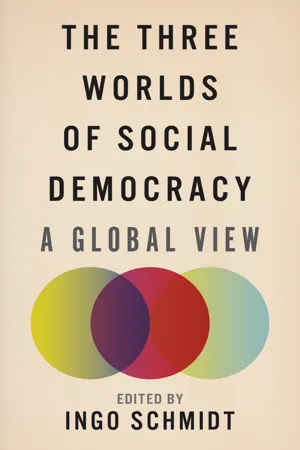
Social democracy is clearly at a dead end, but is it actually dead? The Three Worlds of Social Democracy explores the historical and theoretical path of the social democratic parties from their inception to the present day through a series of essays by high-profile experts in the field. Looking at the international picture, the book highlights the movement's spread to the postcolonial and post-communist countries of the Global East and South such as Eastern Europe, Latin America, India, and South Africa at the time it was considered past its prime in the West, a shift which is often ignored by mainstream analyses. However, the authors are not optimistic about its future – despite the rise of popular parties such as Greece's Syriza, a combination of international economic stagnation combined with an overall weakening of popular left-wing movements and a terrifying rise of extreme rightist parties paints a gloomy picture for the future of social democracy. This is one of the first truly global explorations of the methods, meanings, and limits of social democracy. This book will be of lasting value to students of politics and will further the ongoing debate about the future of social democratic politics across the modern world.
- 304 pages
- English
- ePUB (mobile friendly)
- Available on iOS & Android
eBook - ePub
About this book
Information
1
Introduction: Social Democracy and Uneven Development – Theoretical Reflections on the Three Worlds of Social Democracy
Social democracy is a paradoxical creature. With roots going back to the Age of Revolution from 1789 to 1848, it later established itself as an independent political force aiming to replace the dictatorship of capital by a socialist order in which workers would manage their own affairs in a democratic way. This was in the second half of nineteenth-century Europe. Soon social democrats argued over strategy, the big question being whether social reforms would lead to socialism in a piecemeal process or prepare workers for the revolutionary overthrow of capitalism. They were also torn between some who thought support of imperialism would help to gain reforms in the heartlands and others who considered imperialism as capitalism’s twin that had to be opposed. During and after World War I (WWI), social democracy’s radical wing went its own, communist, ways, and its moderate wing settled for some kind of halfway house between capitalism and socialism (Abendroth, 1972; Eley, 2002). Somewhat unexpectedly, considering the economic and political turmoil from 1914 to 1945 that seemed to indicate capitalism’s complete breakdown, social democratic goals were institutionalized in Western European welfare states during the post-WWII era (Hicks, 1999). Yet, it was in these heartlands that social democratic parties had tried to shake off commitments to the welfare state since the 1990s, a time commonly associated with neoliberal globalization and the end of the Cold War. Ironically, voters who were disappointed with the social insecurities and inequalities produced by neoliberalism repeatedly elected social democratic governments, hoping that they would offer at least some social protections. Balancing these expectations with corporate demands to lower taxes on profits and wealth and to relax all kinds of regulations is difficult enough when the economy is doing okay, but it becomes impossible in times of crises when faltering economies see government revenue plummeting and spending on unemployment benefits skyrocketing. This spectre of runaway deficits is big money’s lever to push for austerity. Submitting to finance capital’s demands, many social democratic governments have sacrificed the expectations of their voters and their own re-election.
Pursuing the same or even more ruthless neoliberal policies, respective successor governments often then also fall out of favour, and so we see a return of social democrats to government offices. Such electoral cycles may save the survival of social democratic parties, but that doesn’t mean that social democratic policies would be pursued at any time social democrats are in office. The social democratic idea of striking a compromise between capitalism and socialism is still popular, it seems, but today’s social democrats seem incapable or unwilling to deliver an update of this kind of compromise that seemingly worked so well from the 1950s to the 1970s. During this ‘Golden Age’ of capitalism, even conservative governments pursued social democratic policies without necessarily labelling them so. These days, social democrats pursue essentially neoliberal policies. For a while they misleadingly branded them as a Third Way, claiming equidistance to their previous commitment to the Keynesian welfare state and the neoliberalism of conservative parties (Fagerholm, 2013; Schmidt, 2012). More recently, most parties have given up any such labelling efforts. Sometimes they prescribe a lower dose of the neoliberal medicine than their conservative or other competitors, but sometimes they opt for bloodletting on a scale that their competitors preferred to avoid (Bailey et al., 2014; Escalona, Chapter 2, Kjeldstadli and Helle, Chapter 3, Crook, Chapter 4 in this volume).
Shaking off the very policies that voters are expecting from them isn’t the only paradox of social democracy. Another is the social democratic turn that former communists in the East and radical movements in the South have taken since the 1990s even though, by that time, social democracy’s glory days in the West were already over. After the downfall of Soviet communism, the parties that had represented it in Eastern Europe had the choice to either follow the fallen economic and political system into the dustbin of history or reinvent themselves with new politics and ideas (Gowan, 1997). Social democracy was a readily available option for them. Notwithstanding bitter infighting that followed the split between social democrats and communists during WWI and later escalated into the Cold War, which saw the mainstream of social democracy aligning themselves with US-imperialism against their erstwhile comrades, they shared the same statist and productivist principles. The fact that communist ideas and actual policies were only loosely, if at all, connected also made it easy for communist parties to drop their old label and put up a new one. Pursuing social democratic policies was a different matter though. Eastern Europe’s newborn social democrats took the Third Way to neoliberalism even faster than their Western European counterparts. They left electorates behind that were fed up with old communists and disappointed by the new social democrats (De Waele et al., 2013, Part III: Central and Eastern Europe; Vachudova, 2013; Vesalon, Chapter 8 and Korsika, Chapter 9 in this volume).
In Western Europe, policies that built and expanded welfare states thrived after WWII because an exceptionally strong and long-lasting boom, along with the exploitation of the South, allowed complementary increases of profits and wages. Capitalists might have preferred to pocket these gains entirely for themselves but the very existence of Soviet communism convinced them that concessions to social democracy and their welfare state project were an advisable way to deepen the divisions between the two red flags (Childs, 2000). This turned out to be a successful move. When social democrats turned to the policies of detente in the 1960s they did this as representatives of welfare capitalism, calling it a more effective and democratic, maybe even more equal, alternative to the bureaucratic dictatorships in the East. Minorities within social democracy that sought realignment with the Soviets in order to open the way for a democratic socialism beyond both welfare capitalism and Soviet communism never gained enough ground to challenge the pro-capitalist and Atlanticist orientation of the social democratic mainstream.
When Soviet communism collapsed, capitalists saw there was no longer the need to give concessions to social democracy and massively scaled up their offensive against the welfare state, which they had already begun in the early 1980s (Schmidt, 2008). Western social democrats reacted to this offensive by developing the Third Way and made it impossible for the new social democrats in Eastern Europe to deliver anything remotely resembling Golden Age-style welfare states. After all, victorious Cold Warriors from the West were keen on downgrading their former challengers to peripheral status, good enough to allow the appropriation of surplus profits by Western capitalists but not to pay for social protections in the East. Thus, even if there had been prolonged growth after the transition to capitalism, most of the economic gains were transferred to the West and little to nothing was left for redistributive policies in the East.
These are exactly the kinds of conditions that post-colonial regimes in the South tried to escape from during the post-WWII era. These regimes, and the developmentalism they pursued, showed some resemblance to Western welfare capitalism. Both were built around cross-class alliances trying to use the state as a countervailing power to markets shaped and controlled by capital. In the West the main goal of the Keynesian state was redistribution, in the South it was industrialization. This was considered a key step to overcome colonial or neocolonial exploitation. Resistance from Western imperialists and domestic capitalists, who were thriving on trade relations with these imperialists, along with the whirlwinds of economic crises in the 1970s, derailed the developmentalist project in ways similar to how the welfare statism in the West was derailed, just that the latter came without the imperialist interventions that the peoples in many countries in the South were facing. Many of them found themselves trapped, or pushed back, to peripheral, at best semi-peripheral, status but some, riding a wave of strong economic growth, developed into regional powers internationally and saw a social democratic turn domestically (Lanzaro, 2011; Sandbrook et al., 2007; Wang, 2012; White, 1998).
This turn may seem like a repetition of developments in Western Europe where social democracy was at its best during times of economic prosperity. But it wasn’t. The emerging economies boom that had underpinned hopes to belatedly repeat social democratic successes in the South was over before much in terms of welfare state development had been accomplished. Western European social democrats had benefited from prosperity and from systemic competition with Soviet communists. In some Southern countries, communists, deprived of their Soviet allies after the latter’s regime imploded, played an important role in turning to social democracy. During the struggle against apartheid the African National Congress (ANC), under significant influence from the South African Communist Party, upheld not only national liberation but even a version of anti-capitalism – the 1955 ‘Freedom Charter’ calling for widespread nationalisation – and then after 1994 replaced them by rhetoric promoting social democracy alongside what Patrick Bond terms ‘tokenistic’ welfare provision (Bond, Chapter 12 in this volume; Prevost, 2006). The Chilean communists underwent a similar transformation from the time they supported Allende’s Unidad Popular to their participation in post-Pinochet coalition governments (de la Barra Mac Donald, Chapter 6 in this volume). In Kerala and West Bengal, governments led by the Communist Party of India (Marxist) pursued a more Keynesian type of social democratic policies for a long time but adopted some Southern version of Third Way social democracy in the 1990s (Prashad, 2015; Sen, Chapter 11 in this volume). The Brazilian Workers Party followed a similar trajectory. Founded as a socialist party during the last years of the military dictatorship, its long-time leader Lula later ran against the social democratic candidate Cardoso, a prominent advocate of radical developmentalism in the 1970s, but also turned to Third Way policies prior to his successful bid for presidency in 2002 (Figueroa, 2015; Nowak, Chapter 10 in this volume).
Like their Western counterparts, Third Way social democrats in the South achieved some social moderation as long as capital accumulates but turn to austerity in times of crises. Not surprisingly, they also have to cope with disgruntled voters and are far from turning popular discontent into a counter-hegemonic project to neoliberalism (Féliz, Chapter 5 and Milios, Chapters 7 in this volume). The social democratic heartlands of Western Europe, new peripheries in Eastern Europe as well as old peripheries and new regional powers in the South occupy very different positions in the capitalist world economy, but on the level of politics there is a certain convergence. Neoliberalism is unpopular in all of these different worlds, social democratic alternatives are in demand, but the political formations that rally around them in election campaigns don’t deliver when they are in office.
This book tries to explain why social democratic policies are in such short supply even though discontent with neoliberalism produces a persistent demand for them. It also looks at alternative ways to articulate this discontent, ranging from various populisms to right-wing fundamentalism but also to new socialist projects. To do this, this introductory chapter recaps the emergence of social democracy in the capitalist centres during the age of imperialism before analyzing the articulation between social democracy, Soviet communism and developmentalism, and then looks at the globalization of Third Way social democracy in the neoliberal age (Evans, 2009; Held, 2005). The main part of the book is made up of case studies on social democracy in its Western European heartlands, in old and new peripheries in Eastern Europe and the South and, finally, in the new regional powers, Brazil, India and South Africa. The concluding chapter discusses the possibilities and challenges of building alternatives to the left of social democracy, but also ponders the dangers of a further rise of right-wing alternatives.
NASCENT WORLDS OF SOCIAL DEMOCRACY
The family tree of what is known as the social democratic party family today (Keman, 2013) goes back to the days of the Second International. In those days, political parties became one of the two main pillars of the then emerging mass movements of workers, unions being the other. The roots of this tree go back all the way to the bourgeois and industrial revolutions that unsettled European feudalism from the seventeenth century onwards and eventually led to the rise of industrial capitalism, the very system social democracy sought to tame or, in its more radical versions, replace by an only vaguely defined socialism (Smaldone, 2014). These roots had less to do with the class struggle between workers and capitalists, notions most distinctively elaborated by Marx and Engels and translated into a ‘movement language’ by many of their followers in the Second International, than with the struggles of ‘the people’, ‘commoners’ or the ‘Third Estate’ against aristocrats and clergymen. These vague notions were picked up again by social democratic or socialist activists to rally support for the social democratic cause beyond their core constituencies in the working class. This was the case when Eduard Bernstein and his followers sought to extend social democracy’s support base beyond the narrow confines of industrial working classes at the turn of the twentieth century. It was also the case when social democratic parties, though still heavily relying on industrial workers and their unions, reinvented themselves as catch-all parties during the age of Keynesian welfare states. The radical wing of social democracy tried to move from populist notions of ‘the people’ that had played a prominent role during the bourgeois revolutions of the early nineteenth century to more clearly defined working class politics. However, it’s moderate wing, equating working class with blue-collar industrial work, thought this class will always be a minority so that winning a majority of the population for social democratic policies would require some kind of cross-class alliance. Such alliances, though relying on class power, were ideological moulded in the populist language of ‘the people’ rather than socialist jargon of ‘the worker.’
Somewhat ironically even the communists, who started their own party family because they were so disgusted with social democratic class-collaboration, adopted the language of ‘the people’ or ‘labouring masses’, notably workers and peasants, in their claim to revive the revolutionary tradition, more precisely its Jacobin wing, against their usurping rulers. The Popular Fronts against fascism that were forged in the 1930s were another reinvention of the notion of ‘the people’ against privilege, power and oppression. One might even see the Popular Fronts advocated by the communists, as precursors of the social democratic catch-all parties of the post-WWII era.
If communists were the hostile brothers and sisters of the social democratic party family, developmentalist regimes were a distant relative of both. Trying to carve out their own space between the capitalist West, moderated by Keynesian welfare states, and the communist East, they identified as Third World (Prashad, 2007). This, of course, was also a reference to the struggles of the Third Estate against feudalism updated to the situation of twentieth century anti-colonialism. In other words, efforts to forge alliances amongst the popular classes and thus transcend the working class politics with which it is often identified are a recurrent part of the history of the social democratic party family. Similar efforts were made by their hostile and distant relatives, that is, communists and developmentalists, respectively. These efforts can be traced back to the Age of Revolution (Hobsbawm, 1962 [1992]), during which the pre-history of social democratic party organizing unfolded.
Another common heritage that social democrats, communists and developmentalists share goes back to the Age of Capital (Hobsbawm, 1975 [1997]), which really took off after the ‘People’s Spring’ of 1848 was defeated. This heritage concerns the question of how the inequalities between haves and have-nots, along with economic exploitation and political suppression accompanying these inequalities, could be overcome. The basic idea, most clearly put forward by Marx and Engels, was that industrialization, pushed forward by the imperatives of capital accumulation in nineteenth-century Europe, would develop the forces of production up to a point where everybody’s needs in society could be satisfied without many people suffering and enable a life of overabundance for everybody and not only, as under capitalist rule, for a happy few. Communists and developmentalists, coming to power in countries with little or no industrial basis, adopted this idea and sought to politically drive industrialization forward and thus overcome the imperialist division of labour between industrialized centres and peripheral producers of agricultural products and natural resources. Accordingly, state-led industrialization in the Soviet Union began in the 1920s and only during the post-WWII era in the newly independent countries of the Global South (Kiely, 1998).
However, the question of industrialization and the related question about the relations between industrialized and non-industrial countries were already on the agenda of nineteenth-century social democrats in Europe (Day and Gaido, 2012). These questions about industrialization and international relations were closely related to the aforementioned issue of class relations within countries (Abendroth, 1972). True to Marxist principles, radical social democrats argued that capitalism would produce large-scale industries but, by doing so, the proletariat would become the gravedigger of capitalism. A workers’ revolution would then replace the class divisions, exploitation and suppression associated with capitalism by a socialist economy, in which the means of production are collectively owned and managed. Recognizing that colonialism extended capitalist exploitation and suppression to the world...
Table of contents
- Cover
- Title Page
- Copyright
- Contents
- 1. Introduction: Social Democracy and Uneven Development – Theoretical Reflections on the Three Worlds of Social Democracy
- Part I. Heartlands
- Part II. Peripheries
- Part III. Regional Powers
- Notes on Contributors
- Index
Trusted by 375,005 students
Access to over 1.5 million titles for a fair monthly price.
Study more efficiently using our study tools.
Frequently asked questions
Yes, you can cancel anytime from the Subscription tab in your account settings on the Perlego website. Your subscription will stay active until the end of your current billing period. Learn how to cancel your subscription
No, books cannot be downloaded as external files, such as PDFs, for use outside of Perlego. However, you can download books within the Perlego app for offline reading on mobile or tablet. Learn how to download books offline
Perlego offers two plans: Essential and Complete
- Essential is ideal for learners and professionals who enjoy exploring a wide range of subjects. Access the Essential Library with 800,000+ trusted titles and best-sellers across business, personal growth, and the humanities. Includes unlimited reading time and Standard Read Aloud voice.
- Complete: Perfect for advanced learners and researchers needing full, unrestricted access. Unlock 1.5M+ books across hundreds of subjects, including academic and specialized titles. The Complete Plan also includes advanced features like Premium Read Aloud and Research Assistant.
We are an online textbook subscription service, where you can get access to an entire online library for less than the price of a single book per month. With over 1.5 million books across 990+ topics, we’ve got you covered! Learn about our mission
Look out for the read-aloud symbol on your next book to see if you can listen to it. The read-aloud tool reads text aloud for you, highlighting the text as it is being read. You can pause it, speed it up and slow it down. Learn more about Read Aloud
Yes! You can use the Perlego app on both iOS and Android devices to read anytime, anywhere — even offline. Perfect for commutes or when you’re on the go.
Please note we cannot support devices running on iOS 13 and Android 7 or earlier. Learn more about using the app
Please note we cannot support devices running on iOS 13 and Android 7 or earlier. Learn more about using the app
Yes, you can access The Three Worlds of Social Democracy by Ingo Schmidt in PDF and/or ePUB format, as well as other popular books in Politics & International Relations & Communism, Post-Communism & Socialism. We have over 1.5 million books available in our catalogue for you to explore.