The world is overheated: Too full and too fast; out of sync, contradiction-ridden and unequal. It is the age of the Anthropocene, of humanity's indelible mark upon the planet. In short, it is globalisation - but not as we know it. This collection explores social identities in today's 'overheated' world, seen from an anthropological perspective. The focus is on contradictions, tensions and paradoxes: How can an identity be stable if its border is constantly shifting? How can a community survive if it is incorporated into a huge entity? How does belonging work in new cities? And what can indigenous peoples do to retain a sense of self in a fast-moving neoliberal world? Ethnographically rich and diverse in its scope, Identity Destabilised contains chapters from many parts of the world, including the Philippines, Israel, Australia, the Cape Verde Islands and Afghanistan. The authors investigate how identity changes in response to contemporary forces, from rapid industrialisation, the enforced return of migrants and the silencing of indigenous groups to sudden population growth in boomtowns and the touristification of local culture.
eBook - ePub
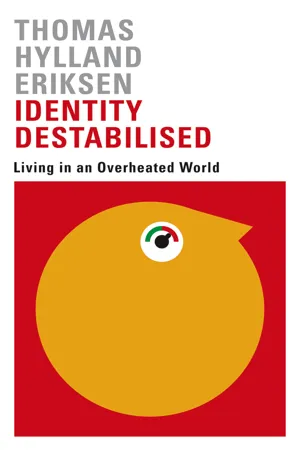
Identity Destabilised
Living in an Overheated World
- 272 pages
- English
- ePUB (mobile friendly)
- Available on iOS & Android
eBook - ePub
About this book
Information
1. Introduction
The Art of Belonging in an Overheated World
Identity and modernity; globalisation, culture and identity; changing identities in the (post-)modern world; cultural creolisation and the politics of identity; ambivalence and fundamentalism; identity, gender and power; intersectionality; social identity, cultural identity, gender identity, ethnic identity, sexual identity, national identity, class identity, regional identity, linguistic identity, the hybridisation of identities and the essentialisation of hybridity. For a while in the 1990s, the concept of identity seemed to be everywhere. It has subsequently faded away somewhat as a keyword in the social sciences, which is to be regretted, since we live in a time when good and focused research on social identification is acutely needed. The need for the term identity is possibly even more pressing today than in the last century, if the high-speed transformations we have witnessed in a number of locations across the globe over the last few years are any indication at all. In a fast changing world with rapidly increasing connectivity and mobility, with mounting environmental challenges, rapid economic transformations and the rise of often virulent nationalisms, forms of belonging to places, groups or communities are being challenged in new ways that social scientists arguably still need to have a language for.
Although it might seem that though the intellectual energy of the concept of identity was spent after the turn of the millennium, it cannot be denied that people in otherwise very different societies continue to raise strikingly similar questions about who they are and what this entails. In rapidly changing surroundings, the answers are fraught with controversy, often pitting ambivalence and doubt against withdrawal and the reassertion of boundaries.
This book represents an approach to identity which aims to take previous research a step further. Shifting, multiple, contested and unstable social identities that hold out a promise as the basis of a meaningful sense of belonging will be at the centre – identities which we view through a particular lens, namely that of accelerated change. It is as if modernity shifted into a higher gear towards the end of the twentieth century (Eriksen 2014, 2016). Phenomena that led to rapid changes in the postwar decades – migration, urbanisation, tourism, communication technology – are changing even faster in the 2010s. Adjusting to new circumstances is therefore necessary, and several options are available. To use Alfred Hirschman’s famous tripartite classification of strategies in organisations (Hirschman 1971): should they opt for exit (withdrawal into the secure and safe), voice (resistance and protest) or loyalty (adapting to the powers that be)? Or perhaps a pragmatic blend of the three? And how can a world that has been ripped apart, whether because of industrial development, migration or the expansion of finance capital, be patched together again so that it appears meaningful and secure? How can continuity with the past be created in a convincing way when change is taking place at enormous speed? And in what ways do global crises influence forms of belonging and the sense of self? That is what this book is about, and we now proceed to presenting some of the main themes that, in our view, should be explored in an updated anthropology of identity.
OVERHEATING AND SOCIAL IDENTITY
Seen from a bird’s-eye perspective, it is difficult to deny that the early twenty-first century appears to be an unusually hectic and restless period in the history of humanity. There seems to be rapid change everywhere. Ranging from foreign direct investment and the number of internet connections to global energy use, urbanisation in the global south and increased migration rates, rapid transformations are having impacts on social life in many ways, and have in some respects visibly stepped up their pace only since the 1990s. Dramatic alterations to the environment, economic transformations and social rearrangements are the order of the day in so many parts of the world, and in so many areas, that it may not be an exaggeration to speak of the global situation as being overheated (Eriksen 2016; see also Spooner 2015).
Overheating may serve as a central metaphor for the current phase of globalisation. The term calls attention to both accelerated change and the tensions, conflicts and frictions it engenders, as well as – implicitly – signalling the need to examine, through dialectical negation, deceleration or cooling down. Generally speaking, when things are suddenly brought into motion, they create friction; when things rub against each other, heat is generated at the interstices. Heat, for those who have been caught unawares by it, may result in torridness and apathy, but it may also trigger a number of other transformations, the trajectories of which may not be clear at the outset. When water is brought to boiling point, for instance, it actually changes into a different substance. In a similar fashion, we arguably find ourselves at a ‘systemic edge’ (Sassen 2014: 221) these days, with economic, social and cultural forms of globalisation expanding into ever new territories, often changing the very fundamentals of customary life for those who find themselves subject to the whirlwinds of change. These processes are not unilaterally negative or positive for those affected by them, since what may be perceived as a crisis by some could very well represent positive opportunities to others, and the potential for spontaneous transformative moments is always present. Even climate change is sometimes welcomed, for example in cold regions where agriculture becomes feasible, or in the far north, where the melting of the Arctic ice creates exciting opportunities for oil companies and may lead to the opening of new shipping routes. Overheating consists of a series of unintended, and interrelated, consequences triggered by global neoliberal deregulation, technological developments rendering communication instantaneous and transportation inexpensive, increased energy consumption and a consumerist ethos animating the desires of a growing world population.
Changes in economic, social and environmental circumstances are often perceived locally as being exogenous, in the sense that large segments of those societies affected did not initiate the changes themselves; indeed, while some local key actors usually collaborate in bringing about, and benefit from, these changes, a good number of people are generally left with the feeling that they were not even asked by anybody in power for their opinion. Such rapid changes in the social fabric may affect, challenge or – sometimes – strengthen people’s existing perceptions of themselves, their social belonging, who they are and where they are going. Making social and cultural identities sustainable in a world where change is unpredictable, frequently exogenous and often resulting in unintended consequences can be compared to rebuilding a ship at sea. It requires flexibility and improvisation, or novel forms of boundary-making. Others may discover that they are committed to change in such a way that it is stagnation, rather than change, that challenges their self-understanding, or they may approach the transformations around them with a lack of care and a fundamental sense of indifference.
Some questions people may typically ask in a situation of rapid change are: How can I be the person that I want to be when there is so much change? What is the essence of being me/us? What are the forces threatening our ability to remain who we think we should be? What kind of changes do we embrace, and what kind of changes do we see as a threat? The work of tracing a line connecting the past to the future, via the present, in a compelling and meaningful way, is easy when there is just repetition, but difficult when there is no clear script relating the past to the future, no story of either continuity or development which is persuasive. All the chapters in this collection engage with this problematic, from Drotbohm’s study of migrant lives which are cooled down upon enforced return to a slow place, via Kearney’s exploration of collective healing as a response to fast and catastrophic changes affecting cultural identity, Thorleifsson’s study of the ongoing negotiation of identity in a contested frontier area and Martin’s analysis of alienation among football supporters unsure of their identity amidst the transformation of their club into a global brand, to Banović’s story about destabilised gender identity in Montenegro and Schober’s ‘navy nostalgia’ in the Philippines, where the changes brought about by recent foreign direct investment makes indigenous people long for the ‘good old times’ when the US military was still around. Whereas MacClancy forcefully argues against frozen identities, showing how they are being resisted, Neumann takes a long historical view and points to how the flow of irreversible time is being punctuated by the construction of monuments creating a sense of stability, continuity – and collective identity.
The issues raised can be related analytically to the broader question of how social reproduction and social identity are related during times of dramatic change. If it is true, as we claim, that accelerated change is now being experienced across the world (although, naturally, in an uneven fashion in particular places, with some communities being entirely unaffected), then the actual reproduction of the social fabric of life – and its connection to the way people make sense of their day-to-day affairs – is a ‘burning’ issue for many. Social reproduction and its inter-linkages with identity may, moreover, be studied through the lens of more specific fields, from cultural reproduction to the reproduction of families, gender relations, class dynamics, ethnic divisions and so on, which are all affected by overheating. As Wimpelmann (this volume) points out, the emergence of new elites in Afghanistan has not eclipsed the old ones but led to a continuing tension, while Pijpers shows how the uneven speed of change in competing Sierra Leonean power structures exacerbates chronic tensions, leading to frequent contestations that boil down to the question of how livelihoods can be secured through identity claims made amidst accelerated transformations.
The term reproduction has played a central role in (neo-)Marxist debates about the meaning of work and labour. Marx understood labour as a key factor in the productive process, with his collaborator Engels (2010 [1884]) introducing an understanding of economic production that tightly linked it to the social reproduction of families. Engels’s understanding of the gendered division of labour, which shapes how men and women partake in economic activities, was later found to conceal more than it actually reveals by Marxist feminists. The reproduction of labour, Harris and Young (1981) argued, as important as it may be, cannot simply be conflated with the wider processes of social and biological reproduction that are undertaken within households, where a number of other non-economic societal values are being (re-)created as well. The old Marxist tension between production and reproduction was later developed in another direction in the work of Pierre Bourdieu (1977; cf. Robbins 2000: 42–65; see also Goody 1976). Bourdieu stresses the social and cultural dimensions of reproduction, with reproduction being turned into a concept that deals with the transmission of social formations from one generation to another. In Bourdieu’s understanding of the term, there is some space left for transformations to take place within routine processes of cultural reproduction. Change, in his view, has usually been a gradual, subtle process confined by pre-existing structural confines.
Through his sweeping study of the cultural reproduction of classes in French society (Bourdieu 1984), however, Bourdieu was essentially investigating the postwar period, which fizzled out in the 1980s. During the last decade of his life, Bourdieu was in fact deeply troubled by the onset of neoliberal regimes in the European Union. He understood globalisation and the shockwaves that it produced in Europe from the early 1990s onwards as destabilising the at times deeply oppressive, but at least predictable regimes of reproduction that he had studied for most of his academic career. With Bourdieu lamenting the end of the modernist era in his last important book (Bourdieu et al. 2000), one cannot but wonder what the French sociologist would have made of the changes unfolding since his death, an era during which the social, cultural and economic reproduction of people’s life-worlds in many places has become ever more destabilised, with concepts such as neoliberalism, Anthropocene and the precariat having rapidly become buzzwords in academic and intellectual discourse.
Since the early 2000s, the concept of identity, which we seek to bring into conversation with local social reproduction and large-scale change, has become increasingly contested in the social sciences, with Rogers Brubaker and Frederick Cooper arguing, at the turn of the millennium, that the social sciences might actually be better off without identity as part of its analytical toolbox (Brubaker & Cooper 2000; cf. MacClancy, this volume). At the same time, the everyday, emic usage of identity as a category of practice, an existential discourse, a feature of commercial life and an important, sometimes virulent form of politics, has spread to such an extent that ‘identity’ has reached near universal currency in the way social relations are made sense of in the world: from Peru to the Philippines, from Norway to Montenegro, the tendency is for people to decipher their collective plights, fortunes and futures through the lens of social identity (see e.g. Brandstädter et al. 2013; Jenkins 2014). Since it is obvious that we need to retain a concept for the analysis of these significant phenomena related to people’s collective views about themselves and others, we shall argue for an understanding of the term inspired by Reinhard Koselleck’s conceptual history approach. If identity is one of the key Grundbegriffe (basic concepts) of our times, then its very contestedness, ambiguity and historically shifting meaning attest to the fundamental role it continues to play in people’s understandings of themselves. Through his meticulous tracing of concepts through their historical transformations, Koselleck (2002) showed that basic concepts are inherently contradictory and multi-layered, and that they acquire new meanings, particularly during tumultuous times. This understanding of Grundbegriffe is supremely compatible with the way in which conceptualisations of identity twist and turn in the present era. To some of these changes we now turn.
BOUNDARIES AND FUZZY ZONES
Although the social science usage of the initially philosophical term identity began in developmental psychology (Erikson 1963), the bulk of the literature over the last decades of the twentieth century dealt with collective identities, often national, ethnic or religious. Whereas Gellner quipped that ‘[n]ationalism is not the awakening of nations to self-consciousness: it invents nations where they do not exist’ (Gellner 1964: 169), his student A.D. Smith (1986) took a different position, arguing that the transformation of ethnic groups into nations was a continuous historical process, not a conjuring trick.
Gellner and Smith nevertheless share a premise made famous in Barth’s essay on ethnicity (Barth 1969a), as well as in Anderson’s definition of the nation as being imagined as ‘inherently limited’ (Anderson 1983: 6). In all of these theorisations, identity categories were delineated as being bounded. While cultural meaning is often described through the concept of flow, thereby depicted as continuous, identity categories were seen as discontinuous and bounded (Eriksen 2015: 9). With the boundary understood by Barth as an ‘osmotic’ entity across which transactions, communication and even the flow of people could take place (Barth 1969a: 21), the existence of a clear dividing line was nevertheless a premise for the study of inter-ethnic processes. However, the very concept of the boundary has subsequently been problematised in a number of ways.
First, as argued by A.P. Cohen (1994), the concept of the frontier, seen as an ambiguous zone of negotiation, may in many cases be a more apt metaphor than the more rigid notion of the boundary. Indeed, the idea that ethnic groups are actually firmly bounded may be seen as an involuntary expression of methodological nationalism (Wimmer and Glick Schiller 2002), using the nation-state and its fixed borders as a template for sub-, non-, trans- and pre-national groups. Although few of the chapters in this volume explicitly deal with frontier areas (Thorleifsson’s is the most obvious example), they all interrogate the boundary as such, since it is being destabilised on the ground by uneven processes of change.
Second, as pointed out by Fardon (1987) and others, in many parts of the world the bounded ethnic group was often a colonial invention. Precolonial groups were often more fluid and overlapping than the groups emerging from population censuses and modern state-building.
Third, research on transnationalism (Glick Schiller et al. 1992; Olwig 2007) has shown that migrants often have an ambiguous national and local identity, with consequences for their ethnic identity. Many have economic and social obligations in two or more locations, bringing wit...
Table of contents
- Cover
- Also Available
- Title Page
- Copyright
- Contents
- List of Figures and Tables
- Preface
- 1 Introduction: The Art of Belonging in an Overheated World
- 2 Down With Identity! Long Live Humanity!
- 3 Frozen Cosmopolitanism: Coping with Radical Deceleration in Cape Verdean Contexts of Forced Return Migration
- 4 ‘We Are All Strangers Here’: Transforming Land and Making Identity in a Desert Boomtown
- 5 Identifying with Accelerated Change: Modernity Embodied in Gladstone, Queensland
- 6 Guarding the Frontier: On Nationalism and Nostalgia in an Israeli Border Town
- 7 Cultural Wounding and Healing: Change as Ongoing Cultural Production in a Remote Indigenous Australian Community
- 8 Indigenous Endurance amidst Accelerated Change? The US Military, South Korean Investors and the Aeta of Subic Bay, the Philippines
- 9 The Politics of Localness: Claiming Gains in Rural Sierra Leone
- 10 Too Many Khans? Old and New Elites in Afghanistan
- 11 Do Homosexuals Wear Moustaches? Controversies around the First Montenegrin Pride Parade
- 12 ‘We’re Far Too Far Down This Road Now to Worry about Morals’: The Destabilising of Football Fans’ Identities in an Overheated World
- 13 Frozen Moments: Visualizing the Polity in Times of Overheating
- 14 Eurovision Identities: Or, How Many Collective Identities Can One Anthropologist Possess?
- Notes on Contributors
- Index
Trusted by 375,005 students
Access to over 1.5 million titles for a fair monthly price.
Study more efficiently using our study tools.
Frequently asked questions
Yes, you can cancel anytime from the Subscription tab in your account settings on the Perlego website. Your subscription will stay active until the end of your current billing period. Learn how to cancel your subscription
No, books cannot be downloaded as external files, such as PDFs, for use outside of Perlego. However, you can download books within the Perlego app for offline reading on mobile or tablet. Learn how to download books offline
Perlego offers two plans: Essential and Complete
- Essential is ideal for learners and professionals who enjoy exploring a wide range of subjects. Access the Essential Library with 800,000+ trusted titles and best-sellers across business, personal growth, and the humanities. Includes unlimited reading time and Standard Read Aloud voice.
- Complete: Perfect for advanced learners and researchers needing full, unrestricted access. Unlock 1.5M+ books across hundreds of subjects, including academic and specialized titles. The Complete Plan also includes advanced features like Premium Read Aloud and Research Assistant.
We are an online textbook subscription service, where you can get access to an entire online library for less than the price of a single book per month. With over 1.5 million books across 990+ topics, we’ve got you covered! Learn about our mission
Look out for the read-aloud symbol on your next book to see if you can listen to it. The read-aloud tool reads text aloud for you, highlighting the text as it is being read. You can pause it, speed it up and slow it down. Learn more about Read Aloud
Yes! You can use the Perlego app on both iOS and Android devices to read anytime, anywhere — even offline. Perfect for commutes or when you’re on the go.
Please note we cannot support devices running on iOS 13 and Android 7 or earlier. Learn more about using the app
Please note we cannot support devices running on iOS 13 and Android 7 or earlier. Learn more about using the app
Yes, you can access Identity Destabilised by Thomas Hylland Eriksen, Elisabeth Schober in PDF and/or ePUB format, as well as other popular books in Social Sciences & Anthropology. We have over 1.5 million books available in our catalogue for you to explore.