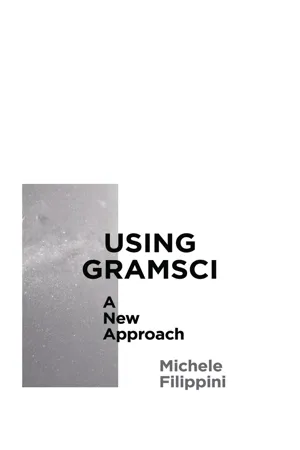
Thought of as one of the world's greatest political theorists, Antonio Gramsci's writings push readers to interpret and change the world. In Using Gramsci, Michele Filippini enlarges upon his seminal works, disentangling it from the prevailing orthodoxy in Gramscian analysis. The book explores his work on ideology, the individual, collective organisms, crisis and temporality, in addition to the more traditional areas of his thought, such as hegemony and civil society. Through this close examination, the use value of Gramscian theoretical instruments to a broad range of disciplines, including, political science, education, language, cultural studies, postcolonial studies, anthropology and geography, becomes apparent. Filippini's approach explicates and emphasises the importance of one of the most popular and enduring Marxist figures.
- 192 pages
- English
- ePUB (mobile friendly)
- Available on iOS & Android
eBook - ePub
About this book
Information
1
Ideology
Ideologies must become dramas if they are not to remain mere ink printed on paper.
Antonio Gramsci
13 October 1917
13 October 1917
THE PROBLEM OF IDEOLOGY
In his study of ideology, Michael Freeden cites Karl Mannheim, Louis Althusser and Antonio Gramsci as the three twentieth-century figures who made the greatest contribution to the broadening of our understanding of ideology. According to Freeden, their merit ‘was that they transformed our conception of ideology from the transient epiphenomenon Marx and Engels had made it out to be into a permanent feature of the political’.1 This view, whilst perhaps somewhat reductive in regard to Marxian writings, nevertheless grasps a fundamental advancement witnessed in the social sciences during the first half of the twentieth century. It is not surprising that the disciplines that suffered this ‘ideological tribulation’ were in fact those ascribable to the aforementioned three figures: that is, sociology, philosophy and political theory.
In the case of sociology, the transition from a purely instrumental conception of ideology to the establishment of a specific field of study regarding the formation of ideas – the sociology of knowledge – was completed without too much difficulty.2 In the case of philosophy, the process proved more uneven, and ended up grinding to a standstill when the attempt was made to interpret the effects and structure of ideology in a ‘constructive manner’, by considering ideology as a constantly coherent expression of social totality. In this case, the gap between ideological forms and economic structure was bridged, and ideology was reduced to the status of an objective function of the system.3 Finally, in the case of political theory, the transition to a more complex conception of ideology was attempted only occasionally, and in fact Gramsci remains, almost a century later, the main source of ideas for those wishing to deal with the question from a non-reductionist Marxist point of view.4
Gramsci agrees with, or rather pre-empts, the Althusserian view of ideology as an organic part of a social totality (Gramsci’s ‘historical bloc’), whilst at the same time maintaining the flexibility of the concept, so that he can consider ideological, on the one hand, the disjointed senso comune5 that is not aimed at, or functional to, any specific historical bloc a priori; and, on the other hand, philosophy, which is, in fact, in keeping with, and functional to, political domination. The various levels of ideology that Gramsci analyses – common sense, folklore, religion, philosophy (and science in part) – can thus be arranged according to a scale of internal consistency, where common sense and philosophy represent the extremes of such a scale. This scale, as we shall see, coincides with the level of consciousness of the bearer of this ideological thought system. In Gramsci’s view, the knowledge, understanding and development of these ideological elements represent the core of revolutionary political theory.
This approach to the formation of historical subjects – and thus to the various ideological forms that distinguish such – reveals Gramsci’s conviction that the historical bloc underlying each type of domination never derives mechanically from the morphological structure of society, but is, on the contrary, the result of the composition of elements that may be arranged in various different ways.
In order to deal with this tangle of problems, however, we need to first examine the context within which Gramsci wrote, and the level of debate on ideology at that time. His Prison Notebooks were written in the early 1930s, in a period in history that had only recently witnessed the introduction of the concept of ideology into the political vocabulary.
THE HISTORICITY OF THE CONCEPT OF IDEOLOGY
The first evidence of Gramsci’s interest in defining ideology can be found in a note from Notebook 4, in which he muses on the origin of the concept:
‘Ideology’ is an aspect of ‘sensationalism’, that is, of the eighteenth-century French materialism. It used to mean ‘science of ideas’, and since analysis was the only method recognized and applied by science, it meant ‘analysis of ideas’, that is, also, ‘search for the origin of ideas’. Ideas had to be broken down into their <original> ‘elements’, which could be nothing other than ‘sensations’.6
From here, Gramsci goes back to the definition of ideology formulated by Destutt de Tracy, whom he considered to be the ‘literary propagator of ideology […], among the most renowned and popular, because of the ease of his exposition’.7 In Tracy’s original design, ideology is a genuine ‘political science of the social’,8 the aim of which is to deal scientifically with the new field of study that actually has emerged with the advent of the French Revolution. The science that is to operate in this new field of study must provide answers to the questions: how are the ideas formed of those free, equal, fraternal individuals who, no longer being subjected to traditional or personal powers, produce ideas that are no longer foreseeable? What impact do such ideas have on the political order, and how can their effects be foreseen? In this case, the basis for the scientific study of ideas and their formation was laid by the historical circumstance that permitted such ideas to be ‘freed’ from their original, constant subjugation to traditional powers. That which, after 1789, became unforeseeable for such traditional powers, which up until then had regulated the formation of ideas, could become predictable for a science.
Thus, Gramsci was aware of the transformation that the concept had undergone, and he immediately displayed a strong awareness of its historicity. In truth, it was the very semantic and political evolution of the term following the post-revolutionary watershed that Gramsci was interested in, that is, ‘How did the meaning of “ideology” change from “science of ideas” and the search for the origins of ideas, to “a system of ideas?”’.9 We know that this transition took place very early in the history of the concept, in a period somewhere between Napoleon’s famous attack on the Idéologues and the emergence of Marxist criticism,10 which Gramsci saw as a ‘distinct advance [superamento]’11 on sensationalism. But if ‘In logical terms, the process is easy to understand – Gramsci continued –, how did it come about historically?’12 Gramsci’s interest in this transition already marks an important point: ideology had followed a rapid process of formation, politicization and, finally, criticism, as a result of the historical process triggered by the French Revolution. Therefore, it did not possess any independent character, since it was modelled on its own connections with historical-political events. Thanks to historical materialism, ideology thus took the form of the political element of the superstructure, to be analysed from a historical perspective.
The distinction between the two meanings of the term is indicated in the Prison Notebooks by the use, or otherwise, of the capital ‘I’. The science of ideas, the capitalized ‘Ideology’ of the Idéologues and of Tracy, is the science of a physiological nature that studies the formation of ideas on the basis of their derivation from sensations;13 ‘ideology’ with a small ‘i’, on the other hand, refers to the system of ideas that each person possesses, which does not depend on physiological causes but on historical-political ones.
In this latter meaning of ideology, the concept becomes a vast analytical terrain that in the Prison Notebooks is broadened and specified to constitute a multitude of further concepts, whilst at the same time revealing an area of theoretical engagement in which debate rages over ideology’s independence or dependence, its cognitive richness or its mystifying aspects, the rigidity it entails or the movement it stimulates. In fact, while the Prison Notebooks also features a non-specific use of the term – often with ‘ideological’ employed as a negative adjective – there are also signs of a knowing, albeit incomplete, construction of an independent concept of ideology on Gramsci’s part.14 This process of construction begins with Gramsci distancing his analysis from two other attempts made to do likewise within the Marxist field: Bukharin’s venture to provide Marxism with a sociology, and a theory of ideology based on this sociology; and that of the so-called ‘reflection theories’ that perceive ideology as a variable that is closely dependent on the economic structure, thus nullifying its importance from the knowledge point of view.
As far as regards the first of these two attempts, Gramsci’s criticism of Bukharin’s Historical Materialism: A System of Sociology submitted in Notebook 11,15 is that this work had remained tied to a concept of ideology similar to the one shared by the Idéologues, namely, a science that reconstructs the components of human thought, such components being taken as stable and uniform insofar as they are rooted in people’s consciousness and expressed by their common sense. Thus, Gramsci believed that Bukharin ‘really capitulated before common sense and vulgar thought, for he did not pose the issue in correct theoretical terms and was therefore practically disarmed and impotent’.16 The correct theoretical terms, on the other hand, are those of historical materialism, which compared to this meaning of ideology ‘represents a distinct advance [superamento] and historically is precisely in opposition to Ideology [capital letter]’.17 Marx himself, Gramsci continues, in connoting the concept of ideology negatively, thus attributing a value judgement to it, had pointed out the historical – and thus criticizable – origin of ideas rather than their physiological origin. By linking ideology to historical elements and to social relations, Marx marked a transition, a historical achievement for historical materialism (the philosophy of praxis in Gramsci’s vocabulary).
The second Marxist attempt to define ideology that Gramsci criticized was that of the so-called ‘reflection theories’. In fact, in the 1920s Gramsci found himself faced with a use of the concept, particularly by Marxists, which, on the one hand, had adopted the originality of the historicity of the ‘system of ideas’, but which, on the other hand, tended to interpret ideology as mere appearance, that is, as a simple reflection of the economic structure, within a rigid framework that once again renders useless the development of a proper concept, at the very time when the notion of ideology had been freed from its naturalistic origins.18 Gramsci reacted against this simplification:
For Marx, ‘ideologies’ are anything but appearances and illusions: they are an objective and operative reality; they just are not the mainspring of history, that’s all […]. Marx explicitly states that humans become conscious of their tasks on the ideological terrain of the superstructures, which is hardly a minor affirmation of ‘reality’ […]. This topic of the concrete value of superstructures in Marx should be studied thoroughly. Recall Sorel’s concept of the ‘historical bloc’. If humans become conscious of their task on the terrain of superstructures, it means that there is a necessary and vital connection between structure and superstructures, just as there is between the skin and the skeleton in the human body. It would be silly to say that a person stands erect on his skin rather than his skeleton, and yet this does not mean that the skin is merely an appearance and an illusion – so much so that the condition of a flayed person is not very pleasant.19
Reference is being made here to the human organism, something that we shall often encounter in the Prison Notebooks, to describe the workings of modern society. For now we are simply going to point out that Gramsci’s analogy between the relationship of skeleton to skin, and that of structure to ideology, serves not only to express the mutual interdependence of the pairs of terms, but also alludes to a general systemic function that ideology (like skin) performs within the overall mechanism. There can be no (living) skeleton without skin, and likewise there can be no skin (performing its function) without a skeleton. The two things only operate together, without, however, any necessary hierarchical relationship between them given that both, albeit in different ways, are determined by the presence of the other. This approach thus negates the simplistic vision of ideology as a mere instrument.
THE COMPLEXITY OF IDEOLOGY
A second characteristic of Gramsci’s conception of ideology is its complexity. In fact, for Gramsci ideology represents a ‘complex form of the social world’,20 not only in the sense of ‘complicated’, but more precisely – and etymologically speaking – in the sense of a non-linear object, composed of different parts and several elements, that depends on various determinations. Thus, ideology in the Prison Notebooks cannot be conceived as a unitary moloch, a pre-established, coherent block of ideas and positions, constructed in order to be instilled in the minds of subalterns by intellectuals, ideologists or party officers. On the contrary, in Gramsci’s view there are those who are privy to an ideology due to their standing in the world of production, or because of their position in the disjointed world of common sense; there are those who produce ideology from their position as major intellectuals, and those who do so as the ‘dominant group’s “underlings”’.21 There are also those who operate in a manner inconsistent with their own ideology, and thus who express an ‘ideology in practice’ that is different from that of their words:
The average worker has a practical activity but has no clear theoretical consciousness of h...
Table of contents
- Cover
- Title Page
- Copyright
- Dedication
- Contents
- Series Preface
- Acknowledgements
- Abbreviations
- Introduction
- 1 Ideology
- 2 The individual
- 3 Collective organisms
- 4 Society
- 5 The crisis
- 6 Temporality
- Conclusion
- Notes
- Bibliography
- Index
Trusted by 375,005 students
Access to over 1.5 million titles for a fair monthly price.
Study more efficiently using our study tools.
Frequently asked questions
Yes, you can cancel anytime from the Subscription tab in your account settings on the Perlego website. Your subscription will stay active until the end of your current billing period. Learn how to cancel your subscription
No, books cannot be downloaded as external files, such as PDFs, for use outside of Perlego. However, you can download books within the Perlego app for offline reading on mobile or tablet. Learn how to download books offline
Perlego offers two plans: Essential and Complete
- Essential is ideal for learners and professionals who enjoy exploring a wide range of subjects. Access the Essential Library with 800,000+ trusted titles and best-sellers across business, personal growth, and the humanities. Includes unlimited reading time and Standard Read Aloud voice.
- Complete: Perfect for advanced learners and researchers needing full, unrestricted access. Unlock 1.5M+ books across hundreds of subjects, including academic and specialized titles. The Complete Plan also includes advanced features like Premium Read Aloud and Research Assistant.
We are an online textbook subscription service, where you can get access to an entire online library for less than the price of a single book per month. With over 1.5 million books across 990+ topics, we’ve got you covered! Learn about our mission
Look out for the read-aloud symbol on your next book to see if you can listen to it. The read-aloud tool reads text aloud for you, highlighting the text as it is being read. You can pause it, speed it up and slow it down. Learn more about Read Aloud
Yes! You can use the Perlego app on both iOS and Android devices to read anytime, anywhere — even offline. Perfect for commutes or when you’re on the go.
Please note we cannot support devices running on iOS 13 and Android 7 or earlier. Learn more about using the app
Please note we cannot support devices running on iOS 13 and Android 7 or earlier. Learn more about using the app
Yes, you can access Using Gramsci by Michele Filippini in PDF and/or ePUB format, as well as other popular books in Politics & International Relations & Political History & Theory. We have over 1.5 million books available in our catalogue for you to explore.