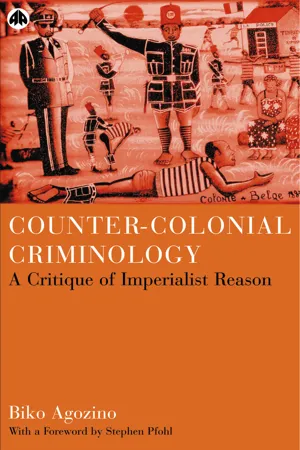
This book is about how the history of colonialism has shaped the definition of crime and justice systems not only in former colonies but also in colonialist countries. Biko Agozino argues that criminology in the West was originally tested in the colonies and then brought back to mother countries - in this way, he claims, the colonial experience has been instrumental in shaping modern criminology in colonial powers. He looks at how radical critiques of mainstream criminology by critical feminist and postmodernist thinkers contribute to an understanding of the relationship between colonial experience and criminology. But he also shows that even critical feminist and postmodernist assessments of conventional criminology do not go far enough as they remain virtually silent on colonial issues. Biko Agozino considers African and other postcolonial literature and contributions to counter colonial criminology, their originality, relevance and limitations. Finally he advocates a 'committed objectivity' approach to race-class-gender criminology investigations in order to come to terms with imperialistic and neo-colonialist criminology.
- 293 pages
- English
- PDF
- Available on iOS & Android
eBook - PDF
About this book
Information
Table of contents
- Contents
- Introduction
- 1. The Enlightenment and Euro- American Theories of the Judicial Process 13Enlightened Retribution and Utilitarianism
- 2. From Determinism to Meaning: The Emergence of the Labelling Perspective
- 3. From Societal Reaction to Questions of Power: From Labelling to Radical Criminology
- 4. Feminist Perspectives and Critical Criminology 63Feminist Empiricism
- 5. Lesbian Rape: Maternal Metaphors for the Patriarchal State and International Conflict Resolution
- 6. Poststructuralism and Positivism in Criminological Theory
- 7. Social Fiction Sui Generis : The Fairy Tale Structure of Criminological Theory 103Tensions between Facticity and Validity 103The Murder of Reality
- 8. Executive Lawlessness and the Struggle for Democracy in Africa 113What is Crime and What is Punishment?
- 9. Radical Criminology in African Literature
- 10. Committed Objectivity in Race Class Gender Research
- 11. How Scientific is Criminal Justice? A Methodological Critique of Research on McCleskey v. Kemp and Other Capital Cases 173The Case of McCleskey
- 12. What is Institutionalised? The Race Class Gender Articulation of Stephen Lawrence
- 13. Criminal Records: The Toughest, the Police and the Thieves: The Policing of Peter Tosh and Popular Culture
- Conclusion: Beyond Criminological Orientalism
- Bibliography
- Index
Trusted by 375,005 students
Access to over 1.5 million titles for a fair monthly price.
Study more efficiently using our study tools.
Frequently asked questions
Yes, you can cancel anytime from the Subscription tab in your account settings on the Perlego website. Your subscription will stay active until the end of your current billing period. Learn how to cancel your subscription
No, books cannot be downloaded as external files, such as PDFs, for use outside of Perlego. However, you can download books within the Perlego app for offline reading on mobile or tablet. Learn how to download books offline
Perlego offers two plans: Essential and Complete
- Essential is ideal for learners and professionals who enjoy exploring a wide range of subjects. Access the Essential Library with 800,000+ trusted titles and best-sellers across business, personal growth, and the humanities. Includes unlimited reading time and Standard Read Aloud voice.
- Complete: Perfect for advanced learners and researchers needing full, unrestricted access. Unlock 1.5M+ books across hundreds of subjects, including academic and specialized titles. The Complete Plan also includes advanced features like Premium Read Aloud and Research Assistant.
We are an online textbook subscription service, where you can get access to an entire online library for less than the price of a single book per month. With over 1.5 million books across 990+ topics, we’ve got you covered! Learn about our mission
Look out for the read-aloud symbol on your next book to see if you can listen to it. The read-aloud tool reads text aloud for you, highlighting the text as it is being read. You can pause it, speed it up and slow it down. Learn more about Read Aloud
Yes! You can use the Perlego app on both iOS and Android devices to read anytime, anywhere — even offline. Perfect for commutes or when you’re on the go.
Please note we cannot support devices running on iOS 13 and Android 7 or earlier. Learn more about using the app
Please note we cannot support devices running on iOS 13 and Android 7 or earlier. Learn more about using the app
Yes, you can access Counter-Colonial Criminology by Biko Agozino in PDF and/or ePUB format, as well as other popular books in Social Sciences & Sociology. We have over 1.5 million books available in our catalogue for you to explore.