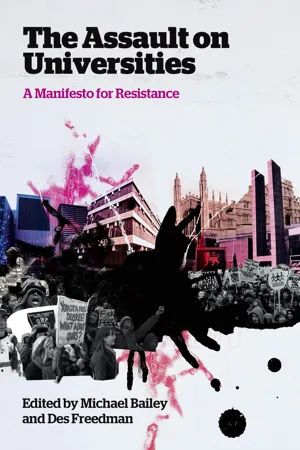
With funding cuts well under way and many institutions already promising to charge the maximum 9, 000 pounds yearly tuition fee, university education for the majority is under threat. This book exposes the true motives behind the government's programme and provides the analytical tools to fight it. Widespread student protests and occupations, often supported by staff, unions and society at large, show the public's opposition to funding cuts and fee increases. The contributors to this sharp, well-written collection, many of whom are active participants in the anti-cuts movement, outline what's at stake and why it matters. They argue that university education is becoming increasingly skewed towards vocational degrees, which devalues the arts and social sciences - subjects that allow creativity and political inquiry to flourish. Released at the beginning of the new academic year, this book will be at the heart of debates around the future of higher education in the UK and beyond, inspiring both new and seasoned activists in the fight for the soul of our universities.
- 200 pages
- English
- ePUB (mobile friendly)
- Available on iOS & Android
eBook - ePub
About this book
Trusted by 375,005 students
Access to over 1.5 million titles for a fair monthly price.
Study more efficiently using our study tools.
Information
1
An Introduction to Education
Reform and Resistance
Reform and Resistance
Des Freedman
‘REFORM’
A celebrated education reformer noted recently that ‘it is only when services are paid for that their beneficiaries really appreciate them and that their employees strive to perfect them. A world in which students pay for their own university education will be a world where the universities are better funded, intellectually freer and where economic justice ensures that the burden does not lie on the taxpayer but on graduates.’1 Who issued this moving tribute to the market? Margaret Thatcher? Ronald Reagan? David Cameron? Nick Clegg? No, Terence Kealey, vice-chancellor of the University of Buckingham (fees: approximately £9000 per year), the UK’s first private university and an institution that is ‘proud never to have accepted Goverment [sic] funding, favouring instead our academic independence’.2
Kealey’s words are significant because they so clearly articulate the ConDem coalition’s devastating perspective on higher education policy as contained in the Browne Review on education funding and student finance and the government’s own legislative programme of 2010–11. This includes a commitment to withdraw most public subsidies for universities, shift financial responsibility on to students who are now to be treated as customers, increase tuition fees to a level that an emerging market can sustain, re-package student debt and loans as ‘deferred payments’ and re-designate universities themselves as sites of service provision, consumer activity and commodity exchange. The UK’s higher education system is to be transformed into a patchwork of academic supermarkets with, at one end, research-led Russell Group universities continuing to super-serve wealthier customers with a wide range of niche offerings while, at the other end, former Polytechnics in the Million+ group will be forced to clear their shelves of distinctive or idiosyncratic goods and to focus on those products for which there is already a clearly defined (mass) market. All shoppers, meanwhile, will have to pay higher prices.
This will be the state of British higher education in the second decade of the twenty-first century should the ConDem ‘reforms’ be fully implemented and internalised by universities themselves. It is a picture of renewed privatisation, intensive marketisation, rampant financialisation and a challenge to the very notion of the university as a mechanism for addressing social inequality and facilitating the circulation of knowledge whether or not it has immediate practical consequences. It is the substitution of private economic activity for robust public life. Of course universities are not, and never have been, pristine sites of autonomous intellectual labour – you only have to consider the close collaboration between many universities and the defence and security industries across the world. However, like many other publicly funded institutions which do not always live up to expectations (the BBC and the NHS spring to mind), a strong defence of the principle of public provision carries with it the possibility not only of ‘holding the line’ but also of invigorating and democratising these institutions. This involves both imagining and campaigning for policies that best express the public interest and most effectively protect it against those who are determined to place all areas of human activity under the discipline of the market.
Responding to the attacks on higher education, however, also requires an understanding of the various contexts behind the ‘reforms’. According to the government, the most pressing challenge is the need to secure stable long-term funding for universities in the light of the budget crisis caused by what it describes as an unsustainable deficit caused by the previous Labour government’s profligacy. What this means in practice is a decision to shift the burden of paying for higher education from the state to individual students. This is not a victimless crime. Research conducted by UCU has found that the scrapping of all public funding for the teaching of arts, humanities and social science subjects (as part of an 80 per cent cut to the annual block grant to universities), together with cuts of over £1 billion that have already been announced, means that some 40,000 jobs and 49 English universities are at risk.3 The most vulnerable institutions are those teaching-intensive universities, often former polytechnics with the highest level of working-class students, who do not have the international students, research contracts or established ‘brands’ to help them withstand the removal of public funding.
This is, of course, only one small part of the government’s neoliberal programme of privatisation and spending cuts which will see billions of pounds withdrawn from public services and welfare budgets as well as the devolution of power away from publicly accountable institutions to, for example, GPs in the running of the health service, academies in the provision of secondary education and housing associations in the management of social housing. We are therefore likely to see huge job losses affecting civil servants, NHS staff and council workers at precisely the time when unemployment, by the start of 2011, had already reached nearly 8 per cent with nearly one million young people without work, the highest since records began in 1992.4 The government’s scrapping of the Education Maintenance Allowance (EMA), originally aimed at improving participation rates in further education, will only compound the problem of youth unemployment.
Indeed, the government’s determination to shrink the higher education budget is utterly counter-productive if it wishes to seek a way out of the recession. The UK already spends a lower proportion of its GDP on higher education (0.7 per cent) not only in comparison with EU and OECD averages (1.1 and 1 per cent respectively), but also in relation to a whole series of countries including the USA, Portugal, New Zealand, Iceland, Hungary and Mexico.5 Now it wishes to reduce this even further even though its own policy documents are filled with rhetorical flourishes about the importance of higher education to the national economy and future prosperity. So while the Obama administration presses for an increase in its education and research budgets as a purposeful way to galvanise the US economy,6 the UK government is set on gambling on the highly dubious assumption that private investment in education will deliver the same public benefits as state support.
The current attack on universities, however, should not be reduced to a desire simply to address the UK’s current deficit, as many of the trends underlying the ‘reforms’ are far from new. Remember that it was a New Labour administration that first scrapped maintenance grants and introduced upfront charges in 1998; in 2003 then education secretary Charles Clarke insisted that ‘[a]s countries throughout the world have discovered, requiring students to contribute to the cost of their education is the only realistic alternative’.7 Under New Labour, private sector activity in higher education grew from 32.3 per cent of all HE spending in 2000 to 64.2 per cent in 2007, well above the EU average of 20.6 per cent.8 This huge increase in private finance was due not simply to the introduction of fees but to other initiatives such as the hundreds of millions of pounds of private investment under PFI schemes which were poured into capital projects on campuses, the government’s backing of ‘employer-led provision’ and the granting of degree-awarding powers to private companies operating outside of the nationally agreed framework for higher education.
Universities are therefore increasingly subject to competing pressures: to continue to privilege teaching, learning and research as a public good but simultaneously to act as corporate entities in achieving this ambition (see Chapter 15 for an assessment of these tensions in relation to the USA). This is a highly unstable relationship as more and more of the structures of university life are outsourced and marketised. It is not simply about the Scolarest experience, where every cup of coffee tastes the same, but about the intrusion of private companies into the very fabric of academic life. Companies such as INTO and Kaplan, whose staff are on vastly inferior terms and conditions, are responsible for the recruitment and teaching of international students at a number of ‘prestigious’ universities including Exeter, East Anglia and Sheffield, while education secretary David Willetts has made it clear that he wants to see more private providers operating in the HE sector. Welcoming the announcement by BPP University College that it would offer up to a thousand places on its programmes in law and business, Mr Willetts responded that ‘[w]e are seeing the first glimmerings of the opening of universities to supply-side reform’.9
Privatisation now extends well beyond the provision of catering and recruitment services. The ConDem’s true objective may be to secure a fully-fledged market inside the UK higher education system but there are already a whole host of ‘everyday’ practices that seek to naturalise competition within academic life. The National Student Survey, where students rate their experience of teaching and resources (and for which an iPod is usually offered to one lucky student) is modelled on US approaches to ‘customer satisfaction’ in universities, while the impending Research Excellence Framework (REF), with its emphasis on bibliometrics and ‘impact’, is a further nod towards the instrumentalisation and quantification of higher education.
While respective governments have set the ideological and policy agenda, university employers seem reluctant to stand in their way. Many of those in the Russell Group positively embraced the Browne Review and the introduction of higher fees while very few vice-chancellors publicly declared their opposition to the government’s ‘reforms’, leading one ex-VC to criticise his fellow employers for doing very little visibly to resist the cuts. ‘Whatever view you take of the planned privatization of higher education, it [the silence of VCs] was not a stirring call to arms.’10 Indeed, employers have been far more willing to use the premise of ‘tough financial times’ as an opportunity to seek redundancies (compulsory as well as voluntary) and drastic changes to pensions provision than they have been to stand up alongside staff and students in opposing the cuts.
So we now have a higher education system which is overwhelmingly privately financed and increasingly market-driven and an ideological consensus shared by all recent governments that this is both desirable and necessary. In this context, dreaming of a ‘golden age’ of universities is not a helpful campaign strategy. There can be no going back to a pre-ConDem ‘paradise’ given New Labour’s commitment to privatisation. But there can also be no return to even older models of higher education given the enormous increase in student numbers and the justified reluctance to go back to a time where a university education was the preserve of a privileged minority. Instead, we need to look ahead: both to defend what is most progressive about the higher education system we have inherited and to imagine new policies, practices and structures for universities on which to focus our campaigns.
RESISTANCE
For many people, the march against tuition fee increases and funding cuts on 10 November 2010 marked the beginning of such a campaign. Staff and students had long been involved in specific battles, for example, against the withdrawal of funding for ESOL courses (English for speakers of other languages), against mass redundancies such as those at Leeds University in 2009/10 and in campaigns against the growth of the private sector in dozens of HE institutions. But more recent protests signal a movement that goes far beyond immediate questions of finance to engage with questions concerning the overall purpose of universities and their continued existence as sites of discussion and discovery. The media and indeed the leaders of the trade unions who called the November demonstration (the NUS and UCU) focused initially on the smashing of windows at Millbank, the headquarters of the Conservative Party. Quite quickly, however, it became clear that the determination of students, including school students who took to the streets in their tens of thousands towards the end of 2010, had captured the imagination of many others whose lives were set to be affected by the broad sweep of government cuts. The birth of a new student movement (see Part IV) has allowed millions to enter a debate about the legitimacy and ideological purpose of the ConDem spending cuts.
The breadth and imagination of this movement has helped partially to insulate it from the demoralisation that inevitably followed the passage of legislation confirming tuition fee increases and the abolition of the EMA in late 2010 and early 2011. This is set to be a struggle for the soul of universities that will be played out over years rather than months along with the pauses, setbacks and sudden advances that characterise most grass-roots campaigns. If resistance to the long-term, but now vastly accelerated, privatisation of universities is to be successful, then the campaign needs to operate on multiple fronts, to embrace a range of strategies and to involve the maximum number of people possible.
For many, the backbone of the movement to defend universities from further privatisation and to protect the livelihoods of those who work on campuses will be the higher education trade unions, the largest of which is the University and College Union (UCU), with over 120,000 members. The UCU has, in contrast to many other unions, actually grown since its creation in 2006 out of a merger between AUT (organized in the ‘old’ universities) and NATFHE (largely representing the post-1992 sector) and demonstrated its strength when members took industrial action in 2006 as part of a substantial pay claim, eventually winning a 15 per cent pay increase between 2006 and 2009 (a gain that employers seem reluctant to forget in current disputes). UCU has quickly established itself as a radical union, partly given the high-profile coverage of its conference resolutions in relation to a boycott of Israeli academic institutions, and partly because of the left-wing make-up of its National Executive Committee. Perhaps the key reason for its radicalism, however, is simply that its members find themselves in a fast-changing ‘industry’ where they are forced to act collectively in relation not only to ‘bread and butter’ issues (for example, massive casualisation, increased workloads and now deteriorating pay and pensions) but the more ‘political’ questions concerning curricula, research outcomes and, of course, the very ‘idea’ of the university.
At the time of writing, UCU members in HE are balloting for industrial action in defence of pensions, job security and salaries, rights which government and employers claim are unsustainable given the current economic problems. Clearly this is a question of priorities in the sense that billions of pounds of public money have been poured into UK banks since 2008 in recognition of their importance for the national economy. No such attention has been paid to UK universities, which are viewed instead as a drain on the public purse. Given the ideological nature of the attack on publicly funded universities, it therefore merits both a robust trade union response – serious and sustained industrial action that delivers a clear message to the employers – as well as a political response with demands on government (similar to those made by Aeron Davis in Chapter 5) in terms of raising taxes on the very rich and pursuing tax avoiders with greater vigour than is currently shown.
UCU members, however, will have to win not just ballots but support amongst other campus staff and students for their actions. This involves breaking down existing sectional barriers as far as possible (between professors and visiting tutors, between staff and students, between academics and support staff) through organising together, holding joint meetings and running united campaigns. Virtually every protest action in the last few years at Goldsmiths, for example, has been backed by both UCU and the Students Union including campaigns against INTO’s proposal to recruit and teach international students, management’s plans to set up a local Trust school free from local authority control and, of course, UCU’s current industrial campaign against the attacks on pensions, jobs and pay. We run an annual teach-in together in which staff and students come together to discuss pressing themes – commodification, ‘alternatives’, the idea of a ‘future’ – and hold regular rallies sponsored by staff and student unions. The more we are encouraged to think of ourselves in the current circumstances as either service providers or customers, the more such unity will be essential in building successful campaigns.
But we also ought to go above and beyond trade union action that is often ...
Table of contents
- Cover
- Title page
- Copyright page
- Contents
- 1. An Introduction to Education Reform and Resistance Des Freedman
- Part I The Changing Idea of the University
- 2. The Idea of the University John K. Walton
- 3. What is a University Education For? Neil Faulkner
- 4. Fighting for the University’s Life Nick Couldry
- Part II Current Challenges and Future Visions
- 5. Economic Alternatives in the Current Crisis Aeron Davis
- 6. Re-imagining the Public Good Jon Nixon
- 7. The War Against Democracy and Education Nick Stevenson
- Part III Critical Pedagogy
- 8. The University as a Political Space Alberto Toscano
- 9. The Academic as Truth-Teller Michael Bailey
- 10. Impoverished Pedagogy, Privatised Practice Natalie Fenton
- Part IV Student Politics
- 11. Student Revolts Then and Now John Rees
- 12. The Politics of Occupation Feyzi Ismail
- 13. Achievements and Limitations of the UK Student Movement Ashok Kumar
- Part V International Perspectives
- 14. Beyond the Swindle of the Corporate University Henry A. Giroux
- 15. Education Reforms in a European Context Marion von Osten
- 16. International Students and the Globalisation of Higher Education Kirsten Forkert
- Part VI The Manifesto
- Demands on Government
- Demands on Universities
- Signatories to the Manifesto
- Notes on Contributors
- Index
Frequently asked questions
Yes, you can cancel anytime from the Subscription tab in your account settings on the Perlego website. Your subscription will stay active until the end of your current billing period. Learn how to cancel your subscription
No, books cannot be downloaded as external files, such as PDFs, for use outside of Perlego. However, you can download books within the Perlego app for offline reading on mobile or tablet. Learn how to download books offline
Perlego offers two plans: Essential and Complete
- Essential is ideal for learners and professionals who enjoy exploring a wide range of subjects. Access the Essential Library with 800,000+ trusted titles and best-sellers across business, personal growth, and the humanities. Includes unlimited reading time and Standard Read Aloud voice.
- Complete: Perfect for advanced learners and researchers needing full, unrestricted access. Unlock 1.5M+ books across hundreds of subjects, including academic and specialized titles. The Complete Plan also includes advanced features like Premium Read Aloud and Research Assistant.
We are an online textbook subscription service, where you can get access to an entire online library for less than the price of a single book per month. With over 1.5 million books across 990+ topics, we’ve got you covered! Learn about our mission
Look out for the read-aloud symbol on your next book to see if you can listen to it. The read-aloud tool reads text aloud for you, highlighting the text as it is being read. You can pause it, speed it up and slow it down. Learn more about Read Aloud
Yes! You can use the Perlego app on both iOS and Android devices to read anytime, anywhere — even offline. Perfect for commutes or when you’re on the go.
Please note we cannot support devices running on iOS 13 and Android 7 or earlier. Learn more about using the app
Please note we cannot support devices running on iOS 13 and Android 7 or earlier. Learn more about using the app
Yes, you can access The Assault on Universities by Michael Bailey, Des Freedman in PDF and/or ePUB format, as well as other popular books in Education & Education Administration. We have over 1.5 million books available in our catalogue for you to explore.