The Iraq war defined the first decade of the twenty-first century – leading to mass protests and raising profound questions about domestic politics and the use of military force. Yet most explanations of the war have a narrow focus either on political personalities or oil. Christopher Doran provides a unique perspective, arguing that the drive to war came from the threat Iraq might pose to American economic hegemony if the UN sanctions regime was ended. Doran argues that this hegemony is rooted in third world debt and corporate market access. It was protection of these arrangements that motivated US action, not Iraq's alleged weapons of mass destruction or a simplistic desire to seize its oil. This book will provide new insights on the war which still casts a shadow over global politics, and will have wide appeal to all those concerned about the Middle East, world peace and global development.
eBook - ePub
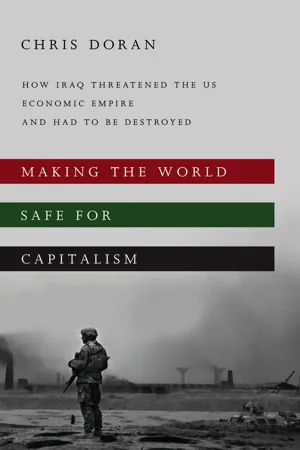
Making the World Safe for Capitalism
How Iraq Threatened the US Economic Empire and had to be Destroyed
- 296 pages
- English
- ePUB (mobile friendly)
- Available on iOS & Android
eBook - ePub
Making the World Safe for Capitalism
How Iraq Threatened the US Economic Empire and had to be Destroyed
About this book
Trusted by 375,005 students
Access to over 1.5 million titles for a fair monthly price.
Study more efficiently using our study tools.
Information
Part I
Making Sense of the Invasion and Occupation of Iraq
1
Introduction: Making Sense of Iraq

If you thought the army
Was here protecting people like yourself
I’ve some news for you
We’re here to defend wealth
... We’re making the world safe for capitalism
Billy Bragg, ‘Marching Song of the Covert Battalions’
In April 1917, Woodrow Wilson told the people of the United States that they had to join the carnage of the First World War in order ‘to make the world safe for democracy’. He lied. Wilson’s desire to have America enter the war was in large part to protect American corporate investments in Britain and France, and to ensure that bankers like JP Morgan would get the money back they had loaned those countries.1 The war was not to make the world safe for democracy; it was to make it safe for capitalism.
Eighty-six years later, in 2003, the US would enter another controversial war to make the world safe for capitalism: Iraq. And like the First World War, an American president would deliberately lie about the real reasons the country needed to wage war, a mainstream media would follow blindly, and in the war’s aftermath people would still be trying to make sense of what had happened, and why.
The 2003 American-led invasion and subsequent occupation of Iraq has arguably received the most media attention and analysis of any event in recent history. Yet a decade after the 9/11 attack that launched the US War on Terror and the subsequent Iraq invasion that fundamentally changed the course of US history, there is still a shortage of credible explanations. The key arguments put forward by the Bush, Blair (UK) and Howard (Australia) administrations were proven to be false, and Iraq proved to be the political downfall of all three leaders and their reputations.
What has resulted is a decade of national soul-searching, and a deep divide between left and right, progressive and conservative. Few agendas have been more divisive in American history than Bush’s self-proclaimed global War on Terror. This agenda has continued under the Obama administration, which despite being elected on a platform and promise of change, has continued much of the War on Terror policies of the Bush administration, which it had roundly condemned. Unfortunately, this has included Iraq. Ensuring that Iraq remains a US client state will continue to be American foreign policy regardless of who is in the White House, because a truly free and independent Iraq, unlike the vast majority of the world’s 195 nations, could actually challenge the key underpinnings of America’s global dominance.
Which is the point of this book: that the motivation for the US-led invasion and subsequent occupation of Iraq in March 2003 was to eliminate the threats a post-UN sanctions Iraq posed to American economic hegemony. This hegemony, rooted in Third World debt and corporate market access, has seen trillions of dollars flow from the Third World to the First via the World Bank, the International Monetary Fund (IMF), the World Trade Organization (WTO), and free trade agreements. An independent Iraq, free to develop its own oil resources unimpeded, would have had the potential to challenge Saudi Arabia’s petrodollar financing of the US economy, and directly challenge the Saudi state’s capacity to serve American interests via its dominant oil producer status.
The war has been an extension, and protection, of the same free market neoliberal policies which have driven successive American, British, and Australian governments over the past three decades. It was market access and control of the global economy that motivated the US to invade Iraq, not weapons of mass destruction, or ties to Al Qaeda, or a simplistic desire to seize Iraq’s oil. While consistent with those policies, invasion by military force was also an important – and frightening – new phase of US willingness to guarantee the survival of its global power.
Neoliberalism is the supercharged form of capitalism which emerged as a concerted American corporate response to the anti-Vietnam war, pro-consumer and environmental movements of the 1960s and 1970s, to become the dominant government ideology from the early 1980s onwards. Along with Austrian Friedrich Hayek, American economist Milton Friedman is one of neoliberalism’s most famous, and enthusiastic, founding champions. In Capitalism and Freedom (1962), Friedman outlines the three key cornerstones of neoliberal policy:
1. Governments must remove all rules and regulations standing in the way of the accumulation of profits.
2. Governments should sell off any assets they own that corporations could be running at a profit.
3. Governments should dramatically cut back funding of social programmes.
These can be succinctly summarised as deregulation, privatisation of public entities, and cutbacks of government services: capitalism on crack cocaine.
Better known in the United States in its various guises of free market ideology, Reaganism, trickle-down economics, or corporate globalisation, neoliberalism, in its most recent ideological incarnation under the Tea Party, is also the fundamental belief that the individual in society is best served by as little government as possible.
Friedman’s formula was applied domestically in the US beginning with the ‘Reagan Revolution’ in the early 1980s and, slightly earlier in the UK, under Margaret Thatcher. It was then applied internationally via the debt control and market mechanisations of the World Bank, IMF, WTO and free trade agreements. Neoliberalism has continued through successive administrations and congresses, including the ‘Yes We Can’ Obama presidency. Fuelled by ever-increasing corporate donations, lobbying and media concentration, the era of free market neoliberalism has seen a massive transfer of wealth from the world’s working class and poor to the wealthiest of the wealthy. Neoliberal policies and their effective implementation have been the basis of US global economic dominance from at least 1982 onwards, when the first World Bank/IMF Structural Adjustment Programmes were instituted under Reagan. Ironically, it has perhaps brought about its own potential downfall through massive unsustainable spending on Wall Street bailouts and military outlay to guarantee its survival.
The election of Barack Obama, the financial markets meltdown and bailouts to Wall Street amidst significant public anger, and the subsequent rise of the Tea Party – at few other times in US history has there been the intense mobilisation of political forces regarding the role of government in the economy: a quintessential question of neoliberal ideology and reality.
The ultimate beneficiaries of free market neoliberalism have been corporations and their shareholders. The ideology of neoliberalism emphasises the right of the individual to be free from government interference. Because corporations are legally recognised as individuals, it is these ‘rights’ of the individual as protected by the US Constitution’s Bill of Rights and under common law provisions in the UK and Australia that have given the corporation as an ‘individual’ the ultimate power and benefits under neoliberalism. Understanding this connection is key to understanding US motivation not only in Iraq, but in any number of other crucial policy crises, such as national health care, climate change, or environmental protection.
This book’s following five parts examine the five areas of how a post-UN sanctions Iraq either directly threatened the ongoing success of American economic power, or provided enormous opportunities to extend it.
IRAQ’S POTENTIAL THREAT TO SAUDI ARABIA AS A US CLIENT STATE
Part II examines the crucial underpinning that Saudi Arabia and Middle Eastern oil revenues have provided for US global hegemony from at least 1973 onwards in the aftermath of the OPEC oil embargo, in both its direct funding of the American neoliberal agenda, domestically and internationally, and via Saudi Arabia’s capacity to control oil supply and price concerns for American interests. The Saudis and other Arab oil-producing states have been reinvesting the bulk of their oil revenues back into the US economy. This had resulted in an estimated $1 trillion in petrodollars being invested in primarily the United States from 1973 to 2000.2 The American economy had become increasingly dependent on these petrodollar investments as a means of addressing its own debt and budget deficits.
A post-sanctions Iraq would also have been in position to use revenue from its oil reserves – second only to Saudi Arabia’s – and offer its internal development model as an alternative to the neoliberal US-dominated World Bank, IMF, WTO and regional free trade agreements. This is what Iraq had done prior to the first Gulf War, when it advocated that other Arab states should reinvest their oil revenues back into their own economies for internal development. In contrast, Saudi Arabia and Kuwait sent their oil profits to be invested in US banks and government securities, money which had provided the backbone of Third World loans via the World Bank and IMF. This arrangement had been instrumental in developing countries paying an estimated $4.6 trillion from 1980 to 2004 to creditors in First World countries, in particular the United States.3
It was, and is, Iraq’s oil-producing potential to directly rival Saudi Arabia that made it imperative that Iraq either be contained (increasingly more difficult under the UN sanctions), or directly placed in the US client-state orbit. Direct control of Iraq via ‘regime change’ meant not only removing these impediments to American global economic dominance, it also meant potential control of Iraq’s oil production as a complement to, or even potential direct replacement of, Saudi Arabia.
Within this context, the 2003 invasion was not the start of a war on Iraq, but a long continuation from when Iraq invaded Kuwait in 1990 and the UN Security Council, under US leadership, passed UN Resolution 687, which placed economic sanctions on Iraq. Despite the US and its allies driving Iraq from Kuwait, the sanctions remained in place for 13 years. The sanctions officially were to ensure Iraq eliminated its weapons of mass destruction programmes. The sanctions were actually intended to remove Saddam Hussein from power and remove the substantial obstacles, as well as open up new opportunities, for the free market neoliberal agenda by having control over Iraq. That the sanctions had failed in their purpose and were nearing the end of their vitality as an ongoing strategy due to increased international pressure regarding their humanitarian effect, meant that the US and its allies went to the next phase: regime change.
DOLLAR DOMINANCE: CONTROLLING THE DOLLAR, CONTROLLING IRAQ
Part III looks at how American economic power was also directly threatened by Iraq’s 2000 decision to switch from accepting dollars for its oil sales to only accepting euros. Up to that time, all oil had been sold exclusively in dollars, which was a key factor underpinning the US’s dominant role in the global economy since the new world financial order was established by the Bretton Woods agreements in 1944. If other Middle East oil producers switched from dollars to euros, trillions would be taken out of the US economy, as countries would need to move from having dollars in reserve to pay for oil, to having euros on hand. The tremendous advantage for the US of having trade exclusively denominated in American dollars is little explored in neoliberal literature, yet it is arguably as vital a component of US economic hegemony as any other. In particular, the Nixon administration’s decision to no longer require the dollar to be backed up by gold reserves, combined with the near-simultaneous decision to remove capital constraints on US banks, created a new economic paradigm for the United States.
The 2003 invasion of Iraq is just one instance, albeit a significant one, of nearly one hundred years of US and British attempts to subjugate Iraq for market control of its oil. Part III also addresses the post-First World War British imperialist founding of and subsequent domination of the nation state of Iraq, through Iraqi independence and the post-Second World War American support for coups in Iran and Iraq. In particular, it addresses American support for Saddam Hussein during the Iran–Iraq War of the 1980s, including assistance in developing chemical weapon infrastructure.
LOSING OUT: US ELIMINATED FROM OIL AND OTHER IRAQI MARKETS POST SANCTIONS
The United States had also been eliminated from any participation in the Iraqi economy once the sanctions were lifted. Saddam Hussein’s regime had signed huge post-sanctions contracts with European and Russian firms to develop its oil resources, at the direct prohibition of American companies. The US was thus eliminated from playing any role, let alone a controlling one, with regard to the world’s second largest oil reserves. Access to markets is a fundamental tenet of free market, neoliberal ideology and policy.
In 1995, the Wall Street Journal summarised: ‘... the European companies will have grabbed the best deals ... Indeed, the companies that win the rights to develop Iraqi oil fields could be on the road to becoming the most powerful multinationals of the next century.’4 Iraq post-sanctions had also eliminated the US and its corporations’ access to every other Iraqi market: agriculture, electronics, vehicles, manufacturing, and so on.
Over nine years after the invasion, actual control of Iraq’s oil remains elusive due to the ongoing militancy of the resistance and the questionable legal authority of the central government. However, despite lacking the clear legislative authority to do so, the Iraqi government has in recent years signed oil contracts that, if fully realised, could see Iraq pumping enough oil to far outstrip Saudi Arabian production, and as a result destabilise if not outright eliminate OPEC. This in turn would solidify US hegemony for the foreseeable future.
The US does have de facto control of the Iraqi government, control which it believes will continue regardless of troop levels thanks to the ensnaring of Iraq in the World Bank, IMF, and the WTO. Even if Iraq descends into all-out civil war and no oil is pumped, it would mean no other nation state or their companies would have control either. Had Saddam Hussein remained in power post-sanctions and honoured the European companies’ access to Iraq’s oil at the expense of American ones, he would also have further strengthened Iraq’s commitment to selling its oil in euros, and influenced others to do the same. Preventing the rise of any potential rival to its superpower dominance is implicit in the Bush administration’s 2002 National Security Strategy, and is even more emphatically declared in previous documents written by Bush administration officials before taking office, as examined throughout this book.
REGIME CHANGE: THE OPPORTUNITY TO CREATE A BRAND NEW, NEOLIBERAL, FREE MARKET STATE
As well as eliminating these threats, seizing direct control of Iraq presented a number of opportunities. Part V examines American efforts to impose a new free market, neoliberal US client state where one had not previously existed. Such a client state would open up a new market to US capital of 28 million well-educated people, affluent from oil revenues. The head of the Coalition Provisional Authority, Paul Bremer, was blunt about American intentions: ‘It’s a full scale economic overhaul. We’re going to create the first real free market economy in the Arab world.’5
According to free market neoliberal theory, it is the state’s responsibility to create markets where they did not exist before. As examined in Chapter 13, in the face of a diminished ability to continue to expand free market neoliberalism in the face of hostile global resistance, the United States moved to the next level of invading Iraq.
The enforced economic orders under the Coalition Provisional Authority are examined in detail in Chapter 17. Chapter 21 addresses ongoing American efforts to control Iraq’s oil, including pressure for the Iraqi Parliament to pass legislation that would have given western oil companies unprecedented access to the country’s nationalised oil industry, and the inspiring story of Iraqi civil society successfully resisting its passage.
The United States, along with Australia and the United Kingdom, the other key members overseeing the occupation, laid the institutional framework to ensure that Iraq’s economic future would be tied to the World Trade Organization, and to the neoliberal structural adjustment programmes of the World Bank and IMF. Chapter 20 also relates how the CPA established the political and legislative framework to ensure that these laws would be embedded in any future elections, constitution, or legislative context.
EXPANDING THE EMPIRE: A NEOLIBERAL FREE TRADE AREA...
Table of contents
- Cover
- Title page
- Copyright page
- Dedication page
- Contents
- PART I MAKING SENSE OF THE INVASION AND OCCUPATION OF IRAQ
- 1 Introduction: Making Sense of Iraq
- 2 Iraq: A Devastated Country
- 3 A Full Scale Economic Overhaul: The Rise of Free Market Neoliberalism
- 4 Chile and the Blueprint for Iraq
- PART II IRAQ’S POTENTIAL THREAT TO SAUDI ARABIA AS A US CLIENT STATE
- 5 Nixon, Saudi Arabia and the Geopolitical Roots of the Iraq Invasion
- 6 Petrodollar Recycling, Third World Debt and the Washington Consensus
- 7 Neoliberalism, Debt and American Empire
- 8 Containing Iraq: The Gulf War and Sanctions
- PART III DOLLAR DOMINANCE: CONTROLLING THE DOLLAR, CONTROLLING IRAQ
- 9 Threat to the Dollar: Iraq, the Euro and Dollar Dominance
- 10 Dollar Challenge Redux: The Global Financial Crisis and Iraqi Oil
- 11 Containing Iraq: Oil, Imperialism and the Rise of Corporate Rule
- 12 Iraq: Resistance and Revolution
- PART IV LOSING OUT: THE US ELIMINATED FROM OIL AND OTHER IRAQI MARKETS POST SANCTIONS
- 13 State of Play: Neoliberalism Wounded, US Hegemony Challenged
- 14 Losing Out: The Geopolitical Significance of Iraq’s Oil
- 15 The Push for War
- 16 Invading Iraq: Bush’s Agenda from Day One
- PART V REGIME CHANGE: OPPORTUNITY TO CREATE A BRAND NEW, NEOLIBERAL, FREE MARKET STATE
- 17 Regime Change: The Bremer Economic Orders
- 18 Reconstruction and Corruption: The Next Klondike
- 19 Reconstruction and Corruption: The Halliburton and Bechtel Contracts
- 20 Locking Down Iraq: Post Sovereignty
- 21 Iraqi Oil: A New and Improved Saudi Arabia for the Twenty-first Century
- PART VI EXPANDING THE EMPIRE: A NEOLIBERAL FREE TRADE AREA FOR THE MIDDLE EAST
- 22 The US Middle East Free Trade Area
- 23 Case Studies: Jordan and Morocco
- 24 Case Studies: Oman and Bahrain
- 25 Egypt and How to Make a Fortune from Hunger and Misery
- PART VII SOWING THE SEEDS OF DEMOCRACY: A CASE STUDY OF IRAQI AGRICULTURE
- 26 Neoliberal Authority: Iraqi Agriculture
- 27 Order 81 and the Genetically Modified Seeds of Democracy
- 28 Seeds in the Ground
- 29 Hunger and Misery: A Profitable Occupation
- PART VIII CONCLUSION: IRAQ AND THE CORPORATE CAPTURE OF THE DEMOCRATIC STATE
- 30 The Corporate Capture of the Democratic State
- Notes
- Index
Frequently asked questions
Yes, you can cancel anytime from the Subscription tab in your account settings on the Perlego website. Your subscription will stay active until the end of your current billing period. Learn how to cancel your subscription
No, books cannot be downloaded as external files, such as PDFs, for use outside of Perlego. However, you can download books within the Perlego app for offline reading on mobile or tablet. Learn how to download books offline
Perlego offers two plans: Essential and Complete
- Essential is ideal for learners and professionals who enjoy exploring a wide range of subjects. Access the Essential Library with 800,000+ trusted titles and best-sellers across business, personal growth, and the humanities. Includes unlimited reading time and Standard Read Aloud voice.
- Complete: Perfect for advanced learners and researchers needing full, unrestricted access. Unlock 1.5M+ books across hundreds of subjects, including academic and specialized titles. The Complete Plan also includes advanced features like Premium Read Aloud and Research Assistant.
We are an online textbook subscription service, where you can get access to an entire online library for less than the price of a single book per month. With over 1.5 million books across 990+ topics, we’ve got you covered! Learn about our mission
Look out for the read-aloud symbol on your next book to see if you can listen to it. The read-aloud tool reads text aloud for you, highlighting the text as it is being read. You can pause it, speed it up and slow it down. Learn more about Read Aloud
Yes! You can use the Perlego app on both iOS and Android devices to read anytime, anywhere — even offline. Perfect for commutes or when you’re on the go.
Please note we cannot support devices running on iOS 13 and Android 7 or earlier. Learn more about using the app
Please note we cannot support devices running on iOS 13 and Android 7 or earlier. Learn more about using the app
Yes, you can access Making the World Safe for Capitalism by Christopher Doran in PDF and/or ePUB format, as well as other popular books in Politics & International Relations & International Relations. We have over 1.5 million books available in our catalogue for you to explore.