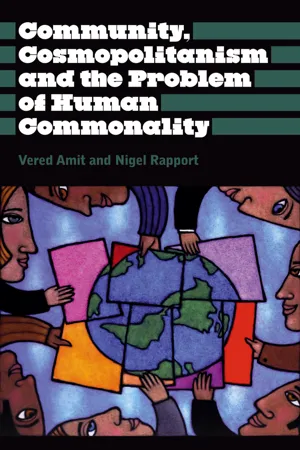
Do notions of community remain central to our sense of who we are, or can we see beyond community closures to a human whole? This volume explores the nature of contemporary sociality. It focuses on the ethical, organisational and emotional claims and opportunities sought or fashioned for mobilising and evading social collectivities in a world of mobile subjects. Vered Amit and Nigel Rapport present an examination of the tensions and interactions between everyday forms of fluid fellowship, culturally normative claims to identity, and opportunities for realising a universal humanity.
eBook - ePub
Community, Cosmopolitanism and the Problem of Human Commonality
- 240 pages
- English
- ePUB (mobile friendly)
- Available on iOS & Android
eBook - ePub
Community, Cosmopolitanism and the Problem of Human Commonality
About this book
Information
Part 1
Community and Disjuncture:
The Creativity and Uncertainty of Everyday Engagement
Vered Amit
1
Community as ‘Good to Think With’:
The Productiveness of Strategic Ambiguities

You might not be surprised to learn that when I picked up my daily newspaper the other day (The Globe and Mail, 25 April 2009) and tried to locate references to ‘community’, I was quickly able to identify dozens of them. These references ranged over a wide variety of contexts and applications: ‘local community leader’, ‘arts community’, ‘farming community’, ‘small community’, ‘utopian communities’, ‘outlying community’, ‘technology community’, ‘building communities’, ‘mining community’, ‘religious community’, along with ‘excluded and marginalized community’ were but some of the citations that appeared, including many that were not specified. ‘The community will not stand for this indiscriminate violence’ was one of these unspecified references, proclaimed by a police officer outside a courtroom in which a judge had just rendered a decision on the sentencing of a man convicted of participation in a shoot-out on a Toronto street that had resulted in a number of injuries and the death of a young woman bystander (Appleby, 2009: 9).
The ubiquity of vague references to community is a familiar story to most of us. The range of these everyday invocations has been repeatedly noted by scholars who have in turn produced their own repertoire of proliferating references to and multiple definitions of community. A common scholarly response to this proliferation of unspecified invocations of community has been to suggest that this ambiguity fatally undermines the analytical utility of this concept.
But I want to suggest a small contrarian exercise: what if instead of viewing this proliferation of everyday references to community as an indication of its banality, we chose to take this propagation as important in its own right. If people continue to insist on using community to refer to many different forms of association, perhaps we need to probe how they might do so rather than bemoan the lack of precision in this terminology. So, rather than viewing the familiar ambiguity of allusions to community as the most problematic aspect of its conceptualization, what if we considered instead the possibility of developing a mode of investigation that recognized this ambiguity as a useful analytical resource rather than a handicap. The wide range of commonplace references scattered throughout my daily newspaper suggest that we are dealing with a veritable family of concepts1 of sociation. That is to say we are not dealing with one concept in various references to community but a genus of concepts. If so, our mandate in this contrarian exercise will be not to define community but to establish a broad working model for investigating a class of related concepts. We need a framework that allows for that kind of breadth and that is, moreover, ‘good to think with’. So rather than providing a definition, I want to suggest a working model of community that may lead us to a variety of situations and concepts. In employing this model, we may well conclude that some of these circumstances are not most effectively grouped together, but such a conclusion is as useful an insight as the possibility that they might well be conceptually linked. In short, I am suggesting that the ambiguity linked with the ubiquity of references to community might just prove to be a useful vehicle for thinking about certain classes of sociation.
STRATEGIC ‘SPOTS’ OF AMBIGUITY
In his introduction to A Grammar of Motives, Kenneth Burke chastises writers who scorn one philosophical term or other as being too ambiguous (1955: xiii). Burke notes that: ‘[s]ince no two things or acts or situations are exactly alike, you cannot apply the same term to both of them without thereby introducing a certain margin of ambiguity’, and all the more so when dealing with key or what he calls ‘titular’ philosophical concepts (1995: xiii).2 Rather than avoiding ambiguity, Burke calls for ‘terms that clearly reveal the strategic spots at which ambiguities necessarily arise’ (1995: xiii, emphasis in the original) because it is at these strategic points of ambiguity that conceptual transformations can occur. Thus in trying to develop a theory of dramatism that can be used to investigate the forms of thought involved in the attribution of motives, Burke identifies five terms that he regards as ‘generating principles’: act, scene, agent, agency, purpose (1955: x). He is not troubled by potential overlaps between these general terms, since these intersections arise because these concepts are interrelated as ‘attributes of a common ground or substance’, in this case the attribution of motives (1955: xiii). Indeed, Burke regards the overlaps between these terms as theoretically productive because they allow the analyst to combine and recombine distinctions and hence anticipate or generate different classes of theory.
Community, I will argue, is just such a ‘titular’ concept, and in investigating it we can productively draw on concepts that are general enough that they can encompass a wide range of situations and are therefore concomitantly – and productively – ambiguous. At the same time, since these terms are all being used as attributes of the common ground of community, we should not be surprised by overlaps between them; indeed, it is these interrelations that allow us to work and rework a variety of combinations and distinctions as we examine different cases. But in demarcating concepts that may prove useful to think with we would be well advised to avoid recourse to the criteria that have usually predominated in academic reflections on this subject. As Marietta Baba notes, the Latin root of community is communis or common (2005: 135). Working from this notion, scholarly definitions of community have therefore often focused on listing what they consider to be the most important elements that must be held ‘in common’ by members of a community: values, meanings, norms or symbols being the most familiar items included in these inventories. But in and of themselves these are essentially criteria of classification. They do not necessarily pose questions about how and whether these are mobilized in sociation. In a globalizing world, in which ideas, materials and images are circulated across ever larger expanses, one would not be hard pressed to imagine situations in which people hold similar expectations, meanings or symbols without necessarily being socially linked.
This classificatory dimension is particularly prominent in that broad swathe of contemporary scholarship that, drawing on Benedict Anderson’s notion of ‘imagined community’ (1991/1983), has treated community as first and foremost a form of categorical identity rather than actual interaction. But this emphasis does little, in and of itself, to focus our attention on the modalities of sociation that might be encompassed in a working model of community. As I have argued elsewhere:
If we hold that the effort to construct communities is fundamentally an effort, whether successful, partial or failed, to mobilize social relations, then as Fredrik Barth has noted, communities cannot be created simply through the ‘mere act of imagining’ (1994: 13) or, one could add, the act of attributing. (Amit, 2002b: 20)
Developing definitions that train our attention primarily on the categorical dimension of community is thus analogous to one hand clapping. A more effective working model of community must therefore focus on the uncertainties arising in the intersection between the idea and actualization of sociation. Thus, inspired by Burke’s notion of strategic ambiguities, in my own effort to develop some concepts that will allow us to productively investigate the ground of community I want to identify three strategic, intersecting points at which such ambiguities necessarily arise: (1) joint commitment; (2) affect or belonging and (3) forms of association.
JOINT COMMITMENT
In delineating an emphasis on joint commitment as a key generative principle of community, I am drawing on a concept of plural subjecthood developed by Margaret Gilbert (1994) as part of her wider-ranging consideration of the philosophical status of sociality. Specifically, Gilbert is concerned with illustrating that, in their ongoing ‘search for an elucidation of categories that are in some sense fundamental’, philosophers would be well advised to add sociality to a list of better recognized categories such as ‘time, space, materiality, and mentality’ (1994: 5).
To establish a notion of sociality that could constitute it as a philosophically significant category, Gilbert suggests that we might respond to the sheer variety of things social by thinking in terms of degrees of sociality (1994: 9). This in turn begs the question of whether there are certain phenomena that can ‘have a claim to the highest degree of sociality’ (1994: 10). To pursue this question, Gilbert distinguishes several situations of sociality: common knowledge, mutual expectations and plural subject concepts.
There can be common knowledge of many things, about the non-human world, and about people. And there is surely a great deal of something like common knowledge among humans. The question arises: are common knowledge phenomena social phenomena to the highest degree? (1994: 11)
But, drawing on an argument put forth by Charles Taylor, Gilbert notes that people may share common knowledge of some fact without necessarily sharing an important social link. In other words, common knowledge can be shared in a ‘detached, external way’ without necessarily implicating a genuine social bond between the holders of this knowledge (1994: 13). Similarly, we could expect that other people will act in particular ways and that they and we might even coordinate our own actions on the basis of these mutual expectations without this form of coordination necessarily requiring or generating a particularly strong linkage between persons. Hence, as noted earlier, one could argue that the increasingly expansive reach of modern communication technologies can extend this kind of repertoire of common knowledge and mutual expectations without this necessarily or automatically being associated with the generation of strong social bonds. To identify situations that involve a stronger form of sociation, Gilbert looks to the concept of plural subjects.
Plural subjects are common phenomena that can range over a wide range of different forms of sociation. What articulates these different phenomena is their reliance on a ‘special unifying principle or mechanism, which I have labeled “joint commitment”’ (Gilbert, 1994: 14).
If we have a joint commitment, each of us is committed, but we are committed independently. Somewhat artificially, we might put this in terms of our ‘individual commitments.’ If we are jointly committed, each one’s ‘individual commitment’ stands or falls with the ‘individual commitment’ of the other. They cannot exist apart. (Gilbert, 1994: 16)
‘Somewhat artificially’, for Gilbert, because the joint commitment may not be greater than but is also not simply the sum of two or more individual commitments, as it creates a ‘new motivational force’ in terms of which the interlocutors act. ‘It is neither mine, nor yours, nor a simple conjunction of mine and yours. It is rather, our commitment’ (1994: 16, emphasis in the original). While Gilbert’s mission is philosophical rather than sociological, her rendering of ‘joint commitment’ strongly resonates with key elements of Simmel’s seminal notion of sociation, particularly his emphasis on the dialectic of interdependence between sociates (Simmel, 1950). More generally, both Gilbert and Simmel emphasize the wide variety of different forms that sociation can assume, yet both locate it as first and foremost arising through the relations and interdependence between individuals.
However, while Gilbert views ‘joint commitment’ as the highest degree of sociality because it sets up a ‘true unity’, a kind of ‘pooling of wills’ (1994: 20), I would be inclined to emphasize that this kind of interdependence is just as likely to engender tensions, conflict and anxiety. When you depend on other people to effect an enterprise, whether an organization, campaign, activity and so on, the disagreements or divergences among you become all the more crucial and unavoidable because they need to be taken into account and dealt with in some way in order to effect or sustain the joint commitment. You can politely ignore disagreements over issues or with people on whom you do not depend, but it is much harder to be equally blasé about such differences with collaborators. That’s when you are more likely to see people seeking to persuade, exhort, cajole or pressure each other to accept divergent versions of how to go about effecting joint commitments. That’s why ethnic or neighbourhood associations, university departments, political parties, recreational groups or religious congregations so often give rise to more or less heated organizational politics, factions and even ruptures. In short, joint commitments do not necessarily, or even often, generate consensus or even collegiality. Nor, for that very reason, can they always be successfully mobilized or sustained.
Placing the emphasis on joint commitment shifts the emphasis away from sameness, whether actual or imagined, as the basis for community and puts the onus more squarely on interdependence as the basis for this class of sociation. Interdependence is first and foremost a matter of coordination. Or, put in colloquial terms: ‘I need you to do this, I can’t do it alone, but can we do this together?’ Shifting attention away from sameness or ‘in common’ kinds of attributes towards issues of coordination and interdependence allows us to acknowledge the connections between a wide variety of different sorts of possible commitments. A joint commitment can range from Suttles’ (1972) notion of the ‘defended neighbourhood’, an instrumental community of necessity set up as a mode of protection in uncertain and troubled environments, to the coordination of work-related practices (Baba, 2005), to more ‘pastoral’ or romantic versions of solidarity (Creed, 2006), to moral enterprises as varied as social movements, religious congregations, charities and self-help organizations. A joint commitment may be ephemeral or enduring, partial or comprehensive. In other words, joint commitment is not intrinsically associated with one form of association or another and, as such, it highlights the areas of ambiguity attending which forms of sociation enable or require interdependent coordination and which do not or not as much.
AFFECT/BELONGING
More than anything else, perhaps, discussions of community actually revolve around this aspect, that is, a sense of belonging to a collectivity. So when people talk about a ‘sense of community’, they usually appear to be assuming and/or implying that this sense of connection is affectively charged. But this presumption obviously begs more questions than it answers. What kind of affect? How is it distributed? How is it expressed?
On an everyday basis, most of us probably do not feel a need to vocalize our sense of belonging to collectivities in which we are stakeholders. Indeed, to the extent that the kinds of joint commitments discussed above might be fairly mundane aspects of our quotidian practices, punctuating these routines with loud proclamations of belonging might be viewed as extraneous, even strange. Explicit or strong assertions of belonging are more likely to occur when people are responding to unusual or even extreme circumstances. It is for this reason that a good deal of the literature on affectively charged expressions of community has often focused on more extreme or polarized circumstances. Thus, Anthony Cohen (1982, 1985) focused his examination of community on processes of boundary marking because he argued it was on the relational boundary between us/them that a feeling of difference from others outside the collectivity superseded divergences within it and people became most self-conscious of their commonality. Victor Turner argued that feelings of communitas would be most strongly felt in situations of liminality, when people were outside their usual routines and relationships.
In liminality, communitas tends to characterize relationships between those jointly undergoing ritual transition. The bonds of communitas are anti-structural in the sense that they are undifferentiated, equalitarian, direct, extant, nonrational, existential, I–Thou (in Feuerbach’s and Buber’s sense) relationships. Communitas is spontaneous, immediate, concrete – it is not shaped by norms, it is not institutionalized, it is not abstract. Communitas differs from the camaraderie found often in everyday life, which though informal and egalitarian, still falls within the general domain of structure, which may include interaction rituals. (Turner, 1974: 274)
In contrast, Benedict Anderson’s construction of nationalism emphasized the affective charge of the imagining of community that could lead people, in some circumstances, to be willing to die or kill for people they would never know personally. (Anderson, 1991/1983). However, if Turner emphasized an intense, concrete communion and Anderson an abstracted sense of identification, both were clearly concerned with situations outside the quotidian. How then do we integrate this emphasis on oppositional or extraordinary situations as catalysts for the affective charge of community with the proliferation of frequent references to more commonplace situations or categories with which I started this chapter?
While drawing on rather different conceptualizations, Cohen’s, Turner’s and Anderson’s versions of community are dependent on the extraordinary and/or the polarized for eliciting communality. To the extent that they do so, they are more likely to limit rather than open up this field of investigation. So if we are interested in positioning community as a frame for interrogation rather than definition, and if we wish to extend rather than limit our field of investigation, then we need a point of departure that could conceivably accommodate the situations and issues encompassed in these more extraordinary or polarized instances but also allow for a broader range of less dramatic circumstances and responses.
But if we have to leave open the possibility that there may be a wide range of affect intersecting with different circumstances of plural subjecthood, then surely we also need to allow for the possibility that any one situation or case might also provoke a variety of different responses as well. In other words, if a joint commitment is not necessarily associated with consensus, by the same tok...
Table of contents
- Cover
- Title page
- Copyright page
- Dedication page
- Contents
- Series Preface
- Acknowledgements
- Prologue: The Book’s Structure
- PART I COMMUNITY AND DISJUNCTURE: THE CREATIVITY AND UNCERTAINTY OF EVERYDAY ENGAGEMENT
- 1 Community as ‘Good to Think With’: The Productiveness of Strategic Ambiguities
- 2 Consociation and Communitas: The Ambiguous Charms of the Quotidian
- 3 Disjuncture as ‘Good to Think With’
- 4 Mobility and Cosmopolitanism: Frustrated Aspirations towards Disjuncture
- Notes
- References
- PART II COSMOPOLITANISM: ACTORS, RELATIONS AND INSTITUTIONS BEYOND THE COMMUNITARIAN
- 5 The Space of Cosmopolitanism and the Cosmopolitan Subject
- 6 Cosmopolitan Living: People of the Air and Global Guests
- 7 Cosmopolitan Learning: Diffusion, Openness and Irony
- 8 Cosmopolitan Planning: Anyone, Society and Community
- 9 Epilogue: Cosmopolitanism and Culture
- Notes
- References
- PART III DIALOGUE
- 10 Vered Amit Responds to Nigel Rapport
- 11 Nigel Rapport Responds to Vered Amit
- References
- Index
Trusted by 375,005 students
Access to over 1.5 million titles for a fair monthly price.
Study more efficiently using our study tools.
Frequently asked questions
Yes, you can cancel anytime from the Subscription tab in your account settings on the Perlego website. Your subscription will stay active until the end of your current billing period. Learn how to cancel your subscription
No, books cannot be downloaded as external files, such as PDFs, for use outside of Perlego. However, you can download books within the Perlego app for offline reading on mobile or tablet. Learn how to download books offline
Perlego offers two plans: Essential and Complete
- Essential is ideal for learners and professionals who enjoy exploring a wide range of subjects. Access the Essential Library with 800,000+ trusted titles and best-sellers across business, personal growth, and the humanities. Includes unlimited reading time and Standard Read Aloud voice.
- Complete: Perfect for advanced learners and researchers needing full, unrestricted access. Unlock 1.5M+ books across hundreds of subjects, including academic and specialized titles. The Complete Plan also includes advanced features like Premium Read Aloud and Research Assistant.
We are an online textbook subscription service, where you can get access to an entire online library for less than the price of a single book per month. With over 1.5 million books across 990+ topics, we’ve got you covered! Learn about our mission
Look out for the read-aloud symbol on your next book to see if you can listen to it. The read-aloud tool reads text aloud for you, highlighting the text as it is being read. You can pause it, speed it up and slow it down. Learn more about Read Aloud
Yes! You can use the Perlego app on both iOS and Android devices to read anytime, anywhere — even offline. Perfect for commutes or when you’re on the go.
Please note we cannot support devices running on iOS 13 and Android 7 or earlier. Learn more about using the app
Please note we cannot support devices running on iOS 13 and Android 7 or earlier. Learn more about using the app
Yes, you can access Community, Cosmopolitanism and the Problem of Human Commonality by Vered Amit, Nigel Rapport in PDF and/or ePUB format, as well as other popular books in Social Sciences & Anthropology. We have over 1.5 million books available in our catalogue for you to explore.