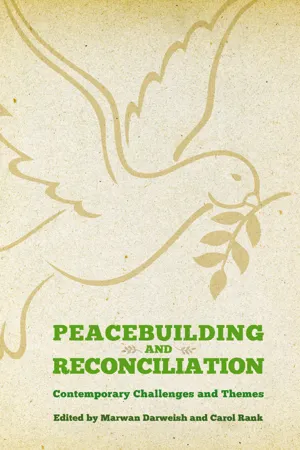
Peacebuilding and Reconciliation brings together a number of critical essays from members of the renowned Centre for Peace & Reconciliation Studies. This highly topical book covers the latest developments and issues in the discipline of peacebuilding and reconciliation, using different global case studies of societies experiencing or emerging out of violent conflict. It brings together a range of scholars, including many from the global south, who provide fresh perspectives and insights based on their experience of living and working in conflict situations. The book connects theory and practice, drawing both on academic research and direct experience of conflict situations, and explores how to meet the challenges involved in peacebuilding and reconciliation. Peacebuilding and Reconciliation is a cutting-edge collection ideal for students and academics in peace studies, development studies and international relations.
eBook - ePub
Peacebuilding and Reconciliation
Contemporary Themes and Challenges
- 240 pages
- English
- ePUB (mobile friendly)
- Available on iOS & Android
eBook - ePub
About this book
Information
PART I
PEACE: BUT WHAT KIND OF PEACE?
1
HOW HAS THE LIBERAL PEACE SERVED AFGHANISTAN?
Chrissie Hirst
LIBERAL PEACE: DEFINING THE MODEL
The end of the Cold War brought crucial changes to the global context of conflicts in the developing world. With the lens of superpower rivalry removed, the role of international organizations to intervene was strengthened, in particular the role of the United Nations (UN). The 1992 UN Secretary-General’s An Agenda for Peace, and the 1995 Supplement to An Agenda for Peace (Boutros-Ghali, 1992 and 1995) outlined an array of steps or measures (for example, disarmament, demobilization, security sector reform, election monitoring and regulatory reform) which have become standardized elements of post-conflict peacebuilding intervention, also described as ‘state building’ or ‘nation building’.
The 1990s saw the consolidation of this ‘standard peacebuilding formula’, involving post-conflict elections and market-oriented reforms, often followed shortly after by a declaration of peacebuilding ‘success’ (Paris, 2006: 175). Some analysts have termed the United Nations’ post-settlement peacebuilding package as ‘standard operating procedure’ (SOP), closely linked to the pursuit of the goals of ‘liberal internationalism’, understood as the pairing of liberal parliamentary democracy and liberal market capitalism. The term ‘liberal peace’ or ‘liberal peacebuilding’ came to be used to describe the intended process and outcome of applying this SOP.
While the liberal peace SOP has gained ground over the last decade, some writers have highlighted its fragile foundation – the SOP is based on the assumption that ‘liberalization’ is the optimal recipe for lasting peace in post-conflict countries. As the number of SOP interventions undertaken increased, in some cases it appeared that interventions had been counterproductive, and by the end of the decade the ‘liberal peacebuilding’ model was increasingly called into question.
Afghanistan, alongside Bosnia, Kosovo and East Timor, is an example of a country where the liberal peacebuilding model has been applied, and where the results are unclear at best. Written in May 2010, as elections in Afghanistan were rescheduled because of the insecurity, and revisited in February 2012 alongside discussion of deadlines for international withdrawal, this chapter reviews the record in Afghanistan, and assesses the validity of different critical perspectives on ‘liberal peace’.
CRITICAL PERSPECTIVES
In the last decade, criticism of liberal peacebuilding has grown. Hoffman groups critics into two main camps (2009: 10). The first are those who argue that while the premise itself is not unsound, the implementation of the model has been overly top-down, formulaic or pushed ahead too quickly with structural reform and electoral processes (for example Paris, Sisk, Rotberg). Hoffman’s second camp includes those who see the problem in the liberal peace model itself, perceiving it as merely ‘a cover for the political and economic interests of the West’ (for example Chomsky and Ignatieff).
A number of critics have focused on the conceptual framework for liberal peace, highlighting problems with specific yet fundamental aspects of the model, forming what can be considered a third camp. Duffield positions the emergence of liberal peace in the context of the conceptual convergence of development and security in the 1990s: the ‘new security framework’, where a wave of ‘new wars’, international crime and terrorism arise from underdevelopment, now seen as dangerous. He argues the liberal peace model is ‘a political project in its own right’, and reflects a radical and specific political, developmental and security agenda ‘to transform the dysfunctional and war-affected societies that it encounters on its borders into cooperative, representative and, especially, stable entities’ (2001: 11).
Mac Ginty describes the ‘near hegemony’ of the ‘liberal democratic peace model’ applied to post-conflict states, arguing that the dominance of this model has had ‘a profound impact on the management of contemporary violent ethnonational conflict in standardising the core elements of peace initiatives and accords and reducing the space available for alternative (non-Western) approaches to peacemaking’ (2006: 33). In his review of the United Nations as one of the key institutions of liberal peace, Chesterman makes further references to colonialism, describing UN transitional administrations as ‘benevolent autocracy’ and post-conflict transformation projects as ‘modern colonial enterprise’. He argues that greater honesty about the motivation behind the international community’s state-building projects would be beneficial for all parties (2004: 47, 127).
THE LIBERAL PEACE AND AFGHANISTAN
Given increasing sensitivity to overly bureaucratic and top-down, outside-in interventions by the international community, at first glance the model applied in Afghanistan appears to break with previous interventions of the 1990s. In many ways this is true, with the approach defined as the ‘light footprint’, reflecting the greatly reduced UN mission role and size, and the commitment to bolstering Afghan capacity – a move away from earlier more colonial and prescriptive interventions such as Kosovo.1
How has this new, much-heralded ‘light footprint’ version of liberal peace served Afghanistan? Mac Ginty identifies three characteristic liberal peace pitfalls that have the capacity to seriously jeopardize the quality of peace achieved:
• a lack of local ownership
• a reflection of external rather than internal concerns
• a premature withdrawal of external support (2006: 162).
The record of international intervention so far in Afghanistan is reviewed below in relation to the first two pitfalls – it remains too early to judge the third, although the announced 2014 deadline for international military withdrawal certainly appears ambitious. This section also considers aid distribution more broadly, with reflections focusing on key elements of liberal peacebuilding, primarily elections and ‘democratization’, and additionally human rights, rule of law, disarmament processes, development assistance and market reform.
Lack of local ownership, lack of a genuine peace process
Despite the ‘light footprint’ approach, it is clear that the process of state building in Afghanistan has been almost entirely controlled by external parties, primarily the United States, working alongside international institutions such as the United Nations and the World Bank. Mac Ginty’s first pitfall was apparent from the early days of the intervention – a lack of local ownership: a lack of full involvement of Afghan stakeholders in shaping, and thereby valuing and committing to, the peace process.
From the outset of the post-2001 liberal peacebuilding project in Afghanistan, the international actors leading the process and convening the Bonn conference determined which constituencies would have ‘local ownership’. This local ownership has been incomplete, selective and based on groups acceptable to Western powers. Although the Bonn Agreement was broadly presented and accepted as a ‘peace deal’, analysts observe that the UN-sponsored talks reflected the distribution of power that resulted from the US strategy, and was more an agreement among those on the winning side than a settlement based on negotiations among conflicting parties. Johnson and Leslie argue that:
The problem started with the Bonn agreement itself ... [and] took place in the shadow of a massive military campaign in retaliation for the events of 11 September 2001. Although the agreement that emerged is often referred to as a ‘peace agreement’, the circumstances that gave rise to it were not those from which peace agreements are usually forged .... The major party to the conflict, the Taliban, was not even at the table. Rather, the Bonn agreement was a victor’s sharing of the spoils of war in the wake of the forcible removal from power of the Taliban.
(Johnson and Leslie, 2004: 157)
In discussing peacebuilding success factors and key roles for outsiders, Liklider highlights ‘inclusiveness’, the need to involve all major parties, noting that ‘It is tempting to negotiate with the moderates and try to leave the extremists out .... But this is often a mistake’ (2001: 701). Many writers emphasize the importance of including all stakeholders in peace processes: excluded parties are far more likely to continue with violence and reject a settlement that has been imposed by others. Bonn excluded various key groups within Afghan society, but the exclusion of the Taliban as a major party in the conflict has been particularly criticized. Commentators argue that the Taliban represent deep-rooted values and interests in Afghan society that must be included in any peace process for it to succeed, regardless of how acceptable such values and interests might be to Western actors (Johnson and Leslie 2004: 209; Sisk 2008: 206).
While some analysts feel the Bonn Agreement reflected the best chance available for a peace deal, in the period following the settlement there was widespread recognition that Bonn was not a comprehensive peace agreement. Others describe it as a mechanism for distributing power and profit among the victors, and a senior UN leader has referred to the Agreement as the ‘original sin’ (Bennett et al., 2003: 15). Sadly, little has changed in the years since Bonn. Wijeyaratne completes her review of the prospects for peace in Afghanistan under the subtitle ‘The missing peace process’, with the observation that although limited efforts are continuing, they are fractured and ultimately ‘There is no clear peace process bringing together all sides of the conflict’ (2008: 5). She emphasizes that Afghanistan is not in a post-conflict situation, the Bonn Agreement and Afghanistan Compact ‘are insufficient as they do not provide a roadmap to peace’, and she sees Bonn as a key factor in the post-2002 conflict (2008: 31).
Where previously any moves to reach out to the Taliban were strongly censured by the international community, the last year has seen a major shift in approach. A decade after their exclusion from the first meeting, the December 2011 ‘Bonn II’ international conference included open discussion on political engagement with the Taliban. As plans for Gulf-sponsored talks to include Taliban and Afghan leaders take shape in early 2012 (amidst some level of regional political controversy), a new, more inclusive phase of peace negotiations may now be approaching.
External rather than internal concerns – prioritization and legitimization
With the basis of the liberal peace state-building exercise undermined from the outset through a failure to establish local ownership at Bonn, the process continued much as it had started, faltering into Mac Ginty’s second pitfall as external concerns took priority over internal concerns in many vital areas.
Beyond the exclusion of the Taliban from Bonn, a crucial point here is the inclusion of leaders who had supported the West and who were important to continuing US efforts to eliminate Al Qaeda. The inclusion in the Bonn talks of the Northern Alliance and other groups responsible for atrocities and abuse during the war sent a strong message: these warlords were legitimized as national leaders, rewarded with support from the international community. As Johnson and Leslie observed, ‘The US decision to engage certain factions to pursue its ground war not only returned to power the very people who had been responsible for Afghanistan’s plunder, but also ensured that they obtained significant supplies of new arms and useful quantities of hard currency’ (2004: 157–8).
The subsequent steps in the process of transition and legitimization of interim institutions have included the holding of two loya jirga meetings and four rounds of elections. Implementation practice has reflected the lack of adherence to liberal peace principles: internal concerns for the need for representative and fair processes were subordinated to external security concerns.
As a key element of liberal peace, elections are valued for the inherently peaceful checks and balances they place on elected leaders, and within the liberal peacebuilding framework for their power to legitimate. Election of post-war leaders is also in many cases legitimization of the peace process in question, and is therefore seen as having enormous potential for strengthening a peace process. In Afghanistan’s case, the use of the traditional loya jirga decision-making mechanisms (a large meeting of community or tribal representatives from across the country) was arguably an appropriate cultural adaptation of the liberal peace SOP and avoided the risks of an early election. While the first ‘emergency’ loya jirga was widely criticized, the second, ‘constitutional’ loya jirga went better than many had dared hope as the United Nations took a stronger role and managed to reduce manipulation. Given the many ethnic and political divisions in Afghan society, commentators saw the second loya jirga debates and the first presidential elections in 2004 as significant successes, in many ways high points for electoral democracy in the country.
However, as both critics and proponents of the role of democratization in peacebuilding warn, elections may also bring negative consequences. In the sensitive post-conflict contexts of inter-group division, elections incur ‘validation risks’, as in the case of Bosnia, where extremist parties emerged from wartime factions. Post-war elections risk reinforcing conflict dynamics and playing a negative legitimizing role:
the Liberian outcome is similar to Afghanistan’s, following elections there in 2005: the inclusion through the legislative arena of a number of factions involved in the war who have either emerged as ‘warlord’ figures or whose hands are not clean in terms of the widesp...
Table of contents
- Cover
- Title page
- Copyright page
- Contents
- Acknowledgements
- Introduction
- Part I Peace: but what kind of peace?
- 1 How has the Liberal Peace served Afghanistan?
- 2 The obstacles to sustainable peace and democracy in post-independence Kosovo
- 3 Ethnicity, ethnic conflicts and secessionism in Ethiopian politics
- Part II Reconciliation and dealing with the past
- 4 State failure and civil society potential: reconciliation in the Democratic Republic of Congo
- 5 Remembering the past and reconciling for the future: the role of indigenous commemorative practices in Sierra Leone
- 6 Decolonization and reconciliation: the colonial dilemma of Canada’s residential school apology and restitution
- Part III Cultural processes and initiatives
- 7 Is ‘interreligious’ synonymous with ‘interfaith’? The roles of dialogue in peacebuilding
- 8 The role of health in building peace: the case of Afghanistan
- Part IV Challenges to peacebuilding and reconciliation
- 9 The new economy of terror: motivations and driving forces behind contemporary Islamist insurgencies
- 10 The question of home: refugees and peace in the Israel–Palestine conflict
- 11 Hamas: between militarism and governance
- 12 Returning home towards a new future: Nepal’s reintegration programme for former child soldiers
- References
- Index
Trusted by 375,005 students
Access to over 1.5 million titles for a fair monthly price.
Study more efficiently using our study tools.
Frequently asked questions
Yes, you can cancel anytime from the Subscription tab in your account settings on the Perlego website. Your subscription will stay active until the end of your current billing period. Learn how to cancel your subscription
No, books cannot be downloaded as external files, such as PDFs, for use outside of Perlego. However, you can download books within the Perlego app for offline reading on mobile or tablet. Learn how to download books offline
Perlego offers two plans: Essential and Complete
- Essential is ideal for learners and professionals who enjoy exploring a wide range of subjects. Access the Essential Library with 800,000+ trusted titles and best-sellers across business, personal growth, and the humanities. Includes unlimited reading time and Standard Read Aloud voice.
- Complete: Perfect for advanced learners and researchers needing full, unrestricted access. Unlock 1.5M+ books across hundreds of subjects, including academic and specialized titles. The Complete Plan also includes advanced features like Premium Read Aloud and Research Assistant.
We are an online textbook subscription service, where you can get access to an entire online library for less than the price of a single book per month. With over 1.5 million books across 990+ topics, we’ve got you covered! Learn about our mission
Look out for the read-aloud symbol on your next book to see if you can listen to it. The read-aloud tool reads text aloud for you, highlighting the text as it is being read. You can pause it, speed it up and slow it down. Learn more about Read Aloud
Yes! You can use the Perlego app on both iOS and Android devices to read anytime, anywhere — even offline. Perfect for commutes or when you’re on the go.
Please note we cannot support devices running on iOS 13 and Android 7 or earlier. Learn more about using the app
Please note we cannot support devices running on iOS 13 and Android 7 or earlier. Learn more about using the app
Yes, you can access Peacebuilding and Reconciliation by Marwan Darweish, Carol Rank in PDF and/or ePUB format, as well as other popular books in Politics & International Relations & Peace & Global Development. We have over 1.5 million books available in our catalogue for you to explore.