Syriza's victory in the recent Greek general election shook the foundations of the Western political establishment and gave hope to the millions suffering the austerity measures imposed by the European Troika. Millions asked, how did this happen and what is it about Greece that created such a centre of radicalism? This insider's account, from Syriza's Finance Minister Euclid Tsakalotos and economist Christos Laskos, shows that that the narrative of Greek exceptionalism is a myth. The blame game that has been played by the EU powers is an ideological tool used to shift attention from the disillusionment and anger at the European and global capitalist economic order. By alienating an entire nation of people, the Troika has revealed the internal contradictions of the modern neoliberal establishment, as well as the inadequacies of the earlier social-democratic Keynesian regime. Tsakalotos and Laskos suggest that there is very little that differentiates Greece from other countries struggling under austerity, and that parties such as Syriza could usher in a new, democratic and socialist era across the continent.
eBook - ePub
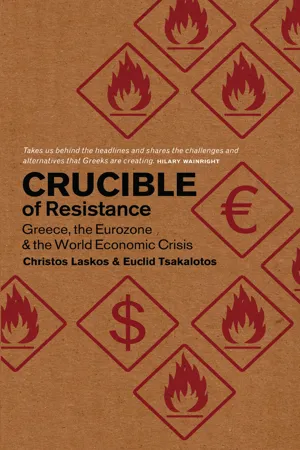
Crucible of Resistance
Greece, the Eurozone and the World Economic Crisis
- 192 pages
- English
- ePUB (mobile friendly)
- Available on iOS & Android
eBook - ePub
Crucible of Resistance
Greece, the Eurozone and the World Economic Crisis
About this book
Information
1
Neoliberalism as Modernization
The Greek people have never been entirely comfortable with either modernity or their place in the world. Wars, occupation, civil wars, massive waves of both emigration and immigration, and a plethora of dictatorial or authoritarian regimes hardly provided fertile ground for self-confidence. They have had their moments of course; most recently with their participation in the euro area in 2001, and, albeit in a more Pyrrhic mode, their organization of a successful Olympic Games in 2004. But the impression always lingered that any success would prove purely temporary; that underneath there lurked fundamental flaws related to incomplete modernization and, in particular, the lack of a proper state. Not surprisingly the feeling that sooner or later ‘they would be found out’ surfaced with a vengeance when the Greek crisis broke out in earnest in the first months of 2010. The dominant narrative of the crisis, already sketched out in the Introduction of this book, sought to transform this feeling into both an interpretation of what had gone wrong and a recipe for how to set Greece, at last, on an irreversible path of modernization.
According to this dominant narrative, at stake were not alternative visions for the economy and society for the post-neoliberal era: no clash of values, merely one between backward- and forward-looking cultures. For, so the argument went, Greece constituted the great exception among EU member states (Ioakeimides, 2011). It had never experienced neoliberalism; appeals to the latter no more than a delaying tactic from those seeking to obstruct all change. Thus, the Greek crisis was more related to the accumulation of internal problems than a consequence of the world economic crisis of neoliberal capitalism that broke out in 2008. The appropriate response lay, therefore, in the implementation of those modernizing reforms that would have been necessary irrespective of the crisis.
In the following chapters we seek to challenge this idea that Greece’s woes stem from an incomplete modernization, and attempt to situate the Greek crisis firmly within the evolving crisis of the Eurozone. For the moment we turn to making the case that from the mid-1990s onwards Greek elites pursued, with some success, a reform programme with impeccable neoliberal credentials.
STYMIED MODERNIZATION AND THE CLASH OF CULTURES
Writing in 1994, the political scientist Nikiforos Diamandouros5 addressed Greece’s longstanding internal problems in terms of a clash between two cultures, which, he contended, had been going strong ever since the creation of the Greek Republic in the late 1820s. His problematic is firmly within the modernization approach that was once so influential, particularly in the US, in both political and economic science. The basic idea is that most societies will eventually converge onto the political, economic and social institutions of the advanced capitalist countries. The attractiveness of these institutions is rarely discussed,6 nor is much thought given to the shifting trajectory of the goal, as if approaching Johnson’s ‘Great Society’ constitutes a similar exercise to approaching the neoconservative vision of Bush the Younger. Given this relative indifference to ends, the analysis is more concerned with examining the obstacles to modernization,7 for it is acknowledged that there are costs involved in this process of catch-up which are ‘unavoidable (and, according to many, necessary)’ (Diamandouros, 1994: 113).
In the Greek case, Diamandouros contends that those forces that have most to lose have attached themselves to a culture that has had a particular take on economics, politics and international affairs: inward-looking,8 suspicious of foreigners, statist, anti-market, and pro-redistribution. Moreover, this ‘underdog’ culture has been able to offer powerful resistance to the outward-looking and pro-market ‘reform’ culture, which has sought to modernize Greece. The clash of cultures has delayed the modernization of both society and the economy, or, at best, led to reforms that have been half-hearted and incomplete.9
From this, and similar perspectives that prevail within the dominant narrative, Greek history since the metapolitefsi – the term given to the period after the fall of the seven-year junta – can be written in terms of turns not taken, of opportunities missed. After the restoration of democracy in 1974 there were governments of the centre-right until 1981, with Konstantinos Karamanlis, the founder of the New Democracy Party, as prime minister until 1980. The 1980s were dominated by the centre-left administrations (1981-89) of PASOK led by Andreas Papandreou. In the dominant narrative these two prominent, not to say domineering, personalities of the post-1974 period get a rather mixed assessment.
Karamanlis is credited primarily with negotiating Greece’s successful accession to the EU in 1981, a critical moment since Greece’s ever closer integration within Europe is considered a critical component of any serious strategy of modernization; external pressure making up for domestic recalcitrance. His partial accommodation of the unions, especially those in the public sector, as well as of an increasingly confident student and wider education movement, is seen in more equivocal terms. On the one hand, the emphasis on social and democratic rights, as well as some nationalization in the banking and productive sectors, are accepted as unavoidable correctives in order to redress the social and political injustices that had evolved in the aftermath of Greece’s civil war in the late 1940s and the period of dictatorship (1967-74). On the other hand, the failure to seriously engage with Greece’s economic problems, and in particular with respect to its overprotected productive structure, as well as a reticence to touch Greece’s statist legacy, are seen in terms of sowing the seeds of future economic disaster.
This account is somewhat partial. For instance, in seeking to make a case for Greek exceptionalism, almost from the year dot, it passes too lightly over the wider Zeitgeist of the period. For all the talk in Greece at the time of ‘social mania’ (i.e. extreme social sensitivities), it takes some effort to remember now that this direction was not out of line with developments elsewhere. Even in the US, Nixon’s first response to the end of the long post-war boom was in terms of price and wage controls, and in 1975 the Humphrey-Hawkins Bill was introduced, which included the notion of the government as the employer of last resort.10 Statism and suspicion of market solutions, the two great bêtes noires of the modernizing tendency, were not, in the 1970s at least, exclusive to the Greek underdog culture. More serious still is the fact that, as we will go on to see, this social mania hardly began to address Greece’s accumulated social and democratic deficit (Dragasakis, 2012). While later contributions to the dominant narrative would bemoan the hegemony of leftist ideas in the early metapolitefsi period,11 the persistence of social inequalities and the realities of elite power hardly justify these claims.
The dominant narrative is also equivocal with respect to the subsequent PASOK administrations of Andreas Papandreou, but with a more negative assessment overall. Thus, while some social interventions, most notably the creation of the national health service, are given a positive assessment, the initial attempted redistribution, through significant increases in wages and pensions between 1981 and 1983, is deemed as being far ahead of what the economy could bear. Not surprisingly therefore, the subsequent economic crisis in 1985 led to the first of many stabilization attempts (1985-87), the reversal of most of the gains in real wages if not pensions, and the end of PASOK’s more radical phase. This signalled the abandonment of the half-hearted experiments with planning agreements, socialization of public industries, and a more interventionist industrial policy.12
For modernizers, who in any case exhibit little interest in social experimentation that is not sanctioned by the calls of modernity, this abandonment was merely a belated wake-up call with respect to reality. More crucial, for them, is that it did not signal a permanent shift to a coherent programme of modernization: for the stabilization programme, significantly (for the story to be told) under the leadership of Kostas Simitis at the Ministry of the National Economy, was also abandoned. What replaced it were spasmodic policy initiatives with little overall coherence or direction, primarily geared to the needs of populist politics. Untenable pre-election promises to all and sundry, state agreements with selected private sector firms, and special tax breaks for some social groups are just some of the elements in the nexus of party, state and sectionalist interests. Giannis Voulgaris, another prominent modernizing political scientist, includes both PASOK and the Left in his critique of those parties that shored up this nexus, which rested on redistribution and consumption with little interest in the culture of production, competitiveness and innovation.13 Such an axis was enough to block reforms, thus laying the foundations for future fiscal crisis. The major losers from this arrangement were those ‘outsiders’ with insufficient bargaining power to extract concessions, subsidies, tax exemptions and other goodies from the state.14 Every grand narrative needs a worthy enemy, and for modernizers, of all persuasions, populism more than fits the bill.
The dominant narrative’s account is as deficient with respect to the PASOK period as it is to that of the New Democracy period. But as we shall focus on the modernizers’ critique in much of what is to come, we will not seek to address the deficiencies here. Suffice it to say that we agree with Kouvelakis’ conclusion (2011: 19) that ‘the social foundations of the ancien régime remained largely in place, not only under the Conservative New Democracy Party in the second half of the 70s, but also during the long rule of PASOK after 1981’. In this light, the charge of populism levelled against both parties needs considerable reformulation if it is not to lose all analytical coherence. Populism was a real phenomenon in Greece, but in the dominant narrative its content is extended to include nearly any popular demand or aspiration, while at the same time keeping many of the real winners from the system out of focus.15
For the dominant narrative then, both New Democracy and PASOK exhibited common achievements and failings. On the plus side, they both contributed to the consolidation of democracy and Greece’s increasing integration with Europe.16 But the failings, with respect to economic and political modernization, dominate. In particular, they failed to reform Greece’s public administration and take on the populist forces that gained most from clientelistic politics. With respect to the latter, if anything the reliance on patron-client relations, and the traditional exchange of favours through ‘rousfeti’, was deepened as the two political parties organized these relations through their increasingly sophisticated party machines (Mouzelis, 1980).
By the mid-1990s, however, there was a new feeling that the tide of history was turning in favour of the modernizers. Thus Diamandouros ends his book with the prediction that the reform culture was gaining ground, especially as a consequence of the process of globalization and European integration. The chan...
Table of contents
- Cover
- Half-title Page
- Title Page
- Copyright
- Dedication
- Contents
- Acknowledgments
- Introduction: The Greek Crisis in Context
- 1 Neoliberalism as Modernization
- 2 The Greek Economy and Society on the Eve of the Crisis
- 3 The Eurozone Crisis in Context
- 4 From Crisis to Permanent Austerity
- 5 The Underdogs Strike Back
- 6 Out of the Mire: Arguments within the Greek Left
- Appendix
- Notes
- References
- Index
Trusted by 375,005 students
Access to over 1.5 million titles for a fair monthly price.
Study more efficiently using our study tools.
Frequently asked questions
Yes, you can cancel anytime from the Subscription tab in your account settings on the Perlego website. Your subscription will stay active until the end of your current billing period. Learn how to cancel your subscription
No, books cannot be downloaded as external files, such as PDFs, for use outside of Perlego. However, you can download books within the Perlego app for offline reading on mobile or tablet. Learn how to download books offline
Perlego offers two plans: Essential and Complete
- Essential is ideal for learners and professionals who enjoy exploring a wide range of subjects. Access the Essential Library with 800,000+ trusted titles and best-sellers across business, personal growth, and the humanities. Includes unlimited reading time and Standard Read Aloud voice.
- Complete: Perfect for advanced learners and researchers needing full, unrestricted access. Unlock 1.5M+ books across hundreds of subjects, including academic and specialized titles. The Complete Plan also includes advanced features like Premium Read Aloud and Research Assistant.
We are an online textbook subscription service, where you can get access to an entire online library for less than the price of a single book per month. With over 1.5 million books across 990+ topics, we’ve got you covered! Learn about our mission
Look out for the read-aloud symbol on your next book to see if you can listen to it. The read-aloud tool reads text aloud for you, highlighting the text as it is being read. You can pause it, speed it up and slow it down. Learn more about Read Aloud
Yes! You can use the Perlego app on both iOS and Android devices to read anytime, anywhere — even offline. Perfect for commutes or when you’re on the go.
Please note we cannot support devices running on iOS 13 and Android 7 or earlier. Learn more about using the app
Please note we cannot support devices running on iOS 13 and Android 7 or earlier. Learn more about using the app
Yes, you can access Crucible of Resistance by Christos Laskos, Euclid Tsakalotos in PDF and/or ePUB format, as well as other popular books in Economics & Economic History. We have over 1.5 million books available in our catalogue for you to explore.