Capitalist growth is widely heralded as the only answer to the crisis still sweeping the global economy. Yet the era of corporate globalisation has been defined by unprecedented levels of inequality and environmental degradation. A return to capitalist growth threatens to exacerbate these problems, not solve them. In The Poverty of Capitalism, John Hilary reveals the true face of transnational capital in its insatiable drive for expansion and accumulation. He exposes the myth of 'corporate social responsibility' (CSR), and highlights key areas of conflict over natural resources, labour rights and food sovereignty. Hilary also describes the growing popular resistance to corporate power, as well as the new social movements seeking to develop alternatives to capitalism itself. This book will be essential reading for all those concerned with global justice, human rights and equity in the world order.
eBook - ePub
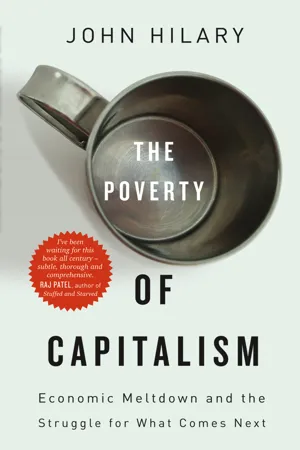
The Poverty of Capitalism
Economic Meltdown and the Struggle for What Comes Next
- 232 pages
- English
- ePUB (mobile friendly)
- Available on iOS & Android
eBook - ePub
About this book
Information
1
Introduction
Of the many consequences of the global economic meltdown that swept the world from 2008 onwards, perhaps the most important for the long term was that it exposed to public attention the true nature of the capitalist world system in the modern age. The immediate trigger for the Great Recession may have been a liquidity crisis brought on by mass panic at the bursting of the US housing bubble, once it was realised that no one could predict to what extent the world's banking system was contaminated with toxic debt. Yet it soon became clear that there was something rotten in the state of the global economy far beyond the greed and grasping of a few creative financiers. Most obviously, the crisis served to reveal the economic, social and ecological imbalances that had developed over the previous three decades of neoliberal globalisation, a period during which states had granted unprecedented powers to capital while steadily undermining the sovereign rights of their own peoples. The neoliberal programme of privatisation, liberalisation and deregulation had aimed at nothing less than a second ‘great transformation’ to rival the free market fundamentalism of the nineteenth century, directing state intervention away from social redistribution towards an unambiguous role as enforcer of the enduring freedoms of capital.1 Any suggestion that these freedoms would be to the greater benefit of society was finally laid to rest in 2008, as unimaginable sums of public money were commandeered to rescue the system from itself. Yet in addition to exploding once again the myth of the self-regulating market, the global economic meltdown also stimulated recognition of a more profound truth: that independently of the excesses of neoliberalism, the massive accumulation of capital at the core of the system offers only crisis and poverty to hundreds of millions of people across the world.
To many people, particularly those living outside the core economies of the capitalist world system, this was not news. The experience of colonialism had taught the peoples of the global South that the accumulation of capital in the metropolitan centres of empire required the violent suppression and immiseration of the colonised, to the extent that it negated the possibility of their historical development.2 Nor was this experience confined to some dim and distant past, as the ‘new imperialism’ exercised through international financial institutions such as the World Bank and International Monetary Fund (IMF) had continued to condemn the same peoples to exploitation throughout the decades following their liberation from colonial rule.3 The result of this systematic dispossession has been mass poverty on a global scale. In August 2008, one month before the collapse of investment bank Lehman Brothers sent financial markets into freefall, the World Bank acknowledged that it had previously overstated the numbers lifted out of poverty in the previous three decades of neoliberal globalisation, and that a staggering 1.4 billion people were still living below the extreme poverty line (the equivalent of what it means to be poor in the world's very poorest countries, such as Mali, Ethiopia or Chad). A total of 2.6 billion people – over half the entire population of the global South – were calculated to be living below the $2 a day poverty line, following the extensive structural adjustment programmes undertaken at the behest of the World Bank and IMF in order to ‘integrate’ their national economies into the capitalist world system.4 Before the global economic meltdown, in other words, the majority world was already in crisis.
At the same time as this social reality was brought home to new audiences, capitalism's drive for growth at all costs was also shown to be the root cause of the ecological crisis facing the planet.5 The finite limits of natural ecosystems are unable to support the infinite process of expansion that capital must engineer in order to prosper, and the consequences of that conflict are apparent in every new media report detailing the latest evidence of irreversible climate change, biodiversity loss or resource depletion. Nowhere is this crisis more obvious than in the additional pressure on the world's natural resource base generated by the rise of today's emerging economies, whose ‘outward turn’ into the global economy has further intensified a rush for land, oil, minerals and other strategic resources that was already driving stocks towards exhaustion. Increasingly, in international conferences as well as local articulations of protest, the connection between capitalist expansion and its ecological consequences is made explicit, with system change recognised as the last and only means of avoiding ecological disaster. While this book focuses primarily on the human poverty of globalised capitalism, the connection between the social and ecological should be understood as an unspoken reality throughout.
As the economies of Europe and North America slid into recession, resulting in dramatic contractions of world trade and investment, the deeper imbalances of the system became a mainstream topic of discussion. Leaders from the core capitalist economies that had brought the world to the brink of disaster issued statements acknowledging that business could no longer continue as usual. France's president Nicolas Sarkozy famously announced in January 2009 that the crisis signalled the return of the state and the end of public impotence in the face of the market, and called for a renewed ‘moralisation’ of capitalism. As London prepared to host the G20 summit three months later, UK prime minister Gordon Brown declared that the old Washington consensus of liberalisation, privatisation and deregulation was dead, and that the world now needed ‘shared global rules founded on shared global values’. Barack Obama spoke of the ‘massive failure of responsibility’ that had led to the crisis, and of the need for comprehensive regulatory reform to prevent its recurrence. Yet it soon became clear that the call for a more ethical form of capitalism represented a determination among the core economic powers to restore the system as it had been before the crash, only strengthened this time by virtue of being cleansed of the taint of bankers’ greed. Incorrectly portrayed in the Anglo-Saxon world as a return to traditional French dirigisme, Sarkozy's speech to the ‘New World, New Capitalism’ conference had been recognised in France as an explicit call to defend the system against its detractors, and to reposition the state as the active partner of capital in place of a finance sector that had failed.6
Thus it was that the G20 used its 2009 London summit to announce a $1 trillion stimulus package for the global economy, in addition to the even greater sums of public money injected into national economies to bail out the banks and restart the circulation of capital that had frozen in the wake of Lehman Brothers’ collapse. Thus also, once it had calculated that its interventions had done enough to restore private lending, the G20 used its 2010 summit in Toronto to announce an abrupt end to stimulus and the beginning of ‘fiscal consolidation’ in those countries deemed to have run up unsustainable public debts. This in turn signalled the launch of a capitalist counteroffensive in the austerity programmes to be visited on the peoples of Europe and North America – the latest application of neoliberal ‘shock doctrine’ to further the radical programme of social and economic reengineering that was initiated at the end of the 1970s.7 The long-term consequences of these structural adjustments – already so familiar to countries of the global South – are only now beginning to reveal themselves, as the threat of ‘perma-austerity’ and simultaneous recession across many of the core capitalist economies causes even friendly commentators to raise the alarm.8
Lest there should be any doubt that the global economic system was to be restored in its neoliberal form, the G20 announced that, despite their manifest failures, the same institutions of capitalist rule would return to police the system as before. The IMF was brought back from the dead by the G20, despite the fact that its catastrophic mishandling of previous crises had destroyed its credibility and consigned it to a marginal role in world affairs. Similarly, despite its persistent failure to conclude the Doha Round of multilateral trade negotiations launched in 2001, the G20 confirmed the World Trade Organisation (WTO) as its chosen instrument of discipline to prevent any possible restrictions on capitalist expansion in the wake of the crisis. The return of these two institutions represented a clear statement of intent on the part of the world's leading economies, and an intensification rather than a revision of the model of corporate globalisation that had developed with such negative consequences over the previous 30 years. Importantly, too, this strategic direction was agreed not by the G8 grouping of old colonial powers but by the G20, which includes among its members several states that had previously mounted vocal opposition to such imperialist manoeuvres.
The power granted to transnational corporations (TNCs) to continue operating in the global economy with ever increasing freedom reaffirmed the political elite's choice of capital as lead agent in the process of historical development. Earlier it had been understood that the private profit-making interests of TNCs operating in the global economy were incompatible with broader public policy goals; yet such an understanding had gradually been eroded by a dominant narrative which portrayed transnational capital not just as part of the solution, but at the heart of any solution. According to this orthodoxy, which not even a full-scale crisis of capitalism was enough to unseat, the expansion of TNCs into every corner of the global economy is the best (if not the only) way to ensure progress towards humanity's development goals.
This book seeks to challenge the notion that transnational capital is a benign force in the service of humanity, and to set against that orthodoxy the evidence of its actual operations around the world. The international focus of the book is deliberate and necessary, as the most extreme injustices of the system are manifest in its relations with the peoples of the majority world, forced to survive their integration into the global economy in situations of incomparable stress and insecurity. The continuing impoverishment of the peoples of the global South, incorporated into the bottom of global value chains so as to generate ever greater profits for those at the top, is a lasting reminder that the programme of corporate globalisation was developed not for public benefit but to further the interests of the few. Years of low inflation and cheap credit allowed the champions of neoliberalism to conceal this reality from people in the rich world, and to sustain the central myth of globalisation as a ‘win-win’ or positive sum equation. This book seeks to restore the experience of the peoples of the majority world to a debate from which they are invariably excluded.9
By the same token, this book also seeks to articulate alternatives of hope to replace the barren wasteland of any future under the current system. These alternatives exist not only in the everyday resistance of social movements to the threat of capitalist expansion, but in the existing operations of those movements and cooperative ventures that are already constructing their own paths out of capitalism. The fact that such alternatives are so often hidden from public view is a result of the power exercised by transnational capital over the economic development discourse, often with the active connivance of ‘respectable’ non-governmental organisations. This book is an attempt to challenge that closed system and to show that there are genuine alternatives to the monoculture of corporate globalisation.
This book is not a work of theory; it has the more modest ambition of seeking to reveal to a wider audience how the expansion of global capitalism continues to bring riches to the few and poverty to the many. I have, however, benefited enormously from the theoretical writings of others in developing my own understanding, and it will quickly become obvious how much this book owes to insights from many traditions that illuminate the workings of the global political economy. The book is also not a polemic in the same sense as the two famous works whose titles it inevitably evokes: Marx's critique of Proudhon in The Poverty of Philosophy or E.P. Thompson's of Althusser in The Poverty of Theory. It is, however, intended to refute those who contend that the future of global development lies with increasing the power of TNCs to roam the earth in search of ever greater profits, with or without the convenient fiction of corporate social responsibility and other public relations tools.
The book is structured as follows. Chapter 2 explores how the global economic meltdown experienced across the world from 2008 onwards is a consequence of more profound dynamics of change in the global political economy, including the emergence of new powers from the semiperiphery of the capitalist world system to challenge those at its core. Despite the truly historic development this represents, such an emergence is in no way the common experience of most countries from the global South: inequality between and within countries is now running at record levels, so that polarisation between rich and poor remains the defining characteristic of corporate globalisation in the twenty-first century. While the rise of the BRICS (Brazil, Russia, India, China, South Africa) has introduced new forces into the global political economy, it has strengthened the dominance of capitalism as their governments seek to promote the interests of their own ‘national champions’ around the world. This rise of new imperialisms in turn raises broader questions as to whether the North-South framing of the global political economy that has dominated since the publication of the Brandt Report in 1980 is still fit for purpose. With business representatives from the global South now joining forces with their Northern counterparts in the elite forums of the transnational capitalist class, it may be necessary to reframe the battle lines of globalisation in contemporary rather than historical terms.
Chapter 3 shows how the interests of TNCs not only differ from public policy goals in theory, but are now in conflict with the democratic pursuit of those goals in practice. The neoliberal programme embodied in globalisation was explicitly developed by the core capitalist states as a mechanism for the expansion of corporate power, first through the Uruguay Round of world trade talks that led to the founding of the WTO in 1995, and then by means of the bilateral free trade agreements and investment treaties that have proliferated since. In particular, the elevation of transnational capital to a de facto legal status equivalent to that of sovereign states has granted corporations the power to challenge government actions directly before international arbitration tribunals, and to claim compensation where their profits might be limited by local or national interventions. The threat posed to democracy by this new development has generated its own backlash, with the first states now beginning to acknowledge that the balance of forces under globalisation may indeed have swung too far in capital's favour.
Chapter 4 examines one of transnational capital's most insidious mechanisms for expanding into new markets: the strategy of corporate social responsibility (CSR). Originally developed as a means to deflect public criticism and see off the threat of external regulation, CSR has developed into an offensive initiative through which to expand the reach of TNCs into new areas of the global economy, and to roll back the frontiers of the state. The chapter looks at the changing significance of the United Nations as a forum in which to contest the rise of transnational capital, and the controversial role it has played in legitimising corporate power. The new corporate mantra of ‘responsible competitiveness’ now seeks to transcend the old contradictions between public and private that were implicit in CSR programmes: if there is no tension between the corporate pursuit of profit and the broader goals of society, then capital can indeed be entrusted with the lead role in delivering public goods.
The next three chapters each examine one sector in which the expansion of capital has led to intensifications of poverty and conflict. Each of the three sectors exemplifies different forms of corporate activity, as well as different forms of resistance that have been mounted in order to contest the power of capital, both locally and internationally. The extractive industries, examined in Chapter 5, have traditionally represented the most violent form of accumulation by dispossession, depriving local communities of their natural resource wealth and generating the most brutal human rights violations in the suppression of protests against their continuing operations. With the boom in world prices for oil, gas and minerals showing no signs of abating, the profits made by the extractive industries have repeatedly broken records, leaving no doubt as to the importance of securing access to the strategic natural resources of foreign countries at all costs. Corporate complicity in abuses up to and including crimes against humanity has been exposed in legal challenges seeking to obtain redress for human rights violations and ecological disasters, yet the power of the sector remains unassailable. Instead, the response from the extractive industries has consisted of a welter of CSR initiatives, plus financial settlements of legal cases whenever companies look likely to be adjudged liable by the courts.
The garments sector, profiled in Chapter 6, represents a different form of corporate expansion: the model of ‘networked capitalism’ that has come to characterise so many sectors of the outsourced global economy. Dominant power over the value chain allows Western brands and retailers to force down factory prices, playing suppliers off against each other in their insatiable demand for lower costs and higher profits. Local trade union action to combat such exploitation remains the most important form of resistance, backed up by worldwide solidarity campaigns to challenge the companies that ultimately control the value chain. Yet such strategies can only ever be partly successful when buyers are able to switch to new suppliers as soon as the terms of their existing contracts no longer offer them sufficient profit, or exposure of their practices becomes too embarrassing. New forms of coordinated cross-border action, such as the campaign for an Asia Floor Wage profiled towards the end of the chapter, seek to combat the structural challenge posed by a system that again guarantees capital unassailable power.
Chapter 7 examines the global food regime, which combines the worst aspects of networked capitalism with the most violent forms of dispossession known from the extractive industries. New attempts to expand corporate control over farming in Africa, in particular, have seen a resurgence of the model of industrial agriculture developed in the Green Revolution, whereby farmers are forced into increasing dependence upon the most powerful seed and agrochemical companies for their livelihoods, or see their land turned over to plantation agriculture in brutal acts of appropriation. The existential threat posed by such corporate domination to peasant farmers and rural communities alike has generated mass resistance; more than this, however, it has inspired the development of an international movement...
Table of contents
- Cover
- Half-title Page
- Title Page
- Copyright
- Contents
- Acknowledgements
- Abbreviations
- 1 Introduction
- 2 Crisis, Continuity and Change
- 3 Corporate Power in Practice
- 4 The CSR Delusion
- 5 Extractives: Dispossession through Devastation
- 6 Garments: Capitalism’s False Promise
- 7 Food: The Final Frontier
- 8 Beyond Capitalism
- Notes
- Bibliography
- Index
Trusted by 375,005 students
Access to over 1.5 million titles for a fair monthly price.
Study more efficiently using our study tools.
Frequently asked questions
Yes, you can cancel anytime from the Subscription tab in your account settings on the Perlego website. Your subscription will stay active until the end of your current billing period. Learn how to cancel your subscription
No, books cannot be downloaded as external files, such as PDFs, for use outside of Perlego. However, you can download books within the Perlego app for offline reading on mobile or tablet. Learn how to download books offline
Perlego offers two plans: Essential and Complete
- Essential is ideal for learners and professionals who enjoy exploring a wide range of subjects. Access the Essential Library with 800,000+ trusted titles and best-sellers across business, personal growth, and the humanities. Includes unlimited reading time and Standard Read Aloud voice.
- Complete: Perfect for advanced learners and researchers needing full, unrestricted access. Unlock 1.5M+ books across hundreds of subjects, including academic and specialized titles. The Complete Plan also includes advanced features like Premium Read Aloud and Research Assistant.
We are an online textbook subscription service, where you can get access to an entire online library for less than the price of a single book per month. With over 1.5 million books across 990+ topics, we’ve got you covered! Learn about our mission
Look out for the read-aloud symbol on your next book to see if you can listen to it. The read-aloud tool reads text aloud for you, highlighting the text as it is being read. You can pause it, speed it up and slow it down. Learn more about Read Aloud
Yes! You can use the Perlego app on both iOS and Android devices to read anytime, anywhere — even offline. Perfect for commutes or when you’re on the go.
Please note we cannot support devices running on iOS 13 and Android 7 or earlier. Learn more about using the app
Please note we cannot support devices running on iOS 13 and Android 7 or earlier. Learn more about using the app
Yes, you can access The Poverty of Capitalism by John Hilary in PDF and/or ePUB format, as well as other popular books in Politics & International Relations & Politics. We have over 1.5 million books available in our catalogue for you to explore.