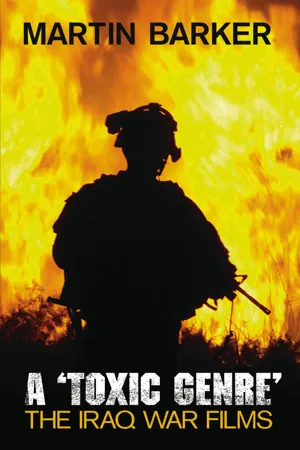
Over the last five years, a cycle of films has emerged addressing the ongoing Iraq conflict. Some became well-known and one of them, The Hurt Locker, won a string of Oscars. But many others disappeared into obscurity. What is it about these films that led Variety to dub them a 'toxic genre'? Martin Barker analyses the production and reception of these recent Iraq war films. Among the issues he examines are the borrowing of soldiers' YouTube styles of self-representation to generate an 'authentic' Iraq experience, and how they take refuge in 'apolitical' post-traumatic stress disorder. Barker also looks afresh at some classic issues in film theory: the problems of accounting for film 'failures', the shaping role of production systems, the significance of genre-naming and the impact of that 'toxic' label. A 'Toxic Genre' is fascinating reading for film studies students and anyone interested in cinema's portrayal of modern warfare.
- 216 pages
- English
- ePUB (mobile friendly)
- Available on iOS & Android
eBook - ePub
About this book
Information
1
The disappearing Iraq war films

On 3 March 2010, the British Broadcasting Coorporation’s (BBC’s) evening news carried a lengthy item about the impending release of the film The Green Zone, Paul Greengrass’s dramatisation of the search for Weapons of Mass Destruction following the 2004 invasion of Iraq. Presenter Huw Edwards prefaced the filmed report with the comment that this was a new development in Hollywood. Up until this point, he declared, few films bar The Hurt Locker had yet tackled the Iraq conflict. How wrong he was. Between 2005 and 2008, at least 23 such fiction films emerged from in and around Hollywood, and most of them claimed a base in the real events and circumstances of the war. But the BBC could be forgiven for not knowing about this lengthy list of films. All of them, until the very last one in the cycle, bombed at the box office, if they made it there at all – and just about all of them vanished without trace. Indeed, for a time, the most important topic of debate about the films was precisely their failure.1 Known collectively simply as the ‘Iraq war movies’, they were, to quote one report, ‘box office poison’ (Everhart 2009). This book is a study of these films.
These films were actually being awaited. Quite a few commentators were asking how long it would take Hollywood, this time, to get round to saying something about the war. Hollywood’s ‘cowardice’ over Vietnam was well-remembered, but there was a feeling that this time, perhaps, the studios might live up to their (partly-deserved) reputation for liberalism, and opposition to George W. Bush and his cronies. The expectations were, of course, different according to your politics. In 2004, the Washington Post ran an article about Jim Deutsch, a historian interested in the scars that wars leave on returning veterans, and the ways these are hidden from view:
The popular portrayals run contrary to the image of postwar boom and optimism that many people think of today. According to Deutsch, 1946 had the highest divorce rate until the 1970s. The disaffected vet from the Vietnam War is familiar, but World War II? Deutsch says it’s a recurring element of American culture after all wars. Bleak post-Iraq war movies and literature are next. ‘Some of these people literally went through hell,’ Deutsch says. ‘A common theme is the civilians back home don’t understand what they went through.’ (Montgomery 2004)
It was mostly assumed that the films, when they came, would be unlike the boosterist films of previous periods. But there were exceptions. The Democratic Underground, a forum on the left of the Democratic Party, feared that the studios were capable of delivering only military-friendly dross:
Now that the War against those Dastardly Saddam-backed 911 terrorists and the Enshrinement of Glorious Democratic Values in the Backwards Middle East and the Freeing of the latent American who resides inside every Iraqi has gone on longer than WWII where are the war films? Where is the Iraq equivalent of the Sands of Iwo Jima? Perhaps we could call it the Streets of Hadithah? … The DoD learned its lessons from Vietnam very well, they will not allow the unvarnished truth to make its way from Iraq. Service members are being censored in theater and at home. (Democratic Underground 2007)
Others on the Right saw ‘Hollywood’ quite differently – as a nest of radical vipers.
The cycle began with a little-noticed film from director Sidney Furie, whose credentials were good – he had directed The Boys in Company C (1978), one of the critical films about the Vietnam War. But American Soldiers: A Day in Iraq, where noticed at all, was judged by most early reviewers (professional or otherwise) to be a total disappointment. As others began to emerge, a pattern quickly emerged. Films would be reviewed in groups. Or if the focus was on one, it was examined for whether it looked any different from the flops that preceded or surrounded it.
In researching this book, there came a point where I had to make some hard decisions about which films to include in my list of ‘Iraq war movies’. I tried to include only those that were included in those comparative lists, for reasons which will become clear (see Chapter 5). Others could have been added. Some commentators have argued, with reason, that the cycle of ‘torture porn’ movies owes much to the revelations about Abu Ghraib and Guantánamo. As an example, consider this web report:
It’s hard to imagine that for every 15-year-old reading this article right now, the war has really been with them since they have probably been conscious of current events. This war has now run longer than World War II. Like the Vietnam War, which definitely influenced horror films of the early 1970s, the Iraq War had a real impact on the horror films of the past half decade. Filmmakers are all influenced by the current events they are operating in, so it’s no surprise that horror films have been affected too. So here are the Top 10 best Iraq War-influenced horror films. Hostel (2005): Eli Roth’s mega-hit horror film was undeniably influenced by the goings on at Abu Ghraib – whether Roth is conscious of it or not. Iraqi soldiers dehumanized, forced into naked human pyramids – vs. Americans dehumanized and cut up by twisted businessmen. Truth is often stranger than fiction … 28 Weeks Later (2007): With smiling faces, American troops take over a war ravaged nation – then attempt to exterminate that nation’s citizens when they lose control. This is what happens in Juan Carlos Fresnadillo’s superior sequel to 28 Days Later. The horror of 28 Weeks Later is actually quite real for a nation run by friendly, smiling occupiers – and it’s happening now. (Anon 2009)
The writer goes on to add Land of the Dead (dir. George A. Romero, 2005), The Hills Have Eyes (dir. Alexandre Aja, 2006), Planet Terror (dir. Robert Rodriguez, 2007), The Signal (dir. David Bruckner & Dan Bush, 2008), Diary of the Dead (dir. George A. Romero, 2007) and The Mist (dir. Frank Darabont, 2007) as further examples of Iraq-influenced horror. But this is Iraq-as-metaphor. Horror, fantasy and the like mark a distance from their topics. The films discussed here frequently made claims of direct relevance and – every bit as importantly – were seen by many commentators as contributions to the debate over the war. The 23 films in Table 1, then, constitute my primary focus.
The figures show the evident financial straits they all encountered. Although there are many important differences among them, we will see that there is a core set of themes, motifs and aesthetic choices which the films veer towards – and do so the more strongly, the more they seek to provide direct commentary on the Iraq War. Those which go elsewhere – The Marine, for instance, or The Objective – ditch those themes and tell their stories differently. And through those very differences we can still learn much.
Table 1 Details of films in the Iraq War film cycle
| ||||
| Title | Director/date | Maximum screens2 | Budget | US gross |
| ||||
| American Soldiers | Sidney J. Furie, 2005 | 0 | No info. | $0 |
| The Jacket | John Maybury, 2005 | 1,331 | $29 million | $7 million |
| Home of the Brave | Irwin Winkler, 2006 | 120 | $12 million | $41,000 |
| The Situation | Philip Haas, 2006 | 2 | $1 million | $48,000 |
| GI Jesús | Carl Colpaert, 2006 | 12 | $2 million | $8,000 |
| The Marine | John Bonito, 2006 | 2,545 | $20 million | $18 million |
| Badland | Francesco Lucente, 2007 | 2 | $10 million | $1,900 |
| Battle for Haditha | Nick Broomfield, 2007 | 2 | $3 million | $7,000 |
| Grace Is Gone | James C. Strouse, 2007 | 7 | $2 million | $50,000 |
| In the Valley of Elah | Paul Haggis, 2007 | 978 | $23 million | $6.7 million |
| The Kingdom | Peter Berg, 2007 | 2,836 | $80 million | $47 million |
| Lions for Lambs | Robert Redford, 2007 | 2,216 | $35 million | $15 million |
| The Mark of Cain | Marc Munden, 2007 | 0 | ‘Low’ | $0 |
| Redacted | Brian de Palma, 2007 | 49 | $5 million | $65,000 |
| Rendition | Gavin Hood, 2007 | 2,250 | $27 million | $9 million |
| Day Zero | Bryan Gunnar Cole, 2007 | 2 | No info. | $13,800 |
| Conspiracy | Adam Marcus, 2008 | 0 | $18 million | $0 |
| The Lucky Ones | Neil Burger, 2008 | 425 | $15 million | $183,000 |
| Stop-Loss | Kimberley Pierce, 2008 | 1,291 | $29 million | £11 million |
| War, Inc. | Joshua Seftel, 2008 | 33 | $10 million | $578,000 |
| Body of Lies | Ridley Scott, 2008 | 2,710 | $70 million | $39 million |
| The Objective | Daniel Myrick, 2008 | 1 | $4 million | $95 |
| The Hurt Locker | Kathryn Bigelow, 2008 | 535 | $11 million | $12.5 million |
| ||||
HOLLYWOOD POST-9/11
Histories such as this do not have starting points. But they can have turning points. And there is little doubt that the 11 September 2001 attacks on New York and Washington set in train many of the circumstances that shaped this cycle of films. Shortly after the attacks, on 17 October 2001, the White House announced the formation of an ‘Arts and Entertainment Task Force’ to help align Hollywood’s money and talents with the Bush Administration’s needs for films appropriate to this new era of ‘terror’. The announcement produced astonishment: was Hollywood ‘getting into bed with Bush’? In an overview of subsequent developments, David Chambers recalls the brief history and impact of this Task Force:
Between October 17 and December 6, there were a series of high-profile meetings in Los Angeles and Washington featuring Karl Rove, senior presidential advisor, and Jack Valenti, the long-time head of the Motion Picture Association of America (MPAA), the lobbying group for the major studios. The major outcome of these meetings was a repeated question from Hollywood, how can we help? while the White House, to avoid accusations of co-opting Hollywood into propaganda, could only answer, we can’t tell you how. (Chambers 2002)
Chambers details a number of small but significant developments that might be attributed to Valenti’s group: for example, free provision of films to American soldiers overseas; special programmes on MTV; the promulgation of exchanges and debates about terrorism among students across a number of countries. In the reverse direction, federal actions against Hollywood over ‘sex and violence’ were largely suspended. Just as importantly, incipient moves to challenge the increasing media monopolisation were transferred to the Federal Trade Commission, and stalled.
The impact on film-making itself was much more muted – not least because, as Chambers notes, the ‘creatives’ were not really part of the Task Force. A number of films (all 2002) were delayed and adjusted to the ‘new sensibilities’. This could involve altering New York skylines (Spiderman [dir. Sam Raimi, 2002]), or re-editing to reflect the ‘new mood’ (an airplane hijack was removed from Collateral Damage [dir. Andrew Davis, 2002]), while Black Hawk Down (dir. Ridley Scott, 2001) was substantially revised in ways which, it has been argued, dehumanised the Somali ‘enemy’ whilst cleaning up the American soldiers.
Films which came close to criticising American policies and motives got pulled back. Philip Noyce’s remake of The Quiet American (2002) made uncomfortable viewing, with its emphasis on American duplicity over war preparations. Due for distribution just days after the attacks, it was stopped; only a campaign by Michael Caine, who smelt a possible Oscar for his performance as world-weary journalist Thomas Fowler, got it a limited release. Even where a film was not it itself political, it could become edgy by dint of the politics of those in it. The UK’s Guardian quoted Peter Rainer, of the American society of film critics, on the makeup of the list of Oscar nominees: ‘If Susan Sarandon was nominated for The Banger Sisters, this would definitely be an issue’ (Campbell 2003). Sarandon was among the most vocal Hollywood star critics of Bush’s preparations for war. In the end, that year, the Oscars played safe with eleven awards to The Lord of the Rings (dir. Peter Jackson, 2001–03) where choosing sides and making wars happened safely in a fantasy world.3
Older films that had briefly been discussed for their uncanny prefiguration of the 9/11 attacks (where had they got such insightful storylines from?) dropped surprisingly out of view:
There seems to be little talk about recent, prophetic films such as The Siege (19...
Table of contents
- Cover
- Title Page
- Copyright
- Contents
- List of figures and tables
- Acknowledgements
- 1. The disappearing Iraq War Films
- 2. No True Glory: the film that never was
- 3. Constructing an ‘Iraq War experience’
- 4. From Doughboys to Grunts: the ‘American soldier’
- 5. Understanding film ‘failures’
- 6. Bringing the war home
- 7. Explaining the Iraq War
- 8. Producing a ‘toxic genre’
- 9. Free-riders and outliers
- 10. Latino Grunts: the new victim-heroes
- 11. The Hurt Locker and beyond
- Notes
- References
- Index
Trusted by 375,005 students
Access to over 1.5 million titles for a fair monthly price.
Study more efficiently using our study tools.
Frequently asked questions
Yes, you can cancel anytime from the Subscription tab in your account settings on the Perlego website. Your subscription will stay active until the end of your current billing period. Learn how to cancel your subscription
No, books cannot be downloaded as external files, such as PDFs, for use outside of Perlego. However, you can download books within the Perlego app for offline reading on mobile or tablet. Learn how to download books offline
Perlego offers two plans: Essential and Complete
- Essential is ideal for learners and professionals who enjoy exploring a wide range of subjects. Access the Essential Library with 800,000+ trusted titles and best-sellers across business, personal growth, and the humanities. Includes unlimited reading time and Standard Read Aloud voice.
- Complete: Perfect for advanced learners and researchers needing full, unrestricted access. Unlock 1.5M+ books across hundreds of subjects, including academic and specialized titles. The Complete Plan also includes advanced features like Premium Read Aloud and Research Assistant.
We are an online textbook subscription service, where you can get access to an entire online library for less than the price of a single book per month. With over 1.5 million books across 990+ topics, we’ve got you covered! Learn about our mission
Look out for the read-aloud symbol on your next book to see if you can listen to it. The read-aloud tool reads text aloud for you, highlighting the text as it is being read. You can pause it, speed it up and slow it down. Learn more about Read Aloud
Yes! You can use the Perlego app on both iOS and Android devices to read anytime, anywhere — even offline. Perfect for commutes or when you’re on the go.
Please note we cannot support devices running on iOS 13 and Android 7 or earlier. Learn more about using the app
Please note we cannot support devices running on iOS 13 and Android 7 or earlier. Learn more about using the app
Yes, you can access A 'Toxic Genre' by Martin Barker in PDF and/or ePUB format, as well as other popular books in Media & Performing Arts & Film History & Criticism. We have over 1.5 million books available in our catalogue for you to explore.