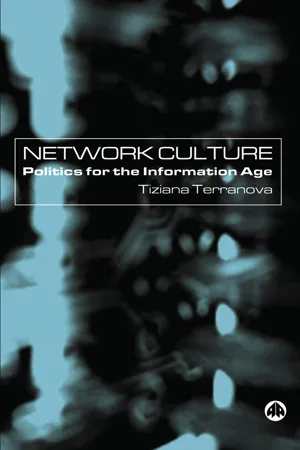
In an age of email lists and discussion groups, e-zines and weblogs, bringing together users, consumers, workers and activists from around the globe, what kinds of political subjectivity are emerging? What kinds of politics become possible in a time of information overload and media saturation? What structures of power and control operate over a self-organising system like the internet?
In this highly original new work, Tiziana Terranova investigates the political dimension of the network culture in which we now live, and explores what the new forms of communication and organisation might mean for our understanding of power and politics. Terranova engages with key concepts and debates in cultural theory and cultural politics, using examples from media culture, computing, network dynamics, and internet activism within the anti-capitalist and anti-war movements.
Network Culture concludes that the nonlinear network dynamics that link different modes of communication at different levels (from local radio to satellite television, from the national press to the internet, from broadcasting to rumours and conspiracy theories) provide the conditions within which another politics can emerge. This other politics, the book suggests, does not entail the production of a new political discourse or ideology, but the invention of micropolitical tactics able to stand up to new forms of social control.
- 192 pages
- English
- ePUB (mobile friendly)
- Available on iOS & Android
eBook - ePub
About this book
Information
Table of contents
- Cover
- Title Page
- Copyright
- Contents
- Acknowledgements
- Dedication
- Introduction
- 1. Three Propositions on Informational Cultures
- 2. Network Dynamics
- 3. Free Labour
- 4. Soft Control
- 5. Communication Biopower
- Notes
- Bibliography
- Index
Trusted by 375,005 students
Access to over 1.5 million titles for a fair monthly price.
Study more efficiently using our study tools.
Frequently asked questions
Yes, you can cancel anytime from the Subscription tab in your account settings on the Perlego website. Your subscription will stay active until the end of your current billing period. Learn how to cancel your subscription
No, books cannot be downloaded as external files, such as PDFs, for use outside of Perlego. However, you can download books within the Perlego app for offline reading on mobile or tablet. Learn how to download books offline
Perlego offers two plans: Essential and Complete
- Essential is ideal for learners and professionals who enjoy exploring a wide range of subjects. Access the Essential Library with 800,000+ trusted titles and best-sellers across business, personal growth, and the humanities. Includes unlimited reading time and Standard Read Aloud voice.
- Complete: Perfect for advanced learners and researchers needing full, unrestricted access. Unlock 1.5M+ books across hundreds of subjects, including academic and specialized titles. The Complete Plan also includes advanced features like Premium Read Aloud and Research Assistant.
We are an online textbook subscription service, where you can get access to an entire online library for less than the price of a single book per month. With over 1.5 million books across 990+ topics, we’ve got you covered! Learn about our mission
Look out for the read-aloud symbol on your next book to see if you can listen to it. The read-aloud tool reads text aloud for you, highlighting the text as it is being read. You can pause it, speed it up and slow it down. Learn more about Read Aloud
Yes! You can use the Perlego app on both iOS and Android devices to read anytime, anywhere — even offline. Perfect for commutes or when you’re on the go.
Please note we cannot support devices running on iOS 13 and Android 7 or earlier. Learn more about using the app
Please note we cannot support devices running on iOS 13 and Android 7 or earlier. Learn more about using the app
Yes, you can access Network Culture by Tiziana Terranova in PDF and/or ePUB format, as well as other popular books in Politics & International Relations & Democracy. We have over 1.5 million books available in our catalogue for you to explore.