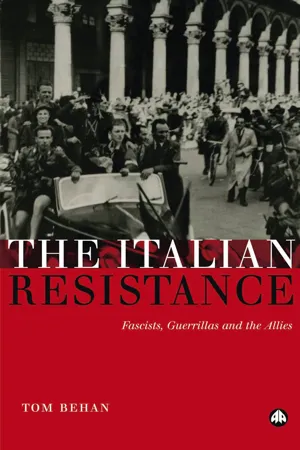
One of the enduring myths about World War Two is that the Allies alone liberated occupied Europe. However, many countries had successful anti-fascist movements, and Italy's was one of the biggest and most politically radical. Yet it remains relatively unknown outside of its own homeland. Tom Behan tells this inspiring history. Within Italy many plaques and streets commemorate the actions of the partisans - a movement from below that grew as Mussolini's dictatorship unravelled. Led by radical left forces, the Resistance trod a thin line between fighting their enemies at home and maintaining an uneasy working relationship with the Allies. Through the use of unpublished archival material and interviews with surviving partisans, this is an inspiring story of liberation.
- 320 pages
- English
- ePUB (mobile friendly)
- Available on iOS & Android
eBook - ePub
About this book
Information
PART I
1
Midnight in the Century

When Mussolini became prime minister in October 1922 the powerful politicians who supported his election thought they could control him. In a parliament of 535 seats, his party had just 35 MPs, yet 479 parliamentarians voted for the formation of his government.
Another group in society was also backing Mussolini – his party was highly reliant on financing from the rich and powerful. For the period 1921–24 the breakdown of contributions to the Fascist Party has been calculated at 25 per cent from individuals, 10 per cent from banking and insurance, and 64 per cent from industrialists and the business world at large.1 These finances were forthcoming because the fascists had quickly shown themselves willing and able to make physical attacks on the left. Early examples were the attack on the Italian Socialist Party (PSI) daily Avanti! in Milan on 15 April 1919, and the beating up of Socialist MPs on the opening day of the new parliament on 1 December.2
The reason such a violent new movement received rapid funding from some of the most powerful financial forces in the country lay in what happened during the biennio rosso, the ‘two red years’ that followed the First World War. The left had grown massively for a combination of reasons: hardships during the war had increased radicalisation, and the idea of solving problems through revolution was growing in popularity, particularly following the Russian Revolution of 1917. The PSI had grown from a membership of 50,000 in 1914 to 216,000 by 1921, and from 50 MPs before the war to 156 in 1919, when it became the largest party in parliament. Avanti! sold 300,000 copies a day – 50,000 alone in Turin. Similarly, the largest union federation, the CGL, rose from just below 250,000 members at the end of 1918 to 1 million in 1919 and 2.2 million in 1920, with the semi-anarchist, semi-revolutionary syndicalist USI federation claiming 500,000 members in 1919.3
Not surprisingly, strike statistics shot up, but so too did the level of wage increases won as a result. In 1918 real wages had fallen to 65 per cent of their 1913 level, but they rose to 114 per cent in 1920 and 127 per cent in 1921.4 This whole period culminated in the ‘occupation of the factories’ in September 1920, when hundreds of thousands of engineering workers occupied their workplaces, sometimes with weapons, for nearly a month. While the PSI and the trade unions publicly debated whether to use this movement as a springboard for revolution, factory owners were faced with the difficulties of stopping armed strikes with the use of force, and the intractable problem of democracy having made the PSI the largest party in parliament.
Hence the financing of fascist squads, committed to destroying a resurgent working class. For example, in August 1922 ship owners in Genoa spent millions financing a fascist ‘punitive expedition’, which in three days of fighting saw five dockers killed and 50 wounded.5
It was this ‘great fear’ which also explained the political as well as the financial support for Mussolini. For his part, Mussolini had a considerable talent for making promises people wanted to hear. Once he had assured business leaders that his movement would not enact any radical or populist economic measures, in early October 1922 the industrialists’ organisation the Confindustria came out in support of Mussolini joining government. Similarly, since the fascists had made it clear they would not close down private Catholic schools, the church was on side too. And the country’s two most important military leaders, Marshals Pietro Badoglio and Armando Diaz, also made it clear on 7 October that the military would not oppose a government led by Mussolini.6
The government sworn in on 30 October was a coalition made up of five parties, with the Liberals taking one cabinet post and the Popular Party three,7 given that leaders such as Ivanoe Bonomi and Alcide De Gasperi had voted to make Mussolini prime minister. Bonomi was not only leader of the Liberal Party, he had also been prime minister during 1921–22 and was elected on a joint ticket with the fascists (on more than one occasion he had allowed his ministerial car to be used in ‘punitive expeditions’).8
The Popular Party was much larger, and in effect Mussolini could not pass laws without their agreement or abstention. Although his methods were not immediately as dictatorial as they later became, Mussolini quickly began to engage in highly reactionary policies. Nevertheless, six months after the formation of Mussolini’s government the Popular Party held its conference in Turin, and in a speech their young MP, De Gasperi, called for his party to adopt the following policy towards government: ‘I ask that conference approves the attitude adopted by the party so far, an attitude of frank and loyal collaboration.’9
Even though the party conference voted 70 to one to stay within government, Mussolini, rapidly growing in power and self-confidence, ejected them. Nevertheless, a meeting of the Popular Party parliamentary group chaired by De Gasperi again expressed the view that ‘an attitude of sincere collaboration with the government should be maintained’.10 The historical peculiarity here is that both these men – Bonomi and De Gasperi – were to take on an important institutional role in Mussolini’s downfall during the Second World War, although their practical contribution was perhaps small.
Mussolini, meanwhile, ruled more or less constitutionally in the first two or three years of his government, although press freedoms were quickly curtailed. But over time internal pressure built up within the fascist movement, which demanded that the party’s ‘revolutionary’ agenda be put into action. Part of this involved continuing to annihilate the left, a strategy that culminated with the kidnapping of Socialist MP Giacomo Matteotti in 1924.
When his body was found several weeks later, a profound political crisis developed: Mussolini’s personal bodyguards were involved in the murder, and Mussolini too was implicated in the plotting before the attack and the cover up afterwards. In the meantime many anti-fascist MPs left parliament and created their own alternative structure in opposition to Mussolini’s mockery of democracy. The Liberal and conservative politicians who remained in parliament disagreed with the fascists’ violent methods, but did not have the numbers to unseat Mussolini with a vote, and neither did the king want to sack him. Crucially, the Popular Party remained in parliament rather than joining the alternative democratic assembly.11 The only way to end Mussolini’s rule therefore would have been unconstitutional – it would have meant calling for a popular uprising or revolution, and while many spontaneous protests had already broken out, these concepts were not part of conservative and Catholic political traditions. Left-wing parties, meanwhile, were suffering terrible harassment and were also politically divided after the Communist Party (the PCI) had been created from a split within the Socialist Party in January 1921.
In the face of all this instability fascist hardliners were demanding that Mussolini face down all his critics. Mussolini had to either resign or accept responsibility for Matteotti’s murder, which he did on 3 January 1925, banning all opposition and effectively creating a dictatorship. His hand had been forced by fascists who had been rattled by the possibility of prosecution over the Matteotti affair, and who were considering removing Mussolini himself.
This was the beginning of a full-blooded dictatorship.
The fascist Special Tribunal, which sat from 1927 to 1943, gave out prison sentences to 4,000 communists, 323 ‘generic anti-fascists’, 24 anarchists and 12 socialists. In all the Tribunal inflicted a total of 28,196 years imprisonment against 4,596 anti-fascists: not for theft, rape, or murder, but for being anti-fascists. Their social composition is interesting to note because it revealed what kind of people were actively opposing fascism: 85 per cent were workers or artisans.12 Another 12,000 anti-fascists, for whom strong evidence could not be presented to the Tribunal, were sent not to jail but into ‘internal exile’ in remote areas of the South or small islands. Others were forced to sign on at a police station twice a day. Many more were followed and spied upon.
However this working-class opposition to fascism did not come from some kind of moral superiority they possessed over other classes. Whilst workers and peasants might be ideologically more opposed to fascism than other classes, it was the anti-working-class policies of fascism that drove many to oppose Mussolini’s government. Once a fully fledged dictatorship had developed, huge wage cuts were imposed on workers: 10–20 per cent in October 1927, 8 per cent in December 1930 and 7 per cent in May 1934.13
Given the risks, opposition to fascism was therefore unlikely to involve the rich or the middle class, by and large – a fact borne out by the social status of those convicted for anti-fascism. Overall Mussolini was careful about protecting the wage levels and savings of the middle class; while overall real wages only regained their 1922 level in 1938 – in a society where the eight-hour day had been won and then abolished. By 1940 Italy had the lowest per capita consumption of sugar in Europe, and by the end of the 1930s there were near starvation conditions in many areas of the South, as outlined in Christ Stopped at Eboli by Carlo Levi, an anti-fascist sent into ‘internal exile’ by the Special Tribunal.
Individual Italians might complain about the government in private but would be foolish to do so in public. But even in their own home parents often would not criticise fascism in front of their children, for fear that the children would innocently betray them as a result of devious questioning at school, or simply through a careless word in the street or the playground.14 Society was highly regimented, and people were fearful of speaking their mind. The risks were enormous: if neighbours saw someone going in and out at odd times, or thought people coming to visit looked suspicious, they might tell the police. The police were also very good at turning captured anti-fascists into spies, so ultimately any anti-fascist activity was likely to end in long-term imprisonment.
Many people died from beatings, or were simply murdered, never appearing in court. And some prisoners such as Antonio Gramsci, the main theoretician of the 1920 ‘occupation of the factories’ and leader of the PCI from 1924, died in prison. This did not go on for just one or two years, but for two decades. If anything, the Tribunal became more vicious as time went on, and as fascism felt under more pressure. For example in 1941 it handed down a three-year sentence against Corporal Francesco Castiglione for complaining about the war during a train journey between Naples and Caserta. In Salerno Eduardo Adinolfi Borea was sentenced to sixteen years for distributing anti-fascist leaflets.15 Although he was writing about the horrors of Stalinist Russia and Nazism, Victor Serge’s definition of the inter-war years as being ‘midnight in the century’ seems very appropriate.
Many anti-fascists were driven into exile abroad, with many settling in France. In essence it was a small band of communists who kept the flame of anti-fascism burning for 20 years. Yet in many towns and cities all links with the party leadership now living abroad, and all publications, were cut for years on end – ‘the darker the night the brighter the star’ was a phrase they used to keep themselves going.
To take one city and one year out of 20, 1927 was a devastating one for Milan communists – a total of 1,960 people were arrested and accused of party membership. Repression was harsh: on one occasion 150 workers were beaten up en masse on suspicion of communism, with five dying of their wounds. In January the printing press of the party newspaper l’Unità was discovered, and in July, through the infiltration of spies, the police discovered the PCI’s offices for the whole of northern Italy, duly arresting the PCI treasurer for Milan and the person responsible for distributing party literature throughout Italy.16 By mid 1928 the PCI in Milan had not surprisingly almost collapsed: their youth organisation had just over 30 members.17
Opposition to fascism continued by and large to be a working-class affair, and those who had doubts about fascism were compromised if they remained in influential positions. As one speaker recalled at a recent congress of the ex-partisan’s association, ANPI: ‘there is a difference between Antonio Gramsci who dies in a fascist jail and senator Benedetto Croce, who in the very same period donated his Senate gold medal to the fascists in support of the war against Abyssinia, fought with poison gas’.18 Although more famous as a philosopher, Croce had also been a senator and Minister of Education in 1920–21 and voted for Mussolini to become prime minister in 1922. Furthermore, in ...
Table of contents
- Cover
- Title Page
- Copyright
- Contents
- List of Illustrations
- Abbreviations
- Acknowledgements
- Chronology
- Introduction
- Part I
- Part II
- Conclusion
- Notes
- Index
Trusted by 375,005 students
Access to over 1.5 million titles for a fair monthly price.
Study more efficiently using our study tools.
Frequently asked questions
Yes, you can cancel anytime from the Subscription tab in your account settings on the Perlego website. Your subscription will stay active until the end of your current billing period. Learn how to cancel your subscription
No, books cannot be downloaded as external files, such as PDFs, for use outside of Perlego. However, you can download books within the Perlego app for offline reading on mobile or tablet. Learn how to download books offline
Perlego offers two plans: Essential and Complete
- Essential is ideal for learners and professionals who enjoy exploring a wide range of subjects. Access the Essential Library with 800,000+ trusted titles and best-sellers across business, personal growth, and the humanities. Includes unlimited reading time and Standard Read Aloud voice.
- Complete: Perfect for advanced learners and researchers needing full, unrestricted access. Unlock 1.5M+ books across hundreds of subjects, including academic and specialized titles. The Complete Plan also includes advanced features like Premium Read Aloud and Research Assistant.
We are an online textbook subscription service, where you can get access to an entire online library for less than the price of a single book per month. With over 1.5 million books across 990+ topics, we’ve got you covered! Learn about our mission
Look out for the read-aloud symbol on your next book to see if you can listen to it. The read-aloud tool reads text aloud for you, highlighting the text as it is being read. You can pause it, speed it up and slow it down. Learn more about Read Aloud
Yes! You can use the Perlego app on both iOS and Android devices to read anytime, anywhere — even offline. Perfect for commutes or when you’re on the go.
Please note we cannot support devices running on iOS 13 and Android 7 or earlier. Learn more about using the app
Please note we cannot support devices running on iOS 13 and Android 7 or earlier. Learn more about using the app
Yes, you can access The Italian Resistance by Tom Behan in PDF and/or ePUB format, as well as other popular books in History & 20th Century History. We have over 1.5 million books available in our catalogue for you to explore.