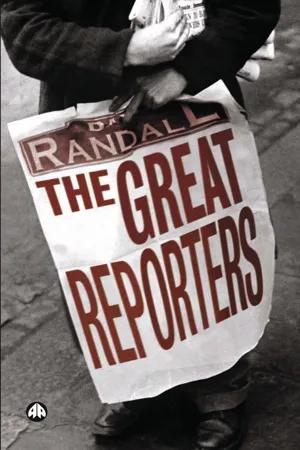
Who are the greatest reporters in history? This unique book is the first to try and answer this question. Author David Randall searched nearly two centuries of newspapers and magazines, consulted editors and journalism experts worldwide, and the result is The Great Reporters - 13 in-depth profiles of the best journalists who ever lived. Each profile tells of the reporter's life and his or her major stories, how they were obtained, and their impact. Packed with anecdotes, and inspiring accounts of difficulties overcome, the book quotes extensively from each reporter's work. It also includes an essay on the history of reporting, charting the technologies, economics, and attitudes that made it the way it is - from the invention of the telegraph to the Internet. The Great Reporters is not just the story of 13 remarkable people, it is the story of how society's information hunter-gatherers succeed in bringing us all what we need to know.
- 288 pages
- English
- ePUB (mobile friendly)
- Available on iOS & Android
eBook - ePub
The Great Reporters
About this book
Trusted by 375,005 students
Access to over 1.5 million titles for a fair monthly price.
Study more efficiently using our study tools.
Information
1
William Howard Russell
1820–1907
William Howard Russell
1820–1907
THE MAN WHO INVENTED WAR CORRESPONDING
The year is 1854, and Britain is unchallenged as a world power. It rules an empire that includes Canada, India, the West Indies, Australia, and it will soon begin annexing large parts of Africa. The majority of its people believe in God, country and the right of the monied and well-born to buy their way into, and out of, the officer class of the army.
A threat is perceived. It is several thousand miles away from the homeland, but, if unchecked, the government fears it will jeopardise the prosperity and security of the nation. So old obligations and new alliances are invoked, flags are waved, and the army is sent off to deter an ambitious empire. This is Russia, a land ruled by a royal dictator where serfdom still exists and which seems, in some indefinable way, a challenge to the civilised, democratic values of the homeland. The battleground is the Crimea, a place few back home could find on the map. But nevertheless, they wave their flags, and wait for news of the victories that they, being citizens of the most powerful nation on earth, expect as of right.
Into these circumstances there came a bearded, dishevelled figure called William Howard Russell. He was the correspondent for The Times, and the stories he wrote from that conflict shocked Britain as no reporting has done since. Middle- and upper-class readers read his despatches and were shaken to their complacent roots to learn that the army sent into the field by their own pre-eminent nation was poorly supplied, woefully organised, led by incompetent aristocrats, managed by an inefficient government and, worst of all, was so careless of its soldiers’ welfare that thousands of them died not in battle but in the filthy hovels that passed for hospitals. Russell’s reporting was, in every sense, a shock to the system for Victorian England; and, not least, because no one had ever written like this before. It was small wonder. To uncover these shortcomings, Russell had to endure nearly two years of fending for himself in the field without any assistance, face almost constant hostility from military authorities unused to the very concept of a meddlesome reporter, and throughout all this he knew that, back home, his honesty and patriotism were being vilified. But, as every line he wrote was picked over for faults by the highest in the land, he held his nerve. That took skill and care, but most of all, it took the guts, after learning awkward truths that conflicted with popular orthodoxies, to report them, and go on reporting them in the face of public attacks. This is the reason why a man born almost a generation before the Victorian age began, and who wrote in a leisurely prose that seems now like a foreign language, can stand comparison with the sharpest of modern operators, and be in this book.
However, he nearly didn’t make it into anyone’s book. In 1844, on his first major reporting assignment, Russell made such a fearful hash of it that only the charity of The Times editor saved him from the sack. He had been sent by the paper to Dublin to cover the trial of Irish leader Daniel O’Connell for sedition, one of that year’s big stories. Since this was the days before the telegraph, the only way news of the verdict was going to get speedily back to London was if someone took it there in person. Thus the two big papers, The Times and the Morning Herald, had made elaborate arrangements to get reporters to the mainland, hiring steamers, special trains and cabs. These conveyances were all standing by when, late one August Saturday, the jury retired. The rest of the press, anticipating a long wait, left to get refreshments, and Russell was sitting outside the court, thinking what best to do, when his messenger boy rushed up and told him the jury was returning. Russell went back into court, heard the foreman deliver a verdict of guilty, and dashed off determined to be first back to London with the news. He jumped in a carriage, then on a special train to the port of Kingstown, boarded the Iron Duke, the boat hired by The Times, and, within half an hour it had got up sufficient steam to start heading for the Welsh coast. As it left, Russell noted that the Herald’s steamer was still lying peacefully at anchor. He arrived at Holyhead, caught the special train to London, tried to sleep but couldn’t because of his tight boots, took them off, reached London after seven hours, flung himself bootless into the waiting cab, and finally, with one boot on and the other under his arm, ran lopsidedly into the precincts of The Times building. Years later, he described what then happened: ‘As I entered Printing House Square, a man in shirt sleeves I took to be the Times printer came up and said: “So glad to see you safe over, sir. So they’ve found him guilty.” “Yes, guilty my friend,” I replied.’
Unfortunately the man he met was not a Times printer, but a reporter working for the Morning Herald. Thus did the young Russell present the paper’s rival with a scoop on a plate, which it duly published. Something of the kerfuffle that ensued within The Times can be judged from the two angry notes sent him by Moberly Bell, the paper’s manager. The first read, ominously: ‘You managed very badly… This must be enquired into.’ The second, penned after the editor saved his young reporter’s neck, began: ‘You have very nearly severed your connection with us by your indiscretion,’ and went on: ‘Let me warn you to keep your lips closed and your eyes open… We would have given hundreds of pounds to have stopped your few words last night.’ Admonished, but spared, Russell went on to cover pretty much every major story of the high Victorian age: the railway mania, the Irish Famine, the Great Exhibition, Wellington’s funeral, the Crimean War, the Indian Mutiny, the American Civil War, the coronation of Czar Nicholas, the Paris Commune, the Franco-Prussian War, the first attempt to lay a trans-Atlantic cable, the Sudan and the Zulu Wars.
The man who was to have this ringside seat at the nineteenth century was born the son of a manufacturer’s agent near Dublin on 28 March 1820. He was fascinated as a child by the soldiers drilling near his home, and, while attending Trinity College, Dublin, toyed with the idea of either the military or the law as a career. But then, when he was 20, his cousin asked him to help cover the Irish elections for The Times of London. Having some knowledge of what passed locally for public debate, Russell thought a good place to cover Dublin’s elections might be not the hustings or meeting rooms, but the casualty ward of the hospital, where candidates would be brought when the brickbats began to fly. Sure enough, as a procession of bloodied electoral hopefuls were wheeled in, there was Russell stepping forward to interview them. The Times was impressed, invited him to London, and signed him up as a seasonal member of the paper’s parliamentary staff at £5 5s a week. The job often involved staying at the House until debates finished at four or five in the morning, and then walking the two miles back to The Times offices to file his reports. But he excelled, and was soon in charge of the reporters covering the blizzard of railway bills then going through Parliament. There were so many that, had they all been successful, their financing would have required all the available capital in the country. It was, of course, a classic speculative frenzy, always easier to see in hindsight than at the time. But The Times, led by Russell, was never fooled. He rejected the bribes on offer to puff various schemes, correctly identified many of them as worthless, and the paper more than made up in enhanced prestige what it lost in advertising revenues.
In 1846, with marriage looming, he accepted a better-paid post at the Morning Chronicle, and it was for them that he covered the Irish Famine. But he was soon back at The Times, covering Parliament, and beginning to prove himself the best ‘colour’ writer on the paper. He was sent to report on the Great Exhibition and, even though it meant having to be recalled from holiday in Switzerland (not a quick return trip in 1852), Wellington’s funeral. So when war against Russia loomed in 1854 and The Times obtained permission to send a correspondent with the army, Russell was the man selected to go. ‘You’ll be home in two months,’ editor John Delane assured him in February. Not for the last time, a desk man’s assurance was to prove worthless. Russell would be gone for two years.
After a farewell dinner given for him at the Garrick Club, by Dickens and Thackeray, Russell made his way to Southampton, sailed with the Guards to Malta, and thence to Gallipoli, Bulgaria and the Crimea. He arrived there on 14 September, and found the stage set for Britain, and her allies France and Turkey, to go to war with Russia. Although he was not the first war correspondent (these were mainly serving soldiers who had reported battles as if they were sporting fixtures), Russell was the first journalist of stature to cover a major conflict.
What he gave the newspaper reading public (and at the time his paper sold more than four times its rivals’ combined sales) was nothing less than its first true picture of war. From its gallantry (the Heavy Brigade charging at the Battle of Balaclava, October 1854):
… As lightning flashes through a cloud the Greys and Enniskilliners pierced through the dark masses of Russians… There was a clash of steel and a light play of sword blades in the air, and then the Greys and the redcoats disappear in the midst of the shaken and quivering columns.
From its moments of fortitude (at the Battle of Inkerman, 1854):
… A shell came right among the staff – it exploded in Captain Somerset’s horse, ripping him open… struck down Captain Gordon’s horse and killed him at once, and then blew away General Strangway’s leg, so that it hung by a shred of flesh… The poor old general never moved a muscle of his face. He said merely, in a gentle voice, ‘Will anyone be kind enough to lift me off my horse?…’
To its chaos (from the battle for Sebastopol, June 1855):
… The men of the different regiments got mingled together in inextricable confusion. The 19th did not care for the orders of the officers of the 88th, nor did the soldiers of the 23rd heed the commands of an officer who did not belong to the regiment. The officers could not find their men – the men had lost sight of their own officers.
Its house-keeping (after the Battle of Inkerman in November 1854):
… Litter-bearers dotted the hillside… hunting through the bushes for the dead or dying. Our men had acquired a shocking facility in their diagnosis… One of the party advanced, raised the eyelid if it was closed, peered into the eye, shrugged his shoulders, saying quietly, ‘He’s dead, he’ll wait,’ and moved back to the litter; others pulled the feet, and arrived at equally correct conclusions by that process…
Its squalor (from the Russian hospital he entered after the fall of Sebastopol in early 1855):
In a long, low room… dimly lighted through shattered and unglazed window frames, lay… the rotten and festering corpses of the soldiers, who were left to die in their extreme agony, untended, uncared for, packed as close as they could be stowed, some on the floor, others on wretched trestles and bedsteads or pallets of straw, sopped and saturated with blood… Many lay, yet alive, with maggots crawling about in their wounds… Many, with legs and arms broken and twisted, the jagged splinters sticking through the raw flesh, implored aid, water, food, or pity…
Its futility (after the fall of Sebastopol – an event watched by sightseers in yachting caps):
… Tired armies, separated from each other by a sea of fires, rest on their arms, and gaze with varied emotions on all that remains of the object of their conflicts.
And its legends. In late October 1854, Russell stood on a ridge overlooking Balaclava and witnessed one of history’s most famous feats of war. Three weeks later (his letters took that long to reach London), The Times published his account of the Charge of the Light Brigade, in which 673 horsemen set out and fewer than 200 returned:
… At 11:00 our Light Cavalry Brigade rushed to the front… They advanced in two lines, quickening the pace as they closed towards the enemy… At the distance of 1200 yards the whole line of the enemy belched forth, from thirty iron mouths, a flood of smoke and flame through which hissed the deadly balls…
With a cheer which was many a noble fellow’s death cry, they flew into the smoke of the batteries; but ere they were lost from view, the plain was strewed with their bodies and with the carcasses of horses… At the very moment when they were about to retreat, a regiment of lancers was hurled upon their flank. Colonel Shewell, of the 8th Hussars, saw the danger and rode his men straight at them, cutting his way through with fearful loss… The Russian gunners, when the storm of cavalry passed, returned to their guns. They saw their own cavalry mingled with the troopers who had just ridden over them, and to the eternal disgrace of the Russian name, the miscreants poured a murderous volley of grape and canister on the mass of struggling men and horses, mingling friend and foe in one common ruin… At 11:35 not a British soldier, except the dead and dying, was left in front of those bloody Muscovite guns…
Not surprisingly, the army never knew quite what to make of Russell. Lacking any official status, he was reliant on his ability to make friends with officers, and prise from them information he could not collect with his eyes. His Irish charm even worked with some senior officers. Early in the war, for instance, he was brought before General Pennyfeather, who demanded to know his business. When Russell told him he was a reporter, the general replied: ‘By God, Sir. I had sooner see the devil!’ Russell, however, replied with a little Dublin banter and the old general was won over. This did not, however, apply to the army as a whole. There were times when he was denied rations, returned to camp to find his tent taken down and flung outside the camp, refused information such as casualty figures, and warned that, if he valued his safety, he would leave. Embedded he was not.
In these circumstances, other reporters might have been inclined to take their foot off the honesty pedal. Not Russell. One of his first reports told of a serious cholera epidemic and the shortcomings of the medical service in dealing with it, and he continued to reveal the chaotic truth about the army. He laid bare the inadequacy of supplies that led to too few wagons, beds for the sick or medicines; he wrote of the fussy uniforms with their stiff high collars that were suffocating in summer and afforded no warmth in winter; the lack of sanitation and water filtration in camp; the poor, often contaminated food that was frequently in short supply (in theory, it was a pound of beef and bread, plus a little coffee and sugar, per man per day); and the fact that each man had to forage for his own firewood and then cook his own meal. The miseries of this life, quite apart from the risks of combat, he captured in late November 1854:
… It is now pouring rain… the trenches are turned into dykes, in the tents the water is sometimes a foot deep, our men have not either warm or waterproof clothing, they are out for twelve hours at a time in the trenches… and not a soul seems to care for their comfort, or even for their lives. These are hard truths, but the people of England must hear them. They must know that the wretched beggar who wanders about the streets of London in the rain leads the life of a prince compared with the British soldiers who are fighting out here for their country, and who, we are complacently assured by the home authorities, are the best appointed army in Europe.
Nothing hit home with the...
Table of contents
- Cover
- Title Page
- Copyright
- Dedication
- Contents
- Introduction
- The World of the Reporter
- 1. William Howard Russell
- 2. Edna Buchanan
- 3. A.J. Liebling
- 4. George Seldes
- 5. Nellie Bly
- 6. Richard Harding Davis
- 7. J.A. MacGahan
- 8. James Cameron
- 9. Floyd Gibbons
- 10. Hugh McIlvanney
- 11. Ernie Pyle
- 12. Ann Leslie
- 13. Meyer Berger
- Index
- Photograph acknowledgements
Frequently asked questions
Yes, you can cancel anytime from the Subscription tab in your account settings on the Perlego website. Your subscription will stay active until the end of your current billing period. Learn how to cancel your subscription
No, books cannot be downloaded as external files, such as PDFs, for use outside of Perlego. However, you can download books within the Perlego app for offline reading on mobile or tablet. Learn how to download books offline
Perlego offers two plans: Essential and Complete
- Essential is ideal for learners and professionals who enjoy exploring a wide range of subjects. Access the Essential Library with 800,000+ trusted titles and best-sellers across business, personal growth, and the humanities. Includes unlimited reading time and Standard Read Aloud voice.
- Complete: Perfect for advanced learners and researchers needing full, unrestricted access. Unlock 1.5M+ books across hundreds of subjects, including academic and specialized titles. The Complete Plan also includes advanced features like Premium Read Aloud and Research Assistant.
We are an online textbook subscription service, where you can get access to an entire online library for less than the price of a single book per month. With over 1.5 million books across 990+ topics, we’ve got you covered! Learn about our mission
Look out for the read-aloud symbol on your next book to see if you can listen to it. The read-aloud tool reads text aloud for you, highlighting the text as it is being read. You can pause it, speed it up and slow it down. Learn more about Read Aloud
Yes! You can use the Perlego app on both iOS and Android devices to read anytime, anywhere — even offline. Perfect for commutes or when you’re on the go.
Please note we cannot support devices running on iOS 13 and Android 7 or earlier. Learn more about using the app
Please note we cannot support devices running on iOS 13 and Android 7 or earlier. Learn more about using the app
Yes, you can access The Great Reporters by David Randall in PDF and/or ePUB format, as well as other popular books in Languages & Linguistics & Journalism. We have over 1.5 million books available in our catalogue for you to explore.