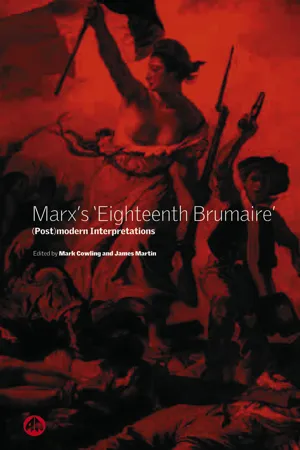
Marx's account of the rise of Louis-Napoleon Bonaparte is one of his most important texts. Written after the defeat of the 1848 revolution in France and Bonaparte's subsequent coup, it is a concrete analysis that raises enduring theoretical questions about the state, class conflict and ideology. Unlike his earlier analyses, Marx develops a nuanced argument concerning the independence of the state from class interests, the different types of classes, and the determining power of ideas and imagery in politics. In the Eighteenth Brumaire he applies his 'materialist conception of history' to an actual historical event with extraordinary subtlety and an impressive, powerful command of language. This volume contains the most recent and widely acclaimed translation of the Eighteenth Brumaire by Terrell Carver, together with a series of specially commissioned essays on the importance of the Brumaire in Marx's canon. Contributors discuss its continuing significance and interest, the historical background and its contemporary relevance for political philosophy and history.
- 256 pages
- English
- ePUB (mobile friendly)
- Available on iOS & Android
eBook - ePub
About this book
Information
1 | Introduction |
On 2 December 1851, Louis-Napoleon Bonaparte – nephew of the great Emperor Napoleon Bonaparte and, since late 1848, elected President of the Second French Republic – announced the dissolution of the Legislative Assembly and, with the backing of the army, ordered the parliamentary chamber to be occupied by troops, the leaders of the main parties arrested and placed himself in sole charge of government. A year later he declared himself Emperor Napoleon III, head of the Second French Empire. Bonaparte’s coup d’état brought to an end not only the republican regime ushered in after the revolution of 1848 but also the period of unstable, limited ‘bourgeois democratic’ government and experimentation with constitutional monarchy since the defeat of his uncle in 1815. For those radicals and socialists who in 1848 hoped to transform the wave of democratic revolutions into a more substantial movement for economic and social reform, Napoleon’s coup symbolised and underscored a demoralising defeat at the hands of popular reaction.
Karl Marx’s The Eighteenth Brumaire of Louis Bonaparte is a bitter, richly entertaining account of these events by one of the radicals who had observed events at first hand. A journalist, intellectual and self-proclaimed communist, Marx, too, had participated as a propagandist in the events of 1848 as co-founder of the ‘Communist League’ and in his Manifesto of the Communist Party of that year, co-written with Frederick Engels, he had encouraged socialist revolutionaries to participate in the revolution alongside the republican bourgeoisie in order to bring to the fore the demands of the proletariat. The Eighteenth Brumaire, written and published in 1852, narrated the rise and decline of the revolution in France from the proclamation of the ‘Second Republic’ to the coup of 1851. By contrast with the Manifesto – characterised by its (deliberately) optimistic reading of history as a series of class struggles leading, ultimately, to communism – the Eighteenth Brumaire tells a more complex and less ‘progressive’ story. It is also one of Marx’s few lengthy analyses of political history and it is widely regarded as one of his most colourful.1 Yet within Marxist scholarship the Eighteenth Brumaire’s novelty is often noted but the text is rarely commented upon at any length. It is the purpose of this volume, one hundred and fifty years after Marx’s publication, to begin to fill that gap.
In the remainder of this Introduction we shall give a brief summary of the content of the Eighteenth Brumaire and then discuss its themes in relation to the concerns of later Marxists and the Marxist tradition generally. Finally we offer a brief overview of the content of the chapters that follow.
MARX’S EIGHTEENTH BRUMAIRE: THE TEXT
The text of the Eighteenth Brumaire (reprinted after this Introduction in a new translation) is a challenge even for those familiar with Marx’s work. Its focus is the transformation of a revolution against a constitutional monarchy (the ‘July Monarchy’ of Louis XV), through a series of internal disputes between the political groups involved, until the dissolution of the Second Republic by Bonaparte’s coup. In this respect, the distance between us and the characters and events in question makes the Eighteenth Brumaire an unfamiliar, and consequently rather burdensome, read. Yet the text is more than a description of events. It is also a reflection, amongst other things, on the nature of revolutions, political leadership and class struggle. In this respect, too, Marxists might find the text less instructive than Marx’s more theoretical works since these political issues are presented in the form of a concrete set of circumstances whose ‘universal’ relevance is at best uncertain. Finally, for those accustomed to reading Marx’s philosophical studies or his critical engagement with political economy, the Eighteenth Brumaire will seem a curiously unscientific commentary, replete with undeclared normative assumptions and personal invective, richly figurative language and with no evident purpose other than of recounting the events and ridiculing the characters under examination.
Yet if the Eighteenth Brumaire is a challenge to read, it is not because it lacks substance as a work of political commentary. For all its difficulties as a text, it remains fascinating and provocative for Marxists and non-Marxists alike. Before we consider some of the themes that can be said to ‘derive’ from the Eighteenth Brumaire let us first consider its contents as a commentary on events.
Marx takes under examination the period from February 1848 to December 1851. He divides this period into three separate phases, in which different alliances of classes and groupings ruled.
In the first phase (the February Period), King Louis Philippe, whose rule Marx identifies with the finance aristocracy, was overthrown by a broad coalition. It comprised:
• | large landowners: these were Legitimists (supporters of a restoration of the Bourbons) and not Orléanists, and had been excluded from power under the July Monarchy |
• | republican bourgeoisie: this social category simply comprised members of the bourgeoisie who were anti-monarchist |
• | manufacturing bourgeoisie: interested in cheap government and thus endangered by the rule of the finance aristocracy |
• | democratic-republican petty bourgeoisie: horrified at the corruption of the finance aristocracy |
• | peasantry: also horrified at the extravagance of the finance aristocracy in stark contrast to its own poverty following crop failure and potato blight in 1845–47 |
• | the proletariat: revolted because it identified the rule of finance aristocracy with that of capital. |
This alliance was modified by the elimination of the proletariat as a political force, first through their immediate diversion to the Hotel de Ville, where they formed a parallel and impotent government, and second through the manoeuvring of the proletariat into a badly organised revolt in June 1848, the failure of which ensured they would play little part in subsequent events. These manoeuvres were carried out by the reigning social category, the republican bourgeoisie.
The second phase was brought on by the decline of the republican bourgeoisie, seen in the election of Bonaparte to the Presidency on 10 December 1848. This was achieved by an electoral alliance of:
• | the peasantry, voting against the taxes the ‘proletarian’ republican government had lain on them |
• | the petty bourgeoisie, voting against the abolition of the progressive tax, by which the bourgeois republicans had hoped to gain the support of the big bourgeoisie; and also voting against Cavaignac, who had put down the June revolt |
• | the big bourgeoisie, who were voting for a restoration of the monarchy (the election of Bonaparte being seen as a step in this direction) |
• | the army, a social category seeking money |
• | the proletariat, who were voting against Cavaignac. |
The result of this alliance was the rise of the Party of Order as the ruling alliance: the Party of Order was the royalist parliamentary party representing the unity of the two bourgeois factions, the large landowners who had ruled under the Restoration and were therefore Legitimists, and the Orléanists, the finance aristocracy who had ruled under the July monarchy. Their rule was paradoxically only possible within the framework of the parliamentary republic and against the background of indefinite postponement of the Restoration. When parliament was recessed in 1850 and 1851, when there seemed a real prospect of restoration, or when Bonaparte dangled the possibility of a ministry representing one faction only, the two factions split up again.
The third phase was the one which brought Bonaparte to power. Besides Bonaparte’s manoeuvrings to split the Party of Order into fractions it disintegrated through the desertion of individual members, through a fear of struggle and to safeguard their posts; and, as a result of this, from the necessity of an alliance with the pure republicans and the Montaigne against Bonaparte and the army – which put the remnants of the Party of Order in worse odour with their erstwhile supporters. This disintegration paved the way for the coup which brought Bonaparte to power.
The alliance behind Bonaparte were:
• | finance capital, because Bonaparte represented their interest in state debt, and because he represented stability against the disintegration of the Party of Order |
• | the Legitimist landed aristocracy, which had effectively merged its interests with the finance aristocracy |
• | the industrial bourgeoisie, concerned with public order to secure good trading conditions, but not in a sufficiently developed condition to make a bid for power on its own (parliamentary struggles were seen as a threat to good trading conditions) |
• | the lumpenproletariat (bribed) |
• | the state officials and the army (interested in the expansion of the state). |
The tone of Marx’s analysis is set by the remarks he makes at the start of the Eighteenth Brumaire concerning bourgeois revolutions and these remarks make the text more than simply a ‘neutral’ telling of history. Marx suggests that revolutions inevitably are enacted in the guise of earlier, classic moments in history. The English Civil War made reference to the Old Testament, the French Revolution of 1789 referenced the Roman Republic, and the 1848 revolution made reference to the French Revolution. It is precisely these guises or ‘spirits of the past’ to which Marx is referring when he remarks that ‘Traditions from all the dead generations weigh like a nightmare on the brain of the living.’ That is, agents in the present are compelled, and yet simultaneously restricted, by the imagery and symbols of the past when they come to fulfil some historic task. In this instance, however, Marx claims the reference to tradition resembles ‘farce’. Marx’s analysis then proceeds in this tenor, sarcastically deriding the failure of the agents to live up to the fanciful imagery and phrases deployed to justify their actions. Throughout the text Marx exposes the limitations of bourgeois and royalist forces, alerting the reader, on the one hand, to the class interests often (though not always) at work behind the shifting alliances and petty intrigue of politics and, on the other, the unrealistic or reactionary delusions motivating others. Unlike earlier bourgeois revolutions, where the invocation of the past served to undermine aspects of the feudal order and promote a whole new conception of society, the 1848 revolution simply couldn’t fulfil its promise. Bonaparte’s coup was final evidence of a bourgeoisie forced to backtrack on its political ambitions for fear of its own success.
If the Eighteenth Brumaire is written as an account of a revolution that declined into farce, nevertheless Marx makes one reference to a point of principle that can be understood as classically ‘Marxist’ – namely, the distinction between an economic base and an ideological and political superstructure. Towards the start of the third section of the text Marx reminds the reader that ‘On the different forms of property, the social conditions of existence, arises an entire superstructure of different and peculiarly formed sentiments, delusions, modes of thought and outlooks on life.’2 Classes build upon the ‘material foundations’ of these property relations but it is their interests at that level that ultimately motivate them. We are advised not to be taken in by the ‘fine words and aspirations’ of political forces but to look to ‘their real interests’ as an explanation for their behaviour. The same point will be made at slightly greater lengt...
Table of contents
- Cover
- Title Page
- Copyright
- Contents
- Acknowledgements
- 1. Introduction
- Part 1: The Text
- Part 2: The Eighteenth Brumaire as Discourse
- Part 3: The Eighteenth Brumaire as History
- Part 4: The Autonomy of the State?
- Part 5: The Eighteenth Brumaire, Classes and Class Struggle, Then and Now
- Notes on the Contributors
- Index
Trusted by 375,005 students
Access to over 1.5 million titles for a fair monthly price.
Study more efficiently using our study tools.
Frequently asked questions
Yes, you can cancel anytime from the Subscription tab in your account settings on the Perlego website. Your subscription will stay active until the end of your current billing period. Learn how to cancel your subscription
No, books cannot be downloaded as external files, such as PDFs, for use outside of Perlego. However, you can download books within the Perlego app for offline reading on mobile or tablet. Learn how to download books offline
Perlego offers two plans: Essential and Complete
- Essential is ideal for learners and professionals who enjoy exploring a wide range of subjects. Access the Essential Library with 800,000+ trusted titles and best-sellers across business, personal growth, and the humanities. Includes unlimited reading time and Standard Read Aloud voice.
- Complete: Perfect for advanced learners and researchers needing full, unrestricted access. Unlock 1.5M+ books across hundreds of subjects, including academic and specialized titles. The Complete Plan also includes advanced features like Premium Read Aloud and Research Assistant.
We are an online textbook subscription service, where you can get access to an entire online library for less than the price of a single book per month. With over 1.5 million books across 990+ topics, we’ve got you covered! Learn about our mission
Look out for the read-aloud symbol on your next book to see if you can listen to it. The read-aloud tool reads text aloud for you, highlighting the text as it is being read. You can pause it, speed it up and slow it down. Learn more about Read Aloud
Yes! You can use the Perlego app on both iOS and Android devices to read anytime, anywhere — even offline. Perfect for commutes or when you’re on the go.
Please note we cannot support devices running on iOS 13 and Android 7 or earlier. Learn more about using the app
Please note we cannot support devices running on iOS 13 and Android 7 or earlier. Learn more about using the app
Yes, you can access Marx's 'Eighteenth Brumaire' by Mark Cowling, James Martin in PDF and/or ePUB format, as well as other popular books in Biological Sciences & Science General. We have over 1.5 million books available in our catalogue for you to explore.