'Powerful and clarifying... The book's combination of careful argument and cogent illustration will make this a landmark volume in Gramscian studies.' John Agnew, University of California, Los Angeles, and author of Hegemony: The New Shape of Global Power 'Morton draws upon an impressive knowledge of Gramsci's writings to provide new insights into key processes in today's world order.' Anne Showstack Sassoon, Emeritus Professor, Kingston University and Visiting Professor, Birkbeck College, University of London Unravelling Gramsci makes extensive use of Antonio Gramsci's writings, including his much-overlooked pre-prison journalism, prison letters, as well as his prison notebooks, to provide a fresh approach to understanding his contemporary relevance in the current neoliberal world order. Adam Morton examines in detail the themes of hegemony, passive revolution and uneven development to provide a useful way of analysing the contemporary global political economy, the project of neoliberalism, processes of state formation, and practices of resistance. The book explores the theoretical and practical limitations of how Gramsci's ideas can be used today, offering a broad insight into state formation and the international factors shaping hegemony within a capitalist framework.
eBook - ePub
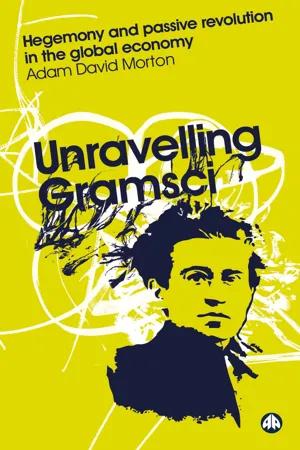
Unravelling Gramsci
Hegemony and Passive Revolution in the Global Political Economy
- 272 pages
- English
- ePUB (mobile friendly)
- Available on iOS & Android
eBook - ePub
Unravelling Gramsci
Hegemony and Passive Revolution in the Global Political Economy
About this book
Information
1 | Introduction: the North/South Question of Uneven Development |
Capitalism is a world historical phenomenon and its uneven development means that individual nations cannot be at the same level of economic development at the same time.
— Antonio Gramsci, ‘The Return to Freedom …’, Avanti! (26 June 1919)
The purpose of this book is to ‘unravel’ the historical and contemporary relevance of the thought and practice of Antonio Gramsci to factors of hegemony and passive revolution to the global political economy. Its central premise is that Gramsci’s approach to uneven development reveals pertinent concerns about the conditions of hegemony and passive revolution relevant to alternative processes of state formation elsewhere in the modern world. The aim of the book is therefore to provide readers with a detailed analysis of subject matter linked to the practical and theoretical constructions of hegemony and passive revolution. As a result, the book will provide a novel entrance point for readers into concerns about uneven development, conditions of state formation, and the role of international factors shaping hegemony and passive revolution in the global political economy.
Unravelling Gramsci in such a way will promote a detailed consideration of his theory and practice that can add to an understanding of the uneven development of capitalism. The task of excursus and interpretation is crucial because it is a necessary moment of concept formation. Once this task has been completed it is then possible to appropriate and develop concepts in a different context from that in which they were originally formed (Nield and Seed 1981: 218). As we shall see, Part I of the book embarks on an excursus and interpretation of Gramsci’s writings by drawing from as wide a reading as possible of his texts, including the pre-prison writings, the Prison Notebooks, and the prison letters. Once such concepts and issues are raised it will then be possible to illustrate their explanatory value. Confronting theory and practice and bringing the concepts to bear on concrete empirical examples in Part II of the book will achieve this objective. However, in accord with Keith Nield and John Seed (1981: 226), ‘actively to engage with Gramsci requires more than a web of empirical illustration; it demands a theoretical engagement with and against Gramsci.’ Unravelling Gramsci therefore takes on a second meaning. It becomes imperative to consider also what might be historically limited in a theoretical and practical translation of Gramsci’s writings to alternative social and political circumstances of hegemony and passive revolution in the global political economy.1 This task will be undertaken in the concluding chapter to the book, which will entail generating conclusions against the Prison Notebooks. Unravelling Gramsci in this second sense, in terms of considering themes that might work against the efficacy of his contemporary relevance, will also assist in developing pointers for future research.
It is hoped that, by recovering facets of older debates and introducing new elements, this approach to ‘unravelling Gramsci’ will contribute to understanding uneven development, conditions of state formation, and the role of international factors shaping hegemony and passive revolution in the global political economy. To concur with Stuart Hall (1991b: 125), Gramsci ‘saw the pluralisation of modern cultural identities, emerging between the lines of uneven historical development, and asked the question: what are the political forms through which a new cultural order could be constructed?’ It is to these issues that the next section will now turn before providing a more detailed overview of the organisation of the book.
The ‘North/South’ Question of Uneven Development
On the eve of a meeting between an Italian delegation and key members of the Comintern leadership in Moscow, the Italian Marxist Antonio Gramsci wrote a letter, dated 18 May 1923, to Palmiro Togliatti, a colleague and co-founder of the Communist Party of Italy (PCd’I). In the letter, Gramsci (1978: 140) declared, ‘We are in the flow of the historical current and will succeed, provided we “row” well and keep a firm grasp on the rudder.’ Beyond the struggles within the PCd’I and other left parties in Italy, to which Gramsci refers, he also reflected in this letter on the changes wrought at the time by the rise of Fascism and the crisis of capitalism in the context both of Italy and of the world. It was within this context that Gramsci was embroiled in activity that combined militant organisational and intellectual struggle.
This practical and intellectual odyssey began with Gramsci devoting his energy to journalism through columns in Il Grido del Popolo, Avanti!, and La Città Futura between 1914 and 1918. Among other issues, this journalism analysed the concrete phenomena of the nature of state formation in Italy, the reorganisation of society and capitalism through periods of crisis, the introduction of new techniques of management into the productive sphere, the Russian Revolution, and the attempt to build socialism in Italy. Activity subsequently centred on the Factory Council movement in Turin and editorship of the journal L’Ordine Nuovo (1919–20) with the aim of realising a vision of revolution from below based on the occupation of factories. The role of the political party later became paramount during the founding and leadership of the PCd’I, whilst Gramsci also further dwelled on the organic crisis of capitalism in Italy in the paper L’Unità (1924–26). By 1926 Gramsci had drafted his essay ‘Some Aspects of the Southern Question’ which analysed class and territorial relations between workers and peasants in the north and south of Italy and the strategic dilemma of forging links between these groups as a prelude to national transformation. Just after this, Gramsci was arrested along with other Communist Party deputies, despite parliamentary immunity, and began an incarceration that was to last almost until his death in 1937. During the show trial against Gramsci, the prosecutor Michele Isgrò enunciated the infamous statement, ‘We must prevent this brain from functioning for 20 years.’ Yet Gramsci’s ambition to concentrate on something für ewig (for always or eternity), according to a pre-established programme, began in 1929, when he started penning the Prison Notebooks (Gramsci 1994a: 82–5).2 Within these writings a prolonged reflection unfolded on issues spanning the formation, development and social function of intellectuals; theatre, literary criticism and the role of popular taste in literature; nineteenth-century Italian history; the theory of history and historiography; and the rise of Americanism and Fordism, which all contributed to a major reworking of historical materialism. Although Gramsci’s sentence ended on 21 April 1937, he suffered a fatal cerebral haemorrhage that finally ended his struggle against ill health on the morning of 27 April 1937 at the Quisisana clinic (Rome). Almost immediately his posthumous patrimony was fought over and constructed; something that has continued ever since. On Gramsci’s heritage, one commentator has pronounced him as, ‘the greatest Marxist Western Europe has produced … and the one from whom there is most to be learned’ (Hoare 1978: xxiv).
Ultimately, then, despite intense social struggle, the ‘flow of the historical current’ that Gramsci referred to in his letter to Togliatti of 1923 was to sweep him away along with many others in Italy during the rise of Fascism. Yet, since his time, the changing nature of capitalism has been no less threatening to those carried by, and fighting against, the tides of social and political upheaval. To develop the analogy, one can add that Gramsci’s thought and action might still be of assistance in charting some kind of course through the stormy waters of capitalism, even if at times he proves to be a little more rudderless or less helpful than one would like.
In his own time, Gramsci appreciated the early stages of development of the modern state in a peripheral region of capitalism. This involved focusing on the Italian situation as part of world history, which included appreciating those relations between capitalist states, seen as the cornerstone of the ‘bourgeois’ system, and those that represented the periphery of the capitalist world (Gramsci 1978: 400–11). One can recall here an earlier insight from the Communist Manifesto that, just as the bourgeoisie created the dependency of the countryside on the towns, it has made ‘dependent’ and ‘semi-dependent’ countries, ‘dependent on the civilised ones, nations of peasants on nations of bourgeois, the East on the West’ (Marx and Engels 1848/1998: 40). As Gramsci (1985: 181, Q29§2)3 subsequently stated, ‘the historical fact … cannot have strictly defined national boundaries, history is always “world history” and particular histories only exist within the frame of world history’. It is thus possible to note a spatial awareness in Gramsci’s writings that includes a focus on the uneven development of social powers at national, regional, and international levels. ‘Moreover’, as James Joll (1977: 67) proffers, ‘the unevenness of economic development in Italy meant, Gramsci believed, that capitalism might be more easily overthrown than in the other advanced industrial economies of western Europe.’
As mentioned earlier, this is evident in his writings on the strategic problem of uniting the north and south of Italy, especially in the essay ‘Some Aspects of the Southern Question’ (Gramsci 1978: 441–62). It is also evident in his lesser-known focus on aspects of colonialism and imperialism within ‘the global politico-economic system’ of Anglo-Saxon capitalism and his focus on dimensions of ‘Anglo-Saxon world hegemony’ (Gramsci 1977: 79–82, 89–93). To quote one indicative passage – where questions are raised about the lagging effect of hegemony within world order trends, how hegemony might be discernible but recessive, and how imperialism could stand as an explanandum of such trends – Gramsci asks:
Is the cultural hegemony by one nation over another still possible? Or is the world already so united in its economic and social structure that a country, if it can have ‘chronologically’ the initiative in an innovation, cannot keep its ‘political’ monopoly and so use such a monopoly as the basis of hegemony? What significance therefore can nationalism have today? Is this not possible as economico-financial imperialism but not as civil ‘primacy’ or politico-intellectual hegemony? (Gramsci 2001, vol.5: 64–5, Q13§26)4
Such writings are important but are scattered (spanning pre-prison and prison writings) and as a result have been much overlooked. These writings are crucial because they display what Gramsci meant by the ‘national’ point of departure, i.e. the intertwined relationship between ‘international’ forces and ‘national’ relations within a society which react both passively and actively to the mediations of global and regional forces. One of the central objectives of the book, then, is to tease out this articulation of capitalism across different scales, with the argument drawing on Gramsci’s understanding of the positioning of both ‘national’ relations within the conditioning of ‘the international’ to reveal a theory of hegemony and passive revolution cognisant of the spatial divisions of geopolitics (see especially Chapter 6).
Failure to recognise this spatial awareness could result in an overemphasis on the national limits of Gramsci’s problematic; for example, by equating Gramsci’s emphasis on the ‘national’ point of departure with relations purely within the state. This flawed assumption is most starkly evident in Randall Germain and Michael Kenny’s claims that Gramsci was ‘above all a theorist who grappled with the discourses and realities of “statism”’ and that ‘the historical nature of his concepts means that they receive their meaning and explanatory power primarily from their grounding in national social formations’ within which they were ‘used exclusively’ (Germain and Kenny 1998: 4, 20). Similarly, it is mistaken to assert that attention to national conditions ‘led Gramsci to refuse the international dimension any constitutive status in his guide to action’ and that he ‘rejected the international dimension’ as a causal factor of social transformation (Shilliam 2004: 72, 73). These issues will be discussed and challenged in more detail in subsequent chapters, specifically when a historicised and engaged reading of Gramsci is undertaken (see Part I). The point to make here, though, is that an overly rigid interpretation of Gramsci’s outlook on the ‘national’ point of departure can be avoided. Taking this a step further, some commentators have emphasised how Gramsci draws our attention to spatial differentiation and to the uneven development of social powers in regional spaces, linked to the failures of state formation and hegemony in the Italian peninsula, and how this might even provide a powerful stimulus to understanding non-European settings experiencing uneven development (Roseberry 1994: 359–60; Jessop 2006a: 38). This has given rise to commentary on new kinds of the ‘North/South’ question within Gramsci’s writings, albeit without much detailed consideration or exegesis.5 Stating it in the most provocative manner, Stuart Hall (1986: 9) claims that ‘[t]he preoccupation with the question of regional specificity, social alliances and the social foundations of the state … directly links Gramsci’s work with what we might think of today as “North/South”, as well as “East/West”, questions’. This is probably no surprise to anybody familiar, generally, with the work undertaken in postcolonial studies and, specifically, with scholarship commonly recognised as subaltern studies.6 Yet, whilst I have refrained from entering explicitly the domain of postcolonial theory in this book, it has been argued clearly by one informed observer that such theorists’ relation to Gramsci has meant that they have frequently ‘deferred to his authority while at the same time declining to wrestle with his writing in any sustained or original way’ (Brennan 2001: 144; Brennan 2006: 261–4). On a broader plane it has been commented similarly that all too often there is a ‘soft focusing of Gramsci’ within commentaries on his legacy, obscuring the pivotal role he attributed to class struggle that simultaneously dilutes his primary concern with transcending the capitalist order (Lester 2000: 143). Too frequently, commentators have strived to search for what Zygmunt Bauman has claimed as ‘an honourable discharge from Marxism’ through the turn to Gramsci.7 In contrast to such moves, then, this book holds to the importance of analysing Gramsci’s writings within the purview of Marxism rather than as a corrective to it (see Brennan 2001: 169). There is much in Gramsci that can help us to think through the particular issues of hegemony and passive revolution in the global political economy, and the aim of this book is to unravel how these are embedded within a historical materialist problematic linked to conditions of uneven development, processes of state formation, and the role of ‘the international’ in shaping the ‘national’ dimension.
Organisation of the Book
Part I of the book begins with a thoroughly historicised and engaged reading of Gramsci before advancing an understanding of hegemonic processes. Chapter 2 sets about ‘unravelling Gramsci’ by addressing the concern to historicise his thought and practice and demonstrating how Gramsci’s own writings help in the endeavour to read his work and thus situate ideas in and beyond their context. The argument of this chapter therefore delves into issues germane to the history of ideas that are crucial to laying the necessary interpretative groundwork for subsequent chapters. The foregrounding of any such interpretative and analytical framework is pivotal to the subsequent task of critically analysing Gramsci’s work (Finocchiaro 1992/2005: 214). Having established an approach to the history of ideas, consisting of identifying Gramsci’s method of thinking, the third chapter considers his historical and contemporary relevance to understanding the international history of state formation and the rise of the modern capitalist states-system.
Such a task begins by outlining Niccolò Machiavelli’s interpretation of the rapidly changing social and political conditions of Italy and Europe in his time, marked by the collapse o...
Table of contents
- Cover
- Title Page
- Copyright
- Contents
- List of Figures
- Reading Gramsci
- Acknowledgements
- Abbreviations
- 1. Introduction: the North/South Question of Uneven Development
- Part I Engaging Gramsci
- Part II Gramsci, World Order, and Resistance
- Notes
- Bibliography
- Index
Trusted by 375,005 students
Access to over 1.5 million titles for a fair monthly price.
Study more efficiently using our study tools.
Frequently asked questions
Yes, you can cancel anytime from the Subscription tab in your account settings on the Perlego website. Your subscription will stay active until the end of your current billing period. Learn how to cancel your subscription
No, books cannot be downloaded as external files, such as PDFs, for use outside of Perlego. However, you can download books within the Perlego app for offline reading on mobile or tablet. Learn how to download books offline
Perlego offers two plans: Essential and Complete
- Essential is ideal for learners and professionals who enjoy exploring a wide range of subjects. Access the Essential Library with 800,000+ trusted titles and best-sellers across business, personal growth, and the humanities. Includes unlimited reading time and Standard Read Aloud voice.
- Complete: Perfect for advanced learners and researchers needing full, unrestricted access. Unlock 1.5M+ books across hundreds of subjects, including academic and specialized titles. The Complete Plan also includes advanced features like Premium Read Aloud and Research Assistant.
We are an online textbook subscription service, where you can get access to an entire online library for less than the price of a single book per month. With over 1.5 million books across 990+ topics, we’ve got you covered! Learn about our mission
Look out for the read-aloud symbol on your next book to see if you can listen to it. The read-aloud tool reads text aloud for you, highlighting the text as it is being read. You can pause it, speed it up and slow it down. Learn more about Read Aloud
Yes! You can use the Perlego app on both iOS and Android devices to read anytime, anywhere — even offline. Perfect for commutes or when you’re on the go.
Please note we cannot support devices running on iOS 13 and Android 7 or earlier. Learn more about using the app
Please note we cannot support devices running on iOS 13 and Android 7 or earlier. Learn more about using the app
Yes, you can access Unravelling Gramsci by Adam David Morton in PDF and/or ePUB format, as well as other popular books in Politics & International Relations & Communism, Post-Communism & Socialism. We have over 1.5 million books available in our catalogue for you to explore.