'This beautifully written and lucidly argued study is the most persuasive account of Bourdieu's work yet to be published. Lane illuminates much that can puzzle a foreign readership by expertly situating Bourdieu within a French context. At the same time he points to those aspects of Bourdieu's writing which are of particular relevance to contemporary debates on questions of citizenship and globalisation. He gives a fascinating account of Bourdieu's astonishingly prescient analyses of the impact of the expansion of higher education, the influence of the mass media, the growth of the culture industries, and the changing nature of political and social elites, not just in France, but in the western world.' - Professor Jill Forbes, Queen Mary and Westfield, University of London
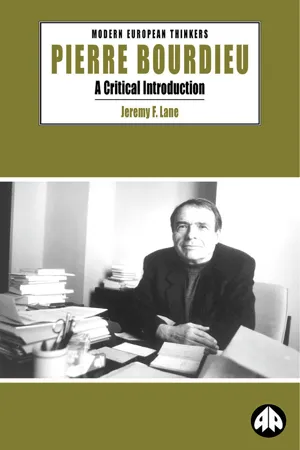
- 240 pages
- English
- ePUB (mobile friendly)
- Available on iOS & Android
eBook - ePub
About this book
Information
CHAPTER 1
Peasants into Revolutionaries?
The broad details of Pierre Bourdieu’s background and early intellectual career have been well documented, both in existing critical studies and in interviews. He was born in 1930, the son of a postman in a peasant community in the Béarn in the French Pyrenees. Having passed through the classes préparatoires at the renowned Lycée Louis-le-Grand in Paris, he entered the elite École normale supérieure to study for an agrégation in philosophy, perhaps the most prestigious academic qualification in France at that time. Bourdieu obtained his agrégation in 1954 but, frustrated by the abstract tenor of academic philosophy, he abandoned his plans to prepare a doctoral thesis under the supervision of Georges Canguilhem on the work of Maurice Merleau-Ponty and took up a post as a philosophy teacher in a provincial lycée instead. His career as a philosophy teacher was short-lived and in 1955 he was drafted into the French Army and sent to Algeria where he served as a conscript during the Algerian War of Independence. His military service completed, Bourdieu remained in Algeria, working as an assistant in the Faculté des lettres of Algiers University, whilst carrying out fieldwork in the country’s cities, villages, and ‘resettlement centres’. In 1960, he returned to France to become Raymond Aron’s assistant at the Sorbonne.1 On the basis of his fieldwork in Algeria, Bourdieu published a series of books and articles between 1958 and 1964 which examined the country’s social, economic, and political development. As Bourdieu has put it, if he arrived in Algeria in 1955 a philosopher, by the time he left he had become a sociologist (Honneth et al. 1986).
Although Bourdieu’s experiences in Algeria clearly represent a founding moment in his intellectual career, his early Algerian work has received relatively little critical attention to date. This is presumably because the work largely pre-dates the elaboration of such key Bourdieusian concepts as ‘habitus’, ‘field’, ‘cultural capital’ or ‘symbolic violence’, whilst its subject matter appears tangential to the analyses of class, culture and social reproduction upon which Bourdieu’s mature reputation rests. Nonetheless, as this chapter will attempt to demonstrate, these early studies of Algeria are important for the insights they offer into the way Bourdieu theorises social and cultural change, insights which will prove vital to an understanding of his later work on socio-cultural change in French society. It was in the course of his work on the Algerian peasantry and sub-proletariat that Bourdieu was to lay the theoretical foundations of his later studies, anticipating in important respects concepts such as ‘habitus’, ‘practice’ and ‘field’. On a more general level, Bourdieu’s decision to abandon his philosophical studies in favour of a ‘scientific’ practice of sociology can tell us much about how he understands his own position within the French intellectual field.
Sociology over Philosophy
In subsequent accounts of his very early career, Bourdieu has suggested that his modest social background, his consequent sense of being an outsider in the Parisian intellectual field, and his frustration at the limitations of academic philosophy were all linked to his decision to undertake empirical sociological studies of Algeria and hence to his ‘conversion’ from philosopher into sociologist. To practise ‘scientific’ sociology, in Bourdieu’s terms, demands achieving an objective distance on the hidden workings of the social world. To be an outsider is already to be endowed with such a distance, whilst to be an outsider who has nonetheless achieved academic success is to supplement that instinctive feeling of distance with a ‘mastery of scientific culture’. Thus, he argues that ‘to combine an advanced mastery of scientific culture’ with ‘a certain revolt against or distance from that culture (most often rooted in an estranged experience of the academic universe)’ is to possess a socially determined disposition towards the practice of scientific sociology (Bourdieu 1992, p. 218 [p. 249]). As Bourdieu was to put it in an interview many years after the Algerian War:
This more or less unhappy integration into the intellectual field may well have been the reason for my activity in Algeria. I could not be content with reading left-wing newspapers or signing petitions; I had to do something concrete, as a scientist … . That’s where my ‘scientific bias’ stems from. (in Honneth et al. 1986, p. 39)
Conducting empirical sociological research not only seemed to represent a more ‘concrete’ form of activity than pursuing the abstractions of academic philosophy, it also, Bourdieu has argued, offered the possibility of an ‘objective’, ‘scientific’ assessment of the situation in Algeria not available to those who commented from the sidelines. Whilst acknowledging the importance of the stand taken by intellectuals such as Jean-Paul Sartre, Francis Jeanson, and Pierre Vidal-Naquet ‘against torture and for peace’, he has explained that he was ‘concerned about the associated utopianism’ since ‘it was not at all helpful, even for an independent Algeria, to feed a mythical conception of Algerian society’. Bourdieu has singled out Frantz Fanon’s The Wretched of the Earth (Les Damnés de la terre 1961) for particular criticism, stating the book contained ‘dangerous’ analyses engendering ‘a pernicious utopianism’ amongst Algerian intellectuals. His own work of the period sought to challenge Fanon’s assertion that the Algerian peasantry and sub-proletariat constituted a revolutionary force, a challenge supported by detailed empirical research, by ‘observation and measurement, not through reflecting upon second-hand material’. Thus, the Algerian War was to find Bourdieu ‘between camps’ in terms of the French intellectual field, opposed to the continued French colonial presence in Algeria but critical of the analyses offered by some of those French intellectuals who supported the struggle for Algerian independence (in Honneth et al. 1986, pp. 38–40).
The account Bourdieu offers here of his conversion to sociology highlights his firm belief in the pre-eminence of an empirically-informed practice of ‘scientific’ sociology over what he sees as the abstract and ahistorical theorising of a particular form of French academic philosophy; ‘the philosophical babble found in academic institutions’ (1987, p. 13 [p. 5]). To recognise the importance of Bourdieu’s account both of his own position and of the position of sociology in the intellectual field is not necessarily to accept that account unreservedly. Bourdieu clearly sees this account as a scientific objectification of his position in the intellectual field. However, it derives much of its force from an essentially rhetorical claim to greater personal authenticity and good faith, combined with an invocation of profoundly subjective feelings of alienation, which, however genuinely felt, surely form a questionable basis for a sociological practice which defines itself in terms of its objectivity and scientificity.
Bourdieu himself has warned of the dangers of conflating ‘questions of science’ with ‘concerns of conscience’ (1963a, p. 259). As he has pointed out, ‘good intentions … often make bad sociology’ and assessments of any thinker’s work, particularly in the politically charged context of colonialism, should focus not on questions of authenticity or sincerity, but rather on the adequacy of that thinker’s ‘problematic’, on the ‘concepts, methods and techniques’ they employ (Bourdieu 1980, p. 14 [p. 5]). Whatever Bourdieu’s motivations for becoming a sociologist, these cannot therefore be invoked in support of a claim to the a priori superiority of his analyses. Any assessment of the importance of his early work on Algeria must confine itself to an analysis of that work’s inherent strengths and weaknesses.
Sociologie de l’Algérie
Bourdieu’s first published book and his first detailed analysis of events in Algeria appeared in 1958 entitled Sociologie de l’Algérie. Echoing Max Weber’s The Methodology of the Social Sciences (1949), Bourdieu emphasised in his Introduction that his approach was based on ‘sober and objective observation’, on ‘disinterest and impartiality’ (1958, p. 5). The first six chapters of the book were dedicated to a ‘reconstruction’ of ‘the original social and economic structures’ of Algeria’s different indigenous ethnic groups, Kabyle, Shawia, Mozabite, and Arab. His analyses of these different societies were to be seen as ‘ideal-types in Max Weber’s sense, the product solely of historical reconstruction – with all the uncertainties that this implies’ (p. 90). This ‘reconstruction’ was seen as ‘indispensable for understanding the phenomena of acculturation and déculturation determined by the colonial situation and the irruption of European civilisation’, which he examined in the final chapter (p. 5). These phenomena of ‘acculturation’ and ‘deculturation’ were understood in terms of the incomplete imposition of ‘modern’ forms of economy and society, based on ‘rational calculation’ and ‘capitalist accumulation’, on to a fundamentally ‘traditional’ society. The problem, according to Bourdieu, was how best to ensure the transition between ‘traditional’ Algerian ways of life, now fatally undermined, and the ‘modern’ socio-economic forms introduced by the Europeans, without aggravating the phenomena of ‘disintegration’ already affecting Algeria’s indigenous populations. Again in classically Weberian style, Bourdieu concluded that the objectivity of ‘a properly sociological analysis’ did not allow him to choose between the various solutions on offer, merely to exclude those that were objectively impractical (p. 126).2
Nonetheless, this ‘properly sociological analysis’ did allow Bourdieu to exclude ‘certain options, such as “assimilation” and the maintenance of the colonial situation’ (p. 126). As Bourdieu pointed out, French colonialism was an inherently contradictory enterprise; although it proclaimed its intention to ‘civilise’ and ‘assimilate’ its Algerian ‘subjects’ by ensuring their social and economic development, to succeed in such a project would undermine the hegemony of Algeria’s European population and hence necessarily spell the end of the colonial regime. Thus, if colonialism had destroyed the traditional structures of Algerian tribal organisation, it could never construct a modern society in its place, he maintained, since this ran counter to the objective interests of the colonial regime.
Bourdieu’s emphasis on the contradiction at the heart of the French colonial enterprise was an attempt to refute Germaine Tillion’s analyses in her L’Algérie en 1957 (1957). Tillion, an ethnographer and adviser to Jacques Soustelle, Governor-General of Algeria from 1955–56, had argued, on the basis of her research in the Aurès mountains, that the introduction of European medicines, famine relief, and the incursions of a money economy had all undermined the stability of traditional tribal society without being able to secure the tribespeople’s integration into a ‘modern’, ‘rational’ economy. The Algerians of the Aurès had been abandoned ‘in the middle of the ford’, as she put it. If only the colonial authorities were to pursue an enlightened policy of aid and education, facilitating ‘a true social mutation’ amongst Algeria’s indigenous populations, then the transition between ‘tradition’ and ‘modernity’ could be secured peacefully and the Algerian nationalists’ grievances would disappear (Tillion 1957).
As Paul Clay Sorum (1977, pp. 84–8) has shown, Tillion’s work was immensely influential amongst those he terms France’s ‘humanist’, ‘anti-colonialist’ intellectuals, who were concerned with reforming the colonial system for the benefit of the colonised peoples rather than with ending the system itself. Sociologie de l’Algérie was an important reminder of the idealism and inconsistencies implicit in this position. As Bourdieu showed, if after more than a hundred years in Algeria the French had been unable to ‘modernise’ the structures of Algerian society, this was by no means accidental. Rather it reflected the objective logic of the colonial system, which demanded that the Algerians be kept in a permanent state of under-development. Bourdieu’s refutation of Tillion’s analysis was thus both an important contribution to debates in France about the Algerian situation and a significant gesture of solidarity with the Algerian independence movement. His attention, in the book’s earlier chapters, to the richness and diversity of Algeria’s indigenous cultures also represented an important riposte to the disparaging depiction of those cultures current amongst the more determined defenders of the colonial regime.
Bourdieu’s analyses of ‘traditional’ Kabyle, Shawia, Mozabite, and Arab social structures owed much to the Durkheimian tradition. He suggested that there was an organic relationship between each group’s religious, cultural, and economic practices and the characteristics of their natural environment. Social practices and natural environment formed the mutually determined and determining elements of an inherently stable entity, itself determined by the classically Durkheimian imperative of maintaining each group’s ‘solidarity’, ‘cohesion’ and ‘equilibrium’. Although noting numerous differences between these groups, Bourdieu argued that all were driven by the same inherent tendency to preserve their structures unchanged; they were characterised by ‘social structures whose cohesion guarantees, as far as is possible, the equilibrium between man and the natural environment’ (1958, p. 101).
In his The Division of Labour in Society (De la division du travail social 1893), Durkheim had identified Kabylia as a classical example of ‘mechanical solidarity’, of a society organised along ‘segmentary principles’, consisting of a structure of homologous, concentric, interlocking segments of family, clan and tribe, ‘a series of successive interlockings [une série d’emboîtements successifs]’ which ensured ‘the unity of the total society’ (1893, p. 153 [p. 178]). Bourdieu echoed this analysis, stating that Kabyle society, ‘composed of successive interlocking collectivities [comme par emboîtements successifs de collectivités], presents a set of concentric allegiances’ (1958, p. 13). Indeed, he argued that each of Algeria’s ‘traditional’ societies was segmentary in the Durkheimian sense, marked by: ‘A proliferation of undifferentiated cells, a simple juxtaposition of families, this strictly conservative society repeats and imitates the past rather than taking it up in order to move beyond it in a continuous progress, innovation being taken for an impure and impious magic which can only bring bad luck’ (p. 101).
Notwithstanding his evident debt to Weber, Bourdieu’s analysis in Sociologie de l’Algérie might be read as an exercise in what Durkheim called ‘social morphology’. According to Durkheim’s definition, social morphology involves the attempt to describe a given social or ethnic group’s ‘social substrate’, that is to say, ‘the mass of individuals, the manner in which they are arranged on their territory, the nature and configuration of the things of all sort which affect their collective relations’. Identifying a group’s ‘social substrate’ was, for Durkheim, the necessary precursor to an analysis of that society’s evolution, of the effects of gradual urbanisation, for example, or of changing population densities and distributions (Durkheim 1969, pp. 181–2). This, then, was Bourdieu’s method in Sociologie de l’Algérie; identifying the original ‘social substrate’ of each of Algeria’s ethnic groups before analysing the effects of colonialism and war thereon.
In accordance with this classically Durkheimian, ‘social functionalist’ problematic, Bourdieu understood any change to the static structures of ‘traditional’ Algerian society as being provoked by ‘culture contact’, the arrival, with colonisation, of a dynamic European civilisation which eroded the ‘traditional’ forms of Algerian culture and imposed ‘modern’ forms in their place in a process of ‘deculturation’ and ‘acculturation’.3 This was the process Bourdieu described in two consecutive chapters he contributed to the 1959 volume Le Sous-développement en Algérie, ‘La Logique interne de la civilisation algérienne traditionnelle’ (The Internal Logic of Traditional Algerian Society) and ‘Le Choc des civilisations’ (The Clash of Civilisations). He argued that a predisposition towards equilibrium and stasis formed ‘the internal logic’ of all of Algeria’s indigenous tribal groups; in ‘a traditionalist and customary social order, resistant to progress, turned towards the past’, all effort was aimed at maintaining the existing equilibrium, so that ‘the possibility of positing a better social order in reference to which the established order would be grasped as imperfect, is radically excluded’ (1959a, pp. 50–1). Colonisation, ‘the irruption of European civilisation’, had shattered forever this state of ‘traditional’ equilibrium. The arrival of Europeans had alerted the Algerians to the existence of alternative forms of social, economic and cultural organisation; ‘The European … thus makes what seemed necessary appear as contingent, what appeared “natural” an object of choice’ (1959b, p. 57).
Although refined and modified in subsequent years, this account of the changes affecting Algerian society might be seen as something of a model for Bourdieu’s later theorisations of socio-cultural change in France. Thus, for example, in his analysis of the crisis in French universities in the 1960s in Reproduction and Homo academicus, Bourdieu would emphasise the importance of morphological chan...
Table of contents
- Cover
- Title Page
- Copyright
- Contents
- Dedication
- Acknowledgements
- Introduction
- 1. Peasants into Revolutionaries?
- 2. Frenchmen into Consumers?
- 3. Universities
- 4. Returning to Kabylia
- 5. Anthropology and Sociology
- 6. Old Wine, Distinctive New Bottles
- 7. Neo-Liberalism and the Defence of the ‘Universal’
- Conclusion
- Bibliography
- Index
Trusted by 375,005 students
Access to over 1.5 million titles for a fair monthly price.
Study more efficiently using our study tools.
Frequently asked questions
Yes, you can cancel anytime from the Subscription tab in your account settings on the Perlego website. Your subscription will stay active until the end of your current billing period. Learn how to cancel your subscription
No, books cannot be downloaded as external files, such as PDFs, for use outside of Perlego. However, you can download books within the Perlego app for offline reading on mobile or tablet. Learn how to download books offline
We are an online textbook subscription service, where you can get access to an entire online library for less than the price of a single book per month. With over 1.5 million books across 990+ topics, we’ve got you covered! Learn about our mission
Look out for the read-aloud symbol on your next book to see if you can listen to it. The read-aloud tool reads text aloud for you, highlighting the text as it is being read. You can pause it, speed it up and slow it down. Learn more about Read Aloud
Yes! You can use the Perlego app on both iOS and Android devices to read anytime, anywhere — even offline. Perfect for commutes or when you’re on the go.
Please note we cannot support devices running on iOS 13 and Android 7 or earlier. Learn more about using the app
Please note we cannot support devices running on iOS 13 and Android 7 or earlier. Learn more about using the app
Yes, you can access Pierre Bourdieu by Jeremy F. Lane in PDF and/or ePUB format, as well as other popular books in Biological Sciences & Science General. We have over 1.5 million books available in our catalogue for you to explore.