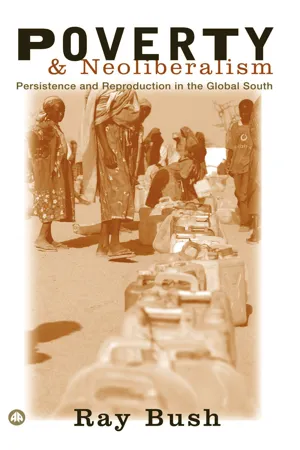
Why do so many people worldwide suffer hunger and poverty when there is enough food and other resources globally to prevent it? This book shows how famine and food insecurity are an essential part of modern capitalism. Although trade, debt relief and development initiatives are important, they do not alter the structure of the global economy and poverty continues to be created by processes like privatisation, trade liberalisation and market reform. Despite the 'end poverty' rhetoric of the World Bank and the G8, these high levels of poverty sustain Western wealth and power. Is there any hope for change? Using case studies from Egypt and North Africa, Nigeria, Sudan and elsewhere in sub-Saharan Africa, Ray Bush illustrates that there is resistance to neoliberal policies, and that struggles over land, mining and resources can shape real alternatives to existing globalisation.
- 256 pages
- English
- ePUB (mobile friendly)
- Available on iOS & Android
eBook - ePub
About this book
Information
1 Framing poverty and neoliberalism: the Middle East and North Africa
Framing poverty
This chapter examines the definition of poverty, and locates a critique of neoliberal bias in the claims that the region of the Middle East and North Africa (MENA) has historically low levels of poverty and relatively good levels of income distribution. I argue that the dominant trend in the literature on poverty in the Global South in general, and in MENA in particular, has a neoclassical bias. Among other things, that bias fails to understand that poverty does not emerge because of exclusion, but because of poor people’s ‘differential incorporation’ into economic and political processes. It also raises the question: if MENA has indeed had relatively low levels of poverty and good income distribution, does this complicate the issue of autocracy and the Western drive to remove political ‘backwardness’ in the region? In particular, the characterization of autocracy and the West’s attempt to promote political liberalization is likely to have adverse impacts on the social contract that autocratic rulers have enforced regarding the delivery of basic services.
There has recently been an increased interest in poverty and income distribution in the Global South in general and the MENA region in particular. I examine here much of that literature, identifying a number of similarities within it. A common theme links much of the material, not only in what it says but particularly in what it omits: namely that, despite the mushrooming of interest in poverty and income distribution, we continue to know very little about some key areas, notably the processes and dynamics of political and economic power that generate poverty and inequality, and skew income distribution towards the rich.
Policy-oriented literature seldom offers an understanding of poverty and its possible relationship with political mobilization. That gap is clearly problematic at a time when the United States and its coalition partners promote a military war against the perceived ‘axis of evil’ with no attempt to address causes of conflict and notably accelerated poverty in MENA. Although Western politicians and the policy literature ignore the link between poverty and conflict, some academic commentators have explored the relationship between poverty and political mobilization (Le Saout and Rollinde 1999; Roberts 2002; Beinin 2001; Bayat 2003; El-Ghonemy 1998).
I want to extend the definition of poverty to include power relations. This chapter also questions statistics on poverty in MENA produced by the international financial institutions (IFIs), and raises the issue of the possible impact that economic reforms may have on reducing the character of the social contract that many states have had with their workers and farmers.
The data and material on poverty and income distribution are voluminous, but are almost entirely driven or conceptualized from within a neoclassical framework. Even where the conservatism of that economic framework appears to be dissipated, as in the perspectives on the characterization of poverty that talk about ‘human development’ (UNDP), a ‘rights-based approach’ (UNICEF), the ‘livelihoods approach’ (DfID), ‘social exclusion’ (the EU and ILO), and ‘human security’ (UN) (see Maxwell 2001: 143), the language still seems to be overwhelmingly framed within the binary oppositions of the ‘global’ and the ‘local’. It also stresses the benefit that the liberalization of markets will bring for the poor. There is a view that the ‘exclusion’ of the poor needs to be reduced (Lipton 1997), but in making this point the crucial issue of how poverty is created and reproduced is lost. In other words, there is a failure to understand that poverty does not emerge because of exclusion but as a result of poor people’s ‘differential incorporation’ into economic and political processes (Bracking and Harrison 2003).
Now more than ever, with US and coalition aggression in Iraq and repeated claims that economic liberalization in the region as a whole will lead ipso facto to greater democracy, we need to explore what the possible consequences will be for poverty in MENA. I use the term ‘poverty’ to refer to ‘a deprivation of human capability of essential opportunities and choices needed for the well being of an individual, household or community’ (UNDP 2002c: 94).
Poverty clearly does not only mean a lack of income, falling below a poverty line necessary for the purchase of a minimum basket of commodities for basic nutrition, or for the purchasing power parity at which local currency is standardized in 1985 dollars as enough for a person to buy minimum commodities to sustain life (often set at $1 or $2 a day). These two measures dominate the literature on poverty in the Global South, and I return later to dissatisfaction with them and with the quantitative bias in research that underestimates the importance of qualitative data collection, among other things.1
I argue that poverty does not occur because of a failure to be integrated into the national, local or international economy, or because of the vulnerability that may accrue through non-incorporation. The mantra of globalization as the panacea for developing countries is expressed repeatedly by the IFIs and donors (World Bank 1995; DFiD 2000, 2006) and I critique this position here and in Chapter 2. I argue that the poor are poor precisely because of their incorporation into the reality of the contemporary capitalist economies.
Adverse differential incorporation results in labour regimes that are hugely exploitative, at their worst leading to the recreation of child labour recruitment or a return to ‘indentured labour’, as in parts of Egypt since Law 96 of 1992, which dramatically removed the protection for land tenants afforded them since Nasser’s revolution. Differential incorporation has also led to a decline in employment as privatization creates redundancy, and as job opportunities, in the age of ‘globalization’, fail to meet demand and labour force growth.
At a macroeconomic level the differential incorporation of MENA fails to address the structural contradictions of high dependency on rent, petroleum, Suez Canal remittances in the case of Egypt, and real estate and worker remittances elsewhere in MENA. The rent economies of MENA reflect the region’s dependency on the world economy; they are the product of uneven incorporation as well as the reluctance and failure of MENA regimes to extricate themselves from rentier politics and all that this means: ‘Dutch disease’, crude project-driven growth, enhanced vulnerability to trade fluctuations, and persistently high military expenditures, including the sale of oil for Western weapons and, with the new security monologue from the Pentagon, a heightened sense of securitization that feeds back into this process and renews it.
No institution, organization or political regime openly condones poverty. Anti-poverty strategies are proclaimed across the world as necessary and important. Some of the narratives of poverty may differ but the strategy to ameliorate it seems to be universal. There is a similarity even in the myriad of superficially contrasting strategy formulations designed to reduce poverty. As Maxwell, among others, has recently observed, these strategies for reducing poverty generally include the raising and spending of money, the provision of incentive or regulatory national economic frameworks, and the reform (downsizing) of public sectors. The latter usually means taking government out of service provision and advocating increased participation (Maxwell 2001: 143), although just what kind of participation, by whom and with what kind of say, usually remains unspecified. These prescriptions for poverty reduction almost without fail include the need for more education, employment, healthcare and protection of the environment (Soudi 2001, among others). Yet little is said about how these prescriptions might be sequenced or funded, and there is still a general preoccupation with money-centred agendas. Poverty and income are seen as issues of ‘vulnerability’, the new catchword of the IFIs.
In the shopping list of policy reforms intended to improve income distribution and reduce poverty, very little is said about the people who are poor, how they are identified, how they express their grievances at being poor and how, under whatever circumstances in which poverty is to be reduced, the essential driver of such a strategy must be the women and men who are poor. They, moreover, must be seen as agents of social change rather than just victims of exclusion (Jordan 1996).
While superficially there seems to have been progress in relation to how poverty has been viewed in the literature, and especially within the World Bank, moving from the need for labour-intensive growth (World Bank 1990) to the importance of understanding issues of opportunity, empowerment and security (World Bank 2000), this new language is mostly concerned with the efficiency of markets, economic liberalization and the importance of social and human capital, where education and the knowledge economy are intended to provide the umbrella under which the forces of globalization operate. The literature, as we will see, has effectively served to buttress the architecture for global capitalism that was in place by the start of the twenty-first century. This comprised, in Cammack’s words:
the essential elements of a global capitalist system – the authority of capital over labour, goods and investment, the receptiveness of governments to the needs of capital, the presence of domestic and global regulatory orders capable of reinforcing the disciplines essential to capitalist reproduction.
(Cammack 2002: 159)
Moreover, justification for the character of twenty-first century capitalism was spread with an ideology that dismissed any alternatives. Globalization is now seen to be the only game in town: MENA and other regions of the world had better learn the rules and start playing by them – or else.
There is now, therefore, a challenge to the old modernity that was at the core of development studies in the 1960s and 1970s, namely that domestic and international policies that worked against market forces were ‘essential to bring about development’ (Cammack 2002: 159). In MENA, the consequences of government policies since the 1970s have been to jettison the centrality of state-led policies and import substitution industrialization (Beinin 2001: 142). Economic nationalism has remained as a rhetorical whimper. Populist social policies have diminished, but the promise of growth that was to accompany economic liberalization has not been fulfilled and the desired incorporation into the world economy has failed to boost investment. Even a cursory look at the presence of direct foreign investment (DFI) in MENA indicates that the region has been bypassed by global capitalism. For advocates of globalization, increasing DFI levels are the quintessential feature, viewed as essential to reduce levels of global poverty. Yet the share of the Arab world in total net flow of DFI from 1975–2000 was barely 1 per cent, and the bulk of that went to Egypt (Morocco and Tunisia received more in the late 1990s, but levels were still very low).
While there is now much attention to issues of poverty and income distribution in MENA, these almost universally operate within a framework of neoclassical bias. This is the assumption that markets can be accessed equally between people and the state, and workers and consumers; that markets are neutral arenas to facilitate the efficient allocation of resources and that the state can, at best, help facilitate the smooth running of markets, but must not regulate them. Globalization is an accepted, albeit seldom-defined, feature of the contemporary period; attempts to ‘opt out’ of global trade are seen as restricting poverty reduction, growth and opportunities for downward income distribution. The poor, a category seldom differentiated, are mostly treated as passive consumers of policy or recipients of donor assistance, and as Bracking and Harrison (2003: 2) note, ‘their prior exclusion from “normal” production and markets remains unproblematised’.
The dominance of neoliberal frameworks in characterizing poverty and income distribution in MENA has ensured that commentators on poverty, vulnerability and income distribution have failed to examine (or chosen to ignore) the prior subordination or exclusion of workers and peasants from markets, production and certainly from international economic relationships. The dominant paradigm for examining political and economic transformation after the 1970s was the ‘Washington consensus’. There has been much hand-wringing by the IFIs that the policies that culminated in lost development decades across the Global South in the 1980s – namely policies of economic stabilization, structural adjustment and cutbacks in government expenditure – have been superseded by policies proclaiming the importance of the knowledge economy, human capital development and recognition of the importance of limited state intervention in the economy. Yet beyond the claims and counter-claims made by the defenders and critics of the region’s economic development, it seems clear that in the heyday of state-led development MENA witnessed rates of economic growth between 1962 and 1977 that were certainly as good as those in the 1980s (Beinin 2001: 147–8).
Another consequence of the neoliberal orthodoxy is the way in which peasants and workers have become invisible in the literature of the politics and society of MENA. As Beinin again has noted:
Along with a new conception of the economy, the Washington Consensus tends to eliminate workers and peasants as social categories altogether, since their very presence recalls the social compact of the era of authoritarian-populism, which the current regimes can not fulfil.
(Beinin 2001: 148)2
The neoclassical bias of the poverty debates in MENA is captured very clearly in the way in which the much publicized and influential Arab Human Development Report (AHDR)(UNDP 2002a) was assembled and the way it discussed inequality. It avoided ‘crucial issues of money and power’ and this ultimately undermined the quality and rigour of the report’s own aims and objectives (Le Vine 2002: 2).
There is a further element to the critique of contemporary debates in MENA (and elsewhere): the discussion on poverty and vulnerability fails to explore the relationship between winners and losers in the processes of development. It is possible here to learn from livelihoods literature. As Colin Murray has noted:
Poverty … must be understood in a structural or a relational sense if we are to comprehend the diverse trajectories of the poor and the not so poor, in order to ‘situate’ them in a particular political, economic, social and institutional context but also to approach the very difficult question of how to achieve a reduction of poverty.
(quoted in Francis and Murray 2002: 486)
I return to elements of this critique below, but first let us briefly summarize the evidence and commentaries on poverty and income distribution using the case of countries in the MENA region of the world.
Poverty and income distribution in MENA
The evidence: speaking for itself?
Fred Halliday warned in a note on the Middle East at the turn of the millennium:
We should long ago have resisted the temptation to see the region as a single integrated political or socio-economic whole, and we should certainly resist any notion that tries to explain the region’s politics and history by timeless cultural features, a Middle Eastern ‘essence’ or an ‘Islamic mindset’.
(Halliday 1999; cf. Bromley 1994 and Le Vine 2002)
Although Washington’s security monologue and recent assault on Iraq may entail a levelling down of the way in which the international community relates to the region, Halliday’s caution remains pertinent. Yet despite MENA’s economic diversity, with differences in per capita income, economic growth and structure, there are also many similarities. There is a high dependence upon economic rents, whether from natural resources or labour remittances. The region’s economies have poor agricultural sectors, with gross investment in this sector falling in the period 1980–92; the result ...
Table of contents
- Cover
- Title Page
- Copyright Page
- Dedication
- Contents
- List of figures and maps
- List of tables
- List of abbreviations
- Preface
- 1. Framing poverty and neoliberalism: the Middle East and North Africa
- 2. Commissioning Africa for globalization: Blair and the G8’s project for the world’s poor
- 3. Labour across frontiers? Capitalism’s struggle for profit and order
- 4. Land, poverty and politics
- 5. Wealth and poverty: mining and the curse of resources?
- 6. Securing food and famine
- 7. Resisting poverty and neoliberalism
- Notes
- Bibliography
- Index
Trusted by 375,005 students
Access to over 1.5 million titles for a fair monthly price.
Study more efficiently using our study tools.
Frequently asked questions
Yes, you can cancel anytime from the Subscription tab in your account settings on the Perlego website. Your subscription will stay active until the end of your current billing period. Learn how to cancel your subscription
No, books cannot be downloaded as external files, such as PDFs, for use outside of Perlego. However, you can download books within the Perlego app for offline reading on mobile or tablet. Learn how to download books offline
Perlego offers two plans: Essential and Complete
- Essential is ideal for learners and professionals who enjoy exploring a wide range of subjects. Access the Essential Library with 800,000+ trusted titles and best-sellers across business, personal growth, and the humanities. Includes unlimited reading time and Standard Read Aloud voice.
- Complete: Perfect for advanced learners and researchers needing full, unrestricted access. Unlock 1.5M+ books across hundreds of subjects, including academic and specialized titles. The Complete Plan also includes advanced features like Premium Read Aloud and Research Assistant.
We are an online textbook subscription service, where you can get access to an entire online library for less than the price of a single book per month. With over 1.5 million books across 990+ topics, we’ve got you covered! Learn about our mission
Look out for the read-aloud symbol on your next book to see if you can listen to it. The read-aloud tool reads text aloud for you, highlighting the text as it is being read. You can pause it, speed it up and slow it down. Learn more about Read Aloud
Yes! You can use the Perlego app on both iOS and Android devices to read anytime, anywhere — even offline. Perfect for commutes or when you’re on the go.
Please note we cannot support devices running on iOS 13 and Android 7 or earlier. Learn more about using the app
Please note we cannot support devices running on iOS 13 and Android 7 or earlier. Learn more about using the app
Yes, you can access Poverty and Neoliberalism by Ray Bush in PDF and/or ePUB format, as well as other popular books in Social Sciences & Poverty in Sociology. We have over 1.5 million books available in our catalogue for you to explore.