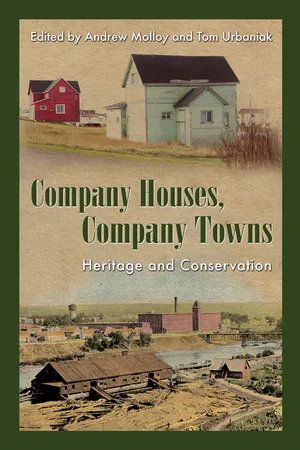
Former company houses and towns have meaning. They can inspire attachment and a sense of place. They can be tight-knit but also quintessentially global; their resources and products have served far-off markets while housing a mosaic of newcomers from around the world; they speak to the diversity of Canada and the immigrant experience. Their landscapes, though often threatened with abandonment and decline, are a kind of language that conveys rich and layered stories. They are hands-on classrooms of culture, economics, architecture, politics and sociology.Taken together, the case studies in this book speak to the heritage and enduring value of these places. Company towns mean a great deal to the people who put down roots there or passed through them. Many of the houses became homes. In Company Houses, Company Towns we also see how some of these places are being commemorated, conserved, regenerated and renewed – not as static museum pieces but as proud living communities aspiring to new economic opportunities and a quality of life.
- English
- ePUB (mobile friendly)
- Available on iOS & Android
eBook - ePub
Company Houses, Company Towns
About this book
Information
Chapter One
Richard MacKinnon
A Typology of Cape Breton Company Housing
The built landscape reveals much about human beings and their relationship to land, work and culture. Architecture has been explored from a variety of perspectives, including art and architectural history, cultural geography, folklore, archaeology and industrial archaeology. While each of these disciplines studies what we call “architecture,” each has its own way of interpreting buildings and landscapes. Despite the variety of methodologies and approaches, one of the first steps required for most studies is the conception of a typology of buildings in a specific cultural region. Cultural geographer Fred Kniffen’s seminal study in the 1960s demonstrated the value of this kind of detailed work to scholars. For Kniffen, “folk housing” includes all human habitations, barns and outbuildings of the folk or common people. Kniffen set up a typology “quantified as to numerical importance and qualified as to areal and temporal position, and to seek out origins, routes of diffusion, adaptations and other processes affecting change or stability” (Kniffen 1965: 550). His study was a massive undertaking, taking into account “the whole eastern United States from the Gulf to the Lakes and from the Atlantic to the Mississippi” (550).
This chapter is more modest; it attempts to provide a typology of the extant company housing on Cape Breton Island, Nova Scotia. Now a largely deindustrialized region, Cape Breton was once heavily industrialized, complete with coal mines, quarries and steel mills. Although much of the mining and steel infrastructure has been dismantled since 2000, the houses of the former industrial workers are evident throughout the landscape, revealing much about the region’s industrial past.
Geographers such as Yi-Fu Tuan, Donald Meinig, Edward Relph and J. B. Jackson study cultural landscapes and eloquently discuss how human beings transform spaces into meaningful places (Tuan 1974, 2004; Jackson 1980, 1994; Jackson and Zube 1970; Meinig and Jackson 1979; Relph 1976, 2000). These explorations under their purview of cultural landscape include: nature, the forest and the various ways human beings transform land and waterscapes; the naming of landscape features; and the spiritual nature of land and seascapes. What is also termed “the built environment,” and corresponding spatial relationships, are also a major component of their gaze. The built environment includes all structures made by human beings, including all forms of architecture, from skyscrapers to churches to homes and outbuildings.
An ethnographic approach to the built environment, which includes conducting fieldwork by taking photographs and doing measured drawings of floorplans, is a technique often employed by folklorists who have studied vernacular architecture and the built environment. Extending the scope of research beyond the library or the archive to include fieldwork allows researchers to traverse the landscape to look at, photograph and measure buildings in an attempt to understand these unique cultural artifacts. Folklorist Henry Glassie, who has explored architecture, material culture, oral tradition and landscape in areas as diverse as Ireland, Afghanistan, Turkey and the United States, has influenced the scope of this research immensely. He has demonstrated that it is important to examine both tangible and intangible culture in order to understand the personality of distinctive places (Glassie 1969, 1972, 1975, 1982, 1999, 2000). One of the few Atlantic Canadian studies to explore traditional buildings and culture in a similar way is found in Gerald Pocius’s A Place to Belong (1991). Pocius recorded and analyzed the buildings, spaces and traditions of a Newfoundland fishing outport prior to the contemporary demise of the East Coast fishery. The cultural-landscape patterns, usage and built structures that he records represent at least a 400-year history that, with the collapse of the regional fishery, has suddenly been shaken. Pocius’s book includes examples of unique vernacular building types distinctive to Newfoundland, such as fishing stages and flakes (for drying fish) that are no longer part of the landscape, and contains considerable local and traditional environmental knowledge. However, he clearly points out that the people of this outport community live in two worlds: one modern, with satellite dishes and contemporary popular culture, and one past, which is continually being re-enacted through stories, songs and oral history. When people are asked, “Where are you from?” they respond by saying, “I belong to Calvert.” The book explores the myriad ways people “belong” to this place and provides a clear understanding of how people in rural communities develop a sense of place. Architect Robert Mellin (2003) also provides a model for studying the built landscape through his detailed survey, including photographs and measured drawings, of all buildings in the Newfoundland outport of Tilting, Fogo Island.
In most studies of Atlantic Canadian architecture, with a few notable exceptions, the housing of miners and steelworkers is ignored (among the exceptions, Latremouille 1988; MacKinnon 1982a, 1996, 1998; MacLeod and St. Clair 1992, 1994; Ennals and Holdsworth 1998; Holdsworth 1984). Usually, the architectural books of the region focus on the homes of well-known or affluent citizens, political leaders or captains of industry (Byers and McBurney 1994; Comiter and Pacey 1988; Pacey and Comiter 1994). Churches and houses of worship feature prominently in many regional architecture studies (Pacey, Rogers and Duffus 1983; Hyde and Bird 1995). In the British Isles, however, there have been numerous important studies of the buildings of industrial communities, including those found in coal-mining distr...
Table of contents
- Cover
- Title Page
- Copyright
- Contents
- Preface
- Chapter One
- Chapter Two
- Chapter Three
- Chapter Four
- Chapter Five
- Chapter Six
- Chapter Seven
- Conclusion
- Contributors
Trusted by 375,005 students
Access to over 1.5 million titles for a fair monthly price.
Study more efficiently using our study tools.
Frequently asked questions
Yes, you can cancel anytime from the Subscription tab in your account settings on the Perlego website. Your subscription will stay active until the end of your current billing period. Learn how to cancel your subscription
No, books cannot be downloaded as external files, such as PDFs, for use outside of Perlego. However, you can download books within the Perlego app for offline reading on mobile or tablet. Learn how to download books offline
Perlego offers two plans: Essential and Complete
- Essential is ideal for learners and professionals who enjoy exploring a wide range of subjects. Access the Essential Library with 800,000+ trusted titles and best-sellers across business, personal growth, and the humanities. Includes unlimited reading time and Standard Read Aloud voice.
- Complete: Perfect for advanced learners and researchers needing full, unrestricted access. Unlock 1.5M+ books across hundreds of subjects, including academic and specialized titles. The Complete Plan also includes advanced features like Premium Read Aloud and Research Assistant.
We are an online textbook subscription service, where you can get access to an entire online library for less than the price of a single book per month. With over 1.5 million books across 990+ topics, we’ve got you covered! Learn about our mission
Look out for the read-aloud symbol on your next book to see if you can listen to it. The read-aloud tool reads text aloud for you, highlighting the text as it is being read. You can pause it, speed it up and slow it down. Learn more about Read Aloud
Yes! You can use the Perlego app on both iOS and Android devices to read anytime, anywhere — even offline. Perfect for commutes or when you’re on the go.
Please note we cannot support devices running on iOS 13 and Android 7 or earlier. Learn more about using the app
Please note we cannot support devices running on iOS 13 and Android 7 or earlier. Learn more about using the app
Yes, you can access Company Houses, Company Towns by Andrew Molloy, Tom Urbaniak in PDF and/or ePUB format, as well as other popular books in Politics & International Relations & Architecture General. We have over 1.5 million books available in our catalogue for you to explore.