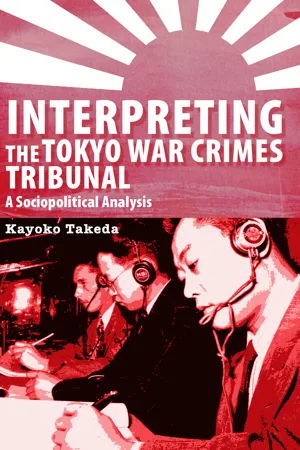
In order to ensure its absolute authority, the Tokyo War Crimes Tribunal (1946–1948), the Japanese counterpart of the Nuremberg Trial, adopted a three-tier structure for its interpreting: Japanese nationals interpreted the proceedings, second-generation Japanese-Americans monitored the interpreting, and Caucasian U.S. military officers arbitrated the disputes. The first extensive study on the subject in English, this book explores the historical and political contexts of the trial as well as the social and cultural backgrounds of the linguists through trial transcripts in English and Japanese, archival documents and recordings, and interviews with those who were involved in the interpreting. In addition to a detailed account of the interpreting, the book examines the reasons for the three-tier system, how the interpreting procedures were established over the course of the trial, and the unique difficulties faced by the Japanese-American monitors. This original case study of the Tokyo War Crimes Tribunal illuminates how complex issues such as trust, power, control and race affect interpreting at international tribunals in times of conflict.
- 192 pages
- English
- ePUB (mobile friendly)
- Available on iOS & Android
eBook - ePub
Interpreting the Tokyo War Crimes Tribunal
About this book
Information
Topic
FilologíaSubtopic
Historia japonesaCHAPTER 1
THE TRIAL
Toward the end of the Second World War, the leaders of three Allied nations—the United States, the United Kingdom and China—met on July 26, 1945, and issued the Potsdam Declaration on the Japanese surrender. This document included a reference to the “stern justice” that was to “be meted out to all war criminals, including those who have visited cruelties upon prisoners.” Following the atomic bombings of Hiroshima on August 6 and of Nagasaki on August 9, Emperor Hirohito’s announcement of surrender was broadcast to his subjects on August 15. The official ending of hostilities was marked when the Instrument of Surrender was signed by representatives of the Japanese government on board the USS Missouri in Tokyo Bay on September 2, 1945.
The prosecution of war criminals had been discussed among the Allied nations in the early 1940s, and the United Nations War Crimes Commission had been established in October 1943 to start gathering evidence of war crimes. Based on its investigations, the Special Far Eastern and Pacific Committee of the War Crimes Commission recommended on August 25, 1945, that Japanese war criminals be “surrendered to or apprehended by the United Nations for trial before an international military tribunal,” and, as Supreme Commander of the Allied Powers (SCAP), U.S. Army General Douglas MacArthur was given the authority to prepare for the establishment and operation of the Tribunal.
The occupation of Japan by the Allied Powers started on August 28. MacArthur arrived in Japan as SCAP on August 30, and one of the first operations he directed was the arrest and prosecution of Japanese war criminals. On September 11, MacArthur ordered the arrest of thirty-nine individuals suspected of having committed war crimes, including the former Prime Minister and War Minister General Hideki Tojo. More arrests followed. Within a few months, more than one hundred war crimes suspects were being detained in Sugamo Prison in Tokyo. Although the charter for the Nuremberg Trials had already been announced on August 8, it took months for the Tokyo counterpart to be established. Meanwhile, President Harry S. Truman appointed Joseph Keenan, former head of the U.S. Justice Department’s criminal division, to serve as chief prosecutor for the trial of Japanese war criminals. Keenan arrived in Japan on December 6 with a team of nearly forty lawyers and aides. Unlike at Nuremberg, where the United States, the United Kingdom, France and the Soviet Union each had its own prosecution team, there was a single prosecution team for Tokyo, led by Keenan and comprising representatives from eleven Allied nations. The International Prosecution Section was established on December 8, the fourth anniversary of the attack on Pearl Harbor according to the Japanese calendar, within the offices of the occupation headquarters (itself known as SCAP by this point). It was not until January 19, 1946, however, that the jurisdiction, functions and procedural guidelines of the Tribunal were announced, in the form of the Charter of the International Military Tribunal for the Far East, commonly known as the Tokyo Charter. This charter had been drafted by the U.S. prosecution team, following the model of the Nuremberg Charter, and was approved and announced by MacArthur. It was later amended following consultations with the other Allied nations.
With the charter in place, each of the nine signatories to the Japanese Instrument of Surrender nominated a judge, and MacArthur officially appointed these judges on February 15, 1946. They were from Australia, Canada, the Republic of China, France, the Netherlands, New Zealand, the Soviet Union, the United Kingdom and the United States. The Australian judge, Sir William Webb, was appointed President of the Tribunal, despite concerns that he had been the chief investigator of the Japanese army’s atrocities against Australian prisoners of war and might be regarded as biased against the Japanese defendants. He remained President of the Tribunal throughout the trial. Prompted by a call from the Far Eastern Commission, the Allied Powers’ highest policy-making agency for the occupation of Japan, for further representations on the bench, MacArthur amended the Tribunal’s charter on April 26 to add judges from India and the Philippines, making a total of eleven judges.
As the International Prosecution Section interrogated “Class A” war crimes suspects in Sugamo Prison, Japanese lawyers were retained to represent them. Concerned about these lawyers’ unfamiliarity with the Anglo-American law of the Tribunal, on February 14 the Japanese government requested that MacArthur provide British and American lawyers for the defense. Since British lawyers were not permitted by British law to practise under a foreign jurisdiction, arrangements were made to bring fifteen lawyers from the United States. Despite urgent requests, however, they did not arrive in Tokyo until May 17, two weeks after the opening of the trial.
The Proceedings
On April 29, 1946, the indictment was formally lodged with the Tribunal against twenty-eight “Class A” defendants, all of whom had been military and political leaders in wartime Japan. They were accused of “crimes against peace (Class A),” “conventional war crimes (Class B)” and “crimes against humanity (Class C).” Despite some reservations in certain countries, such as Australia, about the decision to protect Emperor Hirohito from prosecution, the Allied governments ultimately agreed not to proceed with his trial for the sake of avoiding the possibility of disruption to their larger goal of constructing a democratic Japan. For various reasons, which are still being debated by historians, the Allies also failed to bring to justice some of those who had committed serious war crimes, such as biological and chemical warfare, experiments on Chinese and Russian prisoners of war and civilians and forced prostitution of Korean women (see Dower 1999, 465; Bix 2000, 617; Drea 2006, 4–7; Awaya 2006, 81–114).
The Tribunal convened on May 3, 1946, with the statement by Sir William Webb, often quoted since, that “there has been no more important criminal trial in all history.” The case for the prosecution started right away and lasted until January 24, 1947. The case for the defense followed and lasted until January 12, 1948. Rebuttals and summations by both sides were concluded on April 4, and the Tribunal adjourned until November 4, when the delivery of the judgment began. With the completion of sentencing, the Tribunal adjourned on November 12, 1948. The length of the trial in Tokyo is often cited as one of the major differences from the Nuremberg Trials, the first of which was concluded in less than one year. According to Greg Bradsher (n. d., 180–81), the language difficulty is generally believed to have been the major cause of the relatively extreme length of the proceedings, but there were other factors prolonging them, such as the complexity of the subject matter and the absence of relevant official records, since the Japanese Army had destroyed many documents around the end of the war. A total of 419 witnesses testified in 818 sessions over 417 days, and 779 affidavits and depositions were presented. Admitted exhibits in the form of documents totalled around 30,000 pages, and the English transcripts of the court proceedings, excluding exhibits and the judgment, number 48,488 pages.
During the trial two of the defendants died of natural causes and one had a mental breakdown and was found incompetent to stand trial. The remaining twenty-five were all found guilty by a majority vote of the judges, although separate dissenting opinions were submitted by the judges from the Philippines, France, the Netherlands and India, as well as by Webb. Seven of the defendants, including Hideki Tojo, were sentenced to death by hanging, sixteen to life imprisonment and two to lesser terms. The executions took place inside Sugamo Prison on December 23, 1948 (which happened to be the birthday of Emperor Hirohito’s son, the current Emperor Akihito, and is now a national holiday). Four of the imprisoned died while serving their sentences, but the Japanese government paroled the rest in 1956 and released them unconditionally in 1958.
Controversies
The Tokyo Trial has been viewed in both positive and negative lights. Some refer approvingly to the role it played in exposing some of the Japanese military’s atrocities in China and other Asian countries, both to the world in general and, in particular, to the citizens of Japan, who had been kept in the dark about some of their leaders’ and soldiers’ wartime activities. (Takashi Oka, who was one of the interpreters at the trial, pointed this out to this author when interviewed in Washington, DC, on December 11, 2005.) Some even see this as the starting point for Japan’s confrontation with its wartime record and as an important precursor for later developments of international criminal justice (see Totani 2008).
As for criticism, there is plenty. First and foremost, the Tokyo Trial has been criticized by historians, ideologues and participants in the proceedings as “victors’ justice,” an exercise in revenge or a U.S.-led theatrical “show” trial marred by political whims (see, for example, Pal 1953; Minear 1971; Röling and Cassese 1993; Dower 1999). Some of these critics also emphasize the selectiveness of the prosecutions, which, as has been mentioned, exempted the Emperor and many war criminals, and the forced application of the categorization of war crimes at Nuremberg to what they argue was a different situation in Japan.
The legitimacy of the IMTFE has remained a controversial issue in Japan even sixty years after the conclusion of the trial, and has become one of the major themes of nationalist and revisionist views on Japan’s wartime actions. The standard argument is that the Tokyo Trial was biased, unfair and one-sided, especially in its failure to address the actions of the Allied powers, such as the atomic bombings, and that it was based on the retroactive application of laws that had not existed at the time the war crimes in question were committed. Discussion of the IMTFE and its long-lasting effects on Japan, under the general rubric of Tokyo Saiban shikan (“Tokyo Trial view of history”), have gained momentum every time a Japanese Prime Minister has visited Yasukuni Shrine in Tokyo, where “Class A” war criminals are enshrined among other war dead, as well as every time disputes have arisen with China and South Korea over the publication in Japan of controversial history textbooks with revisionist views.
The validity of the Tokyo War Crimes Tribunal does not fall within the direct scope of this book, but the political nature of the trial must be taken into full consideration nonetheless. The facts that the Tokyo Trial was carried out by the victor nations against the vanquished and that its operation was essentially led by the U.S. military authorities are deeply connected with the selection of linguists, the arrangements for interpreting mechanisms and the development of the actual interpreting procedures. Based on an awareness of this political context, Chapter 2 examines the who, what, where, when, why and how of interpreting at the Tokyo Trial.
CHAPTER 2
THE INTERPRETING ARRANGEMENTS
The aim of this chapter is to describe the overall interpreting arrangements at the Tokyo Trial in detail, including the languages used, how the court handled “non-official” languages, how the linguists were recruited and assigned, their compensation, their equipment, the modes of interpreting they engaged in, the challenges they faced in the actual task of interpreting, and the system used for correcting interpreting errors. It also discusses the work done by the translators in order to provide a fuller picture of how the Tribunal addressed its language needs, both oral and written. Finally, some comments by historians are introduced regarding the effect of interpreting on the trial proceedings.
The Official Languages of the Tribunal
The use of interpreting and translation at the Tokyo Trial was provided for in the Tokyo Charter (of which the official text is available in Pritchard 1998 among others). Under the heading “Fair Trial for Accused,” Article 9 (b) of the Charter states:
Language. The trial and related proceedings shall be conducted in English and in the language of the accused. Translations of documents and other papers shall be provided as needed and requested.
Accordingly, interpretation between English and Japanese in the consecutive mode (as discussed below) was offered throughout the trial, but Russian simultaneous interpretation was also available as a Soviet-operated stand-alone arrangement for the Soviet judge, who understood neither English nor Japanese. “As a courtesy” (according to Brackman 1987, 213–14), one of the three channels of the interpreting equipment was assigned to interpretation into Russian.
Handling of Non-Official Languages
During the trial the Tribunal also used interpreters of Chinese, French, Dutch, German, Russian and Mongolian when witnesses or prosecutors spoke in these languages. However, the transcripts of the proceedings (see Kyokuto kokusai gunji saiban sokkiroku and Pritchard 1998) indicate that the Tribunal had not anticipated or prepared for the use of languages other than English and Japanese. During the early stages of the trial a significant amount of time was spent, inside and outside the courtroom, discussing how testimony in languages other than English and Japanese should be handled and whether the use of “non-official” languages by prosecutors should be permitted in court at all.
When the first Chinese-speaking witness, General Ching The-Chun of the Republic of China, appeared before the Tribunal on July 22, 1946, the initial arrangement was to provide relay interpreting with Japanese as the pivot language between Chinese and English. In other words, Chinese or English was consecutively interpreted into Japanese, then the Japanese interpretation was consecutively interpreted into English or Chinese. This system was devised because the Language Section, which managed the work of all the linguists for the Tribunal, could not find an interpreter who could work directly between Chinese and English. Although a Chinese member of the prosecution had been considered as a potential interpreter between Chinese and English, concerns about the propriety of having him interpret for a witness produced by the prosecution prevented him from assuming the role. However, U.S. counsel became frustrated because they had to hear two unfamiliar languages (Chinese, then Japanese) before the English interpretation was delivered, and voiced their concern that this “double translation” might be “very imperfect” (IMTFE Transcripts, pp. 2300–2301). The President of the Tribunal, who had not previously been informed of this issue, handed down a ruling on the spot, accepting the prosecution’s suggestion that the Tribunal use W. F. S. Fang, an English-speaking secretary to Mei Ju-ao, the judge from the Republic of China, as an interpreter between Chinese and English. Subsequently, English became the pivot language in relay interpreting between the three languages: Chinese or Japanese was first interpreted into English consecutively, and then the English interpretation was interpreted into Japanese or Chinese. Fang interpreted throughout the morning of July 23, 1946, but after that a few other Chinese personnel took over his role. However, the poor performance of these ad hoc interpreters drew questions from both the defense and the prosecution as to the accuracy of the interpretation, which frequently disrupted the court proceedings. Finally, during the testimony of Henry Pu-Yi, the former Emperor of Manchukuo, who appeared as a witness for the prosecution from August 16 to August 27, 1946, the President of the Tribunal personally appealed to General MacArthur by letter (now in the MacArthur Memorial Library & Archives) to enlist the aid of the occupation authorities in finding competent Chinese interpreters. In response, MacArthur sent his own interpreter to the court on August 26, and made an arrangement to bring more interpreters in from Shanghai.
Having these ad hoc interpreters for the pivot language presented a challenge to the Japanese interpreters as well. According to Takashi Oka, one of the Japanese interpreters who worked regularly throughout the trial (interviewed by the author in Washington, DC, on December 11, 2005), the most difficult task he faced during the proceedings was to relay the Chinese interpreter’s unclear Chinese-to-English interpretation into Japanese (as well as to relay the Dutch-to-English interpretation into Japanese). The problems with this relay arrangement are probably what prompted the IMTFE to ask the counterpart Tribunal in Nuremberg about its system of handling multiple languages at the same time. A telegram from the Secretariat of the IMTFE to its counterpart in Nuremberg, dated August 23, 1946 (and now in U.S. National Archives, Record Group 331), made the following inquiries:
1. How many languages are spoken in the court?
2. How many language translations are spoken simultaneously over the translator device?
3. What is the total number of interpreters and monitors used at any one time?
4. Are the interpreters in the open court or behind glass walls?
5. What is the distance between witness box and interpreters?
6. [Is] More than one court reporter for each language needed by the interpreter?
7. Where are official court reporters seated, near witness or near interpreters?
8. How much space is used by interpretation personnel involving interpreters, monitors and others?
9. How are counsel, witness and interpreters’ speech activities coordinated?
Coming almost four months after the start of the trial, this belated inquiry indicates that the Tribunal had not fully prepared for the use of a third language in court. The response from Nuremberg, dated August 27, 1946 (and also in Record Group 331), gives clear answers to all nine of the questions:
1. Number of languages spoken in courtroom—four. (By use of special arrangement any fifth language may also be used.).
2. Three language translations are spoken simultaneously over the equipment. That is, speaker uses one court language, interpreters interpret into other three.
3. Total number of interpreters in use at one time—twelve, with one monitor.
4. Interpreters are in open court behind unroffed [presumably a typo for “unroofed”] glass partitions.
5. Distance between witness box and interpreters—fifteen feet, but distance is immaterial as both are mutually connected by microphones, earphones, and wires.
6. Number of court reporters for each language depends on proficiency of individual reporter. For safety, we have been using two reporters for each language at any one time. Total of about nine reporters for each language to provide coverage for a six-hour working day.
7. Official court reporters are seated between witness stand, prosecution, and defense speaking position. They are also between the bench and the dock, at approximately the ...
Table of contents
- Cover
- Title Page
- Acknowledgements
- Introduction
- Chapter 1 The Trial
- Chapter 2 The Interpreting Arrangements
- Chapter 3 Profiles of the Linguists
- Chapter 4 Hierarchy and Learning Process
- Chapter 5 Tojo’s Testimony
- Chapter 6 Sociopolitical Perspectives
- Conclusion
- References
- Index
- Copyright
Trusted by 375,005 students
Access to over 1.5 million titles for a fair monthly price.
Study more efficiently using our study tools.
Frequently asked questions
Yes, you can cancel anytime from the Subscription tab in your account settings on the Perlego website. Your subscription will stay active until the end of your current billing period. Learn how to cancel your subscription
No, books cannot be downloaded as external files, such as PDFs, for use outside of Perlego. However, you can download books within the Perlego app for offline reading on mobile or tablet. Learn how to download books offline
Perlego offers two plans: Essential and Complete
- Essential is ideal for learners and professionals who enjoy exploring a wide range of subjects. Access the Essential Library with 800,000+ trusted titles and best-sellers across business, personal growth, and the humanities. Includes unlimited reading time and Standard Read Aloud voice.
- Complete: Perfect for advanced learners and researchers needing full, unrestricted access. Unlock 1.5M+ books across hundreds of subjects, including academic and specialized titles. The Complete Plan also includes advanced features like Premium Read Aloud and Research Assistant.
We are an online textbook subscription service, where you can get access to an entire online library for less than the price of a single book per month. With over 1.5 million books across 990+ topics, we’ve got you covered! Learn about our mission
Look out for the read-aloud symbol on your next book to see if you can listen to it. The read-aloud tool reads text aloud for you, highlighting the text as it is being read. You can pause it, speed it up and slow it down. Learn more about Read Aloud
Yes! You can use the Perlego app on both iOS and Android devices to read anytime, anywhere — even offline. Perfect for commutes or when you’re on the go.
Please note we cannot support devices running on iOS 13 and Android 7 or earlier. Learn more about using the app
Please note we cannot support devices running on iOS 13 and Android 7 or earlier. Learn more about using the app
Yes, you can access Interpreting the Tokyo War Crimes Tribunal by Kayoko Takeda in PDF and/or ePUB format, as well as other popular books in Filología & Historia japonesa. We have over 1.5 million books available in our catalogue for you to explore.