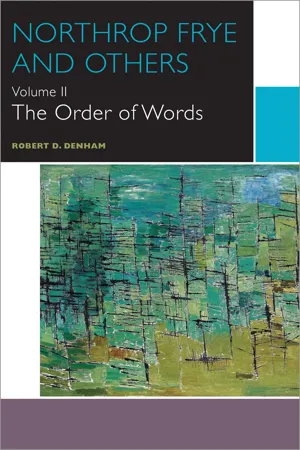
This book, based on extensive archival and historical work, identifies and brings to light additional and littlerecognized intellectual influences on Frye, and analyzes how they informed his thought. These are variously major thinkers, sets of texts, and intellectual traditions: the Mahayana Sutras, Machiavelli, Rabelais, Boehme, Hegel, Coleridge, Carlyle, Mill, Jane Ellen Harrison and Elizabeth Fraser.
In each chapter, dedicated to Frye's connection to a specific influence, Denham describes how Frye became acquainted with each, and how he interpreted and adapted certain ideas from them to help work out his own conceptual systems. Denham offers insights on Frye's relationship with his historical and intellectual contexts, provides valuable additional context for understanding the work of one of the 20th century's leading scholars of literature and culture.
Includes over 20 photos, tables and figures, as well as a chapter on Frye's personal relationship with Elizabeth Fraser.
- 270 pages
- English
- ePUB (mobile friendly)
- Available on iOS & Android
eBook - ePub
Northrop Frye and Others
About this book
Trusted by 375,005 students
Access to over 1.5 million titles for a fair monthly price.
Study more efficiently using our study tools.
Information
1
Frye and the Mahayana Sutras
Northrop Frye was always forthright in acknowledging the significance of the “mythological framework” he inherited. He was inescapably conditioned, he says, by the “cultural envelope” of the classical and Christian traditions of Western culture; the Methodist heritage of his upbringing; and his white, male, middle-class identity. The antifoundationalists, along with others more interested in difference than identity, refer fashionably to this commonplace as a social construction. The implication has often been that Frye is unable to step outside his own Western conditioning to take a broader and more inclusive view of things, so that what we end up with is an insular, ethnocentric, and outmoded structure of thought. Thus, Jonathan Culler’s attack on Frye for being a dogmatic religious ideologue (1327) and Terry Eagleton’s for his being a middle-class liberal and Christian humanist (199–200). While there can be no doubt that Frye is rooted in the tradition of Western liberal humanism in its classical and Christian forms, his notebooks and diaries reveal that he was more influenced by Eastern thought than is commonly imagined and therefore able not simply to engage worlds outside his own cultural envelope but to assimilate their religious principles into his own world view.
FRYE AND THE EAST
Frye’s readers will be aware of the occasional references to the religion and culture of the East—from his comments on Zen Buddhism in Fearful Symmetry: A Study of William Blake at the beginning of his career to those on Eastern techniques of meditation in his posthumous The Double Vision: Language and Meaning in Religion—but no one would take such occasional comments as significant features of Frye’s grand vision. In the Anatomy of Criticism one runs across references to such classical Eastern works as the Brihadaranyaka and Chandoga Upanishads, Chinese romances, the Noh musical drama of Japan, the Mahabharata and the Ramayana, Chinese and Japanese lyric poetry, and Lady Murasaki’s Tale of Genji,6 and Frye makes an occasional comment on the East-West connection in his other books. In A Study of English Romanticism, for example, he calls attention to the similarity between Shelley’s use of “interpenetration” in A Defence of Poetry and the apocalyptic visions of the Eastern poets (CW 17: 201; SR 160).
But in most cases Frye is using these texts for purposes of illustration only, and if they were removed from his argument nothing much would be lost. Sometimes Eastern literature has a more functional role to play in his argument, as in his use of Cao Xueqin’s The Dream of the Red Chamber (dated to the eighteenth century) and Kalidasa’s Sakuntala (dated some time between first century BCE and fourth century CE) in The Secular Scripture (CW 18: 72 and 68, 71, 97; SeS 108–9 and 103, 107, 147). But in his published work it is clear that Eastern literature is not at all fundamental to Frye’s criticism. Similarly, with Eastern religion and philosophy: there are scores of references to Hinduism, Buddhism, and Taoism scattered throughout Frye from Fearful Symmetry to the two books on the Bible, but here Frye’s interest is primarily in the occasional analogue; Eastern religion and philosophy lie on the periphery of his major concerns.
In the notebooks, however, the attraction that the East holds for Frye is considerably less marginal. Notebook 3, for example, contains extensive entries on the path of Patanjali’s Eightfold Yoga, which Frye turns to in order “to codify a program of spiritual life” for himself (CW 13: 38). He also writes about other forms of yoga: Bhakti Yoga, the path to the devout love of god, and Jnana Yoga, the path of abstract knowledge. On the verso of the flyleaf of Notebook 3 is the neatly written entry “Paravritti of July 26/46”—paravritti, Sanskrit for “the highest wave of thought,” meaning the complete conversion of the mind.7 Frye defines it in different ways: “epistemological apocalypse,” “Wiederkehr [return],” “the descent & return through the vortex,” the “reversal of the current… the notion inherent in conversion,” a “revolutionary leap of sudden deliverance,” “the regaining of liberty,” and a “turning around.”8 Paravritti is another way Frye tries to capture the sense of apocalyptic reversal and recognition. Notebook 3 also has entries on Bardo, the “in-between” state in Tibetan Buddhism that connects the death of individuals with the rebirth that follows—an idea that fascinated Frye from the time he first read The Tibetan Book of the Dead.
Frye was aware of the dangers of what he called the “cleaned-up versions” of Eastern religion, the kind that issue from extracting yoga or Zen from its own culture, and he kept in mind Coleridge’s principle that we can distinguish where we cannot divide, meaning that he could differentiate, for example, between the Logos vision of Christianity and the Thanatos vision of Buddhism, Hinduism, Taoism (the “Oriental big three,” as he calls them), and Confucianism. The Eastern religions have no clear sense of the resurrected spiritual body, of a personal god, or of the existential transformation that is found in Christianity outside its institutional forms. The focus of Buddhism, Hinduism, and Taoism is rather on what Frye calls the “evaporation” of the soul (CW 13: 180). Again, while there is a parallel between Jesus and the humble hero of the Tao Te Ching, “the supreme sacrifice of dying for the people does not appear to be anything that would appeal to a Taoist” (CW 4: 225–6; DV 73–4). Frye makes no effort to reconcile these differences. Still, he claimed that we can “learn infinitely and indefinitely from Oriental religions” (CW 24: 1018). His personal library contained forty-four books on Eastern philosophy and religion, forty-two of which have his marginal markings and annotations. Frye learned a great deal from three very different traditions of Mahayana Buddhism (the sutras, Zen, and The Tibetan Book of the Dead), from Hinduism (Patanjali’s yoga and Kundalini), and from Taoism and Confucianism. The most important of these, I believe, were the Mahayana sutras, and we turn now to explore Frye’s interest in these sutras. Notebook 3, just mentioned, includes several extended reflections on the Lankavatara Sutra, a key text for Frye’s understanding of interpenetration, which turns out to be a bedrock idea in his religious thinking.
THE SUTRAS
Frye was familiar with several of the Mahayana sutras. As noted in the Introduction, “sutra” refers to sacred scriptures. Frye annotated his own copies of the Diamond Sutra and the Lotus Sutra,9 and he refers to the sutra on the void. But the first two are never mentioned in the notebooks, and the sutra on the void is referred to in Notebook 3 only in passing (CW 13: 65).10 The Lankavatara and the Avatamsaka Sutras, however, appear with some regularity in the notebooks and diaries. The Lankavatara Sutra (“Sutra on the Descent to Sri Lanka”) is a Mahayana Buddhist text that stresses inner enlightenment, the erasing of all dualities, the concept of emptiness, and the truth of cittamatra, “mind only” or “consciousness only.” The author and the date of composition of the Lankavatara are unknown, though some think it was compiled in the first century CE. The Avatamsaka Sutra is an extravagant and often ponderous text that stresses the identity of all things or the interpenetration of all elements in the world.11 Its author is likewise unknown, though some think it was composed in several stages, beginning as early as five hundred years after the death of Buddha. The Avatamsaka is the only Mahayana text Frye ever mentions in his published work. But there are forty-eight entries in the diaries and notebooks where he records his observations on the Lankavatara and the Avatamsaka Sutras. For all their complexity12 these sutras became for Frye, as he says in one notebook, “vade mecums of practical meditation” (CW 6: 714). Both sutras advance a form of absolute idealism, which has a Western analogue in Hegel’s Phenomenology of Spirit, but the Avatamsaka presents it in a mode that is often concrete and metaphoric, whereas the Lankavatara favours an abstract, almost Hegelian mode over the symbolic one.13
Sometimes Frye seems to regard what he finds in the sacred texts of the East as analogies of Western ideas, as when he observes that the Protestant conception of conversion, different from the straight line of Dante’s Commedia or the parabola of rise and descent in tragedy, is like the vortex of transformation that he finds in the Lankavatara: they are not identical, but they “point in the same direction” (CW 13: 21). Similarly, Frye sees in the miraculous power that often accompanies Eastern enlightenment an analogue of the miracles in the New Testament (CW 4: 211; DV 56) and of Christian salvation without all of the legalism that was never purged from the doctrine (CW 19: 125; GC 105–6). At other times Eastern and Western conceptions seem to be practically identical for Frye. In the Buddhist conception of maya (the illusion of the phenomenal world which the unenlightened mind takes as the only reality) he finds both an affirmation and a denial of the law of noncontradiction, and he remarks that the “Christian conception of evil as the product of original sin & a fallen world is really exactly the same: the same combination of something that exists & yet cannot exist” (CW 13: 43–4). When identity rather than similarity underlies the East-West conjunction, the result is an insight that helps to define his own position: in such cases what he finds in the Mahayana sutras is constitutive.
Frye is wary of framing the connections in philosophical terms. He is attracted to the Lankavatara idea of cittamatra (mind-only), but he finds that it “suggests pantheism to a Western mind” and that its parallel doctrine of vijnaptimatra is “very like Platonic idealism.”14 Still, Frye recurs to the Yogacara doctrine of “mind only” throughout the notebooks, not simply because it corresponds well to his holistic view of apocalypse but also because it helps to define it. Citta means generally the storehouse of thoughts and actions, and specifically, when used in conjunction with matra, it is synonymous with alayavijnana, “storehouse consciousness,” or the fundamental consciousness of everything that exists. Frye’s knowledge of cittamatra is indebted to D. T. Suzuki’s technically intricate commentary, which comes down to this: cittamatra is both a psychological theory of the way the mind operates and an ontological and religious theory, the grasping of which enables one to get beyond dualistic ways of thinking.15 In the Buddhist citta, Frye writes in an essay on Jung, “the self becomes fully enlightened by realizing its identity with a total self, an indivisible unity of God, man, and the physical world” (CW 21: 206; CL 120). But Frye is more interested in the ontological and religious theory, the initial postulate of which is a spiritual unity that transcends logic and the opposites found in all forms of dialectic. In reflecting on a novel he wants to write, he identifies cittamatra with the goal of the apocalyptic quest: “Ever since I read Dante, I have been fascinated by the possibilities of the ascent or anabasis form (less by the Inferno, because so many others, like Orwell and Sartre & Koestler, have done that better than I can do). I think vaguely of seven or eight metamorphoses on various levels of the spiritual world that a dead man’s soul goes through, including a Utopia, a vision of Bardo, an apocalypse, and finally a withdrawal into the Lankavatara ‘mind itself’” (CW 8: 561). One of the goals of the apocalyptic quest is unified consciousness, and the emphasis on unity in cittamatra appeals more strongly to Frye than does the psychological thrust of the word, as we see in this extraordinary passage on the holism of total form, where the words “one” and “uni-” function like power-laden symbols of a secret mantra:
Anagogy begins with the postulate of the verbal universe & its corollary, the one word. Aristotle’s physics leads to the conception of one mover at the circumference of the world.… To make sense of the shape of any subject, you have to assume an omniscient mind. No one mind comprehends the whole of physics, but the subject wouldn’t hang together unless it were theoretically possible for one mind to comprehend it, all at once. And if there is such a thing as “the whole of” physics, the subject must have an objective unification at its circumference. This universal mind is not God, in any religious sense, for it doesn’t necessarily exist: it is necessary only as a hypothesis completing a human mental structure.… But the fact that the guarantor of all our knowledge is a universal mind, of which we can say only a) that we have no reason to suppose that it differs from other human minds except in the amount of knowledge it has, and b) that we have no reason to suppose that it “exists,” certainly makes a lot of sense of the Lankavatara Yogacara doctrine [of cittamatra]. Anyway, the point is that allegorized bodies of knowledge assume an objective single or total form. The musical universe leads to the one chord, the music of the spheres. The historical universe, or the universe of events, leads to the one event, or nature, that which is born, the one thing that is & has happened. The mathematical universe leads to the one number, or as we should say the one equation, which is what Pythagoreanism was all about. The philosophical universe leads to the Form of Forms, the One Idea. Similarly, literature, the verbal universe, leads to the One Word. I don’t know yet how many of these universes there are, or how few they can be reduced to. Thus biology leads to one organism. Blake’s Polypus, & Samuel Butler’s known God, the anima mundi who in Browne is the Holy Spirit, at the circumference of the biological universe. But that seems to disappear in the physical universe, where the one form is nature, the one organism plus the one environment. Also, where does the difference between the descriptive & the hypothetical disciplines come in? I’ve found only the word & the number. Nonsense: there’s a musical universe, & there should be a pictorial & a sculptural one & an architectural one, though the last three seem to disappear into the One Man who is one building. Certainly it’s important that all social & political questions disappear in the One Man.… Chemistry, the analysis of the mixture of elements, lead[s] to one element at the circumference of the universe, in other words quintessence. This, if we identify quintessence with the elixir, which shouldn’t be too hard, was the point about alchemy. Many of these one-form structures are superstitio...
Table of contents
- Cover
- Title Page
- Copyright
- Dedication
- Contents
- Introduction
- Abbreviations and Short Titles
- 1: Frye and the Mahayana Sutras
- 2: Frye and Niccolò Machiavelli
- 3: Frye and François Rabelais
- 4: Frye and Jacob Boehme
- 5: Frye and G. W. F. Hegel
- 6: Frye and Samuel Taylor Coleridge
- 7: Frye and Thomas Carlyle
- 8: Frye and John Stuart Mill
- 9: Frye and Jane Ellen Harrison
- 10: Frye and Elizabeth Fraser
- Notes
- Works Cited
- Index
Frequently asked questions
Yes, you can cancel anytime from the Subscription tab in your account settings on the Perlego website. Your subscription will stay active until the end of your current billing period. Learn how to cancel your subscription
No, books cannot be downloaded as external files, such as PDFs, for use outside of Perlego. However, you can download books within the Perlego app for offline reading on mobile or tablet. Learn how to download books offline
Perlego offers two plans: Essential and Complete
- Essential is ideal for learners and professionals who enjoy exploring a wide range of subjects. Access the Essential Library with 800,000+ trusted titles and best-sellers across business, personal growth, and the humanities. Includes unlimited reading time and Standard Read Aloud voice.
- Complete: Perfect for advanced learners and researchers needing full, unrestricted access. Unlock 1.5M+ books across hundreds of subjects, including academic and specialized titles. The Complete Plan also includes advanced features like Premium Read Aloud and Research Assistant.
We are an online textbook subscription service, where you can get access to an entire online library for less than the price of a single book per month. With over 1.5 million books across 990+ topics, we’ve got you covered! Learn about our mission
Look out for the read-aloud symbol on your next book to see if you can listen to it. The read-aloud tool reads text aloud for you, highlighting the text as it is being read. You can pause it, speed it up and slow it down. Learn more about Read Aloud
Yes! You can use the Perlego app on both iOS and Android devices to read anytime, anywhere — even offline. Perfect for commutes or when you’re on the go.
Please note we cannot support devices running on iOS 13 and Android 7 or earlier. Learn more about using the app
Please note we cannot support devices running on iOS 13 and Android 7 or earlier. Learn more about using the app
Yes, you can access Northrop Frye and Others by Robert D. Denham in PDF and/or ePUB format, as well as other popular books in Literature & Literary Criticism Theory. We have over 1.5 million books available in our catalogue for you to explore.