Part I of this work focuses on the ways in which digitization projects can affect fundamental justice principles. It examines claims that technology will improve justice system efficiency and offers a model for evaluating e-justice systems that incorporates a broader range of justice system values. The emphasis is on the complicated relationship between privacy and transparency in making court records and decisions available online.
Part II examines the implementation of technologies in the justice system and the challenges it comes with, focusing on four different technologies: online court information systems, e-filing, videoconferencing, and tablets for presentation and review of evidence by jurors. The authors share a measuring enthusiasm for technological advances in the courts, emphasizing that these technologies should be implemented with care to ensure the best possible outcome for access to a fair and effective justice system.
Finally, Part III adopts the standpoints of sociology, political theory and legal theory to explore the complex web of values, norms, and practices that support our systems of justice, the reasons for their well-established resistance to change, and the avenues and prospects of eAccess. The chapters in this section provide a unique and valuable framework for thinking with the required sophistication about legal change.
Published in English.
eBook - ePub
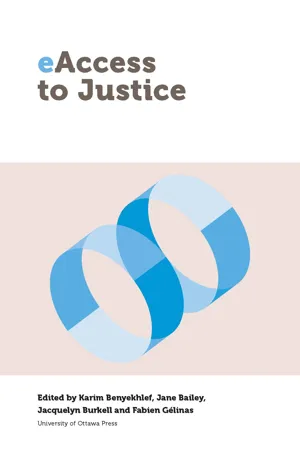
eAccess to Justice
- 415 pages
- English
- ePUB (mobile friendly)
- Available on iOS & Android
eBook - ePub
About this book
Information
Table of contents
- Cover
- Title Page
- Copyright Page
- Contents
- Acknowledgements
- Introduction
- Part I: Justice Values and Digitalization
- Part II: Courtroom Interactions And Self-Empowerment
- Part III: Toward New Procedural Models?
- Postscript: eAccess to Justice – Brief Observations
- Bibliography
- Contributors
Trusted by 375,005 students
Access to over 1.5 million titles for a fair monthly price.
Study more efficiently using our study tools.
Frequently asked questions
Yes, you can cancel anytime from the Subscription tab in your account settings on the Perlego website. Your subscription will stay active until the end of your current billing period. Learn how to cancel your subscription
No, books cannot be downloaded as external files, such as PDFs, for use outside of Perlego. However, you can download books within the Perlego app for offline reading on mobile or tablet. Learn how to download books offline
Perlego offers two plans: Essential and Complete
- Essential is ideal for learners and professionals who enjoy exploring a wide range of subjects. Access the Essential Library with 800,000+ trusted titles and best-sellers across business, personal growth, and the humanities. Includes unlimited reading time and Standard Read Aloud voice.
- Complete: Perfect for advanced learners and researchers needing full, unrestricted access. Unlock 1.5M+ books across hundreds of subjects, including academic and specialized titles. The Complete Plan also includes advanced features like Premium Read Aloud and Research Assistant.
We are an online textbook subscription service, where you can get access to an entire online library for less than the price of a single book per month. With over 1.5 million books across 990+ topics, we’ve got you covered! Learn about our mission
Look out for the read-aloud symbol on your next book to see if you can listen to it. The read-aloud tool reads text aloud for you, highlighting the text as it is being read. You can pause it, speed it up and slow it down. Learn more about Read Aloud
Yes! You can use the Perlego app on both iOS and Android devices to read anytime, anywhere — even offline. Perfect for commutes or when you’re on the go.
Please note we cannot support devices running on iOS 13 and Android 7 or earlier. Learn more about using the app
Please note we cannot support devices running on iOS 13 and Android 7 or earlier. Learn more about using the app
Yes, you can access eAccess to Justice by Karim Benyekhlef, Jane Bailey, Jacquelyn Burkell, Fabien Gélinas, Karim Benyekhlef,Jane Bailey,Jacquelyn Burkell,Fabien Gélinas in PDF and/or ePUB format, as well as other popular books in Law & Media & Entertainment Law. We have over 1.5 million books available in our catalogue for you to explore.