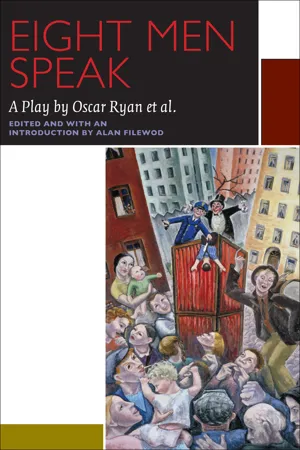
![]()
Eight Men Speak
—
A POLITICAL PLAY IN SIX ACTS
by
Oscar Ryan
E. Cecil-Smith
H. Francis
Mildred Goldberg
––––
Cover Design and Decorations
Direct Print Linoleum Cuts
by
R I C
––––
Progressive Arts Clubs of Canada
P.O. Box 212 - - Toronto, Ont.
![]()
Foreword
Why are the Canadian authorities afraid of this play? Why do they move heaven and earth to prevent it being presented for a second time? Why has the order gone out from the Ontario Parliament Buildings that any theatre which is rented for the showing of EIGHT MEN SPEAK shall at once lose its license? Why did the Winnipeg police and the Manitoba Government swoop down on the Walker Theatre and remove the license the day before the play was to appear there?
The answer is not far to seek. It lies in the essential truth of every word of these six acts. These things which are dramatized in the following pages must not be allowed to be played in public, if the governments concerned can do anything to prevent it.
As part of the campaign to force the authorities to investigate the attempt to murder Tim Buck in his cell at Kingston Penitentiary, the Toronto Progressive Arts Club presented this play at the Standard Theatre on December 4, 1933. The time for rehearsal and preparation was short, less than two months. Therefore a committee of four was struck off to write the play, and all the forces of the club organized to ensure the technical and artistic success of the performance.
It was played to a house seating 1,500, which was sold out long before the curtain was scheduled to rise. It received an ovation from the working class audience, which was reflected by scare lines in the bourgeois press. The Toronto Police Commission held secret sessions and consulted the crown attorney and city solicitor to see what legal action could be taken against the authors, producers or actors. For fear of dragging the facts to light in an even more public manner, these upholders of law and order decided not to make such a frontal attack.
By methods well known to capitalist lawyers and lobbyists, it was finally decided that the attack should be made by the provincial inspector of theatres with a perfectly safe threat of license cancellation.
While these discussions were going on in secret, there was an enormous demand that the play be repeated. Owing to a difficulty in securing a theatre (it was only possible to rent one for one night a week) the Standard was again rented for January 15, 1934. Two days before this, the manager of the theatre was hailed to the office of the inspectorate of theatres and given the ultimatum. He at once broke his signed contract with the P.A.C.
In answer to this, a protest meeting was held January 17 at which part of the play (Act IV) was presented, to the surprise of the red squad detectives who were present. Attorney General Price of Ontario and the Dominion Government were again challenged to investigate the charge of attempted murder, which Buck himself has sworn to more than once in a court of law.
As a result a charge of “seditious utterance” was laid against A.E. Smith, general secretary of the Canadian Labor Defense League, who was one of the speakers at this meeting. This was based on the unsupported, framed-up evidence of Sergeant of Detectives Wm. Nursey and his crew. The jury categorically refused to believe this evidence and Smith was found not guilty.
Then the police department, which had hardly gotten over a previous frame-up scandal, started to try to get out from under the wave of public resentment which grew up. (Incidentally, J. S. Woodsworth and the other leaders of “Canadian Socialism” now keep very quiet about their threat to expell any member or branch of the Co-operative Commonwealth Federation which supported the Smith defense.)
In their disgraceful exhibition of retreat a good deal of information leaked out from the previously very secretive Police Commission as each member strove to clear himself.
It was finally disclosed that Prime Minister R.B. Bennett himself had been sent a copy of the stenographic report of the play by the Royal Canadian Mounted Police. He could not understand, he is quoted as saying, how on earth the Toronto public ever allowed this play to be produced at all. So now we find that this attack on the freedom of the stage and the freedom of criticism of the government has a very highly centralized beginning. Another great myth of “British Freedom” has thus been swept away.
In other cities and towns plans were gone ahead for the presentation of EIGHT MEN SPEAK. In fact, since the ban was pronounced in Ontario it has actually been presented in part on at least six occasions, and never once has the government dared to prosecute the producers or actors.
Later it was decided to produce the entire play in Winnipeg. The Winnipeg P.A.C. rented the Walker Theatre for May 2 and began rehearsals.
Winnipeg Police demanded a copy of the script for preliminary censorship. This was correctly denied by the directors. Such preliminary censorship is contrary to Canadian law. But what are the rights of British subjects when compared with the right of the Canadian Government to refuse and block an investigation into a charge of attempted murder?
The Winnipeg Police Commission debated the matter, again behind closed doors. Finally they made a decision, when they received part of a transcript from the Toronto police. On May 1 Mr. Walker’s license was revoked.
Every effort must be strained to break this system of censorship, which is only another of the signs of the rapid fascization of the Canadian governmental apparatus in preparation for war. It is just another sign to add to the many mentioned in EIGHT MEN SPEAK. In our fight against this cowardly system of censorship, we must see to it that thousands of protests flood the offices of the Attorney General of Ontario, Toronto, and the Attorney General of Manitoba, in Winnipeg. You, as the reader of this play, can greatly assist by sending your personal protest, as well as by urging the organizations to which you belong (trade union, club, dramatic group, fraternal society, church or any other group) to send in their mass protest.
But the Workers’ Theatre must not just wait until we have aroused the mass action of the workers of Canada and elsewhere against these acts. We must at once begin to build our audiences with a view of rendering impotent these acts of capitalist governments. They may be able to frighten the managers of bourgeois theatres by the threat of license cancellation, but the theatres of Japan have clearly shown that this threat is impotent against the working class itself. With more than 40,000 workers in Tokio alone organized into clubs to support their own theatre, the Japanese revolutionary playwright and actor can and does overcome a much more stringent censorship than any yet devised in Canada.
Our solution must be the rooting of our work and the building of our support among the workers in industry and in the organizations of the working class. This is the only stable class in society to-day and the only class historically assured of victory.
Without repeating what has been printed already in pamphlets issued by the Canadian Labor Defense League in detail, I feel that it is in place here to briefly recapitulate a few facts about the attempt to shoot Tim Buck, the general secretary of the Communist Party of Canada.
In sworn evidence in law courts in Kingston and in Toronto, the latter during the Sedition trial of A.E. Smith, Buck has affirmed “I was shot at”. At the former trial he described the shooting in detail. It is in the transcript of the trial and available to the...