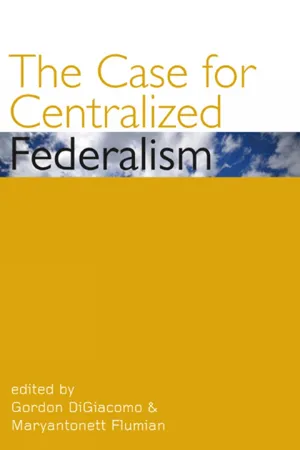
The Case for Centralized Federalism and its sister volume The Case for Decentralized Federalism are the outcome of the Federalism Redux Project, created to stimulate a serious and useful conversation on federalism in Canada. They provide the vocabulary and arguments needed to articulate the case for a centralized or a decentralized Canadian federalism.
In The Case for Centralized Federalism, an array of experts condemns the federal government's submissiveness in its dealings with the provinces and calls for a renewed federal assertiveness. They argue that the federal government is best placed to create effective policy, support democracy and respond to issues of national importance.
Published in English.
eBook - ePub
The Case for Centralized Federalism
- 288 pages
- English
- ePUB (mobile friendly)
- Available on iOS & Android
eBook - ePub
The Case for Centralized Federalism
About this book
Information
Subtopic
Governo americanoChapter 1
Ottawa’s Deferential Approach to Intergovernmental Relations1
Introduction
In his 2009 budget, the federal Minister of Finance announced his intention to establish a single Canadian securities regulator to improve the regulation of capital markets. But rather than make clear that the regulator would operate for ALL of Canada, the Minister indicated that he would work with “willing provinces and territories” to establish the regulator (Canada 2009a: 88). Although virtually every constitutional scholar in the country, save those with a secessionist orientation, would probably agree that securities regulation is a federal responsibility, Ottawa intends to allow some provinces, presumably Alberta and Quebec, to maintain their own systems of securities regulation.2
This announcement from the current government led by Prime Minister Stephen Harper is the latest example of federal reluctance to fully assert its valid constitutional powers. Even though the economic union is one of the areas cited by Prime Minister Harper as clearly being a federal responsibility, he still could not bring himself to confront Alberta and Quebec on the issue. Other examples of federal submissiveness in the Harper years, so far, include Ottawa’s intention to legislatively restrain its own spending power, and Ottawa’s agreement to let Quebec have a seat and to speak at meetings of the UNESCO (United Nations Educational, Scientific and Cultural Organization), even though international affairs is an exclusively federal responsibility.
The Harper government has not been the first to display an extraordinary willingness to restrict or devolve its powers. Among the policy areas where other federal governments accepted or proposed an attenuated role for Ottawa are: labour force training policy; environmental policy; parental benefits policy; and as we will see, internal trade (Haddow 2003; Harrison 2003; DiGiacomo 2009). And, of course, we cannot forget former Prime Minister Brian Mulroney’s efforts to ‘constitutionalize’ the weakening of the federal government.
We can go back further. In a paper originally published in 1931, Frank R. Scott attributed the diminution of federal authority to “the attitude of the leaders of the Dominion parties of recent years. They seem to have wished to hand over as much as possible to the local legislatures” (Scott 1977: 47). This does not mean that there have not been politicians who recognized the importance and value of a strong central government. Nor does it mean that there have not been periods of confident federal activism. It does suggest that the federal impulse towards deference based on jurisdiction is a constant theme in Canadian political history.
This deference is the subject of this chapter. It hypothesizes that federal reticence stems from serious omissions in the Constitution that the founders crafted, omissions that are related to a major constitutional abeyance, in Michael Foley’s terminology, having to do with the very idea of Canadian sovereignty and nationhood. Because of that abeyance, and the particular constitutional exclusions that resulted, the Government of Canada routinely backs away from a leadership role even when the issue in question appears to fall squarely within its jurisdiction. In recent years, those constitutional omissions have led to the development of a type of elite accommodation that some have labeled, ‘collaborative federalism,’ which, under Prime Minister Harper, has been supplemented by its weaker cousin, ‘open federalism’, (discussed by Brooke Jeffrey in this book). Both types represent what former Supreme Court Chief Justice Bora Laskin would have called “a limping federalism under which the central government will be one with dependent status, whether in respect of one Province or all of the Provinces” (Laskin 1968: 139).
The task of the chapter, therefore, is to determine if federal deference to the provinces can be explained by the chapter’s theoretical framework. It opens with a discussion on the meaning of federalism and then moves to an explanation of the theory, the main pillars of which are historical institutionalism and the theory of constitutional abeyances. This framework is tested by an analysis of the federal approach to interprovincial trade barriers.
The essence of federalism
Federalism is a system of governance characterized by a division of law-making powers between a central government and constituent governments, applied on a territorial basis. That said, several other points ought to be made.
Essentially, federalism is a mechanism for unification. Colonies and states enter into a federal arrangement in order to come together; they do not do so in order to maintain their previous independence. They recognize that, because federalism is above all a means for effecting a union of some sort, they will have to surrender some of their autonomy to a central authority. They rightly expect to receive something—protection, financial aid—in return.
The founders of the nation3 envisaged Canada as a federation, not a confederation. Even though the sub-national governments have jurisdiction over several specific areas, they are not independent or semi-independent states. They are the constituent units of a sovereign state—Canada. And the central government in a federation, unlike that in a confederation, is more than a kind of secretariat or cheque-clearing entity. These seemingly banal statements are, nevertheless, contrary to the views of Marc-Antoine Adam. In a recent paper he made this astonishing comment: “Hence, under Canadian federalism, both orders of government are said to be sovereign in their own areas of jurisdiction, in the same manner and to the same extent as independent states” (Adam 2009: 304).
Another point that should be made about federalism is that there is no one type of federal arrangement common to all states. Although they are characterized by a sharing of power, federal states differ in institutional configurations and distributions of powers. As a result, Scott argued that Canadian federalism was never meant to conform to a preconceived notion of federalism.
...the Canadian constitution was never expected to operate on strictly federal principles as the political scientist understands them; we adopted, for what seemed good reasons, a constitution leaning toward a strong central authority whose power might offset in some degree the centrifugal forces which are always present in the body politic (Scott 1977: 298).
Scott cautions against being misled “by the word ‘federal’, which has a meaning in political theory that it does not have in Canadian constitutional law” (Ibid., 189). The definition of Canadian federalism should be based on what the Canadian Constitution provides, not on some accepted meaning of federalism. In Scott’s view we should not say, ‘A federal state requires such and such relationships between the governments, therefore we will find them in the Canadian constitution.’ We should say, ‘This is what the Canadian constitution provides: what kind of federalism is it?’ (Ibid., 177).
Federal states differ in their institutional configurations because they differ in the values they privilege and support. Diversity, equality, efficiency, harmony and democracy are among the values a federal system may at any one point in time either privilege or undermine (Rocher and Smith 2003a: 23). In Canada, one of the important tasks of the federal government has long been to ensure that individuals receive relatively equal treatment regardless of where they live in the country. However, in recent years, the salience of the equality value has receded, while the desire to accommodate diversity has heightened.
Writing in the context of a discussion on the federal spending power, Gaudreault-Desbiens has also commented on the values that federalism reflects. He posits that not only is autonomy inherent in federalism, so also is national solidarity. He draws a conclusion about the Canadian arrangement: “being what it is, and considering what it is not—that is, a confederation—a federation can hardly tolerate blatant discrepancies in the delivery and accessibility of basic social services” (Gaudreault-Desbiens 2006: 195–196, italics added for emphasis).
Types of federalism
Several types of federalism compete for preeminence in Canada and political scientists have labeled or categorized them in various ways. One type has already been mentioned, collaborative federalism, defined by Cameron and Simeon as “the process by which national goals are achieved, not by the federal government acting alone or by the federal government shaping provincial behaviour through the exercise of its spending power, but by some or all of the 11 governments and territories acting collectively” (Cameron and Simeon 2002: 54). The governance of Canada is seen by the proponents of collaborative federalism “as a partnership between two equal, autonomous and interdependent orders of government that jointly decide national policy” (Ibid., 49, italics added for emphasis). While the federal and provincial governments have always worked together to formulate policies and programs, collaborative federalism is distinguished by the willingness of the federal government to accept a diminished role for itself in national policy making and to acknowledge that it is but one of fourteen governments in the country. This degree of federal submissiveness is a somewhat new development, emerging most visibly around the early 1990s.
Collaborative federalism seems like a concept that one would have a hard time opposing. After all, who could be against collaboration? The problem arises when collaboration becomes collusion—that is, when governments collude to achieve their own interests rather than citizen interests, or, as Gerald Baier put it, “when governments co-operate too well” (Baier 2002: 35).
Martin Painter illustrated the negative and positive features of collaborative federalism and its opposite, competitive federalism, in figure 1.1 (Painter 1991: 270). For Painter, the latter occurs when governments keep their distance from each other and provide separate bundles of services as they compete for public support. Collaborative federalism is practiced when governments come together to cooperate in the provision of public services, “with the provincial governments seeking a close involvement in spheres of federal policy that are perceived to intrude on provincial jurisdiction” (Ibid., 269).
Figure 1.1
| Mode | Negative Features | Positive Features |
| Competition | Confrontation | Responsiveness |
| Collaboration | Collusion | Coordination |
Competitive federalism, it is argued, leads to confrontation and deadlock; to federal intervention in provincial affairs; and to contradictory policies. Collaborative federalism “produces better co-ordinated outcomes that achieve a more satisfactory balance of provincial and federal perspectives” (Ibid., 270). While collaboration is said to also produce barriers to public access, to provincial vetoes and to cartel-like behaviour, competition is said to yield more diverse, more responsive policies. “[S]o long as the competitive dynamic operates, governments will remain answerable to their own electorates rather than merely to each other in the deals that they strike” (Ibid.).
Painter concludes that collaborative federalism is a flawed model and argues against two possible institutional reforms that are advanced by advocates of collaborative federalism. One, a re-designed Senate modeled on the German Bundesrat—with members appointed by the provincial governments—“would clearly ‘hobble Ottawa’ in spheres of action where the constitution has assigned it the capacity to act unilaterally” (Ibid., 286). Secondly, permanent first ministers’ conferences “would afford additional temptations for political executives to engage in collusive forms of collaboration” (Ibid., 287).
In their categorization of Canadian visions of federalism, Rocher and Smith include a type similar to collaborative federalism (or confederalism), which they call the equality of the provinces vision—that is, the equality of the provinces with the federal government. It sees Ottawa and the provinces as being sovereign in their areas of jurisdiction and able to act independently of each other. Their use of the phrase, ‘orders of government’, is meant to convey a non-hierarchical relationship between the federal and provincial governments. The implications of this view are profound. As Rocher and Smith point out, “in this view, the provincial premiers have as much right to represent citizens as does the Prime Minister of Canada.” The central government “is not in a position to speak for provincial interests” (Rocher and Smith 2003a: 24). Thus, the federal government is just another government in the country.
Other visions of Canadian federalism identified by Rocher and Smith are the equality of the provinces with each other, a vision reflected in the Calgary Declaration (an agreement on how to approach future amendments to the Constitution); asymmetrical federalism (discussed in this book by Michael Behiels); the rights-based vision of federalism; and the nationalizing vision of federalism.
In the nationalizing vision, the basis of political identity is Canada itself, not a province and not one of Canada’s national minorities. Since it privileges the federal level of government, it “tends to be centralizing”. The main proponents of the nationalizing vision throughout Canadian history have been Sir John A. Macdonald; the Depression-era social democrats such as F. R. Scott; and the Rt. Hon. Pierre Trudeau. In describing this vision, Rocher and Smith make an interesting observation: “Taken to its extreme, this centralizing dynamic permits the federal government to appropriate the authority to define a ‘national interest’” (Rocher and Smith 2003b: 9–10). That a federal government power to define the national interest could be described as “extreme” demonstrates how far the provincial autonomy advocates have taken their argument.
Rocher and Smith’s nationalizing vision has been described in a more disparaging way by Alain Noël. In his analysis of the Social Union Framework Agreement, Noël describes the federal government’s approach to the negotiations as an example of ‘hegemonic cooperation,’ a term borrowed from international affairs scholar, Robert Keohane. This type of cooperation, Keohane writes, “relies on a dominant power making rules and providing incentives for others to conform with those rules” (Noël 2000: 6).
Noël’s use of the word “hegemonic” is pejorative, intended to draw a parallel between the aggressive behaviour of the United States in the world and the approach of the federal government to intergovernmental relations. But—apparently it needs to be said—the relationship between the United States and other countries is not at all like the relationship between the federal and provincial governments. And, as we will see, the phrase certainly does not describe the way Ottawa went about negotiating the Agreement on Internal Trade,4 among other intergovernmental agreements. Noël is clearly unhappy when Ottawa acts like any self-respecting central government in a federal system, determining the rules in accord with what it deems to be the national interest and willing to use whatever tools and incentives it possesses to move the sub-national units in a certain direction. Ind...
Table of contents
- Cover
- Governance Series
- Title Page
- Contents
- Foreword
- Introduction
- Chapter 1 Ottawa’s Deferential Approach to Intergovernmental Relations
- Chapter 2 Asymmetrical Federalism in Canada: Magic Wand or Breaking the Ties that Bind?
- Chapter 3 Prime Minister Harper’s Open Federalism: Promoting a Neo-liberal Agenda?
- Chapter 4 Is Canada Ready for a New Universal Social Program? Comparing the Cases of Universal Medicare in the 1960s and ‘Universal’ Child Care in the New Millennium
- Chapter 5 The Practitioner’s Perspective: Canada is a Journey, Not a Destination
- Chapter 6 The Great Green North? Canada’s Bad Environmental Record and How the Feds Can Fix It
- Conclusion
- Index
- Governance Series Publications
- Back Cover
- Copyright
Trusted by 375,005 students
Access to over 1.5 million titles for a fair monthly price.
Study more efficiently using our study tools.
Frequently asked questions
Yes, you can cancel anytime from the Subscription tab in your account settings on the Perlego website. Your subscription will stay active until the end of your current billing period. Learn how to cancel your subscription
No, books cannot be downloaded as external files, such as PDFs, for use outside of Perlego. However, you can download books within the Perlego app for offline reading on mobile or tablet. Learn how to download books offline
Perlego offers two plans: Essential and Complete
- Essential is ideal for learners and professionals who enjoy exploring a wide range of subjects. Access the Essential Library with 800,000+ trusted titles and best-sellers across business, personal growth, and the humanities. Includes unlimited reading time and Standard Read Aloud voice.
- Complete: Perfect for advanced learners and researchers needing full, unrestricted access. Unlock 1.5M+ books across hundreds of subjects, including academic and specialized titles. The Complete Plan also includes advanced features like Premium Read Aloud and Research Assistant.
We are an online textbook subscription service, where you can get access to an entire online library for less than the price of a single book per month. With over 1.5 million books across 990+ topics, we’ve got you covered! Learn about our mission
Look out for the read-aloud symbol on your next book to see if you can listen to it. The read-aloud tool reads text aloud for you, highlighting the text as it is being read. You can pause it, speed it up and slow it down. Learn more about Read Aloud
Yes! You can use the Perlego app on both iOS and Android devices to read anytime, anywhere — even offline. Perfect for commutes or when you’re on the go.
Please note we cannot support devices running on iOS 13 and Android 7 or earlier. Learn more about using the app
Please note we cannot support devices running on iOS 13 and Android 7 or earlier. Learn more about using the app
Yes, you can access The Case for Centralized Federalism by Gordon DiGiacomo, Maryantonett Flumian, Gordon DiGiacomo,Maryantonett Flumian in PDF and/or ePUB format, as well as other popular books in Politica e relazioni internazionali & Governo americano. We have over 1.5 million books available in our catalogue for you to explore.