- 456 pages
- English
- ePUB (mobile friendly)
- Available on iOS & Android
eBook - ePub
About this book
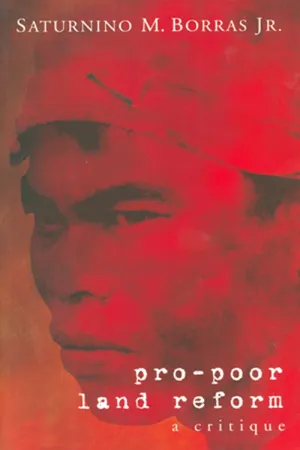
Using empirical case materials from the Philippines and referring to rich experiences from different countries historically, this book offers conceptual and practical conclusions that have far-reaching implications for land reform throughout the world. Examining land reform theory and practice, this book argues that conventional practices have excluded a significant portion of land-based production and distribution relationships, while they have inadvertently included land transfers that do not constitute real redistributive reform. By direct implication, this book is a critique of both mainstream markets led agrarian reform and conventional state-led land reform. It offers an alternative perspective on how to move forward in theory and practice and opens new paths in land policy research. Published in English.
Trusted by 375,005 students
Access to over 1.5 million titles for a fair monthly price.
Study more efficiently using our study tools.
Information
Subtopic
Asian HistoryIndex
Social SciencesCHAPTER ONE
THE POLITICS OF
REDISTRIBUTIVE LAND REFORM:
CONCEPTUAL RECONSIDERATION
1.1 RETHINKING LAND REFORM
According to Jonathan Fox, redistributive reforms are public policies that change the relative shares between groups in society (Fox, 1993). He elaborates:
Distributive reforms are qualitative changes in the way states allocate public resources to large social groups. … Redistributive reforms are a special case of distributive policies: they change the relative shares between groups. This distinction is important for two principal reasons. First, many apparently redistributive reforms are not, and to call them so implicitly begins with what should be the ultimate outcome of analysis: determining what a social reform actually does, and why. Second, redistribution implies zero-sum action, whereas social programs often are carried out precisely because they avoid clearly taking from one group to give to another. In a context of economic growth, moreover, antipoverty spending may well rise in absolute terms without changing its relative share of the government budget. The label “redistribution” builds in an assumption about where the resources come from, whereas the notion of distribution limits the focus to who gets what. (10)
Applied to property rights reform, redistributive land reform means the net transfer of wealth and power from the landed to landless and land-poor classes. Griffin, Khan and Ickowitz (2002: 279–280) have explained land reform as being about redistributing “land ownership from large private landowners to small peasant farmers and landless agricultural workers,” emphasizing that it is “concerned with a redistribution of wealth.” Moreover, Anna Tsing (2002: 97) has explained that property rights are social relationships; that “property is a social relationship between nonowners and owners, in which nonowners are expected to respect the rights of owners to their claimed objects.” It is these social relationships that are ought to be the subject of land reform.
This study understands that, to be truly redistributive, a land reform must effect on a pre-existing agrarian structure a change in ownership of and/or control over land resources wherein such a change flows strictly from the landed to the landless and land-poor classes or from rich landlords to poor peasants and rural workers. Here “ownership and/or control over land resources” means the effective control over the nature, pace, extent, and direction of surplus production and distribution. In other words, according to Tuma (1965: 251), land redistribution aims to create “purposive change” that can result in the improvement of the situation of the landless and land-poor peasants and rural workers. Such purposive change or “reform” is inherently relational: it must result in a net increase in poor peasants’ and rural workers’ power to control land resources with a corresponding decrease in the share of power of those who used to have such power over the same land resources and production processes. In fact, land redistribution is essentially power redistribution. This can occur through the transfer of the entire bundle of property rights, including the “right to alienate,” but it can also be realized without involving full, formal ownership of the land, for example, through leasehold reform and stewardship (see Putzel, 1992: 3; Herring, 1983: 13; Byres, 2004b: 27–32). Thus, what is essentially meant here by “reform” is not simply “change” in production and distribution relationships in a given agrarian structure. The latter (“change”) can happen in multiple directions and both within and between social classes, as it may include elite-to-elite or even poor-to-elite transfer of effective control over land resources. The former (“reform”) limits the direction of change to that which transfers power between social classes, specifically, from landed to landless and land-poor classes, or from rich to poor. The redistributed lands can be held either collectively or individually, the organization of production can take the form of family farm or corporate-type plantation, while the newly formed family farm can be a stand-alone livelihood or just a part of a multiple household livelihood strategies (see, e.g. Hart, 1995; Bernstein, 2002; Razavi, 2003; Borras and Franco, 2005).
Redistributive reform, in terms of its nature and extent, is essentially a matter of degree. The redistributive nature of a land reform transaction in a given landholding, and the change that it causes in the relative shares between the landlord on the one side and the peasants on the other side, is seldom either one hundred percent redistributive or one hundred percent non-redistributive; it is usually somewhere in between. The extent to which redistributive land reform is implemented in a given society is also a matter of degree, with redistributive outcomes seldom being all or nothing. Traditionally, two interrelated elements have defined the redistributive character of a land reform policy, namely, the compensation to landlords and the payment made by peasants. On the one hand, compensation to the landlord can be between zero and somewhere below the “market price” of the land; the difference between the “market price” and the actual compensation partly defines the degree of redistribution.1 On the other hand, the payment made by peasants and rural workers for the land can be between zero and somewhere below the acquisition cost, with the difference between the two also partly defining the degree of redistribution.
Taking redistributive land reform as inherently a matter of degree provides us with an analytic tool to understand and compare land reforms between and within countries. Using this perspective, analysis can move beyond the crude “success” or “failure” comparative divide, which is also overly quantitatively oriented, and bring qualitative aspects into the analysis to allow more nuanced comparisons, especially on the social and political-economic aspects of land reform. For example, a land reform that confiscates lands without compensation to landlords and distributes such lands to peasants and workers for free constitutes redistributive reform. Similarly, a land reform that expropriates lands with compensation to landlords at below market price and distributes such lands to peasants and workers at reduced or subsidized cost is also redistributive. However, the degree of redistributive reform is higher in the former than in the latter. Such is the case comparing land reforms, by both nature and extent, in China and Taiwan immediately after World War II (see Griffin, Khan and Ickowitz, 2002; Apthorpe, 1979). Similarly, in extent, Mexico’s land reform outcomes are more redistributive than Brazil’s. This perspective also allows for a better sub-national analysis of land reform: the surge of redistribution of irrigated private lands in northern Mexico in the 1960s is, arguably, by nature more redistributive than the redistributions of many marginal public lands in the central part of the country in the 1920s (see Sanderson, 1984). The land reform outcome during the Allende administration was, in nature and extent, more redistributive than that during the Frei administration in Chile (see Thome, 1971, 1989: 196; Kay and Silva, 1992; Loveman, 1976: 238; Bellisario, 2007a, 2007b, 2006). True, it is difficult to devise a tool for actually measuring the degree of redistribution in this context, and this makes statistical generalizations on land reform outcomes even more difficult. But this must not stop us from stating that land redistribution is a matter of degree.
Following this framework, this study argues that a land transfer scheme does not constitute redistributive land reform where the landlord is paid one hundred percent spot-cash for one hundred percent (or higher) of the “market value” of the land and where the buyer shoulders one hundred percent of the land cost, including the sales transaction costs. Such is a simple capitalist realestate transaction which, of itself, is highly unlikely to favour the landless rural poor (see also Flores, 1970: 149; Levin and Weiner, 1997: 258). “Exchange” of goods and money in the market between sellers and buyers is not the same as, nor does it necessarily constitute, “pro-poor” redistribution of wealth and power.
The two minimum requirements for redistributive land reform, namely, compensation to landlords at below market price and payment by peasants and workers at below actual acquisition cost must, in turn, be linked to the principle that land is not a simple economic factor of production. Rather, land has a multidimensional function and character, that is, it has political, economic, social, and cultural dimensions. In fact the “value” of land cannot be reduced to strictly monetary terms, and so the “market price” of a parcel of land is actually a contested notion involving political-economic and socio-cultural factors that, themselves, depend on who is attaching the value to the land. The notion of land having a multidimensional character (i) provides the basis for bringing in issues imbued with value judgment such as “social justice,” “social function of the land,” “purposive change,” and “empowerment,” which cannot be understood in purely monetary terms and (ii) inherently requires the intervention of the state to achieve the desired multiple goals of land reform policy. Thus, landlord compensation–related mechanisms ranging from land confiscation without compensation to expropriation with compensation at below market prices (usually inflation adjustment is not factored in) are also largely determined, and should also be determined, by non-economic factors such as socio-historical circumstances and the politics of pre-existing land monopoly and reform. The same consideration applies in determining the level of peasants’ and workers’ payment. Hence, the multidimensional character of land renders the monetary-based valuation method an important but incomplete way to assess the land’s actual and full value.
Finally, while conceptual clarification about redistributive land reform is crucial to understand the nature and implications of a land reform policy, confusion among scholars and policymakers can arise regarding the empirical data they are working with. Specifically, changes in who supposedly controls land might be registered in formal, official records, while such changes do not occur in reality, as explained by Herring (1983: 269).
The conceptual clarification that land reform is about redistribution of wealth and power necessarily implies and requires that analysis of land reform investigate actually existing conditions rather than rely wholly and uncritically on what the official data claim or convey. This is because dynamic land-based production and distribution relationships that are essentially power relations — the very subject of reform — cannot be fully and properly captured by static official statistics alone. The literature on natural resource management, especially in light of popular calls for decentralization and “self-governance” of management (e.g., Ostrom, 2001; Bromley, 199l; Agarwal, 2005; Meinzen-Dick and Knox, 1999; Ribot and Larson, 2005) and law and development (e.g., von Benda-Beckmann, 2001, 1993; Manji, 2006; Nyamu-Musembi, 2006; but see also Peters 2004; Roquas, 2002; McAuslan, 2000; Houtzager and Franco, 2003) offers useful tools to better understand the problematic in this study. Ostrom (2001: 129) correctly criticized the conventional theory on “idealized models of private property and government property.” She explained that from such a traditional perspective, “the concept of private property is conceptualized narrowly with a primary focus on the right to alienate through sale or inheritance as the defining attribute of private property” (emphasis original). Ostrom explained the different types of claims made over different types of rights over various resources. These rights include the right of access, withdrawal, management, exclusion, and alienation. Only a full owner has the complete set of the enumerated rights, while other types of claimants have varying rights or combinations thereof, but not alienation (Ostrom, 2001: 135; see also Toulmin and Quan, 2000). Ostrom’s schema is a powerful critique of the conventional wisdom founded on the simplistic conception of property rights that refers mainly to the right to alienate.
In general, this study employs Ostrom’s schema. However, it puts forth additional insights from the specific context of the research, as there are some limitations in the Ostrom schema’s ability to capture some realities, such as those in the agrarian cases related in the introduction of this chapter. For example, there are cases where a person is the full owner of a parcel of land but has no power to fully and effectively exercise ownership rights (the entire range, from the right of access to the right to alienate). This is because the degree of power of an elite to exercise effective control over the same land is much higher than that of the formal (nominal) owner; in this case, the elite’s power may cover almost the entire range of rights, except the formal right to alienate. However, for the elite, the right to alienate is superfluous because the formal-nominal owner’s right to alienate has been effectively clipped through legal and illegal, violent and non-violent means. Indeed, the elite has no need or want to dispose of the owner’s control over the land, at least not in the medium term, and so the right to alienate has no significant value. To the landed elite what is important is the effective control over the land, that is, all the rights except the right to alienate, which also means effective control over non-economic benefits, such as the captive seasonal electoral votes of the people on the land. In fact, Herring (2002: 288) concludes that “real property rights are inevitably local; right means what the claimant can make it mean, with or without the state’s help.” Such largely class-based relationships have been imposed and enforced by the landowning classes through violence or threat of violence, usually outside formal state institutions or through mutually agreed (real) sales transactions in settings where such sales are not allowed by state law. Thus, it is crucial to include in the analysis the power to effectively control land resources regardless of what the formal bundles of property rights demonstrate.2
From the discussion thus far, it is useful to identify further gaps in the literature. This is done in three broad categories: public lands, private lands, and share tenancy reform through leasehold contracts.
1.2 PROBLEMS WITH THE DOMINANT VIEWS
Public lands
According to the conventional definition, redistributive land reform is a public policy that transfers property rights over large private landholdings to small farmers and landless farmworkers (see, e.g., Griffin, Khan and Ickowitz, 2002: 279–280). The universally accepted definition, implicitly and explicitly, excludes non-private lands (i.e., “public,” “state,” or “communal” lands). The underlying assumption in the dominant land reform literature is that lands that are officially classified as “public/state” properties, especially those used to open up resettlement areas, are lands that are generally not cultivated and inhabited and are without pre-existing private control. In such conditions, it is logical to conclude that land policies that concern these lands do not recast any land-based production and distribution relationships. The literature on land reform is strong on this point, and rightly so. Yet, it becomes problematic when the use of the same lens is stretched as far as to examine “public” lands that are in fact under varying degrees of cultivation, imbued with private interests, and marked by production and distribution relationships between the landed and the landless and land-poor, between the elite and non-elite — interests and relationships that are often not captured by official census. The failure to recognize the potentially and actually contested nature of much of “public lands” risks removing them from the reach of redistributive reform, and so risks the continuation of many of the economic, social, and political problems associated with an agrarian structure that is dominated by the landed classes as well.
Most scholars understand land reform to apply only to land officially classified as private. Private lands are those where the entire bundle of property rights, from the right to use to the right to alienate, is under the formal ownership and control of a private entity that commands respect from nonowners and is legally sanctioned by the state (see, e.g., Tsing, 2002: 97). Here, “public” land is taken in its broadest sense, to mean lands where full private property rights have not been applied and sanctioned by the state. The “public land” category takes a variety of forms from one setting to another, but for the purposes of this book, it loosely includes state-owned (forest), indigenous, or communal lands and lands operated under customary arrangements. In some cases, the social relations in these types of lands are also referred to as “informal tenure” (World Bank, 2003: xxv; see also Delville, 2000; Cousins and Claassens, 2006).
When a land reform policy is directed to and implemented in “public lands,” it is called a “public settlement program” or “colonization.” Because few bother to interrogate the official story about such areas and compare with ground level reality, many scholars, activists, and policymakers alike simply assume that such a policy does not alter pre-existing distributions of wealth and power in society, hence does not constitute and promote redistributive reform, and therefore is politically non-contentious. On the basis of the official classification data alone, rather than empirical investigation, even some of the most important land reform scholars have made explicit their rejection of the idea that public lands can play a significantly positive role in the pursuit of land reform objectives. Hence, Feder (1970) once called the policy of land reform in public lands “counter-reform.” Thiesenhusen (1971: 210) explained, “[L]and reform usually connotes a drastic change in ownership patterns in the established private sector. On the other hand directed colonization patterns on state lands or on a small number of formerly private farms frequently have little to do with making overall resource or income distribution more egalitarian: only a few settlers benefit.” Tai (1974: 234) explained that “public land settlement (or colonization) is an attractive idea. To settle people on new land and to develop it for agricultural use does not involve any basic alteration of the property rights of existing landowners; hence a public-land settlement program will generate no opposition from the landed class.” Lipton (1974: 272, original emphasis) argued that “the two Great evasions of land policy [are] settlement schemes and reform of tenure conditions. Both are often included in a too-weak definition. … Such programmes fail to achieve their stated goals because they do not attack the rural power structure, which is rooted in an extremely unequal distribution of owned land.” Finally, de Janvry, Sadoulet and Wolford (2001: 279) have said that “countries with open frontiers have engaged in settlement programs, but we do not include this form of access to land as part of land reform.”
Specifically in the context of the Philippines, Riedinger, Yang and Brook (2001) exclude redistribution of public lands from land reform accomplishment for the same reasons, as cited by other scholars elsewhere and historically. They declared,
This figure … reflects the area distributed by the Department of Agrarian Reform (2,562,089 hectares) in the period 1972–1997 net of lands distributed as settlements (662,727 hectares), as Kilusang Kabuhayan at Kaunlaran (606,347 hectares), and the rice and corn lands redistributed under Operati...
Table of contents
- Cover
- Halftitle Page
- Title Page
- Copyright
- Table of Contents
- List of Tables
- Foreword
- Acknowledgments
- Introduction
- Chapter 1
- Chapter 2
- Chapter 3
- Chapter 4
- Chapter 5
- Conclusion
- Notes
- List of Abbreviations
- References
- Index
Frequently asked questions
Yes, you can cancel anytime from the Subscription tab in your account settings on the Perlego website. Your subscription will stay active until the end of your current billing period. Learn how to cancel your subscription
No, books cannot be downloaded as external files, such as PDFs, for use outside of Perlego. However, you can download books within the Perlego app for offline reading on mobile or tablet. Learn how to download books offline
Perlego offers two plans: Essential and Complete
- Essential is ideal for learners and professionals who enjoy exploring a wide range of subjects. Access the Essential Library with 800,000+ trusted titles and best-sellers across business, personal growth, and the humanities. Includes unlimited reading time and Standard Read Aloud voice.
- Complete: Perfect for advanced learners and researchers needing full, unrestricted access. Unlock 1.5M+ books across hundreds of subjects, including academic and specialized titles. The Complete Plan also includes advanced features like Premium Read Aloud and Research Assistant.
We are an online textbook subscription service, where you can get access to an entire online library for less than the price of a single book per month. With over 1.5 million books across 990+ topics, we’ve got you covered! Learn about our mission
Look out for the read-aloud symbol on your next book to see if you can listen to it. The read-aloud tool reads text aloud for you, highlighting the text as it is being read. You can pause it, speed it up and slow it down. Learn more about Read Aloud
Yes! You can use the Perlego app on both iOS and Android devices to read anytime, anywhere — even offline. Perfect for commutes or when you’re on the go.
Please note we cannot support devices running on iOS 13 and Android 7 or earlier. Learn more about using the app
Please note we cannot support devices running on iOS 13 and Android 7 or earlier. Learn more about using the app
Yes, you can access Pro-Poor Land Reform by Saturnino Borras in PDF and/or ePUB format, as well as other popular books in Social Sciences & Asian History. We have over 1.5 million books available in our catalogue for you to explore.