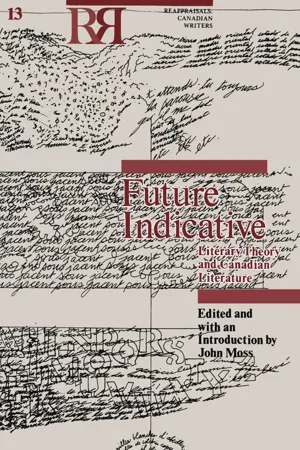
The format of this book is arbitrary and exact, the way paint is in a landscape by Alex Colville. It follows the program of the symposium that took place at the University of Ottawa, from April 25 to 27, 1986.
As Bakhtin leaps from the sidelines to centre stage, as Derrida clambers out of orchestra pit into the prompter's box, and Lancan swings from the flies, as Foucault, Lévi-Strauss, Saussure, Barthes, and a throng of others rhubarb their way through the text, one recognizes just how connected all the disparate elements of this critical extravaganza really are.
eBook - ePub
Future Indicative
About this book
Information
Subtopic
Literary Criticism TheoryIndex
LiteratureStructuralism/Post-Structuralism: Language, Reality and Canadian Literature
BARBARA GODARD
My dilemma is that of Scheherazade, for I speak under the threat of forced closure. Like hers, mine is an endless tale, the saga of the “new new criticism” of Canadian literature. Such is the evolving nature of my subject that, even as I speak, it slips away from me. The thread of my narrative will be unravelled when I stop. Presenting their post-structuralist readings of Canadian literature, other critics will add new episodes to chapters or introduce new characters and new points of view. Such is the fate of a historical narrative about a contemporary phenomenon. Endings are elusive and beginnings …
Without an ending, how can one know where to begin? For in fixing the period, the last word constructs meaning. It defines the contours of an event, determines its possible structure and significance by confirming a beginning, then carves out a plot which assigns to incidents their position as complicating middle or irrelevant digression and so establishes hierarchies. My narrative is a quest for the origins of a discourse, the post-structuralist discourse in Canada, a movement back beyond the beginning to seek out the source of its meanings. Yet this beginning leads always to other beginnings in other countries and other literatures, in other discourses, indefinitely—moving to the vanishing point. Consequently, any selection of a point to begin is inevitably teleological, the “source meanings” appearing rather to be the goal towards which all other meanings are steadily moving. Interpretation, it must be remembered, takes place after, not before the fact, which it naturalizes by turning what is into what must be. To escape from the charnel-house of the historian’s plot, one could follow Scheherazade and take up the art of the fragment. These days, one would be in numerous company, for archeology is a flourishing critical activity. How it came to be so is the thread of my narrative.
Although organized under the sign of the future indicative, the present collection constitutes a period to my narrative and authorizes me to write in the past tense. For it validates my text by demonstrating the vitality of Canadian post-structuralist criticism which has long been invisible. In this, my text is in intertextual relation with the conference on Post-Structuralism in Canada which took place at the University of Ottawa several years ago. On that occasion, criticism of English-Canadian literature was a present absence in a paper entitled “Why Michel Foucault does not like Canadian Literature” (Fogel 1984).1
Fogel’s paper is a castigation of Canadian novelists for not writing postmodernist, meta-fictional narratives like those of Barth and Pynchon. Foucault’s name waved like a battalion flag is virtually the only acknowledgement of deconstruction in the text.2 The attack is extended to include Canadian criticism which, unlike contemporary American criticism, shows no evidence of non-mimetic and anti-referential perspectives on the medium of prose fiction. Fogel does not go on to suggest that the absence of meta-fictional writing is only a mirage, produced by critics’ blurred vision, and to reveal the inadequacy of the existing theoretical models for the analysis of the fiction in question, though this is an avenue which could be (and has been) fruitfully pursued. Indeed, his own paper is a perpetuation of the problem, building up a false opposition by overlooking the most experimental Canadian postmodernists. Turning aside from an exploration of the silences of the critical texts so as to decentre them and produce knowledge of contemporary critical practices, Fogel effaces contradiction as he elaborates on the essential conservatism underlying Canadian aversion to speculative fiction.3
That there is a divergence in the directions of contemporary American and Canadian criticism should not be quite so surprising. “New Criticism” never held sway in Canada as it did in the United States, where it presented the major challenge to Romantic expressive theories that privilege the author as guarantor of meaning by focusing attention instead on the formal properties of the text understood to be a “simulacrum … an experience rather than any mere statement about experience …” (Brooks 1968, 173). In the absence of any studies on the subject, the specificity of a Canadian critical tradition remains elusive. That it exists is undeniable, given its impact in shaping the “new new criticism.” While the debate surrounding the death of the subject is being waged in English Canada, as elsewhere, between phenomenology and structuralism, its evolution in timing and configuration is unique. For the appearance of these two critical theories on the Canadian scene has been nearly simultaneous with the arrival of semiotics, deconstruction and feminism. Forty years of European critical theory have been absorbed in ten brief years, resulting in hybrids which the respective grandparents, French and German philosophy and Saussurian linguistics, would have difficulty recognizing. For this reason, any study of contemporary Canadian literary theory is an exercise in comparative literature. When read for the silences and gaps, for the unexpected swerves and twists which occur when divergent cultures come into contact, this “new new criticism” testifies to an ongoing dialectic between tradition and imported innovation.
Caught in a crisis of paradigms, in turn part of a more global shift in epistemé, to use Michel Foucault’s term, the “analytico-referential” class of discourse of modernism4 is being replaced by a discourse that has as reference its own elaboration and thematizes the act of enunciation, that is, its production, reproduction and reception. In an era when writing has become epistemological, Canadian critics are responding to the Zeitgeist by questioning “thematic” criticism, based on a positivistic theory of ordinary language. Research is becoming theoretical rather than practical, turning upon its own presuppositions, upon the structure of the model itself. This exploration of the model arises from the discovery that a methodology does more than reveal, it actually creates the object of study. Lived reality varies as a function of the choice we make of it or of the model through which we see it. For some, this period of metacritical reflection has resulted in new models. To dis-cover them, one must leave aside the telescope fixed on distant shores to take up a refracting lens more appropriate for the examination of grafts and mutations. What one discovers, in mutant forms, is an initial development of structuralism, a pervasive presence of phenomenology and an enthusiastic movement to post-structuralism—deconstruction, semiotics, feminism, Rezeptionsästhetik, etc.—as the grounds for textual meaning have variously been located in the author, the text, the reader, and now the context. All participate in a larger critical project to “configure difference,” to wrestle with the Canadian “plus.”
To begin, to begin …
****
My starting point is 1974. The late sixties and seventies were a critical moment in the evolution of the discipline of Canadian literature when it was first institutionalized within the academic community, through the development of courses in Canadian literature at the undergraduate and graduate levels and the hiring of scholars to teach them who were the first generation of specialists trained in Canadian literature. Their entry into academia challenged the Great Tradition on which a previous generation of critics had exercised their Leavisite practical criticism in an effort to morally revitalize an impersonal order on the Eliot model, pre-eminently British and authoritarian. This “rise of Canadian”5 manifested itself in a rupture with the discipline of English as demonstrated in the founding of the Association for Canadian and Quebec Literatures. The first meeting of this organization took place at the Learned Societies in 1974. Significantly, this was the occasion for the first examination of the state of literary theory in Canada and Quebec.6
Taken as a whole, the papers of that conference celebrate the rise of the reader and the plurality of meaning. However, only the textual traces of this event have marked the evolving critical debate. While papers were read on psychoanalytic criticism of the school of Charles Mauron, on sociological and phenomenological criticism,7 only one paper has been singled out as the rallying point in the critical debate, Frank Davey’s “Surviving the Paraphrase” ([1976] 1983).
Davey calls for a criticism which would turn the critic’s attention to “literature as language, and on writing as writing” (12). Grouping together the work of Northrop Frye, Margaret Atwood, Douglas Jones and John Moss, he denounces the prevailing mode of “referential,” “thematic” criticism for its tendency to paraphrase, reducing literature to an adjunct of cultural studies approached through the mirror metaphor of poor sociology. In this, the guarantor of meaning and truth is the author’s experience of the world, not grounded in textual experience. Davey’s judgement builds on the work of other poet-critics, notably Louis Dudek, whose denunciation of academics for failing to deal with literature qua literature may be overheard in Davey’s insistence on the “technical concerns and achievements of their peers” (8). Academic critics (read referential, realistic critics), limited here to the “small Fryes,” have turned aside from the autonomous world of literature to coin metaphors as “formulae for Canadianism.” Camouflaged here is the voice of Eli Mandel who has written: “as soon as we add the word Canadian to criticism, we move the object of our concern into a particular space and time, a geographical and historical context, where what might normally remain simply an element of background—the sociology of literature—becomes the foreground” (1971, 3). Behind all of them, we catch faint echoes of the American New Critics’ advocacy of the verbal icon, the poem conceived as self-enclosed object, mysteriously intact in its own being, each of its parts folded in on the other in a complex organic unity which cannot be paraphrased. The poem becomes a spatial figure rather than a temporal process. Rescuing the text from author and reader goes hand in hand with disentangling it from any social or historical context. Like the American New Critics, Davey is uncertain whether to locate meaning in language or in human experience. From “The Heresy of the Paraphrase” to “Surviving the Paraphrase” is but a short step.
Davey also quarrels with thematic critics over a view of literature that fails to grant the autonomy of the artist and the text. System lying behind and taking precedence over it is attacked in the name of process, system being characterized as conservatism, crystallization, objectivity, stability, while process is a chaos of contingency, accidental encounters, subjectivity. This “phenomenology” offers an alternative to the evaluative and normative criticism that Davey associates with “thematic” critics. “The phenomenological critic could study how this experience (of colonial, of regional writing) is projected by the form of the writing, could participate in the consciousness of the artist as it is betrayed by his syntax, imagery and diction; ultimately the critic could give the reader a portrait of each writer’s psychological world” (11).
At this point some of the characteristic features of contemporary Canadian criticism may be noted, notably an idiosyncratic use of terminology and the clash of critical ideologies, frequently self-contradictory. Davey’s cryptic description bears marked resemblance to the project of Gaston Bachelard whom he quotes in support of an attack on thematic criticism (9). This is a radical swerve in light of the term “thematic” usually applied to the Bachelardian mode of phenomenology. Moreover, in reintroducing the author’s world as guarantor of meaning of the text, Davey turns his back on the more radical aspect of his challenge to referentiality in which he advocates “analytic criticism” of “the formal characteristics of Canadian writing, into style, structure, vocabulary, literary form and syntax” (10), an emphasis on text and language that would lead to the death of the author.
A further paradox occurs when, as a third alternative to “thematics,” Davey argues for a thorough application of archetypal criticism to Canadian literature. Here, he seemingly overcomes his antipathy to describing literature as a self-contained system—Frye’s special contribution to English language criticism—which his new critical valorizing of the discrete text would seem to preclude. Perceptively, Davey puts his finger on what Eli Mandel has called Frye’s “schizophrenia,” how when Frye puts on his tuque to write the conclusion for the Literary History of Canada an inversion occurs. The theory of modes is laid aside: what constitutes Canadian literature is new as content, not as form. The resulting split between semantic and syntactic levels continues to characterize the Canadian critical scene as new waves of structuralism advance.
Of the alternatives Davey recommends, phenomenology is the one most frequently connected with his name.8 And the pages of Open Letter, the magazine he edits, have been open to phenomenological criticism, whether in the form of theoretical essays like Leslie Mundwiler’s “Heidegger and Poetry,” or of extended documentaries on the participatory reading of contributors (1972).9 George Bowering’s numerous interviews with writers also emphasize the intersubjectivity of the process of reading, I and you meeting in the work. The “conversation” Heidegger developed from Hölderlin occurs in the oral mode of Charles Olson. This mode of participatory reading to accompany the poetics of openness to the surrounding field and kinetic poetry as process, which the Tish generation adapted from Olson, was formulated by Eli Mandel. Advocating a critical fiction that is direct, emotional, spontaneous, personal, conversational, Mandel posits a critic as “savage” who “does not want to judge but to participate in, to become one with the work of literature …. Criticism must risk the excesses of subjectivity and sentimentality if it is going to become human once more and if it is going to bring us closer to the unsolved mystery at the heart of our best perceptions” (1966, 71-72).10
However, later critics taking up Davey’s call for a new mode of Canadian criticism have focused on his advocacy of formal “analytic criticism,” with its attention to “structure.” Russell Brown (1978, 151-84) and Michael Dixon and Barry Cameron (1977, 142) interpret this latter term differently as they argue that Frye and the other “thematic” critics are in fact structuralists. Where Davey denounces, they support Atwood’s search “for a single unifying symbol” (quoted in Davey, 9), inherited from “a concept central to all (Frye’s) writing” (Dixon and Cameron 142), namely, the autonomy of literary forms whose meaning is derived from their situation within a literary system. These are basic presuppositions of structuralist activity, for the critic works with a corpus which is a closed homogeneous system of signs, related in terms of resemblances and differences wherein the value of each term results solely from the simultaneous presence of others. Atomic empiricism is replaced by a “unified field” approach in which isolated elements in the system are never absolute (Merrell 1975, 70-71). Acknowledgement of Frye’s structuralist affinities has come from several sources. Jonathan Culler praises Frye’s typology of characters for uniting rigour of model and individual variance (1975, 236). Tzvetan Todorov too has lauded Frye’s advocacy of “poetics”; however, he attacks his model for its lack of logical categories (1970, 7-26).
Indeed, in the Anatomy of Criticism, Frye does not bracket the content of the texts he examines to focus solely on differential relations. He does not deny that texts have meaning, but he insists that their final meaning is inward, centripetal. Literature is formal, not instrumental (1957, 74). In this book, he sets out to provide a system of classification of modes, symbols, myths and genres which facilitates the making of distinctions and comparisons across historical periods, emphasizing the intertextual element of intelligibility. The “archetypes” or recurring images and symbols that connect one text with another are ritual patterns found in societies remote from each other. Their recurrence is based not in historical fact, but in human desire, representing the deepest wishes and anxieties of humanity (104-6, 109). The modes and myths of literature are transhistorical, collapsing history to sameness, or cyclical repetition of the same themes....
Table of contents
- Cover Page
- Title Page
- Copyright Page
- Contents
- Introduction: The Presence of Text
- Writer Writing, Ongoing Verb
- Structuralism/Post-Structuralism: Language, Reality and Canadian Literature
- The Question of the Corpus: Ethnicity and Canadian Literature
- Reading for Contradiction in the Literature of Colonial Space
- Signs of the Themes: The Value of a Politically Grounded Semiotics
- Importing Difference: Feminist Theory and Canadian Women Writers
- “Listen to the Voice”: Dialogism and the Canadian Novel
- Lacan: Implications of Psychoanalysis and Canadian Discourse
- Reconstructing Structuralism: The Theme-Text Model of Literary Language and F. R. Scott’s “Lakeshore”
- History and/as Intertext
- Language and Silence in Richardson and Grove
- Rewriting Roughing It
- Bakhtin Reads De Mille: Canadian Literature, Post-modernism, and the Theory of Dialogism
- The Reader as Actor in the Novels of Timothy Findley
- Blown Figures and Blood: Toward a Feminist/Post-Structuralist Reading of Audrey Thomas' Writing
- Reconstructing the Deconstructed Text: A Reading of Robert Kroetsch’s What the Crow Said
- Present Tense: The Closing Panel
- Contributors
Trusted by 375,005 students
Access to over 1.5 million titles for a fair monthly price.
Study more efficiently using our study tools.
Frequently asked questions
Yes, you can cancel anytime from the Subscription tab in your account settings on the Perlego website. Your subscription will stay active until the end of your current billing period. Learn how to cancel your subscription
No, books cannot be downloaded as external files, such as PDFs, for use outside of Perlego. However, you can download books within the Perlego app for offline reading on mobile or tablet. Learn how to download books offline
Perlego offers two plans: Essential and Complete
- Essential is ideal for learners and professionals who enjoy exploring a wide range of subjects. Access the Essential Library with 800,000+ trusted titles and best-sellers across business, personal growth, and the humanities. Includes unlimited reading time and Standard Read Aloud voice.
- Complete: Perfect for advanced learners and researchers needing full, unrestricted access. Unlock 1.5M+ books across hundreds of subjects, including academic and specialized titles. The Complete Plan also includes advanced features like Premium Read Aloud and Research Assistant.
We are an online textbook subscription service, where you can get access to an entire online library for less than the price of a single book per month. With over 1.5 million books across 990+ topics, we’ve got you covered! Learn about our mission
Look out for the read-aloud symbol on your next book to see if you can listen to it. The read-aloud tool reads text aloud for you, highlighting the text as it is being read. You can pause it, speed it up and slow it down. Learn more about Read Aloud
Yes! You can use the Perlego app on both iOS and Android devices to read anytime, anywhere — even offline. Perfect for commutes or when you’re on the go.
Please note we cannot support devices running on iOS 13 and Android 7 or earlier. Learn more about using the app
Please note we cannot support devices running on iOS 13 and Android 7 or earlier. Learn more about using the app
Yes, you can access Future Indicative by John Moss in PDF and/or ePUB format, as well as other popular books in Literature & Literary Criticism Theory. We have over 1.5 million books available in our catalogue for you to explore.