Many scholars, practitioners, and policy-makers in the cultural sector argue that Canadian cultural policy is at a crossroads: that the environment for cultural policy-making has evolved substantially and that traditional rationales for state intervention no longer apply.
The concept of cultural citizenship is a relative newcomer to the cultural policy landscape, and offers a potentially compelling alternative rationale for government intervention in the cultural sector. Likewise, the articulation and use of cultural indicators and of governance concepts are also new arrivals, emerging as potentially powerful tools for policy and program development.
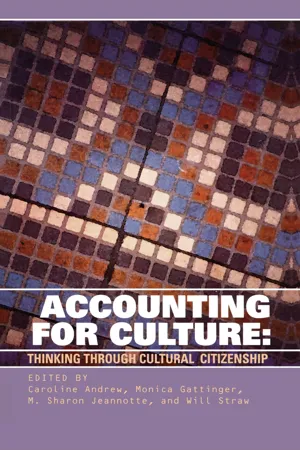
Accounting for Culture is a unique collection of essays from leading Canadian and international scholars that critically examines cultural citizenship, cultural indicators, and governance in the context of evolving cultural practices and cultural policy-making. It will be of great interest to scholars of cultural policy, communications, cultural studies, and public administration alike.
- 300 pages
- English
- ePUB (mobile friendly)
- Available on iOS & Android
eBook - ePub
Accounting for Culture
About this book
Information
Subtopic
Cultural PolicyI
The Evolution and Broadening of Cultural Policy Rationales
1.
From Indicators to Governance to the Mainstream:
Tools for Cultural Policy and Citizenship
The arguments presented below are designed to address a range of issues being taken up by the colloquium but, essentially, I can summarize this chapter by suggesting that there is a need to move along and up the “knowledge value chain” from data (statistics), to information (indicators), to knowledge (benchmarks), to wisdom (policy).
We need to know more about “culture”—however we define it in local, regional, national, and global contexts—both quantitatively and qualitatively. We need to improve the quantitative baseline (cultural statistics) and the qualitative baseline (evidence on “social impacts,” the relationship between culture and quality of life, social cohesion and inclusion, etc). We need more numbers, more facts, more indicators, more benchmarks in both quantitative and qualitative terms.
This will require a research and knowledge-development culture which is stakeholder-based in the terms suggested above in our advocacy of cultural mapping, involving both “top-down” research expertise and “bottom-up” local knowledge, expertise, and ownership. This will require great efforts in “translation” and application from the best conceptual and theoretical work in the field—in cultural studies, anthropology, development economics, economic, social and cultural geography, social theory—into policy-relevant and policy-enabling forms.
The environmental movement has done this, partly by re-inventing the concept of “environment” (on the basis of a robust and accumulated knowledge and research base), and investing it with a strategic significance that it never had before, and partly by developing a common understanding not of what environment “is” but, rather, of how it connects and relates to how we go about our lives, live in our families, run our businesses, consume products and experiences: how, in short this thing called “the environment” relates to the sustainability of our development objectives and to the quality of our lives.
The challenge for us, in the cultural movement, is the same. It is not simply (or even) to define “culture” in a universally acceptable form but, rather, to define its relationship—tension, conflict, reciprocity—the broader and bigger-picture issues of economic development, community regeneration, social inclusion, diversity, convivencia (learning how to live together) and, ultimately, that elusive, but measurable, quality of life.
When we have done that then we can begin to claim that, for the cultural field, we have brought together indicators, governance, and the strategic place of culture in public policy within a unified conceptual horizon within which an enlarged and enriched concept and ambition of citizenship is the central landmark and stake.
Preamble: Citizens
Statistics ... one of the fundamental branches of the art of government.
– The Abbé (Henri Baptiste) Grégoire1
– The Abbé (Henri Baptiste) Grégoire1
The Abbé Grégoire, that most enlightened and durable of the legislators of the French Revolution, and effectively the “father” of modern cultural policy, knew a thing or two. He knew that for government—and governance—in mass and proto-democratic societies, you had to know how to count. More importantly, you had to know what to count. In his case this was books, artifacts, monuments, languages, street signs, and nomenclature, the symbols and signs of the Republic, its manners, and customs. And you had to know in what context and to what ends you were counting. In his case this was “unity of idiom” for the newly formed “One and Indivisible Republic” and “Unity of the Revolution.” There was a single word for the unit, fulcrum and focus of calculation: citizen. Cultural policy, that is to say, has the strategic purpose of forming, maintaining, and “managing” citizens.
Our ambitions two centuries later are perhaps less radical, less revolutionary, less unifying, but there is a common logic to be pursued which underscores the fundamental relationship between “culture,” “policy,” and “citizenship” and the ways in which we can both identify and evaluate this relationship by means of “indicators.”
The aim of this chapter is essentially to map and highlight the conceptual field which does or should inform the work of building a knowledge base for the development of policy-relevant and policy-enabling indicators for cultural citizenship or, properly speaking, cultural indicators for citizenship. I do not fully engage here the array of possible indicators and/or operational issues as these are covered in my book Towards Cultural Citizenship: Tools for Cultural Policy and Development.2 Not do I dwell for too long on the actual definition, currency, or resonance of the concept of citizenship itself, as that could become too abstract for the purposes of this chapter. Rather, just as Baudelaire (no realist!) once pragmatically said, “puisque réalisme il y a,” I’ll add “puisque citoyenneté il y a.”
It is certainly the case, as two Australian authors have recently argued, that cultural policy in general is one of the least studied but possibly most important domains for understanding what citizenship actually means and how it works. “Studies of cultural policy,” argue Meredyth and Minson, “are centrally concerned with ... modes of neoliberal governance, which work between public institutions and private lives and at both national and international levels, shaping civic or civil habits, tastes and dispositions in ways that are all the more effective for not being experienced as obtrusive....”3
This being so, and we strongly believe that it is—increasingly so in a globalized world—the question of “resourcing citizenries” becomes very important and strategic. At the beginning of the nineteenth century (when cultural policy first became an “agenda item” for the institutions of governance), as at the beginning of the twenty-first century (when culture is becoming newly strategic in its connections with industry, with communications, with identity and simply “living together”), citizenship is what cultural policy is, or should be, about.
The Case and the Propositions
Are cultural indicators of citizenship therefore possible? If they are, and there is a strong case for this, then there are six propositions informing this chapter which relate to the three core themes—indicators, governance, and rebuilding the case for culture—of this book:
Indicators
1. Indicators need to rest on a robust knowledge base, both quantitative and qualitative, which is constantly refreshed by research, both pure and applied. We can call this cultural mapping.
2. Statistics are not indicators. They only become such when transformed—or when value is added—through a route map of policy. We can call this cultural planning.
Governance
3. Indicators only become “tools” for policy and governance when they are firmly related to or embedded in a policy framework or strategy from which they gain their meaning and currency. There are no universal cultural indicators independent of these specific and operational contexts of governance.
4. Governance is not the same as government. It describes, rather, our joint and uneven terms of engagement with the complex field of economic, human, social and cultural power relations in which we are all “stakeholders.” Engagement with the concept and reality of governance means moving beyond the more traditional dichotomies of State and People, Government and Community, etc.—a new political rationality, that is.
Rebuilding the Case for Culture—or Mainstreaming Culture
5. Rebuilding the “case for culture” or, in other words, mainstreaming culture, as a central public policy issue, will entail subjecting culture and the cultural field to the same rigorous forms of research, analysis, and assessment as any other policy domain. This will entail—to return to the first proposition—developing indicators or suites of indicators which are integrated (and share a plausible common currency) with economic, social, environmental, and other policy domains. Knowledge of the cultural field, that is to say, will need to be able to “walk and talk” along with its policy neighbours.
6. There are a number of policy catalysts which can enable this work of integration and mobilization and these include sustainable development, economic regeneration, social cohesion, cultural diversity and, especially, the mother of all catalysts: quality of life.
Indicators: “Measuring Culture” or Cultural Mapping?
On the issue of the “knowledge base” for cultural indicators and its need for constant refreshing by both conceptual and quantitative research it may be useful to cite a recent example from the United States, that of the Arts and Cultural Indicators in Community Building Project conducted by the Urban Institute in Washington, D.C.
This project sought to develop indicators through a better understanding of arts and culture, cultural institutions, artists in inner-city neighbourhoods and community-building contexts, and to assess the existing data collection practices among the community-based and mainstream arts and culture organizations. According to the project’s principal researcher, a Toronto-based teacher and consultant, Dr. Arnold Love:
• Mainstream definitions of “the arts” exclude the culture and values of many groups that live in the inner city and many expressions of artistic creativity have not been understood as art or culture;
• Arts and culture should not be viewed only as products to be consumed but also as processes and systems that are part of the life of the community;
• Cultural participation should be measured along a “continuum of cultural participation and not only as audience participation;
• Cultural activities are found in mainstream cultural venues and also in many other community locations; and
• “Indigenous venues of validation” must be understood by using ethnographic research methods before appropriate indicator categories can be created.4
This example is useful insofar as it points—prior to the actual process of data collection and analysis—to the necessity for appropriate and conceptually informed mapping of the specific cultural field in question in order to determine, so to speak, what actually counts as culture to the stakeholder communities—the “indigenous venues of validation.” There is a “qualitative baseline” which needs to be engaged, that is to say, before the quantitative baseline can be constructed.
Cultural statistics and indicators, in this context, cannot simply be “downloaded” or imported from available data sets, no matter how robust these may be. Certainly local, regional, national, and international data on employment in the cultural sector, participation rates, family, or household expenditure, etc., will form an important quantitative baseline for any such investigation but this is necessary but not sufficient for the task of cultural mapping.
The quantitative baseline will need to be gready enhanced by attention to the qualitative baseline of what these activities, participation rates, expenditure patterns, etc., actually mean to the stakeholder communities and how they might contribute, for example, to human, social, and cultural capital and capacity building, to identity and sense of place, to “social impacts.” To citizenship in its fullest sense, that is.
To agree on a framework and agenda for cultural mapping in this sense, we need to be attentive to—and informed by—the special contours, features, and textures of the ground that we are surveying. This will require agreement both on appropriate and sensitive tools and approaches and on the stakeholders to be involved in the mapping process.
On both these counts, there is an urgent need for new forms of collaboration and cross-fertilization between research, community, industry, and government sectors. The research sector often has the competencies in the application and refinement of conceptual frameworks and methodologies; the community sector often has the necessary “local knowledge” the industry and government sectors, in turn, tend to be concerned with sectoral or departmental objectives but, of course, have powers and resources for policy implementation beyond those of other actors. None of these sectors, on their own, has the capacity to undertake cultural mapping in its fullest sense. Cultural mapping is neither simply “pure” nor simply “applied” but, rather, is stakeholder research.
Cultural mapping can provide both a catalyst and a vehicle for bringing together these diverse interests and stakeholders (and thus moving towards cultural planning). Marcia...
Table of contents
- Cover
- Title Page
- Copyright
- Contents
- Foreword by Judith A. LaRocque
- Foreword by Donna Cardinal
- Contributor Biographies
- Introduction Caroline Andrew and Monica Gattinger - Accounting for Culture: Thinking Through Cultural Citizenship
- Part I The Evolution and Broadening of Cultural Policy Rationales
- Part II Voices
- Part III New Approaches in a Changing Cultural Environment
- Part IV Governance, Indicators, and Engagement in the Cultural Sector
- Conclusion M. Sharon Jeannotte and Will Straw - Reflections on the Cultural and Political Implications of Cultural Citizenship
- Annex Greg Baeker - Back to the Future: The Colloquium in Context: The Democratization of Culture and Cultural Democracy
Trusted by 375,005 students
Access to over 1.5 million titles for a fair monthly price.
Study more efficiently using our study tools.
Frequently asked questions
Yes, you can cancel anytime from the Subscription tab in your account settings on the Perlego website. Your subscription will stay active until the end of your current billing period. Learn how to cancel your subscription
No, books cannot be downloaded as external files, such as PDFs, for use outside of Perlego. However, you can download books within the Perlego app for offline reading on mobile or tablet. Learn how to download books offline
We are an online textbook subscription service, where you can get access to an entire online library for less than the price of a single book per month. With over 1.5 million books across 990+ topics, we’ve got you covered! Learn about our mission
Look out for the read-aloud symbol on your next book to see if you can listen to it. The read-aloud tool reads text aloud for you, highlighting the text as it is being read. You can pause it, speed it up and slow it down. Learn more about Read Aloud
Yes! You can use the Perlego app on both iOS and Android devices to read anytime, anywhere — even offline. Perfect for commutes or when you’re on the go.
Please note we cannot support devices running on iOS 13 and Android 7 or earlier. Learn more about using the app
Please note we cannot support devices running on iOS 13 and Android 7 or earlier. Learn more about using the app
Yes, you can access Accounting for Culture by Caroline Andrew, Monica Gattinger, M. Sharon Jeannotte, Will Straw in PDF and/or ePUB format, as well as other popular books in Politics & International Relations & Cultural Policy. We have over 1.5 million books available in our catalogue for you to explore.