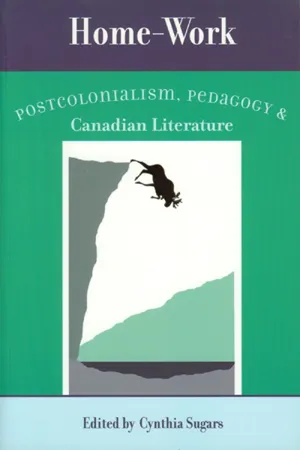
Canadian literature, and specifically the teaching of Canadian literature, has emerged from a colonial duty to a nationalist enterprise and into the current territory of postcolonialism. From practical discussions related to specific texts, to more theoretical discussions about pedagogical practice regarding issues of nationalism and identity, Home-Work constitutes a major investigation and reassessment of the influence of postcolonial theory on Canadian literary pedagogy from some of the top scholars in the field.
- 545 pages
- English
- ePUB (mobile friendly)
- Available on iOS & Android
eBook - ePub
Home-Work
About this book
Information
Topic
LetteraturaSubtopic
Critica letteraria nordamericanaLiterary History as Microhistory
HEATHER MURRAY
NOW THAT THE “linguistic turn” has been replaced by an “historical turn,” it may seem unnecessary to argue for literary history as a mode of work. In recent years, English-Canadian literary criticism has been both deepened and enhanced by the wealth of writing (often by innovative junior scholars) on lesser-known authors and texts. (As a graduate student, I would have dated early Canadian literature as predating the Confederation poets; a student of today may well find Renaissance Canadian literature, or early Native discourses, a familiar terrain.) Literary work for English Canada is, by now, and by and large, historical in its orientation: in a wider time frame, and increasingly contextual. But the development has not been accompanied by a parallel dialogue on historical method. In this respect the situation of the 1990s and the new millennium differs markedly from the 1980s, when the importation of new literary theories to the Canadian critical scene occasioned energetic and extended debate over their suitability and applicability. To begin to generate a corresponding discourse on historical methods is part of my purpose here.
This essay presents a programmatic and somewhat polemical offering, which considers two related models for undertaking literary-historical work in English Canada. I am using the term microhistory to refer to both of these models, although this involves deploying the term in two different ways, one theoretical and technical and the other vernacular or commonsensical. The first microhistory refers to a specific historiographic practice or methodology. The second refers to restrictions of the scope or size of examination. While the methodology called microhistory is rooted in the attempt to incorporate peripheral or marginal events, figures, and communities into the historical picture (thus the prefix micro, which has continued to adhere), microhistory as a method need not necessarily be confined to micro phenomena (or indeed, as I hope to show, need not be restricted solely to past phenomena at all).
While microhistory as a method and microhistory as a focus have a shared origin and a continuing compatibility (in fact the two senses are often conflated), there is some profit at least initially in prying apart the two microhistories as much as possible and arguing their merits separately. Indeed, this division has a precedent in the position taken by microhistorian Giovanni Levi, who argues that “microhistory cannot be defined in relation to the micro-dimensions of its subject-matter” (94). To effect this distinction, and to avoid confusion, where necessary I will refer to Microhistory 1 (method) and Microhistory 2 (dimension). But this essay will go on to consider the special affinity of Microhistory 1 to Microhistory 2, and will suggest that both together can provide new direction for the writing of literary history in English Canada.
Since microhistory has generally not been used for purposes of literary historiography, but rather has remained within the precincts of social history, the transferability of this method needs to be considered. This essay will begin by surveying some of the pros and cons of both microhistories for historical work generally and literary-historical work in particular. In the absence of readily available models of literary microhistory, presentation of what we might call (like a 1960s hem length) a mini-microhistory is intended to be suggestive. The conclusion will try to draw out more explicitly some of the implications of a conjoined literary microhistory for both literary analysis and pedagogy. This method may offer ways to undertake multicultural yet national literary-historical work on premises more congenial to a postcolonial perspective, and hold pedagogic possibilities for teachers and students to think about the narratives and counter-narratives of English-Canadian literary history.
What is microhistory? (We are beginning here with a consideration of Microhistory 1, or microhistory-as-method.) This is a term not always readily familiar since microhistory has yet to develop as a separate current of historiography in North America, although its European legacy extends for a quarter of a century. Nonetheless, like Molière’s prose speaker, a historian may well be a microhistorian without knowing it. Even surveys devoted to historical methods—such as Georg Iggers’ Historiography in the Twentieth Century —define microhistory more easily by example than by its internal characteristics, referring invariably to the founding instance of Carlo Ginzburg’s 1976 work The Cheese and the Worms: The Cosmos of a Sixteenth-Century Miller, a study of the heresy trial of Menocchio, a Friulian miller, whose strange cosmography evolved from an amalgam of eclectic reading, wayward religious contemplation, and ingrained peasant belief. (This example allows us to mark immediately two significant points: the rise of microhistory within the context of early Italian historiography, for dealing with communities within a non-national identity; and the initial interweaving of microhistory with questions of reading, writing, and textual access.) While Italy remains the centre of microhistorical studies, with other practitioners encountered principally in France and Spain, a North American readership may well be familiar with the other famous example of this mode, Natalie Zemon Davis’ tour de force of 1983, The Return of Martin Guerre.
Surveys of historical methodology define microhistory not only by example but by negative definition, by what it is not and what it opposes. It stands, as the name would signify, against the grand macro methods, whether that macro is great personages and grand episodes (thus microhistory counters the exempla and événements school of European historiography), or the macro of overarching historical metanarratives. Microhistory aims to work in opposition to the teleological narratives of both social science (liberal-progressive) and Marxist (dialectical) historiographies, while continuing to share some of the techniques of the first and much of the politics of the latter. Initially conceived as a development in the functionalist-structuralist school of history (as epitomized by Fernand Braudel and the Annales school), microhistory eventually developed in opposition to it, stressing qualitative (documentary or discursive) analysis over the quantitative work of the Annales historians, and denying the structuralist’s postulate of a networked unity of social systems. In addition, in its concern with the historical event or moment, microhistory differs markedly from the Annalistes’ interest in large historical or geopolitical arcs, the long durée.
Let me continue this series of negative definitions by comparing microhistory to two other analytic modes with which it would seem to have strong resemblances. First, what is the difference between microhistory (often focused on the lives and times, or more properly, life in times, of an individual) and biography? The distinction, one could say, is that while microhistory does not see the subject as purely symptomatic (indeed, as with the Friulian miller, it may be strikingly eccentric), the goal is to understand an historically situated mentality; while biography, on the other hand, traditionally postulates the subject as more free-standing or differentiated and (in the case of literary biography) as the prime mover behind the texts he or she produces.1
New historicism would also seem to have significant similarities, and indeed originated as an attempt to graft onto literary studies various branches of European new historiography. As they have both developed, however, new historicism seems to have diverged from microhistory in several important respects. It retains an oddly optimistic faith in the evidentiary nature of texts, insofar as analyses tend to be “grounded” in them; and, following from this, the textual instances are read as representative. New historicism is more concerned with the dominant episteme, even if it is tracking the contradictions and complexities within it, and is as a result both more text-centric, and less eccentric, than its microhistorical cousin.
Even when the microhistorical method is described by one of its practitioners, the principles may be laid out somewhat elliptically. In his much-translated essay “Microhistory: Two or Three Things That I Know about It,” Ginzburg provides a sort of microhistory of microhistory, from which methodological mimesis the following principles may be drawn:
• microhistory works on the “margin” and not in the centre
• it deals with the anomalous and not the representative
• it takes a single personage (usually), or event or circumstance (less usually), and relates this to networks of community, commodity, knowledge, and force, in ways that show both connection and exception
• it is narrative rather than reconstructive
• it stresses both ruptures and connections, narrating (in Ginzburg’s words) while resisting the temptation to “fill[ ] the gaps in the documentation to form a polished surface” (“Microhistory” 23). Or, as Davis informs her readers in the opening to The Return of Martin Guerre: “This book grew out of a historian’s adventure with a different way of telling about the past” (vii).
That historiographers have approached microhistory by exempla, negative definition, and demonstration is not surprising. “It is no accident,” states Levi in his essay “On Microhistory,”
that the debate over microhistory has not been based on theoretical texts or manifestos. Microhistory is essentially a historiographical practice whereas its theoretical references are varied and, in a sense, eclectic. The method is in fact concerned first and foremost with the actual detailed procedures which constitute the historian’s work, so microhistory cannot be defined in relation to the micro-dimensions of its subject-matter. (93)
While “experimental” and lacking a “mode of established orthodoxy,” microhistory does have a set of “crucial” common elements or principles, which Levi traces to the microhistorians’ effort to develop new forms of Marxist historiography. In the resulting formulation,
all social action is seen to be the result of an individual’s constant negotiation, manipulation, choices and decisions in the face of a normative reality which, though pervasive, nevertheless offers many possibilities for personal interpretations and freedoms…. In this type of enquiry the historian is not simply concerned with the interpretation of meanings but rather with defining the ambiguities of the symbolic world, the plurality of possible interpretations of it, and the struggle which takes place over symbolic as much as over material resources. (94–95)
This “struggle” over the symbolic, far from being the object of the historian’s retrospective gaze alone, occurs in the practice of contemporary historiography itself: it is a question of developing methods of interpretation and description in keeping with the microhistorians’ world-view, of “both acknowledging the limits of knowledge and reason whilst at the same time constructing a historiography capable of organizing and explaining the world of the past” (95).
While the method outlined by Ginzburg and Levi appears to involve a cautious treatment of texts, a strong evidentiary base, and a healthy dose of critical self-consciousness, microhistory has had voluble critics, whose principal objections have been summarized by Iggers:
(1) that their methods, with their concentration on small-scale history, have reduced history to anecdotal antiquarianism; (2) that they have romanticized past cultures; (3) that because … they purportedly work with relatively stable cultures, they are incapable of working with the modern and contemporary worlds marked by rapid change; and (4) in this connection that they are incapable of dealing with politics. (113)
Of course, microhistory does have its own politics, and these may generate some internal contradictions, at least according to Dominick La Capra in his critique of The Cheese and the Worms (subtitled “The Cosmos of a Twentieth-Century Historian”). For La Capra, Ginzburg’s insistence on the primacy of an oral and oppositional peasant culture to Menocchio’s thought reinforces exactly the distinction between “low” and “high” cultures to which microhistorians are supposedly opposed. (And La Capra’s subtitle further implies that Ginzburg may share with Menocchio an inventive, even wilful, rendition of texts in the interests of a particular world-view.) A critique may also be made of microhistory’s lack of theoretical transparency: as historian Peter Burke has suggested, in common with other new histories, microhistory has failed to elaborate the premises upon which its own forms of textual interpretation take place, the methods used for reading texts and reading between the lines (9–12). This is in part what Levi alludes to when he refers to a lack of theoretical centralism, in other words, that microhistory is defined by its practices rather than its principles.
To the critiques noted by Iggers, La Capra, and Burke, one might add some other reservations: that microhistory appears to have abandoned diachronic analyses in favour of the deeply synchronic; that the history remains oddly, perhaps even contradictorily, individualizing in its focus on the particularities of discrete subjects; and that the narrativizing bent may lead the microhistorian to make connections on the basis of adjacency or speculation, as much as it permits her or him to self-critically or self-consciously foreground the modus operandi.
However, the advantages of the microhistoric method are apparent to anyone who has read The Cheese and the Worms or The Return of Martin Guerre. This is, as it is often termed, history with a human face: and that face is the face of the daily, the ordinary, the subaltern. Microhistory tells a story, often structured as the attempt to solve an interpretational puzzle or epistemic mystery of some kind. As fellow historians, document readers, and textual explicators, we appreciate being let in on the tradecraft, through the foregrounding of the procedures of research and interpretation. These are the charms of microhistory: there are more serious merits. Most fundamentally, this is a method suited to the writing of history on the margins, where documentation may be scant. It assumes that the lives and activities of the subaltern classes need not be told in the aggregate, but can be seen (at least some of them) in the particular; and that these features can emerge even through dominant documentation. Microhistorians see this particular focus—the individual, event, or text—as a uniquely situated nodal point of social, political, economic, and ideational forces. In this way, and perhaps most radically, microhistory undermines the model of historical “centres” and “margins” in the first place.
The potential of microhistory becomes further evident if we take the initial term, micro, under advisement. This prefix should not be seen as demanding a necessary limitation of analyses to individuals or to small-scale phenomena. (One could have a microhistory of an institution, or a city, or a war, for example.) Rather, the subject or event (of whatever magnitude) is seen as micro in the sense of being situated at a particular point or conjuncture, and as located within larger webs or networks. Just as microhistory need not be confined to the small-scale, nor need it deal necessarily with the marginal: figures at the (so-called) centre could be successfully treated with a microhistorical approach, which would have a sort of reverse effect of de-authorizing events seen to have been set in motion by unique individuals, and of discharging the charismatic accumulation of those personalities and their motivations. So, too, we may expand the base term history. Since it permits an analysis of figures and phenomena within contexts contemporary to it—and draws meaning from that analysis rather than from retrospective evaluation based on the knowledge of later results or consequences—there is no need for microhistory to be confined to the events of the past, although that has in fact been the tendency so far.
Micro, then, is a question not of size but of scale or of proportionality. And yet it appears to me that local phenomena, events, and formations are in fact the most promising foci for a new literary-historical analysis. I have arrived at this assessment primarily through my own work in the areas of literary and cultural history, although it must be admitted at the outset that this has been restricted to the nineteenth century primarily and Ontario almost solely. But from this necessarily limited perspective, I would like to turn to consideration of Microhistory 2, the question of the dimension or scope of examination.
What is the most promising focus (we might call it the centre of gravity) for renewed literary-historical work in English Canada? Would it be the author, especially if we saw the project of such microhistory as bringing to light lesser-known authors, or those from under-examined constituencies? Or should it be the reader? In the bush, on the farm, even in the new cities, we must have had our own Menocchios, idiosyncratic autodidacts in a print-hungry culture. Or should the focus be texts themselves? A microhistorical examination would place the text, as both message and artifact, in its web of historical, literary, and productive relations. There is merit to all of these: but my own sense is that the answer lies in none of the above—none of the author, reader, or text conceived in isolation—but rather the community, circle, or cultural formation. Four reasons may be offered in support of this choice.
The first reason is a simple one: other methods of organization have proven to be limited in their utility. Construction of a national literary history is rendered impossible by the simple fact that “state” and “nation” are in such a complex correspondence here. Other more general critiques may be made, which have been ably argued in the context of postcolonial studies: that “national” cultural histories are frequently the history of the urban centres and even more often of the dominant social groups; ...
Table of contents
- Cover
- Title Page
- Copyright
- Contents
- Acknowledgements
- Introduction
- National Pedagogy and Globalization
- Postcolonial Pedagogies
- Decolonizing the Classroom
- Teaching/Reading Native Writing
- Pedagogies in Practice
- Historical Imperatives
- Afterword
- Contributors
Trusted by 375,005 students
Access to over 1.5 million titles for a fair monthly price.
Study more efficiently using our study tools.
Frequently asked questions
Yes, you can cancel anytime from the Subscription tab in your account settings on the Perlego website. Your subscription will stay active until the end of your current billing period. Learn how to cancel your subscription
No, books cannot be downloaded as external files, such as PDFs, for use outside of Perlego. However, you can download books within the Perlego app for offline reading on mobile or tablet. Learn how to download books offline
Perlego offers two plans: Essential and Complete
- Essential is ideal for learners and professionals who enjoy exploring a wide range of subjects. Access the Essential Library with 800,000+ trusted titles and best-sellers across business, personal growth, and the humanities. Includes unlimited reading time and Standard Read Aloud voice.
- Complete: Perfect for advanced learners and researchers needing full, unrestricted access. Unlock 1.5M+ books across hundreds of subjects, including academic and specialized titles. The Complete Plan also includes advanced features like Premium Read Aloud and Research Assistant.
We are an online textbook subscription service, where you can get access to an entire online library for less than the price of a single book per month. With over 1.5 million books across 990+ topics, we’ve got you covered! Learn about our mission
Look out for the read-aloud symbol on your next book to see if you can listen to it. The read-aloud tool reads text aloud for you, highlighting the text as it is being read. You can pause it, speed it up and slow it down. Learn more about Read Aloud
Yes! You can use the Perlego app on both iOS and Android devices to read anytime, anywhere — even offline. Perfect for commutes or when you’re on the go.
Please note we cannot support devices running on iOS 13 and Android 7 or earlier. Learn more about using the app
Please note we cannot support devices running on iOS 13 and Android 7 or earlier. Learn more about using the app
Yes, you can access Home-Work by Cynthia Sugars in PDF and/or ePUB format, as well as other popular books in Letteratura & Critica letteraria nordamericana. We have over 1.5 million books available in our catalogue for you to explore.